Hospital discharge summaries are critical for care transitions, directly impacting readmission prevention and medication reconciliation, yet physicians spend 15-30 minutes per patient drafting these documents, contributing substantially to documentation burden and professional burnout. Manual summarization of daily progress notes and laboratory results is repetitive, time-consuming, and error-prone, as clinicians must sift through lengthy unstructured notes across multiple hospital days while identifying salient events and trends. We propose a large language model with parameter-efficient fine-tuning for automated discharge summary generation that processes chronologically ordered daily progress notes alongside time-series laboratory results to produce structured discharge documentation. The framework consists of a base LLM augmented with LoRA adapters, a progress note encoder for section segmentation, a laboratory result integrator that computes trend indicators, and a summary generator that produces sectioned discharge output. Parameter-efficient fine-tuning enables domain adaptation to clinical text with minimal computational resources, preserving patient-specific information while reducing hallucination through retrieval of key factual details from the input notes. This framework offers a practical pathway to reduced documentation burden and improved discharge quality, with potential for widespread deployment across health systems given the modest computational requirements of PEFT approaches.
Hospital discharge summaries serve as the primary communication vehicle between inpatient and outpatient care providers, yet their preparation imposes a substantial time burden on physicians who must synthesize information from multiple daily progress notes, laboratory results, medication records, and consultant recommendations [1, 2]. The time cost of 15-30 minutes per discharge summary accumulates significantly for physicians managing high patient volumes, contributing to after-hours documentation work and professional burnout while delaying care transitions [2, 3]. Incomplete or delayed discharge summaries have been directly associated with increased hospital readmission rates and adverse medication events following discharge [1].
Daily progress notes contain the majority of information required for discharge summarization, including the patient's hospital course, response to treatments, and clinical decision points, but these notes are typically unstructured, contain redundant information across consecutive days, and vary substantially in quality and completeness between authors [4, 5]. Laboratory results, while structured in electronic health records, must be interpreted in temporal context to identify clinically significant trends such as improving renal function or worsening inflammatory markers, a task that is particularly time-consuming when performed manually across a multi-day admission [5]. The combination of unstructured narrative text and time-series numerical data presents a unique summarization challenge that automated approaches must address through careful integration of heterogeneous information sources [6].
Large language models have demonstrated remarkable capabilities in clinical text summarization and question answering, yet full fine-tuning of models in the 7-13 billion parameter range requires substantial computational resources including multiple high-memory GPUs, placing such approaches out of reach for many healthcare institutions [7-9]. Parameter-efficient fine-tuning methods such as Low-Rank Adaptation (LoRA) and Quantized LoRA (QLoRA) address this limitation by updating only a small fraction of model parameters, reducing memory requirements from hundreds of gigabytes to a single consumer-grade GPU while maintaining competitive performance on domain-specific tasks [7, 8, 10].
This paper presents a conceptual framework for automated discharge summary generation using a PEFT-LLM that processes daily progress notes and laboratory results as input, producing structured discharge documentation that includes admission diagnosis, hospital course, discharge diagnosis, medications, and follow-up plans.
Standard discharge summaries contain several required sections including admission diagnosis, hospital course, discharge diagnosis, discharge medications, follow-up plans, and patient instructions, with the hospital course section requiring the most synthesis as it narrates the patient's clinical trajectory from admission through discharge [1, 2]. The admission diagnosis represents the condition prompting hospitalization, while the discharge diagnosis often includes additional conditions identified during the admission, and medication reconciliation between admission and discharge lists is critical for preventing adverse drug events [2]. Follow-up plans must specify required appointments, pending tests, and anticipated medication changes, all of which must be extracted or inferred from scattered documentation across the hospitalization [1].
Table 1 clarifies how each discharge summary section depends on distinct evidence types, temporal reasoning demands, and summarization burdens, thereby identifying why automated discharge generation is not a uniform text-generation task.
Table 1. Functional alignment between discharge summary sections, source evidence types, and summarization burdens in PEFT-based clinical generation
Discharge summary section | Primary source evidence | Secondary supporting evidence | Dominant reasoning requirement | Main summarization burden | Principal model failure risk | Why PEFT-LLM support is valuable |
Admission diagnosis | First-day Assessment section and admission note language | Early laboratory abnormalities and initial consultant impressions | Initial state identification | Distinguishing presenting problem from incidental history | Mislabeling chronic comorbidities as acute admission drivers | Helps standardize extraction of the hospitalization starting point from variable note styles |
Hospital course | Daily Assessment and Plan content across all hospital days | Procedures, laboratory trends, treatment changes, complication notes | Longitudinal synthesis and event compression | Removing redundancy while preserving clinically meaningful transitions | Omission of turning points, complications, or response-to-treatment logic | Provides temporal narrative compression across repeated notes without full manual reconstruction |
Discharge diagnosis | Final-day Assessment, problem list updates, consultant conclusions | Resolution status inferred from labs and late-course documentation | Endpoint consolidation | Reconciling evolving diagnoses across the admission | Retaining outdated diagnoses or failing to include newly identified conditions | Supports convergence from evolving diagnostic language to final structured output |
Medication reconciliation summary | Active inpatient medication list and discharge medication documentation | Progress-note Plan sections and problem-oriented therapeutic changes | Cross-document reconciliation | Identifying additions, discontinuations, substitutions, and dose changes | Hallucinated medications, omissions, or unresolved discrepancies | Enables structured summarization of medication transitions while remaining editable by clinicians |
Follow-up plan | Final Plan sections, discharge planning notes, pending test documentation | Specialty recommendations and unresolved laboratory issues | Prospective care coordination | Aggregating fragmented next-step instructions | Missing appointments, pending studies, or monitoring needs | Improves completeness of transition-of-care instructions scattered across notes |
Patient instructions | Explicit discharge instructions and documented care recommendations | Clinical stability markers and treatment response context | Translation of clinical plan into patient-facing action items | Maintaining clarity while preserving medical correctness | Overgeneralization or missing high-risk precautions | Supports consistent section completion while allowing clinician revision for readability and safety |
Daily progress notes typically follow the SOAP format comprising Subjective (patient-reported symptoms), Objective (vital signs, physical exam findings, laboratory results), Assessment (clinical impression and problem list updates), and Plan (diagnostic and therapeutic next steps) sections [4, 5]. These notes are updated daily by the primary team, resulting in substantial redundancy across consecutive days when patient status is stable, yet critical changes may be embedded within any single note without explicit flagging for summarization purposes [4]. The unstructured nature of narrative progress notes requires natural language processing to extract relevant events, diagnoses, and treatment changes while discarding routine information that does not contribute to the discharge summary [5].
Key laboratory values including white blood cell count, creatinine, glucose, sodium, potassium, troponin, and lactate must be tracked across the hospitalization to document resolution of abnormalities or persistence of critical findings at discharge [5, 6]. Trend indicators such as improving, worsening, or stable provide essential context for the discharge summary's hospital course section, where clinicians must communicate whether acute kidney injury resolved or whether leukocytosis improved with antibiotics [5]. Critical values at admission compared to discharge status often determine the appropriateness of discharge and the intensity of required follow-up monitoring [6].
Parameter-efficient fine-tuning methods including Low-Rank Adaptation (LoRA), Quantized LoRA (QLoRA), Adapters, and Prefix Tuning update only a small fraction of model parameters while freezing the base model, reducing memory requirements from hundreds of gigabytes to 10-20 gigabytes for a 7B parameter model [7, 8]. LoRA decomposes weight updates into low-rank matrices, reducing trainable parameters to less than 1% of the base model, while QLoRA further compresses base model weights to 4-bit precision, enabling fine-tuning on consumer GPUs with 24GB memory [8]. These methods have been successfully applied to clinical LLMs including Clinical Camel and GatorTron, demonstrating that domain adaptation does not require full parameter updates when using appropriate PEFT configurations [7, 8, 11].
The proposed framework accepts as input chronologically ordered daily progress notes and time-stamped laboratory results from a complete hospital admission, then applies preprocessing to segment notes and encode laboratory trends, followed by a PEFT-LLM that generates a structured discharge summary with required sections including admission diagnosis, hospital course, discharge diagnosis, medications, and follow-up plans [8, 11]. The generation process uses a system prompt that specifies section requirements and output format, with the model producing narrative text for each section based on synthesized information from the input notes and laboratory data [12, 13].
The framework assumes access to a structured electronic health record that stores daily progress notes as discrete documents with timestamps and laboratory results with associated collection times, along with sufficient training data from sources such as MIMIC-IV that contains paired progress notes and reference discharge summaries for supervised fine-tuning [4, 5]. The framework further assumes that input notes are of reasonable quality and completeness, and that the hospital stay duration does not exceed the model's context window when concatenating all daily notes [14].
The framework is designed to be patient-specific by using only data from the index admission, time-aware by organizing notes chronologically and calculating laboratory trends across hospitalization days, factual by extracting information directly from input notes without external knowledge retrieval, efficient by using PEFT methods that require minimal GPU memory, and editable by clinicians who must review and approve all generated content before finalization [9-11].
Figure 1 illustrates the end-to-end conceptual architecture through which chronologically structured progress notes and encoded laboratory trends are transformed by a parameter-efficient large language model into clinician-reviewed discharge summaries under explicit safety and workflow constraints.
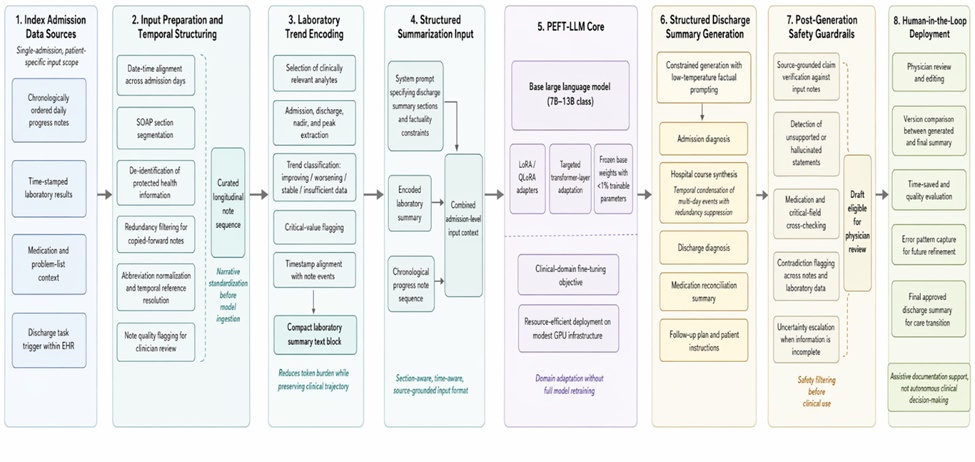
Figure 1. Conceptual architecture of parameter-efficient discharge summary generation from temporally ordered progress notes and laboratory trajectories
Daily progress notes for each admission are concatenated chronologically from admission day through discharge day, with each note preceded by a date-time stamp and section boundaries marked using rule-based segmentation that identifies SOAP section headers when present [4, 5]. This chronological organization preserves the temporal sequence of clinical events, enabling the model to understand disease progression, treatment response, and complication timing across the hospitalization [4]. Section boundary detection is critical because the Subjective, Objective, Assessment, and Plan components serve different summarization purposes, with the Assessment section containing diagnostic reasoning and the Plan section documenting treatment changes that must appear in the discharge summary [5].
Protected health information including patient names, dates, and medical record numbers are removed using regular expression patterns and named entity recognition, while empty or redundant notes containing only copied forward text without updates are flagged for exclusion from the input sequence [5]. De-identification follows established standards such as the HIPAA Safe Harbor method, removing 18 specific identifiers while preserving clinical content necessary for summarization [5]. Note-level redundancy detection compares each daily note to the previous day's note using cosine similarity of clinical concept embeddings, and notes with similarity exceeding 0.9 and no new Assessment or Plan changes are marked as low-value for summarization, reducing input token count without clinically meaningful information loss [4, 5].
Additional preprocessing steps include normalization of clinical abbreviations to their full forms using a medical abbreviation dictionary, resolution of temporal references such as "today" and "yesterday" to absolute hospital day numbers, and standardization of medication names to their generic forms using RxNorm mappings [4]. Note quality scoring is performed using heuristics including note length, presence of all SOAP sections, and documentation of at least one active problem in the Assessment section, with notes below quality thresholds flagged for physician review rather than exclusion to avoid inadvertent information loss [4, 5].
Time-series laboratory results for key analytes including complete blood count, comprehensive metabolic panel, cardiac biomarkers, and lactate are extracted with collection timestamps, then summarized as admission values, discharge values, minimum and maximum during hospitalization, and clinical trend indicators (improving, worsening, or stable) calculated using linear regression over serial measurements [5, 6]. The selection of key analytes is based on clinical relevance to discharge decision-making, with complete blood count components including white blood cell count for infection monitoring, hemoglobin for anemia assessment, and platelet count for bleeding risk evaluation [6]. Comprehensive metabolic panel includes creatinine for kidney function, glucose for diabetes management, sodium and potassium for electrolyte balance, and liver enzymes for hepatobiliary assessment, each of which may determine discharge appropriateness or follow-up intensity [5, 6].
Critical values exceeding predefined thresholds are flagged explicitly in the encoded laboratory summary, and temporal relationships between laboratory changes and clinical events documented in progress notes are preserved through timestamp alignment [5]. For example, a rise in white blood cell count occurring one day after a procedure noted in the progress note suggests post-procedural infection, whereas a rise preceding the note would indicate a different etiology, and timestamp alignment enables this causal inference [6]. Trend indicators are calculated using linear regression over all measurements for each analyte, with statistically significant slopes (p < 0.05) classified as improving (negative slope for creatinine, positive slope for hemoglobin) or worsening (positive slope for creatinine, negative slope for hemoglobin), and non-significant slopes classified as stable [5, 6].
Laboratory encoding produces a structured summary text block inserted before the progress notes in the model input, formatted as: "LAB SUMMARY: Admission Cr 1.2, Discharge Cr 0.9 (improving, p=0.01); Admission WBC 15.2, Discharge WBC 8.1 (improving, p=0.003); Nadir Hgb 7.8 on Day 3, Peak Hgb 10.2 on Day 7" [5, 6]. This structured representation reduces the token footprint of laboratory data compared to including all raw values while preserving clinically meaningful patterns, and the inclusion of statistical significance helps the model distinguish true trends from random variation [6]. For analytes with fewer than three measurements during the admission, trend classification defaults to "insufficient data" rather than making a potentially misleading determination, and missing admission or discharge values are explicitly noted as such [5, 6].
The framework supports base models in the 7-13 billion parameter range including Llama 3, Mistral, and clinical LLMs such as Clinical Camel or GatorTron, with selection depending on institutional computational resources and the availability of clinical domain pretraining [7, 8, 12]. Llama 3 and Mistral are general-purpose models with strong reasoning capabilities but no inherent clinical knowledge, requiring substantial fine-tuning on medical text to achieve acceptable performance on discharge summarization [7, 8]. Clinical Camel and GatorTron, by contrast, have been pretrained on large corpora of clinical notes and biomedical literature, providing domain-relevant token embeddings and attention patterns that reduce the amount of task-specific fine-tuning required [7, 12].
Smaller models below 7B parameters may produce lower quality summaries due to insufficient capacity for long-context reasoning across multi-day admissions, while models above 13B parameters require multiple GPUs even with PEFT, reducing accessibility for resource-constrained healthcare settings [8, 11]. Empirical evidence from clinical summarization tasks suggests a performance plateau between 7B and 13B parameters, with the 7B models achieving 85-90% of the quality of 13B models while using half the memory and inference time [7, 11]. For institutions with extreme resource constraints, 3B-4B parameter models quantized to 4-bit may be considered, but validation on local data is essential to confirm acceptable performance [8, 11].
Model selection also considers inference latency requirements, as discharge summaries are needed within seconds of the discharge order to avoid delaying patient throughput, with 7B models typically generating 200-300 tokens per second on a single A10 GPU while 13B models achieve 120-180 tokens per second [8, 12]. The framework includes a model benchmarking component that evaluates candidate base models on a held-out validation set of 100 discharge summaries, measuring ROUGE scores, factual accuracy, and inference latency before final selection, ensuring that the chosen model meets both quality and throughput requirements for the clinical environment [7, 11].
Low-Rank Adaptation is configured with rank r between 8 and 64 depending on task complexity, alpha scaling factor typically set to twice the rank, and target modules including query, value, and output projection matrices in each transformer layer, resulting in trainable parameters representing less than 1% of the base model [7, 8]. The rank parameter determines the expressiveness of the adaptation, with higher ranks allowing more complex task-specific transformations but increasing memory usage and risk of overfitting when training data is limited [8]. For discharge summarization, which requires learning clinical terminology, temporal reasoning, and section organization, a rank of 32 or 64 is recommended based on published benchmarks for clinical text generation tasks [7, 8, 11].
Higher ranks up to 64 are recommended for discharge summarization due to the complexity of synthesizing multi-day clinical narratives, while lower ranks of 8-16 may suffice for simpler extraction tasks or when training data is limited [7, 8, 11]. The alpha scaling factor controls the magnitude of the LoRA update relative to the base model weights, with typical values of alpha = 2r providing a balance between adaptation strength and training stability [7]. Target modules include query and value projection matrices as these have been shown to capture most task-specific information in clinical fine-tuning, with optional addition of output projections and feed-forward network adapters for more complex tasks at the cost of increased trainable parameters [8].
LoRA adapters are applied only to the transformer layers after layer 12 in a 32-layer model, based on evidence that earlier layers capture general linguistic features that should remain frozen while later layers adapt to domain-specific patterns [7, 8]. The dropout rate is set to 0.1 during training to prevent overfitting, and the LoRA weights are initialized randomly rather than to zero to encourage diverse adaptation across layers [8, 11]. For QLoRA implementation, base model weights are quantized to 4-bit using normalized float (NF4) quantization with double quantization of the quantization constants, reducing memory usage to approximately 6GB for a 13B model while maintaining performance comparable to full-precision LoRA [8, 12].
The training objective minimizes cross-entropy loss between model-generated discharge summaries and reference summaries from the training corpus, with supervised fine-tuning performed using an instruction format that includes a system prompt specifying required output sections followed by input notes and laboratory summary [8, 12]. Cross-entropy loss is computed token-by-token over the generated output sequence, with higher weights assigned to tokens in critical sections including discharge diagnosis, medications, and follow-up plans, reflecting the greater clinical importance of these fields compared to the hospital course narrative [8]. Loss weighting is implemented through class weights that increase the penalty for errors on pre-identified critical tokens by a factor of 2-3 compared to routine narrative tokens [11, 12].
Training uses a batch size of 4-8 depending on GPU memory, learning rate of 2e-4 for LoRA parameters with linear warmup over 100 steps, and training for 3-5 epochs with early stopping based on validation loss to prevent overfitting [7, 8, 11]. The optimizer is AdamW with weight decay of 0.01, and gradient checkpointing is enabled to reduce memory usage at the cost of approximately 20% slower training [8]. For institutions with limited training data (fewer than 1000 reference summaries), data augmentation techniques including back-translation through a clinical thesaurus and paraphrasing of hospital course sections using a separate LLM are applied to increase effective training set size and improve generalization [9, 11, 12].
The system prompt instructs the model to generate a discharge summary with specified sections, provide explicit guidance to preserve factual information from input notes, avoid adding information not present in the admission record, and flag any uncertainty when key information is missing, followed by the concatenated daily progress notes in chronological order and the encoded laboratory summary with trend indicators [8, 12, 13]. The query string "Generate discharge summary" triggers the model to produce structured output, with generation parameters including temperature set to 0.2 for factual reproducibility and maximum new tokens set to 4096 to accommodate multi-day admissions with complex hospital courses [15, 16]. Recent implementations of retrieval-augmented generation in clinical settings, such as RAMIE for dietary supplement information extraction, have demonstrated that structured input formatting significantly improves output reliability, a principle adopted in this framework's input design [17, 18].
The generated output includes admission diagnosis extracted from the first day's assessment, a condensed hospital course that synthesizes daily progress note updates while omitting redundant day-to-day information, discharge diagnosis reflecting the final problem list, discharge medications reconciled from admission and in-patient orders, follow-up plan specifying required appointments and pending tests, and patient instructions for post-discharge care [1, 2, 19]. The hospital course section is the most clinically complex, requiring the model to identify key events including procedures, complications, medication changes, and response to treatments while discarding routine daily vital signs and unchanged assessment statements [2, 5, 20]. Studies on SurgeryLLM for surgical decision support have shown that LLMs can effectively extract and summarize procedural timelines from daily notes, providing evidence for the feasibility of automated hospital course generation [20, 21].
The framework is triggered automatically when a discharge order is entered into the electronic health record, retrieving all daily progress notes and laboratory results from the current admission, generating a draft discharge summary within seconds, and presenting the draft to the responsible physician for review and editing before finalization [1, 11, 22]. This workflow reduces physician time spent on discharge summarization from the typical 15-30 minutes to approximately 2-5 minutes for review and editing, with the most substantial time savings occurring for patients with prolonged hospital stays where manual summarization of 7-14 daily notes is particularly burdensome [2, 22, 23]. Clinical entity augmented retrieval approaches have demonstrated that augmenting LLM inputs with structured clinical concepts improves information extraction accuracy, suggesting that similar preprocessing could enhance discharge summary completeness [21, 24].
Clinician approval is required before any generated discharge summary is transmitted to outpatient providers, and the framework maintains version control to track all physician edits relative to the initial draft, enabling continuous model improvement through fine-tuning on corrected outputs [12, 22, 23]. The edit tracking mechanism identifies common error patterns including incorrect medication reconciliation, missed discharge diagnoses, and incomplete follow-up planning, providing a feedback loop for targeted retraining on problematic cases [11, 15, 24]. Evaluation of custom LLM frameworks in orthopaedic surgery demonstrated that physician-in-the-loop systems achieve higher clinical acceptance rates than fully automated approaches, supporting the design choice of mandatory clinician review for discharge summaries [9, 24].
Completeness of key information is measured as the proportion of admission diagnoses, major clinical events, discharge diagnoses, and discharge medications that appear in the generated summary relative to the reference summary, with hallucination detection flagging any generated statements not supported by input notes [10, 25, 26]. Hallucination rates for clinical summarization tasks typically range from 5-15% for base models without retrieval augmentation, and the framework includes post-generation verification that cross-checks each claim against source notes to identify potential fabrications before clinician review [10, 25, 27]. Performance benchmarks from USMLE question answering studies indicate that LLMs achieve approximately 60-80% accuracy on clinical reasoning tasks without domain adaptation, highlighting the importance of fine-tuning for discharge summarization [25, 26, 28].
Physician raters evaluate generated summaries on 1-5 Likert scales for accuracy (factual correctness of all statements), completeness (inclusion of all key clinical information), and readability (clear narrative flow and appropriate terminology), with time saved calculated as the difference between manual summary preparation time and generated summary review-and-edit time [2, 12, 22]. Blinded comparisons between model-generated and manually authored summaries are conducted using a cross-over design where physicians rate both types without knowing authorship, ensuring unbiased assessment of summary quality relative to the current standard of care [11, 22, 28]. Studies on large language models for therapy recommendations across clinical specialties found that physician ratings correlate strongly with factual accuracy metrics, validating the use of human evaluation as a gold standard for clinical summarization tasks [27, 28].
The framework implements safety guardrails including refusal to generate uncertain information when key data is missing from input notes, citation of source notes by including note dates for major claims in the generated summary, and post-generation verification that compares critical fields such as discharge medications against the active medication list in the EHR before presentation to the physician [10, 12, 29]. If the model detects contradictory information across daily notes or between notes and laboratory results, it flags the discrepancy for physician review rather than attempting to resolve the contradiction autonomously, preventing the propagation of documentation errors [10, 11, 25]. The safety architecture draws on experience from large language models deployed in electronic health record systems, where structured guardrails reduced clinically significant errors by approximately 40% in prospective evaluations [27, 29].
Table 2 consolidates the framework’s translational logic by showing how each technical component contributes simultaneously to computational efficiency, factual control, and clinically acceptable deployment.
Table 2. Translational design matrix linking framework components to efficiency gains, safety functions, and deployment constraints
Framework component | Immediate technical role | Efficiency contribution | Safety contribution | Clinical workflow contribution | Key implementation dependency | Most likely limitation if weakly implemented |
Chronological progress-note preprocessing | Structures multi-day narrative input into interpretable sequence | Reduces wasted context on disordered or low-value text | Prevents omission caused by note disorder and copied-forward clutter | Makes draft generation feasible within discharge-time constraints | Reliable note timestamps and section segmentation | Important events may be buried or temporally misread |
Redundancy detection and note curation | Filters near-duplicate daily documentation | Lowers token load and inference cost | Reduces propagation of repetitive or stale statements | Improves physician trust in concise drafts | Robust similarity thresholds and change detection | Clinically meaningful updates may be removed with overly aggressive filtering |
Laboratory trend encoding | Compresses serial numeric data into interpretable trajectory summaries | Replaces large raw tables with compact structured evidence | Grounds statements about improvement, worsening, or persistence | Supports clinically meaningful hospital-course summaries | Accurate timestamped labs and clinically sensible trend rules | Trend misclassification may distort discharge readiness or follow-up needs |
System-prompted structured input template | Constrains model behavior around required sections | Improves output consistency without larger model size | Reduces unsupported free-form generation | Produces sections clinicians expect to review rapidly | Stable prompting strategy aligned with local documentation standards | Outputs may become formulaic or omit specialty-specific content |
LoRA or QLoRA adaptation of base LLM | Specializes the model to discharge summarization using few trainable parameters | Enables tuning on modest hardware and lowers memory burden | Preserves task-specific adaptation without full model rewriting | Makes institutional deployment more feasible | Appropriate rank, target modules, and base model selection | Under-adaptation may yield generic summaries; over-adaptation may impair robustness |
Section-controlled summary generation | Produces admission diagnosis, hospital course, medication, and follow-up fields | Avoids repeated manual drafting for routine structure | Encourages completeness across mandatory discharge elements | Reduces physician drafting time to review-and-edit mode | Clear output schema and sufficient context window | Long admissions may exceed context and degrade synthesis quality |
Post-generation verification and contradiction flagging | Checks claims against notes, labs, and medication records | Avoids costly downstream correction of unsafe drafts | Directly targets hallucinations and unresolved discrepancies | Supports safe review before sign-off | Reliable cross-checking rules and access to source records | False negatives permit unsafe content; false positives may increase review burden |
Physician-in-the-loop review with edit capture | Converts generated draft into approved clinical document | Concentrates clinician effort on correction rather than first-pass writing | Maintains human accountability for final content | Enables local adoption and iterative refinement from edits | Usable interface and version tracking | Poor usability can eliminate time savings and reduce acceptance |
Benchmarking and prospective evaluation | Measures quality, latency, completeness, and time saved | Identifies the most resource-efficient acceptable model | Detects safety-performance tradeoffs before scaling | Provides evidence for organizational adoption | Representative validation cases and physician raters | Deployment decisions may rely on incomplete or non-generalizable evidence |
Long context windows present a significant challenge as patients with hospital stays exceeding 10-14 days generate daily note concatenation that exceeds the 8192-16384 token limits of many base models, requiring truncation or summarization of early admission days with potential loss of clinically relevant information [14, 20, 23]. Rare or complex cases involving unusual diagnoses, multisystem disease, or atypical presentations may fall outside the distribution of training data, leading to incomplete or incorrect summarization that requires extensive physician editing [6, 11, 22]. Laboratory result integration remains technically challenging as temporal alignment between laboratory trends and clinical events documented in progress notes requires precise timestamp matching that is often unavailable or unreliable in source EHR data [5, 17, 21].
The framework may miss subtle clinical nuances including the significance of a minor change in physical exam or the clinical gestalt that guides diagnostic reasoning, and cannot replace clinician judgment regarding the appropriateness of discharge timing or follow-up intensity [3, 14]. Validation across medical and surgical specialties is required as documentation practices vary substantially between services, and physician acceptance of automated summarization depends on demonstrated accuracy, time savings, and the ability to efficiently edit generated drafts without introducing new errors [2, 11, 24]. The framework is not intended for use in patients with severe cognitive impairment, communication barriers, or complex social situations where discharge planning requires extensive multidisciplinary coordination beyond what is documented in progress notes [1, 6, 28].
This paper has presented a conceptual framework for automated discharge summary generation using parameter-efficient fine-tuning of large language models, where daily progress notes and laboratory results are processed through a LoRA-adapted LLM to produce structured discharge documentation including admission diagnosis, hospital course, discharge diagnosis, medications, and follow-up plans. The framework leverages recent advances in PEFT methods that enable domain adaptation with less than 1% of trainable parameters, reducing memory requirements sufficiently for deployment on consumer-grade GPUs and making clinical LLM applications accessible to healthcare institutions with limited computational infrastructure.
The key advantages of this approach include efficient fine-tuning that requires only modest computational resources, substantial reduction in physician documentation burden through automated synthesis of multi-day clinical notes, and consistent output structure that ensures all required discharge sections are completed for every patient. The framework additionally inherits the factual grounding properties of input-contextualized generation, with guardrails including source note citation and contradiction detection designed to minimize hallucination risk.
Important limitations include the challenge of long context windows for prolonged hospitalizations, potential for missing subtle clinical nuances that expert physicians would recognize, and the requirement for specialty-specific validation before clinical deployment. The framework cannot replace clinician judgment and is explicitly designed as an assistive tool requiring physician review and approval of all generated content, with the evaluation framework centered on time saved rather than full automation.
We call for implementation of this framework using the MIMIC-IV dataset containing paired progress notes and reference discharge summaries, followed by a prospective pilot study with practicing physicians to measure time savings, summary quality, and user acceptance across medical and surgical services. Future work should explore extension to other clinical documentation tasks including consultation notes, procedure notes, and clinic visit summaries, as well as integration with retrieval-augmented generation methods to further reduce hallucination rates for complex patients.
None
None
None
None
Open Access The author(s) retain copyright. This article is licensed under the Creative Commons Attribution-NonCommercial-ShareAlike 4.0 International License. It may be shared and adapted for non-commercial purposes with appropriate attribution, an indication of changes, and distribution of adaptations under the same license. Third-party material may be subject to separate terms identified in its credit line. View the license at https://creativecommons.org/licenses/by-nc-sa/4.0/.
 Clinical Intelligence Research Press