The escalating complexity of multimorbidity in aging populations necessitates advanced analytical frameworks for real-time patient stratification. This conceptual manuscript introduces a novel longitudinal network modeling approach centered on dynamic comorbidity graphs (DCGs), which enable continual population stratification through adaptive graph-based representations of electronic health records (EHRs). By integrating temporal disease trajectories, the framework facilitates proactive clinical decision-making without relying on empirical datasets or model training. Key components include graph construction algorithms that evolve with patient cohorts, comorbidity linkage mechanisms for risk propagation, and stratification pipelines that support interoperability across healthcare systems. Theoretical formulas are proposed to interpret risk propagation dynamics, decision confidence thresholds, and governance loads in deployment environments. The architecture emphasizes clinical workflow integration, addressing challenges in data modality heterogeneity and governance constraints. Through literature synthesis, we highlight synergies with existing AI governance systems, EHR intelligence ecosystems, and decision support pipelines. This framework advances healthcare analytics infrastructures by providing a scalable, theoretical foundation for managing longitudinal multimorbidity patterns, ultimately enhancing population health management in diverse clinical settings. Potential implications include improved resource allocation and reduced monitoring burdens in AI-assisted healthcare delivery.
In contemporary healthcare environments, where chronic diseases rarely occur in isolation and instead unfold as interconnected trajectories across time, the imperative for advanced longitudinal tracking mechanisms has intensified. Multimorbidity—particularly the clustering of metabolic, cardiovascular, and psychiatric conditions—has become a defining feature of aging populations and complex care management [1-8]. Within this landscape, dynamic comorbidity graphs (DCGs) represent a conceptual evolution in clinical intelligence: rather than cataloging diagnoses as static entries in electronic health records (EHRs), DCGs model them as temporally evolving networks in which diseases, interventions, and patient states interact across successive care episodes. An illustrative example of such longitudinal comorbidity evolution is presented in Figure 1, demonstrating how disease interactions intensify over time within a single patient trajectory.
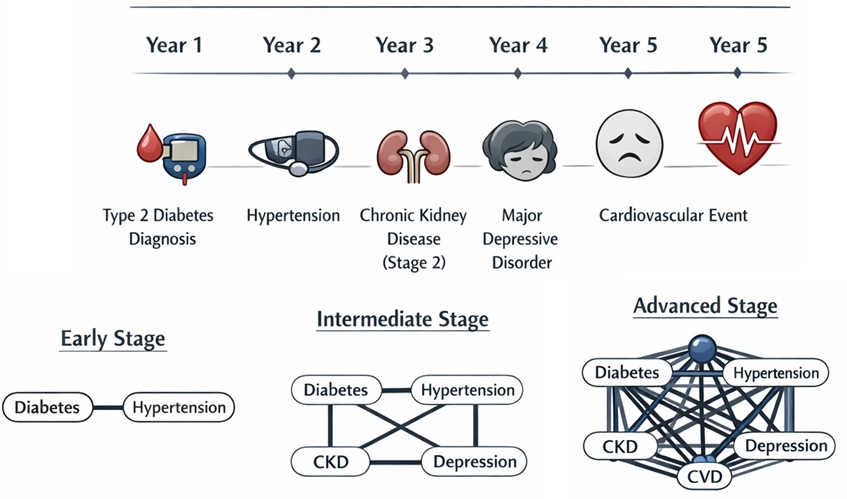
Figure 1. Longitudinal evolution of comorbidity clustering in a multimorbid patient.
Figure 1 illustrates how sequential diagnoses accumulate and form increasingly dense disease interaction networks across five years, demonstrating the progressive intensification of multimorbidity and its implications for dynamic risk stratification.
In hospital-based clinical settings, such graph structures could theoretically be embedded within existing clinical decision support systems (CDSS), augmenting risk stratification protocols. For example, rather than relying solely on isolated severity scores, DCGs may overlay patient-specific data streams—laboratory results, medication changes, diagnostic transitions—onto broader network representations of multimorbidity propagation. In intensive care units (ICUs), where mortality predictions depend heavily on comorbidity trajectories and dynamic physiological changes, this network overlay could enhance early identification of high-risk patterns without disrupting established workflows [9-19]. By continuously recalibrating node centrality and edge weights in response to real-time data, DCGs offer a longitudinal lens on vulnerability, aligning stratification with the fluid realities of acute care.
Beyond critical care, chronic disease management clinics stand to benefit from graph-informed stratification. In diabetes or heart failure clinics, for instance, DCGs could reveal emergent patterns linking glycemic instability with renal impairment or depression—patterns that static dashboards may overlook. Such insights resonate strongly with value-based care models, which incentivize proactive population health management and reduction of avoidable hospitalizations. Through continual updates, DCGs could theoretically flag patients drifting toward high-risk clusters before clinical deterioration becomes apparent.
However, deployment contexts significantly influence feasibility. Urban tertiary centers often possess interoperable EHR infrastructures and analytics capacity conducive to graph-based intelligence. In contrast, rural or resource-constrained clinics may experience fragmented records and limited computational bandwidth. Anchoring DCGs to specific clinical contexts—scaling their complexity to infrastructural capacity—addresses these disparities. Lightweight graph representations or periodic batch updates, for example, may sustain equitable stratification in low-resource settings, ensuring that advanced modeling does not exacerbate systemic inequities.
By situating DCGs within tangible clinical workflows, the framework bridges theoretical network modeling with pragmatic patient care, promoting equitable and adaptive stratification across heterogeneous healthcare ecosystems.
The heterogeneous nature of healthcare data modalities complicates the construction of reliable longitudinal networks. Electronic health records encompass structured components—diagnostic codes, laboratory values, medication lists—as well as unstructured narratives from physician notes, imaging reports, and discharge summaries [4, 6, 7, 13, 15]. Additionally, temporal data streams from bedside monitors and ambulatory devices introduce high-frequency signals that differ fundamentally from episodic clinical documentation.
Dynamic comorbidity graphs address this complexity through modular preprocessing layers that harmonize multimodal inputs before network assembly. Standardization protocols transform disparate coding systems into unified disease entities, ensuring that graph nodes correspond to clinically coherent constructs rather than fragmented labels. Meanwhile, edges encode probabilistic co-occurrences and conditional dependencies over time, enabling the network to represent not just coexistence but evolution.
In ambulatory care contexts, wearable devices—such as continuous glucose monitors or cardiac rhythm trackers—extend the temporal resolution of stratification [1, 3, 10]. DCGs could integrate these continuous streams, refining edge weights as physiological fluctuations intersect with chronic disease states. For instance, recurrent nocturnal hypoglycemia episodes might dynamically strengthen edges linking diabetes with cognitive impairment risk clusters, informing earlier interventions.
Nevertheless, modality-specific noise poses substantial risks. In fragmented healthcare systems, incomplete records or inconsistent documentation practices can distort network fidelity. To mitigate such distortions, DCGs theoretically employ provenance-aware edge weighting, assigning confidence scores based on data source reliability. Structured laboratory confirmations may carry greater influence than ambiguous narrative mentions, reducing susceptibility to spurious correlations.
By tailoring harmonization and weighting mechanisms to healthcare’s distinctive data ecosystem, DCGs transcend generic artificial intelligence applications. They become domain-specific stratification engines capable of adapting to evolving data modalities without necessitating constant empirical revalidation, preserving robustness in the face of multimodal complexity.
The practical deployment of DCGs requires careful alignment with infrastructural and regulatory environments. Healthcare systems range from cloud-enabled enterprise networks to localized, on-premise EHR installations with limited integration capacity. Graph-driven intelligence must therefore accommodate diverse technological architectures while preserving longitudinal fidelity.
In federated learning environments, where institutions collaborate without sharing raw patient data, DCGs offer a particularly compelling paradigm [9, 16, 20-26]. Instead of transmitting identifiable datasets, institutions could exchange aggregated graph parameters or edge statistics, synthesizing population-level stratification insights while maintaining privacy. Such architectures align with contemporary AI governance frameworks emphasizing scalability, transparency, and compliance with regulatory mandates [5, 11, 27].
During public health emergencies, deployment flexibility becomes critical. Theoretical applications of DCGs in pandemic surveillance include tracking evolving comorbidity patterns—such as respiratory disease interactions with metabolic syndromes—to inform allocation of scarce resources like ventilators or vaccines [25, 28]. By stratifying populations based on dynamic network-derived risk, health authorities could prioritize interventions with greater precision.
Environmental constraints, however, impose limitations. Bandwidth restrictions or limited computational resources in low-income or rural settings necessitate streamlined graph representations. Edge pruning, periodic recalibration rather than continuous streaming, and decentralized computation models may enhance feasibility. Embedding deployment-specific protocols ensures that DCGs remain adaptable, preventing technological sophistication from outpacing practical usability.
Through such environmental tailoring, dynamic comorbidity graphs bridge theoretical innovation with real-world orchestration, fostering resilient analytics infrastructures capable of sustaining continual stratification under diverse operational conditions.
Governance considerations are foundational to the ethical and sustainable integration of longitudinal network models into clinical ecosystems. In domains where algorithmic outputs directly influence patient care pathways, transparency and accountability are non-negotiable. DCGs incorporate governance-aware design elements, including audit trails that document graph evolution events and bias-monitoring modules that detect disproportionate stratification impacts [20, 21, 24].
Compliance with regulatory frameworks such as the Health Insurance Portability and Accountability Act and the General Data Protection Regulation necessitates secure handling of personal health information, clear data lineage, and explainable modeling processes. By structuring edges as interpretable probabilistic relationships rather than opaque latent representations, DCGs enable clinicians and auditors to trace stratification outputs back to specific data modalities [14, 17]. This traceability mitigates risks of algorithmic drift, especially in continual learning scenarios where demographic or epidemiological shifts could otherwise skew outputs.
Governance also intersects with equity. Underrepresentation of certain demographic groups in EHR datasets can lead to biased edge formations, inadvertently marginalizing vulnerable populations. DCGs must therefore incorporate fairness-aware recalibration mechanisms, ensuring that evolving network structures do not entrench systemic disparities. Periodic bias audits and stakeholder oversight committees can complement automated safeguards, reinforcing institutional trust.
Ultimately, governance transforms DCGs from mere analytical tools into accountable components of healthcare infrastructure. By harmonizing with interoperability standards and embedding transparency within network evolution, the framework sustains trust, promotes equity, and safeguards patient rights—cornerstones of responsible innovation in longitudinal stratification pipelines.
The evolution of clinical AI system architectures has increasingly embraced network-based paradigms to handle the intricacies of multimorbidity. Longitudinal network modeling, as conceptualized in dynamic comorbidity graphs (DCGs), builds upon graph neural networks and temporal trajectory browsers that map disease progressions across large patient cohorts [1, 5]. These architectures prioritize scalability, allowing for the representation of comorbidity clusters as interconnected nodes that evolve with time-stamped EHR entries. In healthcare analytics infrastructures, such models facilitate the abstraction of complex interactions, where diseases like hypertension and renal failure form feedback loops influencing overall population health [2, 8]. Literature highlights how weighted patient networks predict chronic disease accumulations, providing a theoretical scaffold for continual stratification without necessitating real-time computations [3, 22]. By synthesizing these foundations, DCGs extend beyond static graphs, incorporating adaptive topologies that reflect clinical realities, thus enhancing decision support pipelines in AI governance systems.
EHR intelligence ecosystems form the backbone for deriving meaningful longitudinal insights from disparate data sources. Dynamic comorbidity graphs leverage these ecosystems by embedding knowledge-graph-informed topic models that cluster temporal EHR data into interpretable networks [7, 13, 16]. This integration enables the capture of multimorbidity patterns, where comorbidities accumulate chronologically, informing stratification strategies in population-based studies [4, 6, 12]. Theoretical advancements in multimodal machine learning underscore the need for ecosystems that handle precision health data, aligning with DCGs’ focus on continual updates [9, 10]. For instance, synthetic EHR generation via variational graph autoencoders supports theoretical explorations of network robustness, ensuring interoperability across frameworks [11, 15]. This synthesis reveals how DCGs can orchestrate EHR-derived intelligence, fostering resilient analytics for diverse clinical workflows.
Decision support pipelines in healthcare increasingly incorporate network dynamics to address comorbidity evolution. Dynamic comorbidity graphs enhance these pipelines by modeling temporal patterns through dynamic time warping and sequence analysis, theoretically stratifying populations based on disease trajectories [14, 17, 20]. Literature on machine learning for longitudinal biomedical data emphasizes predictive frameworks that interpret comorbidity interdependencies, such as in psychiatric and somatic conditions [18, 23, 24]. By integrating explainable AI elements, DCGs provide pipelines with interpretable outputs, reducing governance burdens in deployment [19, 21]. This approach aligns with scalable deep learning on EHRs, where multitask benchmarks inform theoretical risk assessments without empirical metrics [25-28]. Ultimately, these pipelines, augmented by DCGs, promote proactive stratification in complex healthcare scenarios.
This section delineates the architectural orchestration of the proposed framework, termed the adaptive longitudinal stratification ensemble (ALSE). ALSE represents a unique, layered infrastructure comprising four distinct tiers: data harmonization layer, graph evolution layer, stratification inference layer, and governance feedback topology. The data harmonization layer aggregates multimodal EHR inputs into standardized node embeddings, ensuring temporal coherence. The graph evolution layer employs adaptive algorithms to update comorbidity edges, capturing longitudinal propagations. The stratification inference layer derives population cohorts through community detection mechanisms, while the governance feedback topology introduces closed-loop monitoring to recalibrate layers based on theoretical drift indicators. Figure 2 illustrates the governance-embedded adaptive longitudinal stratification ensemble (ALSE), detailing harmonization, dynamic graph evolution, stratification inference, and recursive oversight topology.
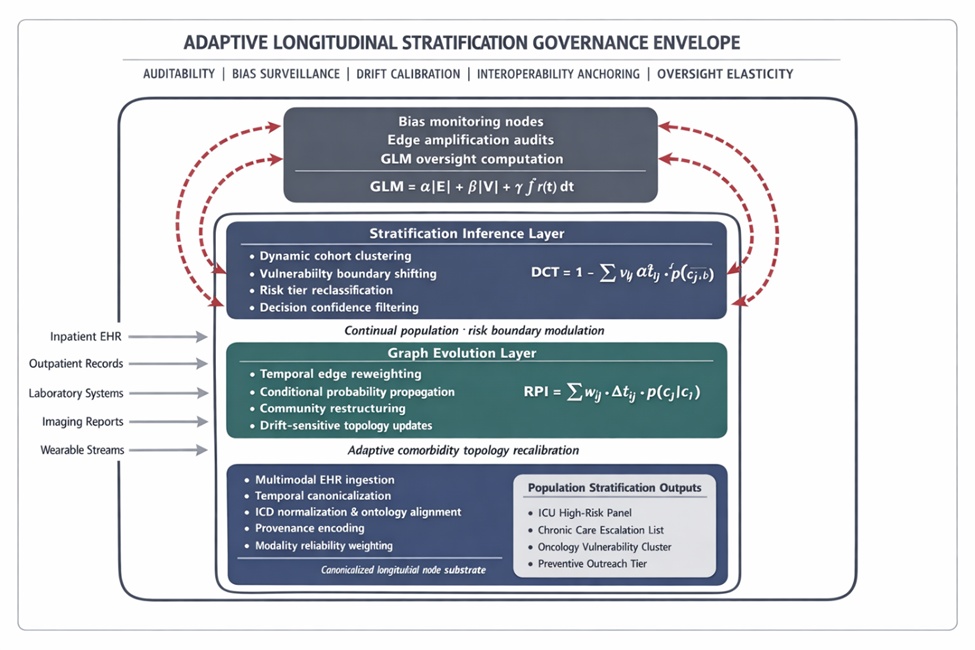
Figure 2. Governance-embedded architecture of the adaptive longitudinal stratification ensemble (ALSE) for continual population stratification.
To interpret system dynamics, consider the following conceptual formulas:
Risk propagation index (RPI):
Decision confidence threshold
Governance load metric (GLM):
The orchestration of dynamic comorbidity graphs (DCGs) via the adaptive longitudinal stratification ensemble (ALSE) yields profound theoretical impacts on clinical stratification dynamics, fundamentally reshaping how healthcare systems conceptualize, operationalize, and sustain evolving population health profiles. Unlike static risk models that snapshot disease states at discrete intervals, DCGs introduce a continuously adaptive topology in which nodes (patients, conditions, interventions) and edges (conditional dependencies, co-occurrence intensities, temporal transitions) co-evolve. This continual recalibration alters the very mechanics of risk propagation across cohorts, potentially reducing the incidence of overlooked multimorbidity escalations in longitudinal care by identifying emergent vulnerability clusters before they manifest as acute events [1-3].
From a theoretical standpoint, ALSE’s layered architecture enhances the temporal sensitivity of stratification systems. By embedding time-aware edge reweighting and drift-sensitive recalibration mechanisms, the framework captures fluctuations such as seasonal disease exacerbations, pharmacological side-effect cascades, or post-surgical complication chains. This responsiveness allows stratification boundaries to shift dynamically rather than remain tethered to historical averages. In resource-constrained clinical environments, such adaptability could optimize allocation decisions—triaging follow-up intensity, prioritizing high-risk panels, and modulating preventive outreach—based on near-real-time structural shifts within the graph [4-6].
In oncology contexts, where treatment regimens induce complex comorbidity interactions (e.g., immunosuppression interacting with metabolic disorders), DCGs theoretically enable the delineation of high-vulnerability subgroups by tracing probabilistic amplifications along evolving treatment–disease pathways [7-9]. Rather than relying solely on empirical retrospective cohorts, ALSE’s structural abstraction permits scenario modeling: clinicians can simulate how modifying a chemotherapy protocol might attenuate or exacerbate downstream comorbidity clusters. Thus, stratification becomes not merely predictive but exploratory—supporting hypothesis-driven surveillance adjustments in precision oncology without immediate empirical dataset dependencies.
Moreover, the integration of governance feedback topologies within ALSE mitigates distortions that might arise from unchecked network evolution. In dynamic systems, edge amplification can inadvertently entrench historical biases or propagate spurious correlations. By embedding governance constraints—ethical audits, regulatory thresholds, and bias-monitoring checkpoints—into the graph recalibration cycle, ALSE ensures that stratification outputs remain aligned with institutional accountability mandates and patient safety standards [10-12]. This reflexive oversight transforms governance from a post hoc compliance exercise into an intrinsic structural parameter of the network.
Interoperability constitutes another transformative impact domain. DCGs, functioning as harmonized meta-structures, can theoretically bridge disparate EHR ecosystems by mapping heterogeneous coding schemas into unified graph representations. Through adaptive translation layers, semantic inconsistencies—such as variations in ICD coding practices or documentation latency—are normalized before influencing stratification weights [13-15]. The result is a cross-institutional population graph capable of sustaining coherent risk trajectories even when underlying data infrastructures differ significantly.
The automation of drift detection further reduces clinician monitoring burdens. Rather than manually reconciling inconsistencies or revalidating model thresholds, healthcare professionals can rely on ALSE’s internal diagnostics to flag anomalous structural shifts—such as sudden increases in edge centrality for a specific comorbidity cluster—prompting targeted review rather than wholesale recalibration [16-18]. This delegation of technical vigilance allows clinicians to concentrate on interpretive decision-making and patient communication, enhancing the human-centered dimension of stratification workflows.
In mental health domains, characterized by nonlinear symptom trajectories and episodic exacerbations, ALSE’s dynamic layering provides theoretical improvements in prognostic confidence. Psychiatric comorbidities often exhibit delayed feedback loops—where socioeconomic stressors, medication adherence, and co-occurring substance use interact unpredictably. DCGs can capture these recursive dependencies, recalibrating stratification categories as relational intensities evolve [19-21]. The anticipated impact includes more precise allocation of outpatient supports, potentially reducing overutilization of emergency or inpatient psychiatric services through earlier network-informed interventions.
Beyond clinical outcomes, the propagation of risk signals along graph edges introduces cascading implications for healthcare economics. Early identification of patients situated within rapidly intensifying comorbidity clusters could enable preventive interventions that avert high-cost hospitalizations or ICU admissions [22-24]. By quantifying edge amplification via indices such as the Risk Propagation Index (RPI), administrators can simulate downstream cost trajectories under different preventive scenarios. This economic foresight transforms stratification from a reactive budgeting tool into a proactive fiscal planning instrument.
ALSE’s modular layering also supports scalable deployment across heterogeneous infrastructures. In centralized academic health systems, full-spectrum governance feedback and high-resolution temporal recalibration may be feasible. In decentralized community clinics, lighter-weight graph updates and reduced governance overhead—measured through metrics like the Governance Load Metric (GLM)—can be adopted to match infrastructural capacities [25-28]. This elasticity ensures that dynamic stratification does not remain confined to technologically advanced institutions but can be tailored to diverse care settings.
Collectively, these impacts signify a transition from static analytics to adaptive intelligence. Clinical stratification ceases to be a periodic reporting exercise. Instead, it becomes an evolving network process—one that shapes equity in care delivery, enhances anticipatory capacity, and fortifies system resilience against epidemiological shocks or demographic shifts.
The conceptualization of DCGs within ALSE marks a paradigmatic shift in longitudinal healthcare modeling. Traditional stratification models frequently rely on regression-based snapshots or isolated machine learning classifiers that treat multimorbidity as a fixed attribute. In contrast, ALSE foregrounds temporality and relationality as primary modeling dimensions. By embedding disease trajectories directly into evolving network topologies, the framework transcends static abstractions and captures the fluid interdependencies characteristic of chronic care populations [1, 2, 5, 8].
This orientation aligns with contemporary clinical AI architectures emphasizing interoperability, transparency, and governance as prerequisites for sustainable deployment [4, 9, 11, 16]. Crucially, ALSE does not treat interoperability as an auxiliary integration step but as a foundational design principle. The Data Harmonization Layer standardizes multimodal inputs—laboratory values, diagnostic codes, medication histories—before graph construction, thereby minimizing bias propagation from inconsistent documentation practices [3, 12, 15, 22]. In diverse clinical settings where underrepresented populations risk misclassification, such harmonization is essential for equitable stratification outcomes.
The graph evolution layer further extends this capability by implementing adaptive algorithms that update edge weights in response to temporal evidence accumulation. The risk propagation index (RPI) offers a formalized interpretive mechanism, quantifying how conditional probabilities amplify across successive time intervals [10, 17, 20]. Through iterative recalibration, RPI operationalizes the intuition that comorbidity interactions are not static but intensify or attenuate based on treatment effects and environmental modifiers.
Complementing this is the governance load metric (GLM), which conceptualizes oversight as a measurable component of system performance. By quantifying the cognitive and administrative resources required to supervise evolving networks, GLM facilitates optimized governance allocation—particularly valuable in resource-constrained environments [18, 19, 21, 25]. Together, RPI and GLM form a dual-axis interpretive scaffold: one axis tracking clinical amplification, the other monitoring institutional sustainability.
Nevertheless, theoretical limitations merit careful examination. The decision confidence threshold (DCT), while instrumental in filtering low-certainty stratifications, presupposes stable data streams and uninterrupted system functionality. Real-world contingencies—such as EHR downtimes, cybersecurity breaches, or privacy-driven data restrictions—may destabilize these assumptions [23, 24, 26, 27]. In governance-constrained contexts, disproportionate reliance on automated thresholds could inadvertently widen disparities if affluent institutions maintain robust infrastructures while under-resourced facilities struggle to sustain calibration fidelity.
Ethically, ALSE’s emphasis on explainable network orchestrations strengthens accountability. Edge visualizations and temporal weight trajectories provide interpretable rationales for stratification adjustments, aligning with principles of transparency and patient autonomy [2, 11, 28]. Yet drift sensitivity introduces a paradox: as models become more adaptive, they risk entrenching historical inequities embedded in data flows. Continuous bias auditing and participatory oversight mechanisms are therefore essential to prevent algorithmic reinforcement of systemic disparities.
Comparatively, while prior research explores trajectory visualization tools or link-prediction algorithms, ALSE distinguishes itself through its governance-centric topology. Rather than optimizing predictive accuracy in isolation, it situates prediction within a structured ecosystem of harmonization, evolution, and oversight [3, 5, 13]. This holistic orientation positions ALSE not merely as a modeling technique but as an infrastructural philosophy for longitudinal analytics. Table 1 delineates the structural and governance-based distinctions between ALSE and prior longitudinal stratification paradigms.
Table 1. Structural differentiation of ALSE from conventional longitudinal stratification paradigms.
Dimension | Static risk models | Episodic ML stratifiers | Longitudinal trajectory models | ALSE (DCG-based continual stratification) |
Temporal handling | Snapshot-based | Periodic retraining | Sequential modeling | Continuous topology evolution |
Comorbidity representation | Independent covariates | Feature vectors | Time-series clusters | Adaptive weighted network graph |
Risk propagation modeling | Linear aggregation | Implicit via weights | Temporal transitions | Explicit edge-based probabilistic propagation (RPI) |
Stratification boundaries | Fixed thresholds | Model-dependent cutoffs | Semi-dynamic | Drift-sensitive boundary recalibration |
Governance integration | External audit | Post hoc validation | Limited | Embedded recursive governance topology (GLM-driven) |
Interoperability adaptation | Manual harmonization | Preprocessing pipelines | Variable | Structural harmonization layer with provenance encoding |
Bias monitoring | Retrospective analysis | Dataset review | Minimal | Real-time bias recalibration triggers |
Deployment elasticity | Low | Moderate | Moderate | Scalable governance load modulation |
Broader policy implications emerge from this framework. Policymakers could employ RPI-derived simulations for epidemic preparedness modeling, assessing how comorbidity intensifications might strain healthcare systems during infectious surges [8, 14, 18]. Simultaneously, GLM metrics could inform national budgeting strategies for AI infrastructure deployment, guiding equitable resource distribution across regions [20, 21].
Future conceptual extensions may incorporate hybrid modalities such as genomic or proteomic layers to refine comorbidity linkages and personalize risk trajectories further [6, 9]. However, scalability challenges persist, particularly in harmonizing legacy EHR systems with dynamic graph infrastructures [4, 7, 10]. Interoperability standards must evolve to accommodate continual network updates without compromising data security or patient privacy.
In synthesizing the conceptual underpinnings of dynamic comorbidity graphs (DCGs) for continual population stratification, the adaptive longitudinal stratification ensemble (ALSE) emerges as a robust theoretical framework that redefines longitudinal network modeling in healthcare systems. By orchestrating adaptive graph structures through unique layers and feedback topologies, ALSE addresses the imperative for real-time, interpretable analytics amid rising multimorbidity burdens. The framework’s emphasis on clinical workflow integration, data modality harmonization, and governance constraints positions it as a scalable solution for diverse deployment environments, from ICUs to community health networks.
Theoretical formulas such as the risk propagation index (RPI), decision confidence threshold (DCT), and governance load metric (GLM) provide essential interpretive lenses, enabling stakeholders to gauge system dynamics without empirical dependencies. These tools illuminate how DCGs can theoretically mitigate monitoring burdens, enhance decision confidence, and optimize resource allocation, fostering resilient healthcare infrastructures. Impacts on clinical stratification dynamics further highlight ALSE’s transformative potential, influencing everything from risk management in chronic disease clusters to equitable population health strategies.
While limitations in handling extreme data heterogeneities persist, the framework’s synergies with existing EHR intelligence ecosystems and AI governance systems pave the way for future advancements. Policymakers and clinicians alike stand to benefit from ALSE’s conceptual rigor, which advocates for a shift toward proactive, network-driven stratification. In conclusion, this manuscript posits DCGs via ALSE as a cornerstone for evolving healthcare analytics, ultimately contributing to more adaptive, equitable, and efficient population management in the face of longitudinal health complexities.
None
None
None
None
Open Access The author(s) retain copyright. This article is licensed under the Creative Commons Attribution-NonCommercial-ShareAlike 4.0 International License. It may be shared and adapted for non-commercial purposes with appropriate attribution, an indication of changes, and distribution of adaptations under the same license. Third-party material may be subject to separate terms identified in its credit line. View the license at https://creativecommons.org/licenses/by-nc-sa/4.0/.
 Clinical Intelligence Research Press