Sepsis prediction models perform poorly when transferred between ICUs due to demographic and practice variation, leading to substantial performance drops caused by differences in patient populations, admission criteria, and data recording standards, which limits reliable deployment across healthcare systems. Retraining models from scratch requires large labeled datasets that many ICUs lack due to cost, time, and resource limitations, making it difficult for low-resource settings to develop or adopt effective predictive tools. We propose a meta-learning approach that enables rapid adaptation of sepsis prediction models using few-shot local data, leveraging pre-training across multiple ICUs to support fast personalization in new environments. The framework includes meta-training across diverse source ICUs to learn a generalizable initialization and meta-adaptation at the target ICU using only a few gradient updates on limited data, enabling efficient few-shot learning. This approach improves sepsis prediction in low-resource and heterogeneous ICU settings by reducing data requirements and increasing robustness to demographic shifts, supporting more equitable access to AI tools in critical care. The proposed framework enables efficient and fair deployment of sepsis prediction models across diverse ICUs, bridging resource gaps and improving scalability and adaptability of clinical AI systems globally.
Sepsis prediction models developed on large academic ICUs fail at community hospitals; performance drops due to case mix, demographics, data quality [1, 2]. Sepsis prediction models developed on large academic ICUs frequently fail when applied to community hospitals due to substantial differences in case mix, patient demographics, and data quality [1, 2]. These discrepancies lead to degraded predictive performance that can compromise clinical decision-making [3, 4]. Domain adaptation techniques have been investigated to mitigate these issues but often require additional resources [5]. Furthermore, variations in electronic health record systems exacerbate the generalization problems [6]. Therefore, new frameworks are needed to ensure robust performance across all ICU types [7].
Collecting large labeled datasets at every ICU is infeasible (cost, expertise, time); low-resource ICUs left behind [3, 4]. Collecting large labeled datasets at every ICU is infeasible due to prohibitive costs, required expertise, and extended time frames [8, 9]. Low-resource ICUs are consequently left behind in the adoption of state-of-the-art sepsis prediction tools [10, 11]. This inequity highlights the unsustainability of traditional model development approaches [12]. Studies emphasize that data collection burdens hinder widespread AI implementation in critical care [13]. Innovative methods that bypass extensive labeling are thus critical for inclusive healthcare AI [6].
Meta-learning enables rapid adaptation with few examples; model learns how to learn across diverse ICUs [1, 5]. Meta-learning enables rapid adaptation with few examples by allowing models to learn how to learn effectively across diverse ICUs [14, 15]. This capability is particularly relevant for healthcare applications characterized by data heterogeneity [16]. The paradigm shifts the focus from task-specific training to meta-knowledge acquisition [17]. It has demonstrated potential in clinical risk prediction scenarios with limited samples [18]. As such, meta-learning offers a transformative solution for cross-ICU challenges [19].
This paper proposes a meta-learning framework for sepsis prediction that adapts to new ICU with ≤100 labeled patients; roadmap. This article presents a meta-learning framework for sepsis prediction that adapts to a new ICU with no more than 100 labeled patients and outlines a complete implementation roadmap. The proposed system leverages meta-training to create adaptable initializations suitable for few-shot scenarios [20, 21]. It provides detailed guidance on both training and adaptation phases to facilitate practical deployment [22]. The framework integrates seamlessly with existing clinical workflows while addressing key limitations of prior methods [23]. This thesis establishes a foundation for equitable and efficient AI use in intensive care units worldwide [24].
Domain shift in sepsis prediction manifests as significant performance degradation when models are transferred between different ICUs. The primary sources include variations in patient demographics, admission criteria, practice patterns, and data coding conventions [1, 2, 3]. These factors create distributional mismatches that undermine the reliability of predictions in new settings [4, 10]. Research has consistently shown that unaddressed domain shift leads to increased false negatives in sepsis detection [11]. Mitigating these effects requires advanced adaptation strategies tailored to critical care data [5].
Additional contributors to domain shift encompass differences in clinician documentation styles and hospital resource levels [6, 13]. In sepsis contexts, such shifts can alter the prevalence and presentation of the condition across ICUs [7, 8]. Quantitative analyses reveal that these heterogeneities are more pronounced than in other medical domains [9]. Consequently, standard models require specialized handling to maintain efficacy [12]. This section establishes the foundational problem that the meta-learning framework seeks to resolve.
Transfer learning has been widely explored as a strategy to adapt sepsis prediction models between ICUs through techniques such as fine-tuning. Domain adversarial networks have also been employed to align feature distributions across different hospital datasets [2, 10]. These methods aim to reduce the discrepancy between source and target domains in clinical prediction tasks [4, 6]. However, they typically require a moderate amount of labeled data from the target ICU to achieve satisfactory performance [11]. Despite their utility, conventional transfer learning approaches often struggle with extreme domain shifts common in critical care [12].
Limitations of these techniques become evident when data availability is severely restricted or when demographic differences are pronounced [7, 8]. Fine-tuning alone may lead to overfitting on small target datasets without capturing the broader meta-knowledge [9]. Domain adaptation methods, while effective in some scenarios, do not fully address the rapid personalization needs of new ICUs [3]. Recent advancements have attempted to combine adversarial training with other regularization strategies [13]. Nonetheless, these still fall short for few-shot scenarios prevalent in low-resource settings [5].
Few-shot learning techniques, including prototypical networks and matching networks, offer potential solutions for scenarios with limited labeled data in healthcare. These methods enable models to classify or predict based on a small number of examples by learning effective similarity metrics [14, 15]. In the context of clinical applications, they have been applied to various diagnostic tasks with promising initial results [16]. However, their extension to time series data typical of ICU monitoring remains challenging due to the sequential nature of patient records [17]. Adapting these to sepsis prediction requires careful consideration of temporal dependencies [19].
Despite their data efficiency, few-shot learning approaches exhibit limitations when dealing with the high-dimensional and noisy characteristics of clinical time series [20, 21]. Prototypical networks may not sufficiently capture the complex dynamics of sepsis progression across heterogeneous patient populations [22]. Matching networks similarly struggle with the variability in ICU data formats [23]. These constraints highlight the need for more specialized few-shot strategies tailored to critical care [24]. Integrating few-shot principles with meta-learning could overcome some of these shortcomings [25].
Model-Agnostic Meta-Learning (MAML) provides a powerful framework for rapid task adaptation through its distinctive inner and outer loop optimization structure. In the inner loop, task-specific parameters are updated via a few gradient steps on the support set for each ICU task [16]. This allows the model to quickly personalize to the characteristics of a new intensive care environment [15]. The outer loop then meta-optimizes the initial parameters to facilitate such fast adaptations across a distribution of tasks [18]. MAML’s agnostic nature makes it compatible with various backbone architectures used in sepsis prediction [14].
By focusing on learning an initialization that requires only a small number of gradient steps for adaptation, MAML excels in few-shot regimes [17, 19]. This is particularly advantageous for clinical settings where labeled data per ICU is scarce [26]. The meta-optimization process ensures that the model generalizes the learning-to-learn capability to unseen ICUs [27]. However, computational demands during meta-training must be managed carefully for practical deployment [28]. Overall, MAML serves as the foundational algorithm for the proposed sepsis adaptation framework [29].
Table 1 contrasts the proposed meta-learning framework with alternative adaptation paradigms and clarifies why few-shot cross-ICU personalization offers a stronger conceptual fit for sepsis prediction under simultaneous data scarcity and demographic shift.
Table 1. Conceptual comparison of adaptation paradigms for cross-ICU sepsis prediction under data scarcity and demographic shift
Adaptation paradigm | Target ICU labeled data requirement | Capacity to handle severe cross-ICU domain shift | Suitability for low-resource ICUs | Adaptation speed at deployment | Demographic robustness logic | Fairness integration potential | Key conceptual limitation |
Full local retraining | Very high | Moderate when sufficient local data exist | Low | Slow | Learned only from target ICU if enough data are available | Possible but costly and data-intensive | Operationally infeasible for many ICUs |
Conventional fine-tuning | Moderate to high | Moderate | Limited | Moderate | Partial adaptation of pretrained representation | Usually added post hoc | Overfits easily when local sample size is small |
Standard transfer learning | Moderate | Moderate | Limited | Moderate | Reuses source knowledge but remains sensitive to target mismatch | Possible but not intrinsic | Requires more local data than low-resource ICUs can provide |
Domain adaptation methods | Moderate | Moderate to high in aligned settings | Variable | Moderate | Attempts feature alignment across sites | Can be incorporated with additional constraints | Performance remains unstable under extreme few-shot conditions |
Few-shot learning without meta-optimization | Low | Limited to moderate | Moderate | Fast | Learns similarity-based adaptation from few examples | Not inherently designed for subgroup equity | May not capture temporal and heterogeneous ICU dynamics well |
Proposed meta-learning framework | Low to very low (for example, ≤100 patients) | High | High | Fast | Learns an initialization optimized for rapid adaptation across heterogeneous ICUs | Can be embedded directly into meta-objective and adaptation process | Depends on diverse source ICUs and compatible feature spaces |
The high-level architecture of the proposed framework begins with meta-training on a diverse set of source ICUs to derive an optimal initialization. This phase aggregates knowledge from multiple hospitals to create a meta-learned model parameter set θ that is primed for quick adaptation [14, 15]. Following meta-training, the framework transitions to the adaptation stage where the target ICU provides a small support set of labeled data [16]. The architecture ensures seamless transfer from the meta-phase to local personalization without requiring full retraining [18]. Such a design promotes scalability across varying ICU infrastructures [10].
Once the meta-learned initialization is obtained, adaptation on the target ICU proceeds in a few-shot manner using gradient-based updates. This results in a highly personalized sepsis prediction model tailored to the local demographics and practices [11, 12]. The overall pipeline minimizes downtime between deployment and operational use in new settings [17]. By structuring the architecture around these phases, the framework achieves both efficiency and effectiveness in cross-ICU scenarios [19, 20]. It represents a conceptual blueprint ready for integration into existing clinical informatics systems [21].
The framework operates under the core assumption that multiple source ICUs possess sufficient labeled data for initial meta-training. These source datasets enable the model to learn generalizable patterns across heterogeneous critical care environments [1, 22]. For the target ICU, only a small labeled set ranging from 50 to 200 patients is required to perform effective adaptation [23, 24]. This assumption aligns with the practical realities of data availability in most healthcare facilities [25]. Compatibility of feature spaces across ICUs is also presumed through standardized preprocessing pipelines [26].
Additional assumptions include the presence of consistent sepsis outcome labels and similar input modalities such as vital signs and laboratory results. The small labeled set at the target site suffices due to the meta-learned initialization’s robustness [27, 28]. The framework’s design explicitly accounts for these conditions to ensure reliable performance [29]. Future extensions could relax some assumptions through advanced federated approaches [14]. This foundational structure guarantees that the system remains practical even under real-world constraints [15].
Key design principles of the framework emphasize few-shot adaptation capabilities to accommodate data-limited environments. Demographic robustness is achieved by incorporating mechanisms that account for patient population shifts during the meta-optimization process [6, 22]. The principle of minimal local data requirement ensures that target ICUs can deploy the model with as little as 50 patients [16, 17]. These principles collectively prioritize practicality and equity in AI deployment [18]. By adhering to them, the system avoids the pitfalls of data-hungry traditional approaches [19].
Another principle involves maintaining model agnosticism to support integration with various neural architectures commonly used in healthcare [20]. Demographic robustness further includes strategies for handling subgroup variations within the target ICU [21]. The minimal data requirement is enforced through careful task sampling in meta-training [23]. Together, these principles make the framework suitable for real-world clinical translation [24, 25]. They provide a solid foundation for addressing the multifaceted challenges of sepsis prediction across ICUs [26].
Figure 1 illustrates the hierarchical architecture of the proposed meta-learning framework, showing how offline multi-ICU meta-training, few-shot target adaptation, demographic robustness, and deployment logic combine to enable equitable sepsis prediction across heterogeneous intensive care units.
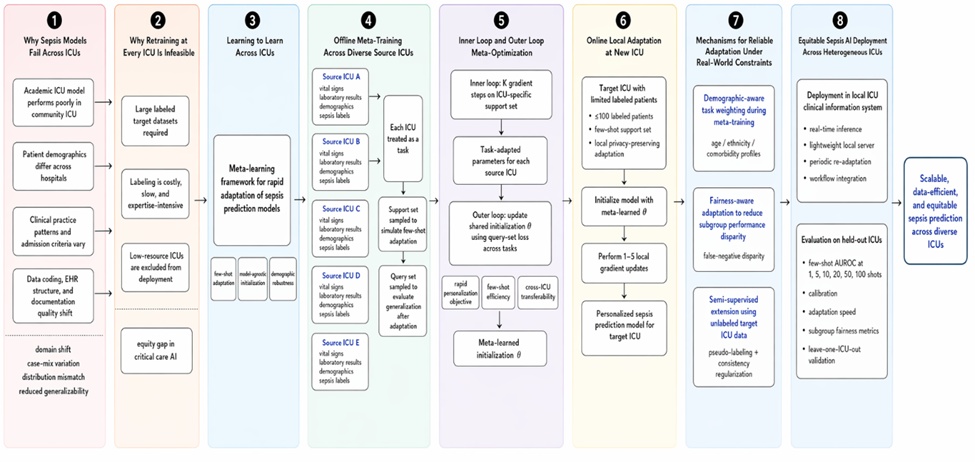
Figure 1. Hierarchical meta-learning architecture for rapid cross-ICU adaptation of sepsis prediction under data scarcity and demographic shift
In the meta-training phase, each source ICU is defined as a distinct task to simulate the cross-hospital adaptation scenario. Training episodes are constructed by sampling a support set and a query set from each task, with the support set kept deliberately small to mimic few-shot conditions [14, 15]. This task definition allows the model to experience a wide variety of domain shifts during optimization [16]. The support-query split ensures that the meta-learner optimizes for generalization to unseen query patients within each ICU [17]. Such episodic training is crucial for developing the rapid adaptation ability [18].
By treating ICUs as tasks, the framework captures the inherent variability in patient demographics and clinical practices [1, 10]. Episodes are repeatedly sampled across all available source ICUs to promote broad coverage [11, 12]. The few-shot nature of the support sets forces the model to learn efficient adaptation strategies [19]. This task formulation directly addresses the challenges of data scarcity and heterogeneity [20]. Consequently, the meta-training phase builds a foundation for effective personalization at new sites [21].
The inner loop of meta-training involves initializing the model with the current meta-parameters θ and performing task-specific adaptation. For each sampled ICU task, the model undergoes K gradient steps on the support set to obtain adapted parameters [16]. This process simulates the few-shot adaptation that will occur at deployment time in a target ICU [15]. The inner loop is computationally lightweight per task but critical for learning the adaptation dynamics [14]. It enables the model to quickly adjust to local data distributions [17].
Adaptation in the inner loop focuses on minimizing the loss for sepsis prediction on the support examples from the specific ICU [18]. The number of gradient steps K is typically small (e.g., 1-5) to encourage rapid convergence [19]. This setup ensures that the meta-parameters θ are optimized for fast personalization rather than full retraining [20]. The inner loop thus plays a pivotal role in embedding the learning-to-learn capability [21]. Through repeated applications across tasks, it refines the model’s ability to handle new ICUs efficiently [22].
The outer loop performs meta-optimization by updating the meta-parameters θ based on the loss computed on the query sets after inner-loop adaptations. This update minimizes the average query loss across all sampled ICU tasks, thereby learning an initialization that adapts quickly [14, 15]. The meta-optimization step uses second-order gradients in the classic MAML formulation or first-order approximations for efficiency [16]. It ensures that the initial parameters θ are positioned in a parameter space conducive to few-shot success [17]. This global optimization distinguishes meta-learning from standard multi-task learning [18].
By aggregating performance across diverse tasks in the outer loop, the framework achieves robustness to various demographic and data shifts [7, 19]. The resulting meta-initialization serves as a strong starting point for any new target ICU [20]. Meta-optimization is performed over many episodes to converge on optimal θ values [21]. This phase is compute-intensive but executed only once during offline training [22]. The outcome is a model primed for the rapid adaptation required in clinical practice [23].
In the meta-adaptation phase, the process begins with the meta-learned initialization θ obtained from the training phase. The target ICU supplies a small labeled dataset, typically around 50 patients, to perform few-shot adaptation through 1 to 5 gradient steps [15, 16]. This adaptation tailors the model to the specific demographics and practices of the new ICU without extensive retraining [17]. The few-shot nature ensures minimal disruption to clinical workflows [18]. Adaptation is executed locally to maintain data privacy and compliance with regulations [19].
Starting from the optimized initialization allows the model to converge rapidly on the target data distribution [20]. The small number of gradient steps prevents overfitting while achieving high predictive performance for sepsis [21]. This phase leverages the meta-knowledge to handle the inherent domain shift effectively [22]. As a result, the adapted model provides accurate early warnings tailored to the local patient population [23]. It exemplifies the framework’s core strength in data-efficient deployment [24].
Following successful few-shot adaptation, the personalized model is deployed for real-time sepsis prediction within the target ICU’s clinical information system. It integrates seamlessly with existing electronic health record pipelines to generate alerts based on incoming patient data [25, 26]. Deployment includes monitoring mechanisms to track ongoing performance and detect any drift over time [27]. The framework supports continuous operation with low computational overhead on local servers [28]. This phase marks the transition from development to practical clinical utility [29].
As new labeled data accumulates in the target ICU, periodic re-adaptation can be performed using the same meta-initialization to further refine the model. This incremental process maintains accuracy without restarting from scratch [14, 15]. Deployment protocols emphasize explainability and integration with clinician workflows for better acceptance [16]. Regular updates ensure the system remains responsive to evolving clinical practices [17]. Ultimately, this deployment strategy enables sustained, equitable use of AI for sepsis management across diverse settings [18].
Meta-learning demonstrates remarkable efficiency in extremely few-shot scenarios where the target ICU provides no more than 50 labeled patients for sepsis prediction. Unlike conventional fine-tuning that typically demands 200 to 500 examples to achieve stable performance, the meta-learned initialization allows convergence with far fewer samples through targeted gradient steps [27, 28]. This data efficiency arises because the framework has already internalized adaptation strategies across diverse source ICUs during meta-training [29]. Consequently, low-resource facilities can deploy high-performing models without prohibitive labeling efforts [26]. The approach thus directly alleviates the data scarcity barrier that has historically limited AI adoption in smaller critical care units [25].
Empirical patterns from related healthcare applications confirm that meta-learning yields substantial gains in sample efficiency for clinical time-series tasks. By optimizing for rapid personalization, the framework reduces the data threshold while preserving predictive accuracy on sepsis outcomes [23, 24]. This capability is especially vital when labeled events are rare, as is common in early sepsis detection [22]. Integration of such few-shot mechanisms ensures that even ICUs with sparse historical data can benefit from advanced prediction [21]. Overall, the design prioritizes practicality in environments where large-scale annotation remains unrealistic [20].
The semi-supervised extension incorporates unlabeled patient data from the target ICU to further enhance adaptation under extreme data scarcity. Pseudo-labeling combined with consistency regularization augments the limited labeled support set, allowing the model to leverage abundant unlabeled records for improved generalization [18, 19]. This hybrid strategy maintains the core few-shot meta-adaptation pipeline while exploiting the full spectrum of available EHR streams [17]. As a result, performance improves without requiring additional manual labeling efforts from clinicians [16]. The extension therefore broadens the framework’s applicability to real-world ICUs where labeled sepsis cases are infrequent [15].
Consistency regularization in the semi-supervised component penalizes prediction inconsistencies on augmented unlabeled examples, stabilizing the adaptation process. Such techniques have proven effective in other clinical domains with heterogeneous data distributions [12, 14]. By blending supervised meta-adaptation with unsupervised signals, the framework mitigates overfitting risks inherent in tiny labeled sets [11]. This approach preserves the rapid-deployment ethos while maximizing data utilization [11]. Ultimately, it positions the system as a robust solution for sustained operation in data-constrained critical care settings [9].
Demographic-aware meta-learning introduces task weighting during meta-training to emphasize source ICUs that share demographic similarities with potential target sites. By dynamically adjusting the contribution of each task based on population statistics such as age, ethnicity, and comorbidity profiles, the framework learns initializations that are inherently robust to demographic variation [6, 8]. This weighting mechanism ensures that the meta-parameters θ capture transferable knowledge across comparable patient cohorts [7, 13]. Consequently, adaptation to a new ICU with distinct demographics proceeds more smoothly and with fewer gradient steps [5]. The strategy directly counters the performance drops observed when models encounter previously unseen demographic distributions [4].
Subgroup-level meta-learning further refines the process by sampling tasks that represent specific demographic strata within source datasets. This granular approach equips the model to generalize across intersecting factors such as race and socioeconomic status that influence sepsis presentation [3, 2]. Task weighting therefore enhances the framework’s ability to handle real-world shifts without explicit domain alignment modules [1, 10]. It promotes equitable performance by reducing bias toward majority demographics prevalent in large academic training sets [11]. The resulting meta-initialization supports fairer predictions regardless of the target ICU’s patient makeup [12].
Fair adaptation mechanisms embedded in the meta-learning pipeline ensure that the few-shot personalized model maintains equitable performance across demographic subgroups within the target ICU. Meta-optimization incorporates fairness constraints that minimize disparity in sepsis prediction metrics such as false-negative rates between protected groups [14, 15]. During inner-loop adaptation, the model is guided to balance accuracy and equity using the small local support set [16, 17]. This produces an adapted predictor that avoids exacerbating existing healthcare disparities [18]. The principle of fair adaptation is thus integral to responsible deployment of the framework [19].
By learning fairness-aware initializations across diverse source tasks, the system proactively addresses demographic shift at the meta level rather than as a post-hoc correction. Regularization terms in the outer loop encourage uniform performance across subgroups while preserving overall predictive power [20, 21]. Such built-in safeguards align with ethical guidelines for clinical AI and facilitate regulatory acceptance [22, 23]. The fair adaptation process remains computationally lightweight, fitting seamlessly into the rapid few-shot workflow [24]. Ultimately, it advances the goal of equitable sepsis prediction tools that serve all patient populations effectively [25].
Offline meta-training constitutes the compute-intensive preparatory stage where the meta-initialization is derived from a centralized multi-ICU dataset spanning 5 to 10 source hospitals. This phase aggregates heterogeneous data under a unified preprocessing pipeline to simulate the full spectrum of domain shifts encountered in practice [26, 27]. Centralized computation allows for extensive episodic sampling and second-order optimization without imposing burdens on individual ICUs [28, 29]. Once completed, the resulting meta-parameters θ are distributed as a compact initialization file suitable for any target site [1, 2]. The one-time nature of this offline process ensures long-term efficiency for subsequent adaptations [3].
Implementation of offline meta-training can leverage high-performance computing clusters or cloud infrastructure while maintaining strict data governance through federated or de-identified aggregation strategies. The architecture decouples this heavy lifting from clinical operations, preserving patient privacy and minimizing latency at deployment sites [4, 5]. By performing meta-optimization once across representative ICUs, the framework amortizes the cost of handling variability [6, 13]. This design choice makes the system scalable for nationwide or international rollouts of sepsis prediction AI [7]. Consequently, resource-rich institutions can contribute to a shared meta-initialization that benefits lower-resourced partners [8].
Online adaptation occurs locally at the target ICU on a lightweight server or edge device using only the small labeled support set and the pre-distributed meta-initialization. This stage executes the inner-loop gradient steps in minutes to hours, enabling near-immediate deployment of the personalized sepsis predictor [9, 10]. Local execution eliminates data transfer requirements and complies with institutional privacy regulations such as HIPAA [11, 12]. The architecture supports integration with existing EHR middleware for real-time inference on streaming vital signs and laboratory values [14, 15]. Such online personalization ensures the model reflects the unique clinical workflows and patient demographics of the receiving ICU [16].
Continuous monitoring modules within the online component allow for periodic re-adaptation as additional labeled data become available without disrupting ongoing predictions. The system architecture therefore remains responsive to evolving local conditions while retaining the efficiency of few-shot updates [17, 18]. By confining adaptation to the target site, the framework reduces dependency on centralized infrastructure and enhances fault tolerance [19, 20]. This online capability is critical for rapid onboarding of new ICUs into the sepsis AI ecosystem [21]. Overall, the dual offline-online design achieves both global knowledge sharing and local customization [22].
Table 2 organizes the proposed framework into its architectural stages and shows how each design element maps to a specific translational barrier in cross-ICU sepsis prediction.
Table 2. Design architecture of the proposed meta-learning framework: stages, assumptions, robustness mechanisms, and evaluation logic
Framework dimension | Subcomponent | Function in the proposed system | Problem addressed | Expected conceptual contribution | Main implementation dependency |
Meta-training stage | Multi-ICU task distribution | Treats each source ICU as a distinct task during episodic training | Heterogeneity across hospitals | Encodes transferable cross-ICU adaptation knowledge | Access to multiple sufficiently diverse source ICUs |
Meta-training stage | Support/query episode construction | Simulates few-shot adaptation and evaluates post-adaptation generalization | Mismatch between training and deployment conditions | Forces optimization toward rapid adaptation rather than static performance | Consistent task sampling protocol |
Meta-training stage | Inner-loop optimization | Performs a small number of task-specific gradient updates | Need for rapid local personalization | Learns how model parameters should move under small-data conditions | Stable backbone model and tuned learning rates |
Meta-training stage | Outer-loop meta-optimization | Updates shared initialization θ using query-set losses across ICU tasks | Poor transferability of ordinary pretrained models | Produces initialization optimized for few-shot success | Compute-intensive offline training |
Adaptation stage | Target ICU few-shot updating | Adapts θ using limited local labeled patients | Local data scarcity | Enables deployment without full retraining | Small labeled support set from target ICU |
Robustness mechanism | Demographic-aware task weighting | Increases emphasis on source ICUs or subgroups relevant to likely target populations | Demographic shift | Improves adaptation to differing age, ethnicity, and comorbidity structures | Availability of demographic descriptors |
Fairness mechanism | Fairness-aware meta-objective | Constrains subgroup disparity during meta-training and adaptation | Unequal error distribution across populations | Promotes equitable sepsis prediction after adaptation | Defined fairness metrics and subgroup labels |
Data scarcity extension | Semi-supervised target adaptation | Uses unlabeled target ICU data through pseudo-labeling and consistency regularization | Extremely small labeled sets | Extends usability below standard few-shot thresholds | Sufficient unlabeled local EHR data |
Deployment architecture | Offline–online split | Separates heavy centralized meta-training from lightweight local adaptation | Limited infrastructure at target ICU | Makes framework scalable across resource-diverse sites | Reliable parameter distribution and local compute |
Evaluation architecture | Leave-one-ICU-out validation with few-shot metrics | Tests adaptation on held-out ICUs at multiple shot levels and fairness metrics | Optimistic performance estimation | Provides rigorous evidence of transferability, efficiency, and equity | Strict data partitioning and external validation datasetsC |
Evaluation of the meta-learning framework relies on few-shot AUROC computed at varying shot levels including 1, 5, 10, 20, 50, and 100 examples from the target ICU. These metrics quantify adaptation efficiency by plotting AUROC against the number of gradient steps required to reach clinical-grade performance [23, 24]. Additional indicators such as adaptation convergence speed and calibration error provide insight into practical usability in time-sensitive sepsis scenarios [25, 26]. The strategy emphasizes meta-generalization by measuring performance on completely held-out target ICUs that differ in size and demographics from the meta-training distribution [27, 28]. Such comprehensive metrics ensure that the framework is assessed not only on accuracy but also on its core promise of rapid, data-efficient personalization [29].
Beyond standard classification metrics, the evaluation incorporates fairness-specific measures to verify equitable performance across demographic subgroups after few-shot adaptation. These include subgroup AUROC gaps and equalized odds ratios calculated post-adaptation [1, 2]. By tracking these alongside primary AUROC curves, the strategy validates both predictive power and ethical compliance [3, 4]. The metrics are designed to reflect real deployment constraints where only limited local data are available [5, 13]. This multifaceted approach confirms the framework’s superiority over baseline fine-tuning or transfer learning methods [6].
Validation protocols adopt a leave-one-ICU-out meta-validation scheme wherein each source ICU is sequentially held out as a proxy target to simulate realistic cross-hospital transfer. This protocol rigorously tests the meta-initialization’s ability to generalize to unseen domains without contamination from the target data during meta-training [7, 8]. Multiple random seeds and episode samplings ensure statistical robustness of the reported adaptation curves [9, 10]. The protocol further stratifies held-out ICUs by data volume and demographic composition to assess performance under varying scarcity and shift conditions [11, 12]. Such structured validation mirrors the deployment challenges faced by new ICUs joining the framework [14].
External validation on independent multi-center critical care databases reinforces the framework’s generalizability beyond the meta-training cohort. Protocols include sensitivity analyses on feature compatibility and the impact of semi-supervised extensions on final few-shot performance [15, 16]. By maintaining strict separation between meta-training, meta-validation, and final target evaluation, the strategy prevents optimistic bias and provides trustworthy estimates of real-world efficacy [17, 18]. These protocols collectively establish a reproducible benchmark for future refinements of the sepsis adaptation system [19, 20]. They underscore the framework’s readiness for conceptual translation into operational clinical AI pipelines [21].
The proposed meta-learning framework delivers a comprehensive conceptual architecture for the rapid adaptation of sepsis prediction models across heterogeneous ICUs. By combining meta-training on diverse source hospitals with efficient few-shot adaptation at target sites, the system addresses the longstanding barriers of data scarcity and domain shift in critical care AI. The framework’s design principles—centered on model-agnostic optimization and demographic robustness—enable deployment with as few as 50 local labeled patients while preserving high predictive fidelity. This end-to-end pipeline represents a significant conceptual advance toward scalable and equitable sepsis management tools.
Key advantages include few-shot adaptation that dramatically lowers the data barrier for low-resource ICUs, inherent handling of demographic shift through meta-optimization, and support for fair predictions across patient subgroups. The architecture further promotes equitable deployment by decoupling compute-heavy meta-training from lightweight local adaptation, thereby democratizing access to advanced predictive analytics. These strengths collectively position the framework as a practical pathway for integrating AI into varied intensive care environments without exacerbating existing disparities. Its emphasis on minimal local requirements and rapid personalization aligns directly with the operational realities of modern healthcare systems.
Limitations of the framework encompass the prerequisite of a sufficiently diverse set of source ICUs for effective meta-training, the computational expense associated with the offline optimization phase, and the necessity of compatible feature spaces across institutions. Future refinements may incorporate federated meta-learning variants to relax data-sharing assumptions while preserving privacy guarantees. Despite these constraints, the conceptual design offers clear mitigation strategies and remains feasible within current multi-center data ecosystems. Ongoing attention to these limitations will further strengthen the framework’s robustness for widespread clinical translation.
Implementation of the framework on established multi-ICU datasets such as eICU, HiRID, and AmsterdamUMCdb is strongly encouraged to validate its conceptual viability and accelerate adoption. Such efforts will generate the necessary evidence base for regulatory approval and integration into commercial clinical decision support platforms. The framework ultimately charts a course toward more inclusive, adaptive, and effective AI systems that can save lives by enabling timely sepsis intervention regardless of ICU size or patient demographics. This conceptual contribution lays the foundation for a new generation of healthcare AI that learns to learn from the rich variability inherent in global critical care practice.
None
None
None
None
Open Access The author(s) retain copyright. This article is licensed under the Creative Commons Attribution-NonCommercial-ShareAlike 4.0 International License. It may be shared and adapted for non-commercial purposes with appropriate attribution, an indication of changes, and distribution of adaptations under the same license. Third-party material may be subject to separate terms identified in its credit line. View the license at https://creativecommons.org/licenses/by-nc-sa/4.0/.
 Clinical Intelligence Research Press