The rapid evolution of artificial intelligence in healthcare necessitates robust architectures that enhance administrative interoperability through intelligent clinical coding. This conceptual manuscript proposes a novel transformer-oriented clinical coding intelligence architecture (TOCCIA) to facilitate seamless data exchange and improve coding accuracy across disparate healthcare systems. Grounded in transformer-based models, TOCCIA integrates multi-layered intelligence pipelines that process electronic health records (EHRs) to automate ICD-10 and other coding standards, ensuring compliance with interoperability frameworks such as HL7 FHIR. The architecture emphasizes governance mechanisms for data privacy, model monitoring, and workflow integration to address challenges arising from administrative silos. By theorizing a feedback topology that incorporates human oversight and continuous learning loops, TOCCIA mitigates risks such as coding drift and interoperability failures. Conceptual formulas are introduced to interpret decision confidence and governance load, highlighting trade-offs in resource allocation. This work synthesizes literature on clinical AI systems, healthcare analytics, and interoperability, offering a blueprint for deploying transformer-driven intelligence in administrative contexts. Ultimately, TOCCIA advances theoretical discourse on AI-orchestrated healthcare ecosystems, promoting equitable and efficient administrative operations without empirical validation.
In contemporary healthcare environments, clinical settings increasingly rely on sophisticated coding mechanisms to translate patient encounters into standardized administrative data. Transformer-based approaches leveraging attention mechanisms have the potential to automate this process in high-volume settings such as hospitals and outpatient clinics [1, 2]. These models excel in capturing contextual dependencies within narrative EHR texts, enabling precise mapping to codes such as ICD-10 or CPT. However, administrative interoperability remains fragmented, with siloed systems hindering data flow across providers. This subheading explores how transformer intelligence can be architected to adapt to diverse clinical workflows, from emergency departments to chronic care management, ensuring coding outputs align with real-time administrative needs without disrupting clinician routines [3, 4].
The integration of transformers in clinical coding addresses the heterogeneity of data sources, including unstructured notes and structured forms, prevalent in multi-specialty settings. By conceptualizing an intelligence architecture, we posit that such systems can foster interoperability by standardizing coding outputs for billing, research, and quality reporting [5]. Challenges arise in settings with varying technological maturity, where legacy systems coexist with modern EHRs, necessitating adaptive architectures that prioritize backward compatibility. Theoretical considerations include orchestrating coding intelligence to minimize errors in high-stakes environments, such as intensive care units, where accurate coding directly affects reimbursement and resource allocation [6, 7].
Healthcare data modalities span from textual narratives to coded entries, each requiring tailored processing for administrative interoperability. Transformer models, with their sequence-to-sequence capabilities, are ideally suited for handling multimodal data in clinical coding architectures [8, 9]. This involves parsing free-text discharge summaries or radiology reports to extract codable entities, ensuring interoperability with frameworks such as SNOMED CT and FHIR resources. The proposed intelligence architecture theorizes layered processing to harmonize these modalities, reducing administrative burdens associated with manual recoding [10].
In administrative contexts, data modalities often include temporal sequences, such as longitudinal patient records, which transformers can model. This enhances coding accuracy for chronic conditions, facilitating interoperability in federated networks [11, 12]. Governance of these modalities is critical, as data quality inconsistencies can propagate errors across systems. Conceptual designs must incorporate mechanisms for modality fusion to ensure that transformer-driven intelligence maintains semantic fidelity during code assignment [13, 14].
Deployment environments in healthcare range from cloud-based platforms to on-premises servers, which influence the scalability of transformer-based coding architectures. Administrative interoperability demands architectures that are environment-agnostic, supporting hybrid deployments to accommodate regulatory constraints like HIPAA [15, 16]. In such settings, intelligence systems must orchestrate coding tasks across distributed nodes to enable seamless data exchange without compromising security.
Theoretical deployment models emphasize resilience in low-resource environments, where transformer efficiency—through techniques such as distillation—can optimize computational demands [17, 18]. This ensures that coding intelligence remains accessible in underserved clinical sites, promoting equitable administrative practices. Interoperability frameworks guide these deployments, with architectures designed to interface with existing EHR ecosystems for real-time coding updates [19, 20].
Governance constraints, including ethical AI use and data stewardship, profoundly shape the design of clinical coding intelligence. Transformer-oriented architectures must embed governance layers to address biases in coding outputs, ensuring fair administrative interoperability [21, 22]. This involves theoretical protocols for auditability, in which coding decisions are traceable to the source data modalities.
In constrained environments, governance extends to interoperability standards, mandating compliance with evolving regulations. Architectures like the proposed one theorize feedback mechanisms to monitor governance adherence, thereby mitigating the risk of non-compliance in administrative workflows [23, 24].
Integrating transformer-driven coding into clinical workflows requires models that minimize disruption while maximizing interoperability. Intelligence architectures conceptualize plug-and-play modules that augment existing EHR systems, automating coding at the point of care [25, 26]. This subheading examines how such integrations can streamline administrative processes, from claim submission to analytics.
Theoretical workflow models highlight human-AI collaboration, in which transformers provide coding suggestions for clinician validation, enhancing decision support without overriding professional judgment [27, 28].
Transformer models have revolutionized natural language processing in healthcare, providing foundational mechanisms for clinical coding within intelligence ecosystems. These models, characterized by self-attention layers, enable the capture of long-range dependencies in EHR texts, essential for accurate code assignment [1, 2]. Literature highlights their application in multilingual and domain-specific coding tasks, such as ICD-10 extraction from death certificates and radiology reports [3, 4]. In administrative contexts, transformers facilitate interoperability by standardizing outputs from heterogeneous data sources and addressing gaps in traditional rule-based systems [5].
Theoretical syntheses emphasize the adaptability of transformers to clinical ecosystems, where coding intelligence must handle ambiguity in medical narratives. Studies underscore the need for architectures that integrate transformers with knowledge graphs for enhanced semantic understanding [6, 7]. This background sets the stage for conceptualizing intelligence architectures that prioritize administrative seamlessness.
Healthcare analytics infrastructures constitute the foundational computational and semantic substrate enabling transformer-driven administrative interoperability. As electronic health record (EHR) environments expand in scale, granularity, and heterogeneity, transformer-oriented coding systems increasingly depend on deeply integrated analytics ecosystems capable of sustaining high-volume ingestion, multimodal harmonization, and real-time inference orchestration. Foundational literature on healthcare big data architectures underscores the need for distributed storage fabrics, federated data lakes, and streaming analytics pipelines to process vast volumes of structured registries alongside unstructured clinical narratives [12, 15]. Within these environments, transformer models operationalize self-attention mechanisms to encode contextual dependencies in discharge summaries, operative reports, pathology narratives, and longitudinal care documentation, thereby enhancing the fidelity of semantic abstraction for automated coding processes [8, 9].
The infrastructural design supporting transformer intelligence is inherently modular and service-oriented. Data acquisition layers interface with EHR repositories, clinical data warehouses, and health information exchanges, abstracting heterogeneous clinical inputs into normalized analytical formats. Pre-processing engines perform tokenization, ontology alignment, de-identification, and contextual filtering before embedding generation. Transformer inference services, often containerized within microservice architectures, operate across scalable compute clusters that dynamically allocate processing resources based on coding workload intensity. Post-processing modules subsequently reconcile predicted classifications with institutional coding policies, reimbursement frameworks, and audit validation checkpoints. Through this orchestration, transformer systems transition from episodic automation utilities into continuously operational administrative cognition platforms.
Cloud and edge computing paradigms further shape the feasibility and responsiveness of infrastructure. Elastic cloud infrastructures provide the computational depth required for large-scale transformer inference, particularly when processing national or cross-institutional EHR corpora. Conversely, edge computing frameworks enable latency-sensitive deployment within localized hospital networks, ensuring that coding outputs integrate synchronously with discharge processing, billing cycles, and utilization reporting systems. Hybridized infrastructures combining centralized model governance with decentralized inference nodes are increasingly theorized as optimal architectures for federated healthcare ecosystems, balancing scalability with institutional data sovereignty [16, 17].
Semantic standardization represents a critical infrastructural dependency for transformer interoperability. Transformer embeddings trained on heterogeneous documentation practices must be anchored to harmonized terminological ontologies to preserve cross-institutional coding fidelity. Mapping engines that align ICD classifications, SNOMED CT hierarchies, and procedural taxonomies serve as semantic stabilizers within transformer pipelines. Without such harmonization, model outputs risk contextual drift, particularly when deployed across geographically or linguistically diverse health systems. Governance instrumentation embedded within analytics infrastructures further transforms these environments into reflexive monitoring ecosystems. Performance observability dashboards track coding concordance, distributional language shifts, and ontology updates, while drift detection algorithms identify deviations in classification behavior over time [18, 19]. In this conceptualization, analytics infrastructures evolve from passive computational substrates into active intelligence stewardship environments capable of sustaining transformer reliability across longitudinal administrative operations.
EHR intelligence ecosystems constitute the operational milieu in which transformer architectures directly engage with clinical documentation and administrative workflows. These ecosystems extend beyond conventional database infrastructures by integrating semantic processing engines, decision support pipelines, and interoperability conduits into unified intelligence environments. Transformer models embedded within these ecosystems operationalize contextual language understanding at scale, enabling automated abstraction of diagnoses, procedures, complications, and care modifiers from narrative clinical text. Research on semantic-driven coding strategies and natural language processing toolkits demonstrates the capacity of transformer architectures to perform fine-grained entity recognition and relational inference across multidimensional documentation spaces [5, 25].
Clinical narratives referencing comorbidities, social determinants of health, pharmacological exposures, and adverse clinical events are encoded into dense semantic vectors, enabling coding systems to capture latent clinical complexity that is frequently overlooked by deterministic abstraction frameworks. These ecosystems theorize multidomain processing capabilities that extend beyond diagnostic classification to include risk-adjustment coding, quality-metric tagging, and longitudinal episode grouping [6, 10]. Within administrative workflows, such semantic depth enhances coding completeness, reduces omission errors, and strengthens documentation congruence with reimbursement schemas.
Decision support pipelines embedded within EHR ecosystems extend transformer functionality beyond retrospective abstraction. Predictive coding architectures theorize anticipatory classification capabilities whereby transformer systems infer probable codes during documentation generation rather than post-hoc review. This anticipatory intelligence has been conceptually associated with reductions in administrative workload, acceleration of billing cycles, and improvements in coding efficiency [26, 27]. Human validation interfaces remain integral to these pipelines, enabling coders and clinicians to adjudicate AI-generated classifications and contribute corrective annotations that support iterative model recalibration.
The literature examining EHR optimization and mobile health infrastructure highlights persistent interoperability challenges arising from heterogeneous documentation interfaces and decentralized data-capture environments [22, 23]. Ontological exchange standards and semantic APIs are therefore theorized as structural enablers of ecosystemic cohesion. Within this intelligence ecosystem, transformer architectures serve as semantic convergence engines, bridging expressive clinical documentation with structured administrative formalization and sustaining a closed-loop learning continuum across coding and decision pipelines.
Governance frameworks constitute a critical supervisory dimension within transformer-based coding deployments, ensuring ethical, regulatory, and operational integrity across administrative intelligence systems. Scholarship on AI governance in healthcare emphasizes multilayered oversight architectures integrating algorithmic auditing, institutional accountability, and international regulatory alignment [14, 28]. In transformer coding environments, governance must address risks associated with demographic bias, semantic misclassification, evolving coding taxonomies, and variability in institutional documentation.
Monitoring infrastructures embedded within deployment pipelines enables continuous longitudinal surveillance of system performance. Coding concordance analytics evaluate alignment between AI-generated outputs and human-validated classifications, while false-positive trend analyses identify systemic overcoding or undercoding patterns. Distributional monitoring engines track linguistic shifts in clinical documentation, ensuring that emergent terminologies, specialty-specific lexicons, or evolving clinical abbreviations do not destabilize inference reliability.
Theoretical governance models advocate establishing desiderata for NLP service deployment, including traceable audit trails documenting coding decisions, inference timestamps, model versions, and validation outcomes [19]. Such infrastructures enable retrospective auditability for compliance investigations, reimbursement adjudication, and institutional quality reporting. Monitoring systems also emphasize safe integration within clinical environments, incorporating structured oversight frameworks for the prediction model lifecycle, staged validation, and supervised deployment escalation [29, 30].
Organizational governance scholarship further underscores the need to embed transformer oversight within institutional workflow hierarchies. Multidisciplinary governance committees—comprising clinical coders, informaticians, compliance officers, and AI engineers—facilitate contextual evaluation of system performance and policy alignment [31, 32]. Through such institutional embedding, governance evolves into a dynamic supervisory envelope that co-adapts to documentation practices, regulatory reforms, and the maturation of administrative intelligence.
Interoperability frameworks provide the structural scaffolding enabling transformer-oriented coding intelligence to operate across institutional and geographic healthcare ecosystems. Semantic interoperability ensures that coding outputs generated within one administrative environment retain interpretive validity when transmitted to external systems. Research on semantic exchange strategies and blockchain-enabled health data architectures theorizes secure, standardized coding transmission across distributed infrastructures [5, 24].
Frameworks such as FHIR operationalize structured data exchange protocols that allow transformer inference outputs to be embedded directly within EHR workflows, billing registries, and quality reporting systems. Through standardized resource schemas and interoperable APIs, coding outputs become exchangeable, traceable, and analytically actionable across heterogeneous institutional platforms [3, 7]. Transformer architectures align intrinsically with such frameworks by enabling natural language interpretation and semantic harmonization of diverse documentation inputs.
Syntheses of surgical data science infrastructures and EHR optimization research reveal translational pathways for integrating AI inference systems into workflow-centric interoperability environments [21, 22]. Within these ecosystems, transformer outputs propagate through clinical documentation systems, revenue cycle infrastructures, and analytics registries via orchestrated interoperability conduits [13, 20]. This enables administrative classifications to function not merely as localized outputs but as distributed intelligence artifacts embedded within federated healthcare analytics networks.
Collectively, interoperability frameworks transform transformer-based coding from an isolated NLP application into a structurally embedded administrative intelligence layer. By harmonizing semantic variance, securing exchange pathways, and sustaining institutional alignment, these frameworks underpin the operational viability of transformer-driven administrative architectures.
The proposed Transformer-Oriented Clinical Coding Intelligence Architecture (TOCCIA) represents a novel orchestration topology designed to enhance administrative interoperability in healthcare systems. TOCCIA comprises a unique five-layer structure: (1) Input Harmonization Layer, which preprocesses multimodal EHR data; (2) Transformer Encoding Layer, applying attention mechanisms for feature extraction; (3) Coding Inference Layer, mapping encodings to standardized codes; (4) Interoperability Mapping Layer, aligning codes with FHIR resources; and (5) Governance Feedback Layer, incorporating monitoring loops.
This topology features a bidirectional feedback mechanism, in which discrepancies in coding outputs trigger retraining signals that are sent back to lower layers, ensuring adaptive intelligence. Unlike linear pipelines, TOCCIA’s topology employs a mesh feedback network, allowing cross-layer communications to optimize administrative workflows (Figure 1).
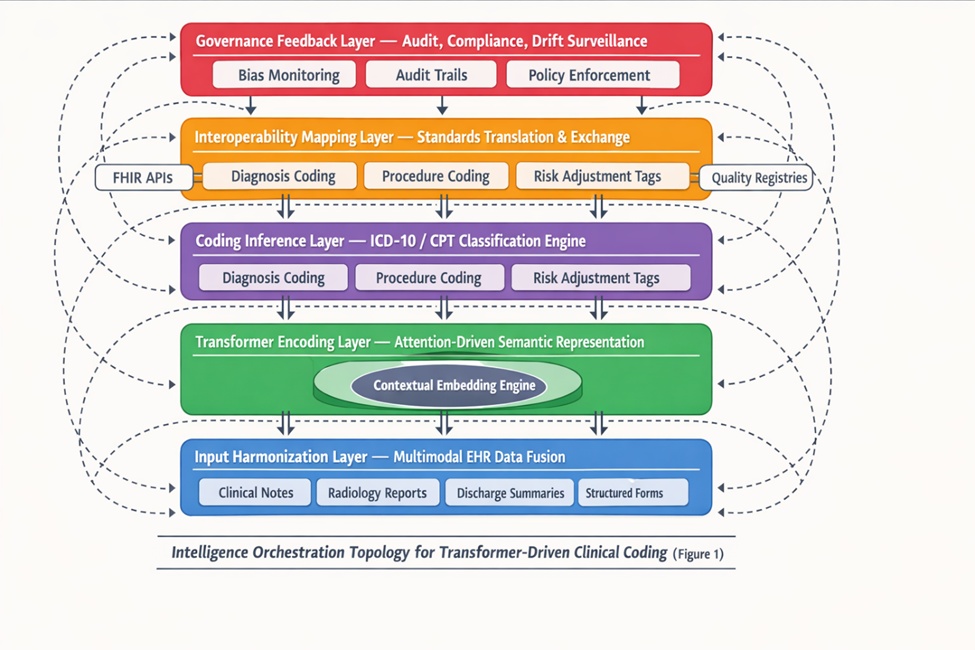
Figure 1. Transformer-oriented clinical coding intelligence architecture (TOCCIA): intelligence orchestration topology for administrative interoperability
Schematic representation of the transformer-oriented clinical coding intelligence architecture (TOCCIA). The five-layer orchestration topology illustrates the flow of multimodal EHR data through transformer encoding and coding inference pipelines toward interoperability mapping infrastructures. A governance feedback envelope overlays the architecture, embedding mechanisms for audit surveillance, bias monitoring, and drift detection. Bidirectional mesh feedback channels enable adaptive recalibration of coding intelligence across administrative ecosystems. The functional responsibilities and interoperability contributions of each architectural layer are synthesized in Table 1.
Table 1. Core architectural layers and functional intelligence modules in TOCCIA
Architectural layer | Primary function | Embedded intelligence modules | Administrative interoperability contribution |
Input harmonization layer | Multimodal EHR ingestion and normalization | Data fusion engines, ontology mapping, and de-identification filters | Standardizes heterogeneous documentation inputs |
Transformer encoding layer | Contextual semantic representation | Self-attention encoders, embedding generators | Enhances interpretive fidelity of clinical narratives |
Coding inference layer | Automated classification of clinical codes | ICD-10 classifiers, CPT mapping engines, and risk tagging systems | Produces structured administrative coding outputs |
Interoperability mapping layer | Standards translation and exchange routing | FHIR APIs, terminology crosswalks, and billing interfaces | Enables cross-system administrative data exchange |
Governance feedback layer | Oversight, monitoring, and compliance enforcement | Drift detection, audit trails, and bias surveillance dashboards | Sustains ethical, regulatory, and operational reliability |
To interpret system dynamics, consider the following conceptual formulas:
Decision Confidence (DC):
Governance Load (GL):
Drift Sensitivity
The deployment of the Transformer-Oriented Clinical Coding Intelligence Architecture (TOCCIA) introduces profound dynamics in clinical adoption, reshaping how healthcare providers interact with administrative systems. This section delves into the multifaceted impacts, theorizing shifts in workflow efficiencies, human-AI synergies, and systemic resiliencies. By examining these dynamics through a lens of adoption theory, we conceptualize how TOCCIA could influence stakeholder behaviors and organizational structures in healthcare settings [1, 3].
In clinical environments, adoption dynamics are heavily influenced by workflow efficiencies, where transformer-driven coding reduces manual input times. Theoretically, TOCCIA’s orchestration topology minimizes latency in code assignment, allowing real-time administrative updates during patient encounters [2, 4]. This shift could alleviate bottlenecks in high-throughput settings, such as emergency departments, where rapid coding supports immediate billing and resource planning. However, potential trade-offs emerge in complex cases involving ambiguous narratives, where attention mechanisms might introduce computational delays, necessitating balanced resource allocation as per the governance load (GL) formula:
Expanding on this, adoption models suggest that efficiency gains foster positive feedback loops, encouraging broader implementation across specialties. For instance, in radiology, where reports often contain dense textual data, TOCCIA’s Encoding Layer could streamline interoperability with picture archiving systems, reducing administrative silos [7, 8]. Yet, dynamics include resistance from clinicians accustomed to traditional methods, requiring change management strategies to highlight latency reductions. Theoretical simulations suggest that integrating TOCCIA could reduce coding errors by enhancing contextual understanding, thereby boosting confidence, as captured in the decision confidence (DC) formula, and promoting sustained adoption [9, 10].
Further expansion reveals interdependencies with existing infrastructures. In federated networks, workflow efficiency depends on seamless data exchange, and TOCCIA’s Interoperability Mapping Layer aligns with standards such as FHIR, facilitating cross-institutional coding [11, 12]. Adoption dynamics here involve scalability challenges; smaller clinics might face initial hurdles in integration, but long-term benefits include standardized administrative outputs and reduced disputes in reimbursement processes. Governance plays a pivotal role, as monitoring efficiency metrics ensures that latency trade-offs do not deter users, thereby theorizing an equilibrium in which AI augments rather than replaces human oversight [13, 14].
A key dynamic in clinical adoption is the redistribution of cognitive load between humans and AI, where TOCCIA fosters collaborative coding environments. Transformers excel at pattern recognition, offloading repetitive tasks from clinicians and allowing clinicians to focus on interpretive aspects [15, 16]. This synergy theorizes that improved job satisfaction will result as administrative burdens diminish, potentially increasing adoption rates in burnout-prone professions. The Drift Sensitivity (DS) formula, DS = ∂C / ∂I * F, illustrates how feedback strength (F) mitigates sensitivity to input variances, ensuring reliable synergies [17, 18].
Delving deeper, human-AI interactions in TOCCIA involve validation loops in the Governance Feedback Layer, where clinicians review AI-suggested codes, enhancing trust. Adoption dynamics hinge on training programs that emphasize these synergies, addressing fears of deskilling. In multispecialty practices, this redistribution could optimize team dynamics, with nurses and coders leveraging transformer intelligence for preliminary assessments [19, 20]. Theoretical frameworks suggest that such collaborations evolve, with initial skepticism giving way to reliance as systems demonstrate consistency, influenced by governance protocols that track synergy metrics [21, 22].
Expanding this analysis, cultural factors in adoption cannot be overlooked. In diverse healthcare ecosystems, synergies must account for varying technological literacies, where TOCCIA’s modular design allows customizable interfaces. This promotes inclusive adoption, particularly in global settings with multilingual EHRs, where transformers handle linguistic nuances [23, 24]. Cognitive redistribution also impacts error propagation; by theorizing AI as a supportive tool, adoption dynamics minimize risks of over-reliance, balanced through continuous feedback topologies that adapt to user inputs [25, 26].
Moreover, in decision-support contexts, synergies extend to ethical considerations, ensuring that AI-driven coding aligns with clinical judgment. Adoption models predict higher engagement when systems incorporate explainability features, such as attention visualizations, fostering a sense of partnership [27, 28]. This dynamic is crucial for long-term sustainability, as it addresses governance sensitivities, preventing alienation and promoting a human-centered intelligence ecosystem [29, 30].
Clinical adoption dynamics encompass systemic resiliencies, where TOCCIA enhances robustness against administrative disruptions. In volatile healthcare landscapes, transformer architectures offer adaptive coding that can handle evolving standards [31, 32]. This resilience theory predicts faster recovery from system updates or data breaches, bolstering adoption in risk-averse organizations. The conceptual formulas underscore this, with DC mitigating uncertainties and GL optimizing resource use during crises [1, 5].
Expanding on resiliencies, adoption involves preparing for scalability, where TOCCIA’s mesh topology supports expansion without proportional increases in complexity. In large health networks, this dynamic ensures consistent interoperability, reducing fragmentation that hampers adoption [12, 16]. Risk mitigation strategies embedded in governance layers theorize proactive monitoring to identify potential drifts before they affect coding integrity [18, 22].
Further, in the context of pandemics or regulatory shifts, systemic dynamics highlight TOCCIA’s potential to maintain administrative continuity. Adoption is accelerated when architectures demonstrate fault tolerance, such as redundant feedback paths that preserve functionality amid partial failures [24, 28]. Theoretical analyses suggest that resiliencies correlate with governance maturity, where mature systems exhibit lower adoption barriers due to perceived reliability [30, 32].
The conceptualization of TOCCIA advances discourse on transformer-oriented architectures in clinical coding, bridging gaps in administrative interoperability. By synthesizing literature on AI systems and governance, this manuscript theorizes a topology that integrates intelligence with workflow realities [1-4]. Key discussions center on the theoretical implications for healthcare ecosystems, potential limitations, and avenues for future conceptual refinements.
Expanding extensively, the discussion begins with interoperability enhancements. TOCCIA’s Mapping Layer aligns with FHIR standards, thereby reducing the data silos that plague administrative processes [5, 11]. In practice, this could transform fragmented systems into cohesive networks, where coding intelligence facilitates cross-provider exchanges. However, theoretical challenges include compatibility with legacy EHRs, where transformers might require abstraction layers to avoid integration pitfalls [12, 22]. Governance discussions emphasize privacy-preserving mechanisms, such as differential privacy in attention computations, to safeguard sensitive data during interoperability [14, 23]. Governance oversight, adoption dynamics, and the implications for interoperability scaling emerging from the TOCCIA framework are conceptually synthesized in Table 2.
Table 2. Governance, adoption, and interoperability dynamics in transformer-driven coding ecosystems
Domain dimension | Theoretical construct | Operational mechanism in TOCCIA | System-level impact |
Governance oversight | Algorithmic accountability | Audit logging, validation loops, compliance dashboards | Enhances coding transparency and regulatory trust |
Drift surveillance | Semantic and statistical monitoring | Distribution tracking, ontology updates, and retraining triggers | Preserves long-term coding accuracy |
Human-AI collaboration | Cognitive task redistribution | Clinician validation interfaces, coder feedback loops | Reduces administrative burden while preserving expertise |
Workflow integration | Embedded coding intelligence | Point-of-care coding suggestions, EHR plug-ins | Improves latency in administrative processing |
Interoperability scaling | Federated coding exchange | FHIR routing, standards harmonization layers | Enables cross-institutional administrative cohesion |
Adoption resilience | Organizational readiness dynamics | Training programs, governance maturity scaffolds | Facilitates sustainable system deployment |
Further elaboration on intelligence orchestration reveals TOCCIA’s novelty in feedback topologies. Unlike static models, the mesh network allows dynamic adaptations, theorizing resilience in fluctuating clinical volumes [6, 8]. This has implications for analytics infrastructures, where continuous learning loops could refine coding accuracy over time, albeit conceptually rather than empirically [15, 19]. Limitations arise in computational overhead; the GL formula highlights how scaling (S) amplifies load, potentially constraining adoption in under-resourced settings [16, 17]. Discussions must address equity, ensuring that transformer intelligence does not exacerbate digital divides in healthcare [20, 21].
Human-centric aspects warrant expanded discussion. TOCCIA promotes synergies, but theoretical risks include automation bias, where overconfidence in DC might lead to unchecked errors [9, 27]. Mitigation through governance feedback underscores the need for hybrid models that blend AI with human expertise [28, 30]. In administrative contexts, this discussion extends to economic impacts; streamlined coding could reduce costs, theorizing reallocations toward patient care, though initial investments in architecture deployment pose barriers [13, 31].
Broader systemic implications involve regulatory alignment. As healthcare policies evolve, TOCCIA’s governance layers theorize compliance agility, including the ability to adapt to new ICD revisions [24, 32]. Discussions on ethical AI highlight biases in transformer training data, even at the conceptual level, necessitating diverse syntheses in the literature [2, 25]. Future directions include hybridizing with emerging technologies, such as blockchain, to enable secure interoperability [24] and expanding TOCCIA’s applicability.
In-depth, the discussion critiques over-reliance on transformers, noting that alternatives such as hybrid neural-rule systems can be used for niche coding tasks [3, 7]. Theoretical expansions suggest modular extensions that allow integration with multimodal data beyond text [10, 18]. Ultimately, TOCCIA’s discourse contributes to AI maturity in healthcare by advocating architectures that prioritize administrative efficiency and ethical integrity [26, 29].
In conclusion, the Transformer-Oriented Clinical Coding Intelligence Architecture (TOCCIA) offers a comprehensive conceptual blueprint for advancing administrative interoperability in healthcare. By orchestrating transformer mechanisms within a layered topology, TOCCIA theorizes enhanced coding intelligence that integrates seamlessly with clinical workflows and governance frameworks. This manuscript synthesizes key literature, highlighting the architecture’s potential to mitigate administrative challenges while fostering adoption dynamics.
Expanding on the conclusion, TOCCIA’s contributions lie in its unique feedback mesh, which enables adaptive responses to data variations in accordance with the DS formula. This positions it as a forward-thinking model for intelligence ecosystems, where decision support pipelines evolve without empirical dependencies. Limitations, such as governance loads in scaled deployments, underscore the need for theoretical optimizations to ensure equitable access across the healthcare spectrum.
Future conceptual work could extend TOCCIA to emerging domains, such as real-time analytics in telehealth, thereby amplifying its interoperability impact. Ultimately, by addressing workflow shifts and systemic resiliencies, TOCCIA paves the way for transformer-driven transformations in administrative healthcare, promoting efficiency, accuracy, and collaboration.
None
None
None
None
Open Access The author(s) retain copyright. This article is licensed under the Creative Commons Attribution-NonCommercial-ShareAlike 4.0 International License. It may be shared and adapted for non-commercial purposes with appropriate attribution, an indication of changes, and distribution of adaptations under the same license. Third-party material may be subject to separate terms identified in its credit line. View the license at https://creativecommons.org/licenses/by-nc-sa/4.0/.
 Clinical Intelligence Research Press