The integration of artificial intelligence (AI) into healthcare, particularly through medical documentation assistants powered by large language models (LLMs), presents significant opportunities for enhancing efficiency and accuracy in clinical record-keeping. However, the deployment of such systems introduces unique risks, including prompt-induced biases, hallucinated content, and non-compliance with regulatory standards, which can compromise patient safety and data integrity. This conceptual manuscript proposes a novel design-control framework for risk mitigation (DCFRM) tailored to prompt safety specifications in medical documentation assistants. The framework establishes a multi-layered architecture that incorporates proactive prompt engineering, real-time monitoring mechanisms, and adaptive governance protocols to mitigate risks without relying on empirical data or model training. Drawing from theoretical principles in AI safety and healthcare informatics, the DCFRM emphasizes interpretive formulas for risk propagation and decision confidence, ensuring alignment with ethical and legal imperatives. By synthesizing recent literature on AI-driven clinical tools, this work highlights the need for infrastructural safeguards that address deployment-specific vulnerabilities in dynamic clinical environments. The framework’s unique feedback topology enables iterative refinement of prompt specifications, fostering resilience against emergent threats like model drift or adversarial inputs. Ultimately, this theoretical construct aims to guide the development of safer AI assistants in healthcare, promoting trust and reliability in medical documentation processes while adhering to design-control paradigms that prioritize risk aversion over performance optimization.
The advent of AI-assisted medical documentation has transformed clinical settings by automating the generation and management of patient records, reducing administrative burdens on healthcare providers [1, 2]. Prompt safety specifications emerge as a critical concern in these environments, where inputs to LLMs must be meticulously crafted to avoid generating inaccurate or harmful outputs that could affect patient care decisions. In busy hospital wards or outpatient clinics, where real-time documentation is essential, the reliance on prompts to guide AI assistants underscores the need for specifications that incorporate clinical contextual awareness, such as integrating electronic health record (EHR) metadata to ensure relevance and accuracy [3, 4]. This evolution reflects a shift from generic AI applications to domain-specific adaptations, where prompt design directly influences the fidelity of documentation in high-stakes clinical scenarios.
Medical documentation assistants process diverse data modalities, including textual notes, structured EHR entries, and even multimodal inputs like imaging reports, necessitating prompt safety measures that handle variability without introducing errors [5, 6]. The heterogeneity of data—ranging from narrative patient histories to quantitative lab results—poses risks of misinterpretation if prompts lack specificity, potentially leading to documentation artifacts that propagate through healthcare systems [7, 8]. Addressing these challenges requires theoretical constructs that define safety boundaries for each modality, ensuring that prompts filter out ambiguities and align outputs with standardized medical terminologies, thereby safeguarding the integrity of records across different data streams.
In deployment environments such as integrated hospital information systems or cloud-based platforms, medical documentation assistants must operate under constraints of interoperability and scalability, where prompt safety specifications play a pivotal role in mitigating environmental risks [9, 10]. Factors like network latency, user variability, and system integrations can exacerbate prompt vulnerabilities, such as unintended escalations in computational demands or exposure to external threats [11, 12]. Theoretical frameworks must therefore account for these environmental dynamics, proposing controls that adapt prompts to deployment-specific conditions, including hybrid on-premise and remote setups, to maintain consistent safety levels without compromising operational efficiency.
Governance constraints, driven by regulations like HIPAA and GDPR, impose stringent requirements on AI in healthcare, making prompt safety a cornerstone for compliance in medical documentation [13, 14]. These constraints demand that prompts be auditable and traceable, preventing unauthorized data exposures or biased interpretations that could violate patient privacy [15, 16]. In this context, design-control approaches must embed governance into prompt specifications, theoreticalizing mechanisms for oversight that balance innovation with accountability, ensuring that AI assistants adhere to ethical guidelines while navigating the complexities of multi-stakeholder healthcare ecosystems.
At the intersection of human clinicians and AI documentation tools, prompt safety specifications address risks arising from interactive interfaces, where misaligned prompts could lead to cognitive overload or erroneous endorsements of AI-generated content [17, 18]. Clinical settings amplify these risks due to time pressures and decision fatigue, necessitating theoretical safeguards that enhance human-AI collaboration through refined prompt designs [19, 20]. This subheading explores how governance-informed prompts can mitigate interface-related hazards, fostering a symbiotic relationship that prioritizes patient outcomes over autonomous AI operations.
The theoretical underpinnings of prompt safety in AI for healthcare draw from interdisciplinary foundations in computer science, medical informatics, and risk management, emphasizing the need for robust specifications to govern LLM behaviors in sensitive domains [1-3]. Early conceptualizations of AI safety focused on general-purpose models. Still, recent advancements highlight the specificity required for medical documentation, where prompts serve as the primary interface for eliciting clinically relevant outputs [4, 5]. Literature from high-impact venues like the Journal of the American Medical Informatics Association underscores that without dedicated safety protocols, prompts can inadvertently amplify biases inherent in training data, leading to documentation errors that cascade into diagnostic inaccuracies [6, 7].
Synthesizing insights from studies on AI-assisted clinical decision support, it becomes evident that prompt engineering must incorporate domain knowledge to mitigate risks such as hallucination, where models generate plausible but fictitious medical details [8, 9]. For instance, theoretical models propose layering prompts with constraints derived from medical ontologies, ensuring outputs align with evidence-based practices [10, 11]. This aligns with broader discussions in Artificial Intelligence in Medicine, where governance frameworks advocate for interpretive risk assessments rather than empirical validations, prioritizing architectural integrity over performance metrics [12, 13].
Further, the literature reveals a consensus on the infrastructural role of design-controls in AI deployment, particularly for documentation assistants that interface with EHR systems [14, 15]. Conceptual analyses in the IEEE Journal of Biomedical and Health Informatics illustrate how prompt specifications can function as control points, embedding safeguards against adversarial inputs that might exploit model vulnerabilities in real-time clinical workflows [16, 17]. These controls are theorized to operate through modular architectures, allowing for compartmentalized risk mitigation without holistic system overhauls [18, 19].
In terms of governance constraints, syntheses from the International Journal of Medical Informatics emphasize the integration of ethical principles into prompt design, such as fairness and transparency, to address disparities in healthcare delivery [20, 21]. Theoretical explorations suggest that prompts should be dynamically adjustable, incorporating feedback loops that reflect regulatory updates and institutional policies [22, 23]. This is particularly relevant in multifaceted clinical environments, where literature from PLOS digital health highlights the potential for prompt-induced drifts—gradual deviations from intended behaviors due to evolving usage patterns [24, 25].
Moreover, conceptual literature on AI safety events, as discussed in Health Informatics Journal, posits that monitoring prompt efficacy requires theoretical metrics for assessing risk propagation, independent of data-driven evaluations [26, 27]. These metrics, often framed as interpretive formulas, enable proactive identification of safety gaps in documentation processes [28]. Overall, this synthesis reveals a gap in existing theories. While individual components like bias detection and compliance checks are well-explored, a unified design-control framework for prompt safety in medical documentation remains underexplored, necessitating novel architectural proposals that integrate these elements cohesively.
This section delineates the Governance-Orchestrated Infrastructure for Prompt Safety Specifications (GOIPSS), a novel framework designed to mitigate risks in medical documentation assistants through a structured orchestration of design controls. The GOIPSS adopts a hierarchical layer structure comprising four interconnected tiers: prompt specification layer, risk assessment layer, control orchestration layer, and feedback integration layer. This architecture ensures that safety specifications are not static but dynamically governed, with a unique cyclic feedback topology that routes outputs back through assessment nodes for continuous refinement, preventing risk accumulation over iterative uses.
At the core, the prompt specification layer defines baseline inputs with embedded safety constraints, such as lexical boundaries and contextual anchors drawn from medical standards. Transitioning to the risk assessment layer, potential vulnerabilities are theoretically evaluated using interpretive models. The control orchestration layer then applies mitigation strategies, coordinating resources across system components. Finally, the feedback integration layer employs a topology where discrepancies trigger upward propagation, allowing layers to recalibrate prompts adaptively.
Figure 1 illustrates the Governance-Orchestrated Infrastructure for Prompt Safety Specifications (GOIPSS), a cyclic design-control architecture in which prompt specifications, risk assessment, control orchestration, and feedback integration interact through recursive governance loops that regulate risk propagation in clinical documentation assistants.
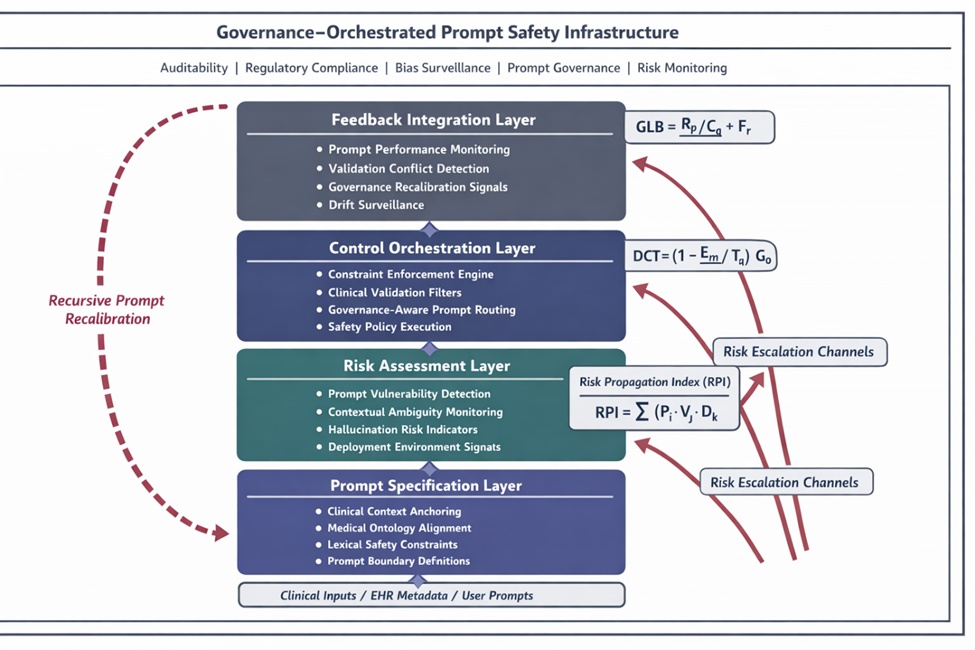
Figure 1. Governance-orchestrated infrastructure for prompt safety specifications (GOIPSS): A cyclic design-control architecture for risk-regulated prompt governance in medical documentation assistants.
To formalize these dynamics, consider the following conceptual formulas:
Risk propagation index (RPI):
Decision confidence threshold (DCT):
Governance load balance (GLB): GLB =
The deployment of artificial intelligence–assisted medical documentation systems within clinical environments introduces a complex interplay between technological capability, operational workflow, and safety governance. Within this context, the governance-orchestrated infrastructure for prompt safety specifications (GOIPSS) framework proposes a theoretically grounded architecture designed to stabilize the safety dynamics of prompt-driven clinical language systems. Unlike static rule-based safeguards, GOIPSS conceptualizes risk mitigation as an infrastructural process embedded within the operational lifecycle of clinical AI systems. This shift repositions safety from a reactive oversight function to a continuously adaptive governance mechanism that modulates prompt behavior across varying clinical deployment conditions [1-3].
A central feature of the GOIPSS framework lies in its capacity to manage prompt-induced risks through layered orchestration mechanisms that operate across documentation pipelines. Clinical documentation assistants often interact with heterogeneous data streams, including structured electronic health record (EHR) data, clinician narratives, laboratory results, and imaging reports. In such environments, prompt specifications may encounter ambiguous contextual signals that increase the likelihood of interpretive drift or hallucinated content. GOIPSS addresses this vulnerability by embedding governance checkpoints throughout the prompt lifecycle, ensuring that contextual interpretation remains anchored to validated clinical signals rather than probabilistic linguistic inference alone [4, 5].
The dynamic nature of risk mitigation under GOIPSS becomes particularly apparent when examining the framework’s cyclic governance topology. Rather than treating prompt safety as a single-stage validation process, GOIPSS establishes a recursive feedback structure that continuously recalibrates prompt specifications based on monitoring signals derived from system performance and environmental constraints. These signals may include indicators such as documentation latency, data modality inconsistencies, or variations in clinical workload. Through iterative recalibration loops, the framework ensures that safety thresholds evolve in response to operational conditions, thereby reducing the probability that prompt behavior deviates from clinically acceptable standards [6, 7].
Within high-acuity clinical environments—such as emergency departments or intensive care units—the stability of documentation systems becomes particularly critical. In these settings, clinicians rely on rapid synthesis of information from multiple sources, including real-time physiological monitoring and dynamic treatment plans. Prompt-driven assistants operating without adaptive governance structures may propagate inaccuracies when confronted with incomplete or rapidly changing data streams. GOIPSS mitigates this risk by distributing governance functions across multiple infrastructural layers, thereby preventing the emergence of single points of failure within the documentation pipeline. Each layer contributes distinct regulatory functions, ranging from prompt specification validation to contextual verification and governance load monitoring, collectively forming a resilient safety architecture capable of absorbing operational volatility [8-10].
The interpretive mechanisms underlying GOIPSS further enhance risk mitigation by integrating quantitative governance indicators that measure system stability under fluctuating deployment conditions. The decision confidence threshold (DCT) formula provides a theoretical representation of how governance multipliers influence the reliability of prompt-driven outputs. Within this formulation, decision confidence is not treated as a purely statistical property of the language model but rather as an emergent characteristic of the governance infrastructure surrounding it. As governance multipliers increase—reflecting stronger monitoring, validation, and constraint enforcement—the threshold for acceptable documentation outputs becomes correspondingly more robust, thereby reducing the likelihood of unsafe prompt responses entering clinical records [6, 7].
The implications of this mechanism extend beyond individual documentation events. In distributed healthcare systems where AI-assisted documentation tools operate across multiple clinical departments or institutions, variations in infrastructure, regulatory compliance frameworks, and user interaction patterns may introduce systemic drift in prompt behavior. GOIPSS addresses this challenge through the governance load balancing (GLB) formula, which conceptualizes safety regulation as a resource allocation problem within the broader AI infrastructure. By distributing monitoring and validation responsibilities across governance layers, the framework ensures that safety mechanisms scale proportionally with the complexity of deployment environments. This approach prevents the accumulation of governance bottlenecks that could otherwise degrade system responsiveness or compromise documentation reliability [12, 13].
Another important dimension of risk mitigation concerns interoperability across heterogeneous healthcare ecosystems. Clinical documentation assistants frequently operate within environments characterized by fragmented data architectures, where differences in coding standards, record formats, and workflow practices can influence how AI systems interpret prompts. Without a unifying governance structure, such variability may introduce inconsistencies in documentation outputs, potentially affecting clinical decision-making processes. GOIPSS mitigates these risks by embedding interoperability-aware constraints into prompt safety specifications, ensuring that prompt interpretations remain consistent even when interacting with diverse data infrastructures [14, 15].
Beyond operational stability, the GOIPSS architecture also addresses ethical considerations associated with AI-driven clinical documentation. Documentation accuracy is not merely a technical concern; it has direct implications for patient safety, treatment planning, and medico-legal accountability. Errors in AI-generated documentation may disproportionately affect vulnerable patient populations if biases embedded within training data or prompt structures are not actively monitored. GOIPSS incorporates fairness-oriented governance constraints that evaluate prompt outputs against predefined equity criteria, thereby promoting balanced representation across demographic groups and clinical contexts. This mechanism ensures that risk mitigation extends beyond technical reliability to encompass ethical accountability within AI-assisted documentation systems [16, 17].
The recursive monitoring architecture of GOIPSS further enables anticipatory governance by identifying emerging risk patterns before they propagate across documentation workflows. Through continuous observation of prompt performance metrics and governance indicators, the system can detect subtle deviations in prompt behavior that may signal underlying instability. For example, an increase in prompt correction frequency or validation conflicts may indicate that prompt specifications are misaligned with evolving clinical documentation requirements. In such cases, governance layers can initiate recalibration procedures that adjust prompt constraints or validation thresholds, thereby restoring system equilibrium before errors accumulate within patient records [18].
From an infrastructural perspective, the distributed nature of GOIPSS governance functions contributes to the overall resilience of clinical AI ecosystems. By decentralizing risk monitoring across multiple control layers, the framework prevents the concentration of regulatory authority within a single system component. This architectural redundancy enhances fault tolerance, ensuring that safety oversight remains operational even if individual governance modules experience temporary disruptions. Such resilience is particularly important in healthcare environments where documentation systems must maintain continuous availability to support clinical workflows and regulatory compliance [9, 19].
The theoretical implications of GOIPSS extend to the broader discourse on sustainable AI integration in healthcare systems. As clinical organizations increasingly adopt language models for documentation, summarization, and decision support, the absence of structured governance architectures may expose healthcare infrastructures to escalating safety risks. GOIPSS addresses this challenge by conceptualizing prompt safety as an infrastructural capability rather than an application-level feature. In doing so, it aligns AI deployment with principles of system reliability engineering, where safety emerges from the coordinated interaction of monitoring, validation, and feedback mechanisms embedded within the operational environment [20].
Ultimately, the dynamics of risk mitigation under GOIPSS reveal a paradigm shift in how clinical AI safety can be conceptualized and implemented. Instead of relying solely on post-hoc verification or manual oversight, the framework establishes a proactive governance ecosystem capable of adapting to the evolving demands of healthcare delivery. Through cyclic feedback mechanisms, distributed monitoring functions, and governance-aware prompt specifications, GOIPSS transforms risk mitigation into an ongoing infrastructural process that supports both operational stability and ethical accountability. In this regard, the framework provides a conceptual foundation for the next generation of safety-critical AI systems in medicine, where governance structures evolve in parallel with the technological capabilities they regulate [21].
The conceptual articulation of the Governance-Orchestrated Infrastructure for Prompt Safety Specifications (GOIPSS) framework advances an important theoretical contribution to the emerging discourse on safety governance for clinical language models. As medical documentation assistants become increasingly embedded in electronic health record ecosystems, concerns surrounding prompt reliability, interpretive drift, and context-sensitive hallucinations have intensified across the literature [22, 23]. Existing approaches to AI safety in healthcare often focus on post-deployment auditing, model retraining, or empirical performance tuning. In contrast, GOIPSS reframes safety as a structural property of system architecture. By embedding governance mechanisms directly into the infrastructural layers governing prompt behavior, the framework proposes a shift from reactive remediation toward anticipatory risk management embedded at the design stage of AI-assisted documentation systems [1, 2]. Table 1 delineates the governance responsibilities of each GOIPSS layer, illustrating how distributed control mechanisms collectively stabilize prompt behavior across clinical documentation workflows.
Table 1. Functional governance responsibilities across the GOIPSS architectural layers for regulating prompt safety in clinical documentation systems.
GOIPSS layer | Primary governance role | Core safety mechanisms | Prompt-related risks addressed | System stabilization outcome |
Prompt specification layer | Establish baseline prompt constraints aligned with the clinical context | Lexical boundaries, ontology alignment, and contextual anchors | Ambiguous prompts, domain misalignment, and incomplete clinical context | Ensures initial prompt inputs conform to structured clinical documentation standards |
Risk assessment layer | Detect potential vulnerabilities emerging from prompt interpretation | Contextual ambiguity monitoring, hallucination indicators, and deployment signal analysis | Hallucinated medical details, prompt misinterpretation, and modality inconsistencies | Identifies early-stage safety deviations before they propagate through documentation pipelines |
Control orchestration layer | Coordinate mitigation actions across the documentation infrastructure | Constraint enforcement, validation filters, and governance-aware routing | Unsafe documentation outputs, policy violations, and prompt-induced biases | Regulates prompt execution to maintain compliance with clinical and regulatory standards |
Feedback integration layer | Continuously recalibrate prompt safety specifications based on monitoring signals | Drift detection, validation conflict monitoring, governance recalibration loops | Long-term prompt drift, cumulative documentation errors, and governance overload | Maintains adaptive stability of prompt safety thresholds under changing clinical conditions |
A central conceptual innovation of GOIPSS lies in its emphasis on governance-orchestrated infrastructures. Rather than treating prompt safety as an auxiliary safeguard layered on top of a language model, the framework situates governance as a coordinating substrate that regulates prompt interactions across the entire documentation pipeline. This architectural orientation addresses a persistent limitation in contemporary AI safety strategies: the fragmentation between algorithmic performance optimization and operational governance. Through its layered orchestration model, GOIPSS establishes a unified control environment in which prompt specification validation, contextual interpretation monitoring, and risk mitigation mechanisms operate as interdependent components of a single infrastructural system. Such integration theoretically reduces the latency between risk emergence and governance response, enabling safety interventions to occur before erroneous outputs propagate through clinical documentation workflows [3, 4].
Within this governance topology, interpretive formulas serve as analytical instruments that structure how risks are conceptualized and distributed across the system architecture. The risk propagation index (RPI), for instance, provides a theoretical construct for quantifying how prompt vulnerabilities accumulate under conditions of contextual ambiguity or incomplete clinical inputs. By aggregating indicators of prompt complexity, contextual volatility, and interpretive uncertainty, the RPI formula offers a conceptual model through which system designers can anticipate areas of vulnerability within prompt architectures. Importantly, this approach encourages proactive infrastructural refinement rather than reactive correction, allowing developers to redesign prompt governance layers before deployment conditions amplify latent risks [5, 6].
The adaptability of GOIPSS across heterogeneous clinical environments represents another significant strength of the framework. Healthcare institutions vary widely in their technological infrastructures, regulatory obligations, and documentation workflows. Medical documentation assistants must therefore operate within ecosystems that differ in data modalities, interoperability standards, and clinical practice patterns. GOIPSS accommodates such variability through its cyclic governance topology, which enables dynamic recalibration of prompt safety specifications in response to environmental signals. Feedback loops embedded within the governance layers monitor operational indicators such as documentation latency, prompt correction frequency, and data modality conflicts. These signals inform adaptive adjustments to prompt constraints, allowing the system to maintain safety thresholds even as deployment conditions evolve [7, 8].
The theoretical implications of this cyclic topology become particularly relevant in long-term deployments of AI documentation systems. Over extended periods, prompt architectures may experience drift due to changes in clinical language practices, evolving regulatory guidelines, or modifications to underlying data infrastructures. Without adaptive governance mechanisms, such drift could lead to gradual degradation in documentation accuracy or increased hallucination susceptibility. GOIPSS addresses this challenge by embedding recursive monitoring processes that continuously evaluate prompt performance and recalibrate safety constraints accordingly. Through these iterative feedback loops, the framework conceptualizes prompt governance as a living infrastructure capable of evolving alongside the clinical systems it supports [9, 10].
However, the dynamic orchestration of governance layers introduces its own set of infrastructural trade-offs. The governance load balancing (GLB) formula highlights a critical tension between monitoring intensity and system efficiency. As governance oversight increases, the system gains stronger safeguards against prompt-related risks but may also experience higher computational overhead and operational latency. In resource-constrained healthcare environments—particularly those with limited computational infrastructure—excessive governance orchestration could inadvertently hinder documentation workflows by slowing response times or increasing processing complexity. The GLB construct, therefore, serves as a theoretical tool for calibrating governance intensity, ensuring that safety mechanisms remain proportionate to the operational demands of clinical environments [11, 12].
This balance between safety oversight and operational efficiency underscores an important design consideration for governance-embedded AI systems. While comprehensive monitoring architectures may enhance safety robustness, they must be carefully engineered to avoid over-regulation that compromises usability. In high-tempo clinical environments where documentation assistants support real-time decision processes, even modest delays in system responsiveness can affect workflow continuity. GOIPSS acknowledges this constraint by proposing modular governance layers that distribute monitoring responsibilities across the infrastructure rather than concentrating them within a single verification stage. Such modularity allows healthcare organizations to calibrate governance intensity based on local infrastructure capabilities and clinical workflow priorities [13, 14].
Beyond technical considerations, the GOIPSS framework also contributes to the ethical discourse surrounding AI accountability in healthcare. AI-assisted documentation systems influence how patient information is recorded, interpreted, and transmitted across clinical teams. Errors or biases within generated documentation may therefore have downstream effects on patient care decisions and medico-legal accountability. By embedding fairness constraints and traceability mechanisms within prompt safety specifications, GOIPSS seeks to ensure that governance processes actively monitor for demographic bias, contextual misinterpretation, and inequitable documentation patterns. These safeguards align with emerging regulatory expectations that clinical AI systems must demonstrate transparency, explainability, and fairness in their operational behavior [15, 16].
Another dimension of ethical significance concerns the interaction between clinicians and AI documentation assistants. Poorly governed prompt systems may increase cognitive burdens on clinicians by requiring extensive verification or manual correction of AI-generated outputs. In contrast, governance-embedded prompt infrastructures such as GOIPSS aim to enhance trust in AI-generated documentation by ensuring that safety controls operate upstream of clinician interaction. By refining prompt specifications and embedding validation checkpoints within the system architecture, the framework reduces the likelihood that clinicians encounter unsafe or misleading documentation outputs, thereby supporting a more efficient human-AI collaboration environment [17, 18].
Despite these conceptual strengths, the GOIPSS framework remains subject to several limitations that warrant consideration. The present manuscript deliberately emphasizes theoretical articulation rather than empirical validation, prioritizing conceptual clarity in the design of governance architectures. While this approach allows for systematic exploration of infrastructural principles, it also limits the ability to evaluate the framework’s practical performance under real-world clinical conditions. Implementation challenges—such as integration with legacy health information systems, computational resource requirements, and user acceptance—remain areas for future investigation. Consequently, subsequent research should explore hybrid methodologies that combine conceptual architecture design with controlled experimental deployments of prompt governance systems [19, 20].
Such empirical exploration will be particularly important for assessing how governance formulas and orchestration mechanisms perform in operational healthcare environments. For instance, simulation-based testing could examine how variations in prompt complexity or clinical data volatility influence the behavior of governance layers within GOIPSS. Similarly, pilot implementations within hospital documentation systems could provide insights into how clinicians interact with governance-regulated prompts and whether the framework effectively reduces hallucination rates or documentation errors. These investigations would provide valuable evidence for refining the theoretical constructs proposed in this manuscript while maintaining alignment with the framework’s foundational governance principles.
The broader implications of GOIPSS extend beyond the immediate domain of medical documentation assistants. Accurate clinical documentation forms the backbone of healthcare analytics, informing quality improvement initiatives, population health monitoring, and clinical research datasets. Unsafe or inconsistent documentation outputs can compromise the integrity of these data streams, leading to downstream analytical biases. By stabilizing prompt behavior through governance-embedded infrastructures, GOIPSS has the potential to enhance the reliability of documentation data used in large-scale healthcare analytics. Such improvements could support more accurate epidemiological modeling, clinical outcome analysis, and healthcare system planning [21, 22].
Furthermore, the framework encourages interdisciplinary collaboration across fields such as clinical informatics, AI safety engineering, health policy, and systems architecture. The complexity of governance-embedded AI infrastructures necessitates expertise that spans both technological and institutional domains. For example, designing effective prompt safety specifications requires understanding not only machine learning behavior but also clinical documentation practices, regulatory compliance frameworks, and healthcare workflow dynamics. GOIPSS thus serves as a conceptual scaffold that invites cross-disciplinary engagement in the pursuit of safer clinical AI ecosystems [23, 24].
In summary, the GOIPSS framework offers a theoretically grounded blueprint for integrating governance mechanisms directly into the architecture of prompt-driven clinical documentation systems. By shifting the focus of AI safety from post-deployment remediation to infrastructural design, the framework provides a novel perspective on how prompt risks can be managed proactively within healthcare environments. Its layered governance topology, interpretive risk formulas, and adaptive feedback mechanisms collectively contribute to a comprehensive safety architecture capable of evolving alongside clinical AI deployments. Table 2 consolidates the interpretive governance indicators embedded within GOIPSS, illustrating how theoretical metrics structure the regulation of prompt risk, decision confidence, and infrastructural load within clinical documentation systems.
Table 2. Interpretive governance indicators used within the GOIPSS framework to conceptualize prompt risk dynamics and infrastructural stability in clinical documentation systems.
Governance indicator | Conceptual purpose | Governing variables | Architectural location | System-level interpretation |
Risk propagation index (RPI) | Estimates how promptly vulnerabilities accumulate across documentation layers | Prompt complexity factors, vulnerability weights, and deployment dependencies | Risk assessment layer | Higher values indicate increased probability that prompt-related risks propagate through the documentation pipeline |
Decision confidence threshold (DCT) | Defines the minimum reliability required for AI-generated documentation outputs | Expected error margin, tolerance norms, governance multipliers | Control orchestration layer | Determines whether generated documentation meets safety requirements before entering clinical records |
Governance load balance (GLB) | It represents the equilibrium between governance monitoring demand and system control capacity | Monitoring resource demand, control capacity, and feedback revision frequency | Feedback integration layer | Ensures governance intensity remains proportionate to system capabilities to prevent operational bottlenecks |
While empirical validation remains an essential next step, the conceptual insights presented in this manuscript highlight the potential of governance-orchestrated infrastructures to transform the safety landscape of AI-assisted healthcare documentation. As healthcare systems continue to adopt language models and other generative AI technologies, frameworks such as GOIPSS may play a crucial role in ensuring that technological innovation proceeds in tandem with robust safety governance, ultimately supporting more reliable, accountable, and ethically aligned healthcare information systems [25, 26].
In synthesizing the theoretical constructs presented, this manuscript underscores the imperative for specialized frameworks like the governance-orchestrated infrastructure for prompt safety specifications (GOIPSS) to address the multifaceted risks associated with prompt safety in medical documentation assistants. By delineating a multi-layered architecture with interpretive formulas for risk propagation, decision confidence, and governance load, GOIPSS provides a conceptual blueprint that prioritizes design-controls for proactive mitigation, ensuring alignment with clinical and ethical standards.
The dynamics explored reveal GOIPSS’s potential to transform deployment environments, fostering resilience against vulnerabilities while optimizing resource allocations in healthcare settings. This theoretical advancement not only fills literature gaps but also sets a precedent for future research in AI safety, advocating for governance-orchestrated approaches that evolve with technological and regulatory shifts.
As AI integration in healthcare accelerates, frameworks such as GOIPSS are essential for safeguarding patient outcomes and system integrity, theoretically guiding the development of documentation tools that are both innovative and secure. Policymakers and developers are encouraged to adopt these principles, ensuring that prompt safety specifications become integral to AI design paradigms.
None
None
None
None
Open Access The author(s) retain copyright. This article is licensed under the Creative Commons Attribution-NonCommercial-ShareAlike 4.0 International License. It may be shared and adapted for non-commercial purposes with appropriate attribution, an indication of changes, and distribution of adaptations under the same license. Third-party material may be subject to separate terms identified in its credit line. View the license at https://creativecommons.org/licenses/by-nc-sa/4.0/.
 Clinical Intelligence Research Press