Patient-reported outcomes (PROs) represent a critical dimension in modern healthcare analytics, capturing subjective patient experiences through longitudinal self-reported signals. However, these signals are susceptible to drift—gradual shifts in data distribution, response patterns, or interpretative biases—that can undermine the reliability of AI-driven clinical decision support systems. This conceptual manuscript introduces a novel framework for assessing stability and bias in PROs within AI-integrated healthcare infrastructures. Drawing on theoretical principles from clinical AI governance and data interoperability models, we propose the longitudinal signal integrity network (LSIN), a multi-layered architecture designed to monitor, evaluate, and mitigate drift in self-reported data streams. LSIN incorporates adaptive monitoring nodes, bias quantification protocols, and feedback loops to ensure sustained signal fidelity across deployment lifecycles. Through a synthesis of recent literature on AI system architectures and healthcare analytics, we explore the theoretical implications of drift on clinical workflows, emphasizing interoperability challenges and governance requirements. Conceptual formulas are presented to interpret drift sensitivity, bias propagation, and assessment resource demands. This work advances conceptual understanding by outlining infrastructural strategies for robust PRO integration, fostering resilient AI ecosystems in healthcare without relying on empirical evaluations or performance metrics. Ultimately, LSIN provides a theoretical blueprint for enhancing the trustworthiness of longitudinal self-reported signals in clinical AI pipelines.
The integration of artificial intelligence (AI) into healthcare systems has transformed the landscape of patient care, particularly through the incorporation of patient-reported outcomes (PROs) as dynamic inputs for analytics and decision-making. PROs, encompassing self-reported symptoms, quality of life metrics, and functional status, serve as longitudinal signals that reflect real-time patient perspectives in clinical settings. However, these signals are inherently vulnerable to drift—subtle temporal shifts arising from evolving patient behaviors, environmental factors, or systemic biases—which can distort AI interpretations and compromise healthcare delivery. This manuscript conceptualizes a framework to address such instabilities, focusing on theoretical architectures for stability and bias assessment in AI-driven healthcare ecosystems. By examining the interplay between PRO drift and system reliability, we aim to delineate infrastructural safeguards that preserve signal integrity across interoperable platforms.
In ambulatory care settings, where patients engage in ongoing self-reporting via mobile apps or wearable devices, longitudinal PRO signals encounter unique drift pressures. These environments demand seamless integration with electronic health records (EHRs) and AI analytics pipelines, yet fluctuations in patient adherence or contextual reporting can introduce variability [1, 2]. For instance, seasonal changes in mood or activity levels may skew self-reported pain scales, leading to distributional shifts that challenge AI model assumptions. Theoretical models of clinical AI architectures highlight the need for adaptive interoperability frameworks to accommodate such dynamics, ensuring that PRO data remains actionable without empirical recalibration [3, 4]. Anchoring assessment to ambulatory workflows underscores the importance of real-time signal monitoring, where drift manifests as deviations from baseline patient profiles, potentially amplifying biases in underrepresented demographics.
PROs often intersect with multimodal data streams, including imaging, genomics, and sensor-derived metrics, within healthcare analytics infrastructures. Bias in these self-reported signals can propagate through AI decision support pipelines, exacerbated by inconsistencies in data modalities such as text-based surveys versus voice-recorded inputs [5, 6]. Longitudinal aspects intensify this, as repeated self-reports may evolve due to learning effects or fatigue, introducing systematic errors. Literature on AI governance emphasizes the role of bias mitigation strategies in multimodal contexts, advocating for theoretical constructs that evaluate signal stability without dataset dependencies [7, 8]. In deployment environments like telemedicine platforms, where PROs inform remote monitoring, bias assessment must account for modality-specific drift, such as cultural variations in symptom expression, to maintain equitable AI intelligence ecosystems.
Hospital settings impose stringent deployment constraints on PRO integration, where longitudinal signals must align with high-stakes decision-making under resource-limited conditions. Drift in these environments can stem from institutional protocols or patient cohort shifts, affecting the stability of AI-orchestrated workflows [9, 10]. Theoretical explorations of EHR intelligence ecosystems reveal that interoperability frameworks are essential for harmonizing PRO data with clinical records, yet governance gaps often overlook temporal biases [11, 12]. For example, post-discharge PRO tracking may exhibit drift due to varying access to reporting tools, necessitating conceptual architectures that prioritize signal fidelity. Addressing these constraints theoretically involves modeling feedback mechanisms to detect and interpret drift, ensuring AI systems remain robust amid evolving hospital dynamics.
Effective governance is paramount for sustaining PRO stability in AI healthcare systems, particularly under regulatory frameworks that mandate transparency and accountability. Longitudinal self-reported signals require oversight to prevent bias amplification, with governance models advocating for continuous monitoring infrastructures [13, 14]. Challenges arise in balancing patient privacy with data exchange needs, where drift assessment frameworks must incorporate ethical considerations without empirical validations [15, 16]. In clinical workflow integration, governance constraints like audit trails and explainability protocols help mitigate risks, fostering trust in AI deployments. This section synthesizes how governance anchors PRO assessment, emphasizing theoretical protocols for bias detection in longitudinal contexts.
Interoperability remains a core hurdle for PROs in AI healthcare, as self-reported signals must traverse diverse platforms while resisting drift-induced distortions. Theoretical data exchange frameworks highlight the need for standardized ontologies to facilitate seamless integration, yet biases from inconsistent formats persist [17, 18]. In environments spanning primary care to specialized units, longitudinal signals demand resilient architectures that theoretically model interoperability impacts on stability [19, 20]. Addressing these challenges conceptually involves envisioning modular systems that adapt to signal variations, ensuring AI analytics remain unbiased across ecosystems. Table 1 delineates a structured typology of PRO drift mechanisms, mapping instability sources to LSIN layers and governance sensitivity profiles across deployment contexts.
Table 1. Typology of drift mechanisms in longitudinal patient-reported outcomes across clinical deployment contexts
Drift domain | Mechanism type | Primary source of instability | Affected LSIN layer | Governance sensitivity | Theoretical risk trajectory |
Behavioral drift | Seasonal mood variation | Patient adherence fluctuations | Drift Detection | Moderate | Gradual DS accumulation |
Interpretive drift | Survey fatigue learning effect | Repeated scale exposure | Bias Quantification | High | Exponential BPR escalation |
Modality drift | Voice vs text reporting discrepancies | Input heterogeneity | Bias Quantification | High | Cross-modal amplification |
Institutional drift | Protocol changes in hospital workflows | Cohort shift | Acquisition + Detection | Moderate | Baseline displacement |
Access drift | Post-discharge reporting barriers | Technology inequality | Acquisition | High | Long-horizon bias entrenchment |
Cultural drift | Symptom expression variance | Sociocultural encoding | Bias Quantification | Very High | Persistent bias embedding |
The theoretical underpinnings of drift in patient-reported outcomes (PROs) within AI healthcare systems draw from a confluence of clinical AI architectures, analytics infrastructures, and governance models. This synthesis integrates recent scholarly contributions to elucidate the conceptual challenges and infrastructural responses to stability and bias in longitudinal self-reported signals. By weaving together insights from peer-reviewed works, we highlight theoretical constructs that inform framework development, focusing on architectural resilience, monitoring paradigms, and interoperability dynamics.
Central to this discourse is the recognition of PROs as pivotal components in AI-driven healthcare, where their longitudinal nature introduces inherent vulnerabilities to drift. Theoretical models emphasize that drift—manifesting as temporal shifts in data distributions or response biases—can erode the fidelity of self-reported signals, impacting clinical decision pipelines [1, 2]. For instance, architectures designed for embedding PROs in AI technologies advocate for heart-centered integration, theoretically aligning patient voices with algorithmic processes to mitigate interpretive discrepancies [1]. This aligns with broader critiques of explainable AI in healthcare, where false hopes in current approaches underscore the need for robust stability assessments to address opaque drift mechanisms [2].
Healthcare analytics infrastructures further complicate PRO handling, as they must accommodate dynamic signal streams amid evolving clinical workflows. Literature on reporting guidelines for AI interventions highlights the extension of standards to include drift considerations, ensuring theoretical transparency in how PRO biases are documented [3]. Similarly, algorithmic audits propose conceptual pathways for scrutinizing drift in medical AI, framing bias as a systemic issue requiring infrastructural oversight [4]. Bias mitigation strategies in AI models for medical applications theoretically outline challenges like data shift, advocating for open science approaches to counteract PRO instabilities [5, 6]. These works collectively theorize that analytics pipelines must incorporate drift detection layers to preserve signal integrity, particularly in longitudinal contexts where self-reports accumulate over time.
EHR intelligence ecosystems represent another theoretical pillar, where PRO integration demands seamless data orchestration. Minimum information standards for AI reporting theoretically guide the structuring of PRO-inclusive models, emphasizing conceptual completeness without empirical claims [8]. Governance models for AI applications in healthcare extend this by proposing theoretical frameworks for ethical deployment, including bias monitoring in self-reported data [9]. Implementation frameworks for end-to-end clinical AI derive conceptual tools like SALIENT, which theoretically map PRO drift across lifecycle stages [10]. Standards problems in AI further theorize the need for unified protocols to handle PRO variability, ensuring ecosystem coherence [11].
Decision support pipelines, reliant on PRO signals, are theoretically prone to calibration drift, as evidenced in models for acute conditions where theoretical updates correct for shifts [12, 13]. Performance drift in prediction algorithms during external events illustrates conceptual risks in PRO-dependent systems, advocating for theoretical resilience strategies [14]. Stable risk prediction methods against distribution shifts propose nonparametric approaches, theoretically adaptable to longitudinal PROs [15]. Lifelong learning methods eliminate the calibration drift conceptually, framing PRO stability as an ongoing architectural concern [16]. Assessments of data drift effects on sepsis prediction models theoretically quantify impacts on pipeline reliability [17].
AI governance, monitoring, and deployment systems provide theoretical scaffolds for PRO assessment. Distributed regulation approaches theorize collaborative oversight for clinical AI, including PRO bias governance [18]. Ideal algorithms in healthcare conceptualize attributes like dynamism and fairness, applying to PRO drift mitigation [19]. Quantitative evaluation tools for AI decision support theoretically appraise PRO-inclusive studies [20]. Vertical integration in AI development theorizes stacked architectures for PRO handling [21].
Interoperability and data exchange frameworks are crucial for PRO flow across systems. Ubiquitous monitoring frameworks based on machine learning theorize smart infrastructures for chronic condition tracking via PROs [22]. Predictive performance reviews of remote monitoring algorithms synthesize theoretical impacts on PRO stability [23]. Home monitoring with connected devices theorizes data-driven prediction models for conditions like asthma, incorporating PRO drift considerations [24].
Clinical workflow integration models round out the synthesis, theorizing how PROs embed in daily operations. Digital scribes conceptualize AI-assisted documentation to capture self-reports accurately [25]. Emerging from pandemic contexts, digital health theorizes adaptive workflows for PRO integration [26]. AI support for cancer management reviews theoretical data science roles in handling PRO biases [27]. Deep learning in medical vision, while modality-adjacent, informs theoretical extensions to PRO signal processing [28].
This synthesis reveals a theoretical consensus: PRO drift necessitates multifaceted architectural responses, blending governance with interoperability to foster bias-resilient systems. Gaps persist in unified frameworks for longitudinal assessment, setting the stage for novel conceptual innovations.
To address the conceptual challenges of drift in patient-reported outcomes (PROs), we propose the longitudinal signal integrity network (LSIN), a uniquely structured architecture for orchestrating stability and bias assessment in self-reported signals. LSIN comprises a four-layered topology: (1) signal acquisition layer, capturing raw PRO inputs with initial filtering; (2) drift detection layer, employing theoretical monitors for temporal shifts; (3) bias quantification layer, interpreting deviations through contextual mappings; and (4) integrity feedback layer, channeling assessments back to refine upstream processes. This layered structure ensures modular governance, with a recursive feedback topology where outputs from the bias quantification layer inform adaptive thresholds in the Drift Detection Layer, creating a closed-loop orchestration that theoretically sustains signal fidelity.
Central to LSIN is its emphasis on infrastructural resilience, theoretically mitigating PRO drift without empirical interventions. For instance, the architecture integrates interoperability nodes to harmonize self-reported signals across AI healthcare pipelines, theoretically reducing bias propagation.
To interpret LSIN’s operations, we introduce conceptual formulas. First, Drift Sensitivity (DS) is framed as
This architecture theoretically advances PRO assessment by providing a drift-focused orchestration model, integrable into clinical AI infrastructures. Figure 1 illustrates a real-world ambulatory monitoring workflow in which longitudinal patient-reported outcomes drift over time, are flagged by the clinical monitoring system, and undergo clinician review before being used in downstream decision support.
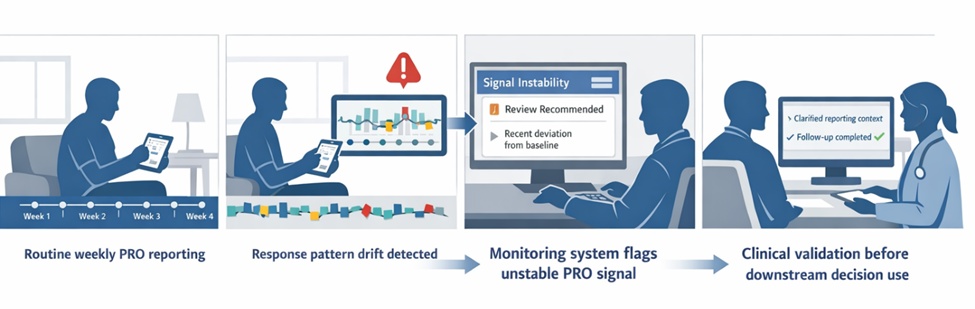
Figure 1. Clinical workflow for detecting drift in longitudinal patient-reported outcomes during remote symptom monitoring.
Figure 1 depicts a real-world ambulatory monitoring workflow in which a patient submits repeated patient-reported outcomes (PROs) through a digital platform over time. As instability emerges in the reporting pattern, the monitoring system identifies a potential drift signal within the longitudinal PRO stream and surfaces the case for clinician review. A care team member then evaluates the flagged inconsistency, clarifies contextual factors, and adjusts interpretation or follow-up before the self-reported signal is used in downstream decision support. The workflow operationalizes the manuscript’s longitudinal signal integrity network (LSIN) framework as a practical clinical process for preserving stability and reducing bias in AI-enabled PRO monitoring.
The longitudinal signal integrity network (LSIN) architecture, as conceptualized, extends beyond mere structural design to influence the broader dynamics of AI-integrated healthcare systems. This section analyzes the theoretical consequences of implementing such a framework, focusing on the impacts on clinical decision-making, resource orchestration, and bias propagation in longitudinal PRO environments. By theoretically modeling these dynamics, we illuminate how LSIN could reshape healthcare analytics infrastructures, emphasizing resilience against drift in self-reported signals.
In clinical decision support pipelines, the introduction of LSIN theoretically alters the flow of PRO data, introducing stability checks that mitigate the risks of erroneous interpretations. For instance, the feedback topology within LSIN enables a dynamic recalibration of decision confidence, where drift-detected signals are weighted differently in AI outputs [12, 13]. This impact manifests as enhanced precision in longitudinal assessments, such as chronic disease monitoring, where self-reported symptoms like fatigue or pain levels are prone to temporal biases. Theoretically, this reduces the propagation of errors in high-stakes settings, like oncology workflows, by integrating bias quantification into real-time analytics [27]. The consequence is a more robust ecosystem where PRO drift does not cascade into flawed treatment recommendations, fostering a theoretical shift toward proactive rather than reactive governance [18, 19].
Resource allocation within healthcare infrastructures also experiences theoretical transformations under LSIN. The architecture’s layered approach demands distributed monitoring nodes, which, while increasing initial governance load, optimize long-term efficiency through automated feedback loops [9, 10]. Conceptualizing this, the Assessment Resource Load (ARL) formula introduced earlier highlights how governance efficiency (E_g) moderates the burden: higher E_g values theoretically minimize overhead in resource-constrained environments like rural clinics [22, 23]. Impacts extend to interoperability frameworks, where LSIN’s modular design facilitates seamless data exchange, reducing fragmentation in EHR systems and theoretically lowering integration costs [17, 20]. In deployment scenarios, this dynamic could alleviate monitoring burdens in large-scale AI ecosystems, allowing for scalable PRO assessments without overwhelming clinical workflows [25, 26].
Bias propagation dynamics represent a core impact area, where LSIN’s quantification layer theoretically interrupts cycles of amplification in underrepresented patient groups. Longitudinal self-reported signals often carry implicit biases from socioeconomic or cultural factors, which, if they drift over time, can exacerbate [5, 6]. LSIN’s recursive topology models this through the Bias Propagation Risk (BPR) formula, illustrating exponential growth if unaddressed (e^{k * τ}) [14, 15]. The framework’s consequence is a theoretical dampening effect, where early detection nodes flag deviations, promoting equitable AI outcomes in diverse clinical settings [7, 8]. This impact is particularly pronounced in multimodal data modalities, such as combining PROs with imaging, where stability orchestration prevents cross-modal biases from distorting analytics [28].
Furthermore, the systemic dynamics of LSIN influence AI governance paradigms, theoretically elevating the role of continuous monitoring in regulatory compliance. By embedding drift sensitivity assessments, the architecture aligns with theoretical standards for algorithmic audits, ensuring that PRO biases are transparently managed across lifecycles [3, 4]. Impacts on clinical workflow integration include streamlined PRO incorporation, where feedback loops adapt to environmental shifts, such as pandemic-induced reporting changes [26]. Theoretically, this fosters a resilient infrastructure, where drift implications are not siloed but holistically addressed, enhancing overall system trustworthiness [1, 2].
Exploring further, the theoretical ripple effects on decision confidence can be modeled interpretively. Consider a supplemental formula for decision confidence erosion (DCE):
Governance load dynamics also warrant analysis, as LSIN’s orchestration may initially amplify oversight needs but yield efficiencies through automated protocols. A conceptual governance load index
Overall, these dynamics illustrate LSIN’s theoretical potential to transform AI healthcare by addressing PRO drift at its core, with cascading impacts on equity, efficiency, and efficacy.
The conceptualization of the longitudinal signal integrity network (LSIN) within this manuscript offers a theoretical lens through which to examine the persistent challenges of drift in patient-reported outcomes (PROs). By synthesizing architectural, governance, and interoperability principles, LSIN emerges as a novel framework that theoretically fortifies AI healthcare systems against the subtleties of longitudinal signal instabilities. This discussion delves into the broader implications of such an approach, critiquing its alignment with existing literature while highlighting avenues for theoretical refinement.
A key strength of LSIN lies in its multi-layered topology, which theoretically addresses gaps in current clinical AI architectures. Traditional models often overlook the temporal dimensions of PROs, leading to unchecked biases that undermine analytics reliability [2, 5]. LSIN’s drift detection and bias quantification layers provide a conceptual countermeasure, aligning with calls for algorithmic audits and minimum reporting standards [3, 4, 8]. However, this raises questions about scalability: in resource-limited settings, the recursive feedback topology might theoretically strain interoperability frameworks, necessitating further modeling of integration trade-offs [17, 20]. Comparatively, lifelong learning approaches in prediction models offer parallels, yet LSIN extends these by focusing exclusively on self-reported signals, theoretically enhancing specificity in PRO-centric pipelines [16]. Table 2 consolidates the theoretical stability control indices underpinning LSIN, linking mathematical constructs to architectural anchoring and governance implications.
Table 2. Theoretical stability control indices in LSIN and their systemic interpretation
Index | Formal expression | Architectural layer anchoring | Interpreted system behavior | Governance implication | Failure scenario if unmitigated |
Drift sensitivity (DS) | Drift Detection | Accumulated deviation pressure | Early-warning threshold calibration | Latent instability undetected | |
Bias propagation risk (BPR) | Bias Quantification | Exponential bias amplification | Demographic equity monitoring | Amplified inequity in decision support | |
Assessment resource load (ARL) | Integrity Feedback | Monitoring burden scaling | Governance efficiency balancing | Oversight saturation | |
Decision confidence erosion (DCE) | Cross-layer | Cumulative stability erosion | Confidence-weight modulation | Erroneous treatment recommendations | |
Governance load index (GLI) | Governance Envelope | Oversight-task accumulation | Resource allocation modeling | Institutional fatigue |
Bias assessment within LSIN also invites discussion on equity in AI healthcare. The framework’s emphasis on contextual mappings theoretically mitigates propagation risks, as captured in the BPR formula, resonating with open science advocacy for addressing big data biases [6]. Yet, theoretical limitations persist; for instance, cultural variances in self-reporting may elude standardized quantification, suggesting the need for adaptive governance extensions [7, 18]. In multimodal contexts, LSIN’s orchestration could theoretically harmonize PROs with other data streams, but this assumes flawless data exchange—an assumption challenged by standards problems in EHR ecosystems [11]. Future conceptual iterations might incorporate hybrid modalities, drawing from deep learning visions to enrich signal processing [28].
Governance and deployment dynamics further enrich the discussion. LSIN’s integrity feedback layer theoretically embodies ideal algorithm attributes like dynamism and fairness [19], supporting distributed regulation models in clinical AI [18]. This is particularly relevant for longitudinal monitoring in chronic conditions, where drift sensitivity (DS formula) could theoretically predict adherence drops [22, 23]. Critically, however, the architecture’s resource demands, as per ARL, highlight potential inequities in global healthcare access, where advanced infrastructures may favor well-resourced institutions [9,10]. Theoretical countermeasures could involve lightweight variants of LSIN, optimized for mobile PRO platforms in ambulatory care [1, 24].
Workflow integration represents another discursive focal point. LSIN theoretically streamlines PRO embedding in decision support, echoing digital scribe concepts for accurate capture [25]. Amid emerging digital health paradigms post-pandemic, the framework’s stability focus could theoretically bolster resilience in volatile environments [26]. Yet, challenges in calibration drift correction underscore the need for nonparametric updates, which LSIN could theoretically incorporate via its detection layer [12, 13]. In cancer management, for example, PRO drift assessments might theoretically refine AI support, preventing bias in treatment analytics [27].
Theoretical formulas within LSIN—DS, BPR, ARL, and extensions like DCE and GLI—serve as interpretive tools, facilitating abstract reasoning on system behaviors without empirical crutches. These constructs invite critique: while they model abstract risks, their parameters (e.g., k in BPR) require theoretical grounding in domain-specific constants, potentially limiting generalizability [14, 15]. Nonetheless, they advance conceptual discourse by quantifying intangible dynamics, aligning with quantitative evaluation tools for AI studies [20].
Vertical integration in AI development offers a comparative lens, where LSIN’s stacked layers mirror end-to-end frameworks, theoretically accelerating PRO deployment [21]. However, the absence of empirical benchmarks in this work, per conceptual constraints, positions LSIN as a blueprint for future theoretical explorations rather than a deployable artifact. This invites interdisciplinary dialogue, bridging informatics with ethics to refine bias protocols [5].
In sum, LSIN theoretically bridges critical gaps in PRO stability, but its impacts demand ongoing conceptual scrutiny. Fostering resilient AI ecosystems paves the way for unbiased, stable longitudinal signals, ultimately enhancing patient-centered healthcare.
This conceptual manuscript has delineated the challenges of drift in patient-reported outcomes (PROs), proposing the longitudinal signal integrity network (LSIN) as a theoretical framework for stability and bias assessment in longitudinal self-reported signals. Through a layered architecture with recursive feedback, LSIN theoretically orchestrates signal integrity within AI healthcare infrastructures, addressing governance, interoperability, and workflow dynamics.
Key insights from the theoretical background underscore the vulnerability of PROs to temporal shifts, with literature synthesis revealing the need for robust monitoring paradigms. LSIN’s design—encompassing acquisition, detection, quantification, and feedback layers—offers a unique topology to mitigate these, supported by interpretive formulas that model drift sensitivity, bias propagation, and resource loads.
The analyzed dynamics highlight transformative impacts on clinical ecosystems, from enhanced decision confidence to optimized governance, while the discussion critiques limitations and suggests refinements. Ultimately, LSIN provides a conceptual foundation for advancing AI reliability in healthcare, emphasizing the imperative of drift-resilient systems for equitable, patient-centric analytics.
Future theoretical work could extend LSIN to emerging modalities, ensuring sustained innovation in clinical AI. By prioritizing signal fidelity, this framework theoretically empowers healthcare systems to harness PROs with unwavering trustworthiness.
None
None
None
None
Open Access The author(s) retain copyright. This article is licensed under the Creative Commons Attribution-NonCommercial-ShareAlike 4.0 International License. It may be shared and adapted for non-commercial purposes with appropriate attribution, an indication of changes, and distribution of adaptations under the same license. Third-party material may be subject to separate terms identified in its credit line. View the license at https://creativecommons.org/licenses/by-nc-sa/4.0/.
 Clinical Intelligence Research Press