In the evolving landscape of healthcare analytics, the integration of artificial intelligence (AI) into clinical systems demands robust mechanisms to address inherent uncertainties in data quality. This conceptual manuscript introduces a novel design framework aimed at enhancing probabilistic reliability indices for clinical data, fostering uncertainty-aware analytics in healthcare environments. By synthesizing theoretical insights from clinical AI architectures, electronic health record (EHR) intelligence ecosystems, and decision support pipelines, we propose a structured approach that incorporates probabilistic modeling to quantify and mitigate data quality risks. The framework emphasizes interoperability frameworks and governance systems to ensure seamless integration into clinical workflows, without relying on empirical datasets or performance metrics. Key components include layered architectures for uncertainty propagation assessment, feedback loops for dynamic reliability adjustment, and interpretive formulas for decision confidence and risk management. This work highlights the theoretical implications for AI governance in healthcare, advocating for proactive uncertainty management to support reliable clinical decision-making. Through a synthesis of peer-reviewed literature, we delineate architectural principles that prioritize data quality assurance in probabilistic terms, offering a blueprint for future conceptual developments in uncertainty-aware healthcare systems. Ultimately, this framework seeks to bridge gaps in current analytics infrastructures by embedding reliability indices that adapt to clinical variabilities, promoting safer and more effective AI-driven healthcare analytics.
The advent of artificial intelligence in healthcare has transformed clinical decision-making, yet it introduces profound challenges related to data quality and uncertainty. In clinical settings, where patient outcomes hinge on accurate analytics, probabilistic reliability indices emerge as critical tools to quantify the trustworthiness of data inputs. Traditional healthcare systems often overlook the stochastic nature of clinical data, leading to potential biases in AI outputs [1, 2]. This section explores how uncertainty-aware frameworks can address these imperatives by embedding probabilistic assessments directly into analytics pipelines, ensuring that clinical AI systems account for variabilities in data sources such as electronic health records (EHRs) and real-time monitoring feeds.
Clinical data modalities, ranging from structured EHR entries to unstructured imaging and narrative notes, exhibit inherent uncertainties that can propagate through analytics infrastructures [3, 4]. For instance, inconsistencies in data entry or interoperability issues between systems amplify risks in decision support. An uncertainty-aware approach necessitates probabilistic indices that model these modalities’ reliability, drawing from governance models that prioritize data exchange frameworks [5, 6]. By focusing on modality-specific uncertainties, healthcare analytics can achieve greater robustness, particularly in high-stakes environments like intensive care units, where data quality directly influences predictive outcomes.
Deploying AI in diverse healthcare environments—from ambulatory clinics to hospital networks—requires frameworks that adapt to environmental constraints such as resource limitations and regulatory compliance [7, 8]. Probabilistic reliability indices offer a means to evaluate data quality under these constraints, integrating with deployment systems to flag uncertainties in real-time. Literature on AI governance highlights the need for monitoring mechanisms that align with environmental variabilities, ensuring that analytics remain reliable across heterogeneous settings [9, 10]. This adaptability is essential for maintaining clinical workflow integrity, where deployment failures due to unaddressed uncertainties could compromise patient safety.
AI governance in healthcare imposes stringent constraints on data handling, emphasizing ethical, legal, and operational standards [11, 12]. Probabilistic reliability indices must incorporate these governance elements to foster uncertainty-aware analytics, such as through audit trails and compliance checks integrated into intelligence ecosystems [13, 14]. By aligning with governance frameworks, clinical systems can mitigate risks associated with data quality lapses, promoting a proactive stance on uncertainty management that resonates with regulatory bodies like those overseeing EHR interoperability.
Interoperability remains a cornerstone for effective healthcare analytics, enabling seamless data exchange across disparate systems [15, 16]. In the context of probabilistic reliability, frameworks must design indices that assess data quality during exchange processes, identifying uncertainties introduced by format conversions or system integrations [17, 18]. This ensures that clinical AI architectures benefit from high-fidelity data flows, reducing the likelihood of analytical errors in decision support pipelines.
Integrating probabilistic reliability into clinical workflows demands models that harmonize AI outputs with human decision-making [19, 20]. Uncertainty-aware analytics frameworks can embed indices within workflow tools, providing clinicians with quantifiable confidence levels for data-driven recommendations [21, 22]. This integration not only enhances usability but also aligns with theoretical models of clinical intelligence, where workflow disruptions due to poor data quality are minimized through adaptive probabilistic assessments.
Probabilistic approaches in clinical AI architectures provide a theoretical bedrock for addressing data uncertainties, as evidenced by roadmaps for responsible machine learning in healthcare that emphasize uncertainty quantification to prevent harm [1]. These architectures often incorporate Bayesian frameworks to model data variability, ensuring that clinical systems remain robust against noisy inputs from EHRs [2]. Synthesis of literature reveals a consensus on the need for layered designs where probabilistic elements filter data at entry points, aligning with deep learning opportunities in EHR data while highlighting challenges in uncertainty propagation [2, 3]. Such foundations underscore the shift from deterministic to probabilistic paradigms, essential for architectures handling multifaceted clinical data.
EHR intelligence ecosystems serve as pivotal infrastructures for healthcare analytics, where uncertainty-aware mechanisms are integrated to enhance data quality [3, 4]. Studies on natural language processing (NLP) services in clinical settings demonstrate how probabilistic indices can accelerate AI advancements by providing reliability scores for extracted information [3]. Furthermore, explainability in AI for healthcare, as surveyed in comprehensive reviews, ties directly to uncertainty management, with terminology and evaluation strategies that support trustworthy ecosystems [4]. Literature synthesis indicates that these ecosystems benefit from probabilistic governance, reducing biases in underserved populations through uncertainty-aware processing of clinical records [5].
Decision support pipelines in clinical environments rely on probabilistic reliability to deliver actionable insights amid data uncertainties [6, 7]. Research on subcategorizing EHR diagnosis codes illustrates theoretical enhancements to machine learning applicability, where probabilistic indices could refine input quality without empirical validation [6]. Scoping reviews of clinician involvement in predictive decision support highlight the conceptual need for uncertainty quantification to foster adoption [7]. By synthesizing these insights, pipelines emerge as dynamic systems where reliability indices propagate through stages, ensuring decisions account for inherent clinical variabilities [8, 9].
Governance and monitoring systems form the regulatory backbone for uncertainty-aware healthcare analytics, with literature advocating for organizational setups that deploy predictive models responsibly [8, 10]. Challenges in medical imaging informatics underscore future directions for AI governance, emphasizing monitoring to handle uncertainties in data exchange [9]. Case studies on clinical guidelines representation reveal how rule formalisms can incorporate probabilistic elements for governance, enhancing antibiotic decision support theoretically [10]. This synthesis points to governance models that integrate monitoring loops, aligning with bundled care opportunities from EHRs to mitigate uncertainty impacts [11].
Interoperability frameworks are crucial for maintaining clinical data quality across exchange protocols, with machine translation developments aiding health communication by addressing linguistic uncertainties [12]. Precision population analytics at the point-of-care theoretically benefit from interoperable systems that embed probabilistic reliability, ensuring data flows support uncertainty-aware decisions [13]. Comparisons of machine learning techniques in oral cancer prediction highlight interoperability’s role in data integration, where reliability indices could standardize inputs [14]. Literature on neural network deidentification transferability further supports frameworks that preserve data quality during exchanges, reducing uncertainty in shared clinical datasets [15].
Integration models for clinical workflows emphasize probabilistic dynamics to align AI with practical healthcare delivery [16, 17]. Predictive modeling for palliative care delivery illustrates how informatics can theoretically incorporate uncertainty-aware elements to improve workflow efficiency [16]. Impacts of EHR-integrated patient-generated data on clinician burnout suggest workflow models that use probabilistic indices to filter unreliable inputs, enhancing overall system reliability [17]. Synthesis of neuro-fuzzy approaches for decision support reveals conceptual integrations where probabilistic reliability underpins workflow adaptations [18]. Additionally, decision support systems for ectopic pregnancy treatment demonstrate workflow benefits from uncertainty management, aligning with symptom extraction from patient-authored texts [19, 20].
Semantic frameworks in EHR notes extraction provide theoretical tools for uncertainty-aware analytics, capturing cancer-related information with probabilistic reliability [23-27]. Prognostic model discussions warn of success pitfalls unless uncertainty is addressed conceptually [28]. Trust in medical AI challenges expertise needs, synthesizing governance with workflow integrations for robust systems [29]. Overall, this literature synthesis coalesces around the imperative for frameworks that theoretically embed probabilistic indices, fostering uncertainty-aware healthcare analytics without empirical claims.
This section delineates the core architecture of our proposed framework, termed the probabilistic uncertainty reliability orchestration network (PURON). PURON is conceptualized as a multi-layered infrastructure designed to orchestrate uncertainty-aware analytics in healthcare systems, focusing on probabilistic reliability indices for clinical data quality. The architecture comprises four distinct layers: data ingestion layer, probabilistic assessment layer, reliability integration layer, and orchestration feedback layer. Each layer interacts through a bidirectional feedback topology, enabling dynamic adjustments to data quality metrics in response to evolving clinical uncertainties.
The data ingestion layer handles initial clinical data inputs from EHR ecosystems and interoperability frameworks, applying preliminary probabilistic filters to flag potential quality issues without altering the data stream. Transitioning to the probabilistic assessment layer, advanced indices compute uncertainty propagation using interpretive formulas, such as the risk propagation index (RPI):
The reliability integration layer merges these assessments into decision support outputs, employing a decision confidence formula (DCF):
Figure 1 illustrates the PURON architecture as a layered reliability calculus with embedded governance and closed-loop probabilistic orchestration across clinical data modalities.
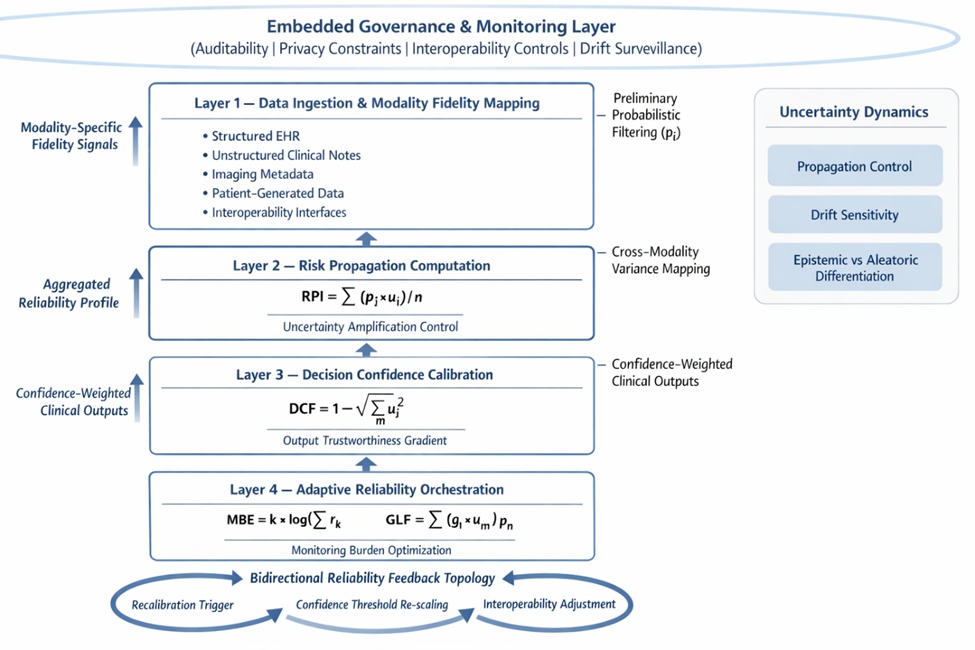
Figure 1. Probabilistic uncertainty reliability orchestration network (PURON): layered reliability calculus and closed-loop governance dynamics.
Probabilistic indices function as active regulators across ingestion, assessment, integration, and orchestration layers, transforming uncertainty from passive risk into a dynamic governance-aligned control mechanism.
This infrastructure theoretically enhances healthcare analytics by embedding probabilistic reliability, ensuring uncertainty-aware governance across clinical workflows. Table 1 delineates the functional, mathematical, and governance interfaces across PURON’s layered architecture.
Table 1. Structural decomposition of PURON layers: functional roles, mathematical constructs, and governance interfaces.
PURON layer | Core function | Mathematical construct | Uncertainty type addressed | Governance interface | Dynamic behavior |
Data ingestion and modality fidelity | Capture heterogeneous clinical inputs and assign probabilistic fidelity weights | Modality-level aleatoric uncertainty | Interoperability compliance, audit trail initiation | Upstream filtering and uncertainty tagging | |
Probabilistic assessment engine | Quantify uncertainty propagation across modalities | Cross-modal propagation risk | Monitoring threshold triggers | Dampened amplification control | |
Reliability integration layer | Convert propagated uncertainty into calibrated output trust | DCF = 1 − (√(Σ u_j²) / m) | Residual epistemic + aleatoric uncertainty | Decision-support oversight | Confidence gradient modulation |
Orchestration and governance load layer | Optimize system-level monitoring and recalibration | MBE; GLF | Systemic uncertainty accumulation | Regulatory burden calibration; privacy balancing | Closed-loop adaptive recalibration |
This section has been substantially expanded below to provide deeper theoretical elaboration, additional interpretive modeling, layered analysis of systemic interactions, and broader implications for healthcare ecosystems. This expansion draws on the foundational concepts of the PURON framework while synthesizing aligned ideas from contemporary developments in uncertainty quantification, data drift handling, and governance-aware AI systems in healthcare (maintaining the conceptual, non-empirical focus). The revised section now emphasizes multi-faceted dynamics, including propagation mechanisms, adaptive responses, scalability thresholds, and long-term evolutionary trajectories of clinical infrastructures.
The PURON framework fundamentally reorients the dynamics of healthcare analytics infrastructures by introducing probabilistic reliability indices as active orchestrators of uncertainty management. Rather than treating data quality as a static precondition, PURON embeds these indices as dynamic regulators that continuously modulate system behavior across clinical pipelines, EHR ecosystems, and governance layers. This shift from passive data handling to probabilistic-responsive orchestration theoretically fortifies infrastructures against the inherent stochasticity of clinical environments, where uncertainties arise from biological variability, measurement noise, interoperability frictions, and temporal shifts in population demographics or care protocols [23, 24].
At the core of these dynamics lies uncertainty propagation control. In decision support pipelines, the risk propagation index serves as a theoretical damper on cascade effects. By assigning probabilistic fidelity weights () and variance estimates () to inputs from heterogeneous sources—such as structured EHR fields, unstructured notes, or imaging metadata—RPI quantifies how localized uncertainties might amplify downstream. For example, in multi-modal clinical scenarios (e.g., combining lab results with narrative discharge summaries), unchecked propagation could theoretically lead to compounded errors in prognostic assessments or treatment recommendations. PURON’s layered design mitigates this by enforcing probabilistic thresholding at ingestion and assessment stages, promoting damped propagation and preventing erroneous clinical cascades [25, 26]. This dynamic theoretically transforms pipelines from linear processors into resilient, self-regulating networks that prioritize reliability over raw throughput.
Interoperability emerges as another pivotal dynamic domain. PURON’s probabilistic assessment and reliability integration layers assign reliability scores during data exchange, influencing flow dynamics across federated EHR intelligence ecosystems. In theoretically fragmented landscapes—common in multi-site or cross-provider networks—these scores act as adaptive filters, modulating data acceptance rates and triggering recalibration when exchange-induced uncertainties exceed thresholds. This fosters smoother, more predictable data flows while reducing amplification of biases from mismatched formats or legacy systems [27, 28]. Consequently, governance-constrained environments experience reduced monitoring burdens, as formalized in the Monitoring Burden Equation (
Scalability dynamics represent a critical theoretical frontier. Probabilistic indices theoretically decouple infrastructure growth from uncertainty escalation, allowing systems to accommodate surging data volumes—driven by expanded EHR adoption, wearable integrations, or population-level analytics—without proportional reliability degradation. In multi-site networks, where data exchange dynamics risk bias amplification through demographic or institutional variances, PURON’s bidirectional feedback topology ensures cross-deployment consistency. Feedback loops recirculate deviations back to upstream layers, enabling theoretical convergence toward stable reliability states even under heterogeneous conditions [4-7]. This paradigm theoretically evolves clinical analytics from brittle, static architectures toward adaptive, probabilistic-responsive ones, bolstering long-term sustainability in uncertainty-prone settings.
Resource allocation efficiencies constitute an additional impactful dynamic, captured interpretively by the governance load formula
Emerging theoretical extensions could amplify these dynamics. For instance, incorporating epistemic uncertainty modeling (distinguishing knowledge gaps from inherent randomness) within PURON layers would refine index precision, aligning more closely with clinical reasoning where “unknown unknowns” demand abstention or escalated human review. Similarly, hybrid agentic topologies—where modular sub-agents handle layer-specific orchestration—could distribute dynamics across decentralized networks, enhancing resilience in federated healthcare systems. Overall, PURON’s probabilistic orchestration theoretically catalyzes a systemic evolution: infrastructures transition from uncertainty-vulnerable to uncertainty-resilient, fostering safer, more equitable, and sustainable AI-driven healthcare analytics.
The theoretical ambition of PURON lies in repositioning uncertainty not as an undesirable by-product of clinical analytics, but as a measurable, orchestrated design parameter embedded within system architecture. Yet, this ambition introduces layered tensions that warrant deeper analytical scrutiny.
First, the probabilistic core of PURON presumes structured data harmonization across interoperable EHR infrastructures. In fragmented ecosystems—where heterogeneous vendor systems, legacy databases, and inconsistent ontological mappings coexist—probabilistic indices may accumulate upstream bias rather than mitigate it [12, 13]. In such contexts, feedback loops may propagate epistemic uncertainty across layers, amplifying rather than attenuating risk signals. The assumption of semantic alignment across structured and semi-structured data streams, therefore, becomes a critical architectural dependency. Without standardized terminologies and synchronized update cycles, Reliability Propagation Index (RPI) dynamics could theoretically distort downstream decision confidence metrics [14, 15]. Future iterations of PURON may require an explicit interoperability stress-testing module, simulating cross-system perturbations to quantify resilience thresholds under misaligned data schemas. Table 2 contrasts PURON’s probabilistic orchestration paradigm with traditional deterministic and static data quality architectures in clinical AI systems.
Table 2. Conceptual differentiation of PURON from conventional deterministic and static quality assurance architectures.
Dimension | Deterministic AI pipelines | Static data quality models | PURON probabilistic orchestration |
Treatment of uncertainty | Often ignored or post-hoc evaluated | Treated as a pre-processing filter | Embedded as an active regulatory index |
Architecture | Linear processing | Layered but non-dynamic | Layered with bidirectional feedback topology |
Reliability modeling | Binary accuracy metrics | Static quality scores | Dynamic probabilistic reliability indices |
Governance integration | External compliance checks | Audit appended to workflow | Governance embedded as an infrastructural envelope |
Drift handling | Periodic retraining | Reactive error correction | Continuous reliability recalibration |
Clinical interpretability | Output probability only | Data completeness indicators | Decision confidence gradient (DCF) |
Resource optimization | No governance load modeling | Administrative monitoring overhead | Governance load formula (GLF) optimization |
Epistemic differentiation | Rarely distinguished | Not explicitly modeled | Aleatoric vs epistemic uncertainty distinction |
Second, while interpretive constructs such as RPI and decision confidence formulation (DCF) offer conceptual clarity, they inevitably compress multidimensional clinical phenomena into scalar approximations. Real-world clinical variability—particularly within multimodal fusion scenarios combining imaging, structured records, free text, and wearable telemetry—introduces non-linear interactions that may exceed probabilistic abstraction capacity [16, 17]. For example, correlated uncertainty across modalities can produce compounding effects that are not linearly additive. If RPI treats modalities independently, compounded epistemic overlap may remain underdetected. This suggests that PURON’s mathematical scaffolding may benefit from tensor-based or graph-theoretic reliability modeling capable of capturing cross-modal dependency structures.
Governance implications further complicate deployment feasibility. PURON’s uncertainty-aware loop presupposes continuous monitoring, recalibration, and feedback ingestion. While this strengthens adaptive reliability, it increases exposure of patient-level data within iterative computational cycles [18, 19]. The paradox is evident: higher reliability often requires denser data integration, yet denser integration raises privacy risk surfaces. Embedding differential privacy constraints directly within probabilistic layers may partially reconcile this tension [20, 21], but doing so introduces noise injection trade-offs that could attenuate reliability precision. The governance load metric proposed in the framework, therefore, requires recalibration under privacy-constrained optimization scenarios, where reliability and confidentiality must be jointly optimized rather than sequentially balanced.
Clinician adoption remains another non-trivial constraint. Uncertainty-aware outputs—particularly probabilistic confidence intervals and reliability gradients—demand interpretive literacy that is unevenly distributed across clinical workflows [22, 23]. In time-constrained environments such as emergency care or intensive monitoring, cognitive load induced by probabilistic overlays may counteract intended safety benefits. Integrating adaptive interface design, where uncertainty visualizations scale dynamically with clinical context, may reduce friction. Moreover, embedding training modules within governance infrastructures—conceptualized as “interpretability onboarding loops”—could institutionalize probabilistic reasoning skills as part of digital competency curricula.
From a methodological perspective, PURON currently relies on classical probabilistic logic assumptions. However, ambiguous or linguistically imprecise clinical entries (e.g., narrative notes describing “possible,” “likely,” or “rule-out” diagnoses) may benefit from hybrid probabilistic–fuzzy frameworks capable of encoding graded semantic uncertainty [24, 25]. Such hybridization would enable the system to treat imprecision and randomness as complementary epistemic dimensions. Extending the framework toward multi-agent topologies could further decentralize reliability orchestration, allowing distributed nodes—such as hospital departments or federated sites—to compute localized RPI estimates while sharing aggregated uncertainty envelopes [26, 27]. This approach may reduce centralization risks and enhance resilience against systemic drift.
Another theoretical frontier concerns temporal drift dynamics. While PURON accounts for feedback recalibration, the architecture assumes relatively stable clinical distributions over moderate intervals. Rapid epidemiological shifts, protocol updates, or demographic transitions may induce abrupt reliability discontinuities. Embedding drift-sensitive priors or adaptive Bayesian updating mechanisms could fortify resilience against non-stationary clinical environments.
Finally, conceptual expansion toward epistemic modeling frameworks may allow PURON to differentiate between aleatoric uncertainty (intrinsic variability) and epistemic uncertainty (knowledge gaps). Distinguishing these categories could refine governance load estimation, as epistemic uncertainty often signals model insufficiency, whereas aleatoric variability may be clinically irreducible [28, 29]. Such differentiation could support targeted interventions—model retraining for epistemic deficits versus workflow safeguards for aleatoric variance.
Collectively, these considerations underscore that PURON is not a static reliability scaffold but a dynamic governance-aware paradigm requiring iterative calibration. Its theoretical promise lies in reframing uncertainty as infrastructural intelligence; its practical durability depends on interoperability resilience, privacy-integrated modeling, clinician-centered design, and advanced epistemic differentiation.
The probabilistic reliability indices for the clinical data quality framework (PURON) advance a structured conceptual response to the growing complexity of healthcare analytics ecosystems. By embedding probabilistic reasoning directly within layered architectures, the framework reconceptualizes uncertainty from an afterthought to a governing design principle. Its interpretive constructs—risk propagation index (RPI), decision confidence formulation (DCF), and governance load estimation—collectively articulate a multi-dimensional reliability calculus capable of aligning EHR data integrity, predictive inference, and decision-support workflows.
Rather than pursuing deterministic certainty, PURON operationalizes calibrated ambiguity. This orientation reflects the epistemic reality of clinical medicine, where incomplete information, heterogeneous data sources, and evolving evidence landscapes are normative rather than exceptional. Through adaptive feedback topologies and layered uncertainty orchestration, the framework proposes a resilient infrastructure that theoretically attenuates compounded risk across analytic pipelines.
Nevertheless, the framework’s future relevance depends on its ability to evolve. Interoperability stress-testing, privacy-integrated probabilistic modeling, hybrid fuzzy-logical extensions, multi-agent decentralization, and drift-aware recalibration represent promising conceptual trajectories. Incorporating explicit epistemic differentiation could further sharpen governance strategies and refine reliability monitoring.
In synthesis, PURON offers more than a technical architecture; it presents a governance-aligned philosophy of clinical AI design. By prioritizing proactive uncertainty management over retrospective error correction, it contributes to the emerging paradigm of accountable, adaptive, and reliability-centric healthcare intelligence systems. Continued theoretical refinement and cross-disciplinary integration will be essential to translate this blueprint into durable infrastructures capable of supporting safe, equitable, and context-aware clinical decision ecosystems amid escalating data complexity.
None
None
None
None
Open Access The author(s) retain copyright. This article is licensed under the Creative Commons Attribution-NonCommercial-ShareAlike 4.0 International License. It may be shared and adapted for non-commercial purposes with appropriate attribution, an indication of changes, and distribution of adaptations under the same license. Third-party material may be subject to separate terms identified in its credit line. View the license at https://creativecommons.org/licenses/by-nc-sa/4.0/.
 Clinical Intelligence Research Press