In the dynamic landscape of healthcare delivery, hospital staffing represents a critical operational pillar susceptible to multifaceted constraints, including regulatory mandates, resource limitations, and unforeseen disruptions. This conceptual manuscript introduces a resilience-oriented modeling framework designed to enhance workforce stability through constraint-aware forecasting mechanisms. By integrating architectural principles from clinical AI systems, healthcare analytics infrastructures, and electronic health record (EHR) intelligence ecosystems, the framework addresses the interplay between predictive analytics and governance constraints in hospital environments. It proposes a layered architecture that incorporates feedback topologies for adaptive decision support, emphasizing theoretical constructs for risk propagation and resource allocation without empirical validation. Drawing on peer-reviewed literature, the synthesis highlights interoperability frameworks and workflow integration models that inform the framework’s design. Key interpretive formulas capture decision confidence under constraints and monitoring burdens in staffing prognostics. The architecture promotes theoretical resilience by orchestrating data exchange and AI governance, offering a blueprint for stable workforce management in constrained clinical settings. This work contributes to conceptual advancements in AI-driven healthcare systems, advocating for infrastructural robustness amid operational volatilities. Ultimately, it underscores the need for constraint-sensitive approaches to foster sustainable staffing equilibria in hospitals.
Hospital staffing forecasting operates within intricate clinical settings where constraints such as shift regulations, skill mix requirements, and patient acuity fluctuations impose significant operational pressures [1, 2]. These environments demand models that anticipate workforce needs while accounting for regulatory and resource boundaries, ensuring that forecasting does not exacerbate instability. In acute care facilities, for instance, constraints from labor laws and accreditation standards intersect with real-time clinical demands, creating a nexus where AI architectures must prioritize resilience to maintain service continuity [3, 4]. This subheading explores how constraint-aware approaches can mitigate risks in high-stakes hospital wards, drawing on EHR intelligence ecosystems to inform predictive stability.
The integration of diverse data modalities—ranging from EHR-derived patient flow metrics to administrative scheduling logs—forms the bedrock of constraint-aware forecasting in hospitals [5, 6]. These modalities introduce complexities in data exchange frameworks, where interoperability standards like HL7 must accommodate constraint variables to avoid forecasting inaccuracies [7, 8]. In deployment environments characterized by variable patient volumes, data modalities influence the resilience of staffing models by enabling theoretical mappings of workforce allocation under scarcity conditions [9]. This analysis underscores the role of analytics infrastructures in synthesizing multimodal inputs for enhanced prognostic reliability, without delving into empirical data handling.
Governance frameworks in hospital AI deployments constitute a multi-layered lattice of ethical oversight, regulatory compliance, and institutional accountability that directly shapes the resilience profile of staffing forecasting systems [10, 11]. These governance constraints are not peripheral administrative considerations; rather, they operate as structural determinants of how predictive models are designed, validated, monitored, and iteratively recalibrated. Data privacy mandates, auditability requirements, algorithmic transparency standards, and institutional risk management policies collectively introduce normative guardrails that influence the architecture of staffing intelligence pipelines [12, 13].
In hospital ecosystems, governance mechanisms frequently encompass compliance with patient data protection statutes, internal review board protocols, algorithmic audit trails, and documentation standards for explainable outputs. Such layers impose formal constraints on data ingestion, model training, and deployment modalities, thereby requiring AI systems to embed monitoring checkpoints directly into their operational logic. Instead of external compliance audits functioning as episodic interventions, governance-aware architectures internalize compliance through continuous validation modules and traceability logs. This integration ensures that workforce stability forecasting does not deviate from ethical norms or regulatory mandates even under dynamic operational stressors.
Within clinical workflow integration models, governance operates as a sentinel against forecasting drift—an insidious phenomenon wherein model outputs gradually diverge from institutional expectations due to evolving data distributions or contextual shifts [14]. Drift, if unmonitored, can propagate inequities in resource allocation or exacerbate workforce disparities. By embedding drift detection algorithms and compliance validation checkpoints into the lifecycle of staffing AI systems, governance constraints theoretically stabilize predictive trajectories. Decision-support pipelines thus remain tethered to institutional policy objectives, such as equitable distribution of high-acuity staff or adherence to labor agreements.
Moreover, governance constraints shape the entire lifecycle of AI systems in hospitals—from design and procurement to validation, deployment, and retirement. Pre-deployment validation protocols may require bias audits to ensure that forecasting algorithms do not systematically disadvantage certain units or demographic groups of clinicians. During deployment, real-time monitoring mechanisms verify that staffing recommendations adhere to overtime regulations, licensure boundaries, and safety ratios. Post-deployment, retrospective audits evaluate alignment with performance benchmarks and compliance obligations. Collectively, these stages establish theoretical safeguards for equitable resource distribution, positioning governance not as a limiting force but as a resilience amplifier that constrains volatility while preserving ethical integrity.
Interoperability frameworks are foundational to resilient staffing intelligence, as accurate forecasting depends upon seamless exchange of clinical, operational, and workforce data across heterogeneous systems [15, 16]. However, constrained clinical settings frequently rely on legacy infrastructures, fragmented electronic health record (EHR) platforms, and bandwidth-limited communication networks. These structural limitations create friction in data harmonization, impeding the comprehensive aggregation of staffing-relevant signals.
In hospitals operating under constrained bandwidth or with disparate EHR architectures, interoperability challenges amplify forecasting uncertainty. Data latency, inconsistent schema mappings, and incomplete metadata transmission can distort acuity indicators or misrepresent workforce availability. Consequently, resilience-oriented system design must theoretically bridge such infrastructural gaps without presupposing uniform or high-fidelity data flows [17, 18]. Rather than demanding perfect interoperability, constraint-sensitive architectures employ abstraction layers, semantic normalization modules, and redundancy-aware ingestion pipelines to accommodate partial or asynchronous data exchange.
Anchoring forecasting models to clinical realities further strengthens resilience. When interoperability is contextualized within clinical settings—such as specific unit-level workflows or specialty-driven documentation practices—forecasting accuracy improves despite infrastructural fragmentation. Adaptive mapping frameworks translate heterogeneous data inputs into standardized constraint signals, thereby reducing volatility introduced by system incompatibilities. In this sense, interoperability is reframed not merely as a technical objective but as a resilience enabler that fortifies predictive integrity under resource limitations.
Furthermore, resilient interoperability acknowledges that data ecosystems evolve. System upgrades, vendor transitions, and policy shifts alter data schemas and transmission protocols. Constraint-resilient staffing models must therefore incorporate adaptive interfaces capable of recalibrating semantic mappings as infrastructures change. This dynamic interoperability posture ensures that forecasting frameworks remain responsive to evolving constraints, sustaining operational continuity amid infrastructural transformation.
Clinical workflow integration represents a critical nexus where AI intelligence and human oversight converge to sustain workforce stability [19, 20]. In hospitals facing chronic staffing shortages or episodic surges in demand, isolated predictive models are insufficient; resilience emerges only when forecasting outputs are embedded within the lived rhythms of clinical practice. Workflow integration thus requires the orchestration of constraint-aware algorithms with supervisory decision-making structures and frontline clinician engagement.
Constraint-sensitive workflow models incorporate governance parameters, regulatory caps, skill-mix requirements, and fatigue thresholds directly into shift allocation engines. These models do not operate in isolation from human judgment but instead function as collaborative decision-support instruments. Feedback loops between AI outputs and managerial oversight enable recalibration when contextual nuances—such as interpersonal dynamics, emergent patient complexities, or unforeseen absences—render purely algorithmic allocations suboptimal [21].
The integration of AI forecasting into clinical workflows also mitigates operational disruptions by distributing cognitive load. Instead of reactive scheduling adjustments, managers receive anticipatory alerts regarding impending constraint breaches, enabling preemptive mitigation strategies. This anticipatory posture reduces last-minute staffing improvisations, which are often associated with burnout and workflow instability.
Additionally, workflow integration strengthens transparency and clinician trust. When staffing recommendations are contextualized within familiar operational dashboards and accompanied by interpretable rationale, clinicians are more likely to engage constructively with AI-generated insights. This collaborative interface reinforces resilience by aligning algorithmic intelligence with professional norms and ethical standards. Over time, such integration fosters a culture in which resilience is co-produced by human and machine actors, rather than imposed by opaque computational processes.
The imperatives for constraint-sensitive prognostics in hospital staffing crystallize at the intersection of AI governance, analytics infrastructures, and organizational resilience theory [22, 23]. In deployment environments characterized by uncertainty—pandemic surges, regulatory revisions, supply chain disruptions, or demographic shifts—forecasting models must transcend deterministic extrapolation. Instead, they must embed constraint sensitivity as a core prognostic principle.
Theoretically, constraint-sensitive prognostics require the formal incorporation of governance parameters, interoperability variability, and workflow dependencies into predictive calculus. Rather than treating these elements as external perturbations, models integrate them as endogenous variables shaping forecast trajectories. Decision-support systems thus produce outputs that account for both anticipated demand and constraint elasticity, balancing workforce allocation against stability thresholds [24].
This convergence of governance and analytics infrastructures generates a meta-resilient architecture. Decision support becomes simultaneously predictive and normative—forecasting not only expected staffing needs but also permissible and ethically aligned allocation pathways. Theoretical constructs guiding such architectures emphasize transparency, proportionality, and adaptability. Transparency ensures that constraint weighting mechanisms are interpretable; proportionality aligns resource distribution with acuity severity; adaptability allows recalibration as constraint intensities fluctuate. Table 1 delineates the structural and epistemic distinctions between conventional staffing optimization models and the constraint-resilient prognostic logic formalized in CRASE.
Table 1. Structural differentiation between optimization-centric forecasting and constraint-resilient prognostics (CRASE)
Dimension | Optimization-centric staffing models | Constraint-resilient prognostics (CRASE) |
Conceptual orientation | Demand maximization and cost minimization | Stability preservation under bounded constraints |
Treatment of constraints | External limitations imposed post-forecast | Endogenous variables embedded within forecasting calculus |
Governance role | Compliance review after allocation | Embedded infrastructural surveillance across layers |
Interoperability assumption | Assumes high-fidelity uniform data flows | Accepts fragmented systems and models’ semantic variability |
Volatility response | Reactive schedule adjustment | Recursive equilibrium recalibration |
Workforce allocation logic | Deterministic optimization outputs | Elastic, governance-weighted allocation proposals |
Drift handling | Episodic model retraining | Continuous stability deviation monitoring |
Human oversight | Supervisory override | Hybrid orchestration with decision confidence signaling |
Monitoring burden | Escalates with complexity | Modulated through governance-load balancing |
Systemic goal | Efficiency | Resilience equilibrium |
Ultimately, constraint-sensitive prognostics reframe workforce volatility as a manageable systemic phenomenon rather than an unpredictable crisis variable. By embedding governance, interoperability, and workflow considerations into forecasting infrastructures, hospitals can theoretically achieve sustained equilibrium in staffing ecosystems. These imperatives underscore a broader paradigm shift: resilience in healthcare AI deployment is not achieved through maximal optimization alone, but through principled constraint integration that harmonizes predictive intelligence with ethical and operational realities [22-24].
The conceptual underpinnings of constraint-aware hospital staffing forecasting draw from a rich body of clinical AI system architectures, healthcare analytics infrastructures, and EHR intelligence ecosystems documented in recent peer-reviewed literature. This synthesis organizes the discourse around key themes, emphasizing theoretical and infrastructural insights without empirical evaluations.
Clinical AI system architectures provide foundational blueprints for integrating predictive capabilities into hospital operations. Architects supporting digital transformation in healthcare focus on scalable information technologies that enable decision support [1]. System designs for efficient AI insights from EHRs highlight pipelines that theoretically streamline data processing in constrained environments [2]. Surveys of organizational setups for deploying predictive models underscore architectural considerations for health systems under resource limitations [3]. These contributions inform resilience-oriented frameworks by theorizing modular architectures that adapt to clinical volatilities.
Healthcare analytics infrastructures address data handling and exchange. Distributed data networks serve as blueprints for Big Data sharing, enabling analytics that could theoretically support staffing forecasts amid constraints [4]. Data warehouse solutions for health services research emphasize infrastructural elements that facilitate analytical stability [5]. Challenges in public health informatics infrastructure, particularly data exchange in hospitals, resonate with constraint-aware modeling needs [6]. Laboratory analytics infrastructures for pandemic responses illustrate adaptations for workforce-related analytics [7]. OMOP-on-FHIR approaches accelerate multi-site informatics, providing theoretical interoperability for constrained data flows [8].
EHR intelligence ecosystems focus on intelligent data utilization. Machine intelligence perspectives in healthcare emphasize trustworthiness and transparency in ecosystems that could underpin staffing decisions [9]. Healthcare data warehouse systems for cross-border interoperability theorize ecosystems that handle diverse constraints [10]. Structured data capture mechanisms inform broader intelligence frameworks [11]. Emerging technologies like blockchain offer secure ecosystems for health records exchange, potentially enhancing resilience in staffing analytics [12, 13].
Decision support pipelines represent a critical intersection. Big data’s promise for precision population health management outlines pipelines that theoretically allocate resources under constraints [14]. Fuzzy logic implementations in health data management frameworks provide interpretive tools for performance parameters in constrained settings [15]. Policies for active assisted living data exchange inform decision support in hospital workflows [16]. Initiatives for interoperable health data exchange theorize pipelines that support stable operations [17].
AI governance, monitoring, and deployment systems are pivotal for ensuring framework resilience. Health data elements defined under HL7 frameworks address governance in constrained environments [18]. Roadmaps for cross-border health data exchange highlight governance challenges in deployment [19]. AI applications in personalized healthcare theorize governance in decision support [20]. Enabling AI in high-acuity environments focuses on monitoring systems that align with resilience goals [21]. Machine intelligence reviews in diagnostics emphasize governance for stability [22].
Interoperability and data exchange frameworks facilitate seamless integration required for constraint-aware forecasting. Visions of AI frontiers theorize exchange frameworks extendable to staffing domains [23]. Evaluation frameworks for AI implementation in healthcare include interoperability considerations [24]. Requirements for AI in pathology highlight data exchange needs [25]. Challenges in AI development and deployment in pathology theorize monitoring for governance [26]. Discussions of AI for future services emphasize interoperable infrastructures [27].
Clinical workflow integration models bridge theory to application. Narratives of AI in imaging include workflow integration for planning [28]. Descriptions of public healthcare AI applications theorize models for integration that inform workforce contexts [29]. These models collectively advocate for architectures that embed resilience, ensuring that constraint-aware forecasting promotes workforce stability through theoretical orchestration of AI elements.
This literature synthesis reveals a convergence toward resilient, constraint-sensitive systems, setting the stage for innovative architectural proposals in hospital staffing.
This section delineates the constraint-resilient adaptive staffing ecosystem (CRASE), a novel conceptual framework engineered to orchestrate hospital workforce forecasting under multifaceted constraints. CRASE features a unique tri-layered structure: the constraint ingestion layer, the resilience orchestration layer, and the stability feedback layer, interconnected via a bidirectional adaptive topology that propagates adjustments across layers to mitigate disruptions.
The z constraint ingestion layer assimilates inputs from clinical AI architectures and EHR ecosystems, theoretically mapping regulatory, resource, and operational constraints into a unified prognostic space. This layer employs interoperability frameworks to handle data modalities, ensuring theoretical alignment with governance protocols [1, 5, 10].
Transitioning to the resilience orchestration layer, CRASE integrates decision support pipelines to generate forecasting outputs resilient to volatilities. Here, interpretive formulas guide the process:
Risk propagation formula:
Decision confidence formula:
Resource allocation formula:
The stability feedback layer employs a unique recursive topology, channeling outputs back to ingestion for iterative refinement, fostering workforce equilibrium [3, 9, 18]. Figure 1 illustrates the constraint-resilient adaptive staffing ecosystem (CRASE) as a tri-layered, governance-embedded architecture in which constraint ingestion, resilience orchestration, and recursive stability feedback are structurally integrated through a bidirectional adaptive topology.
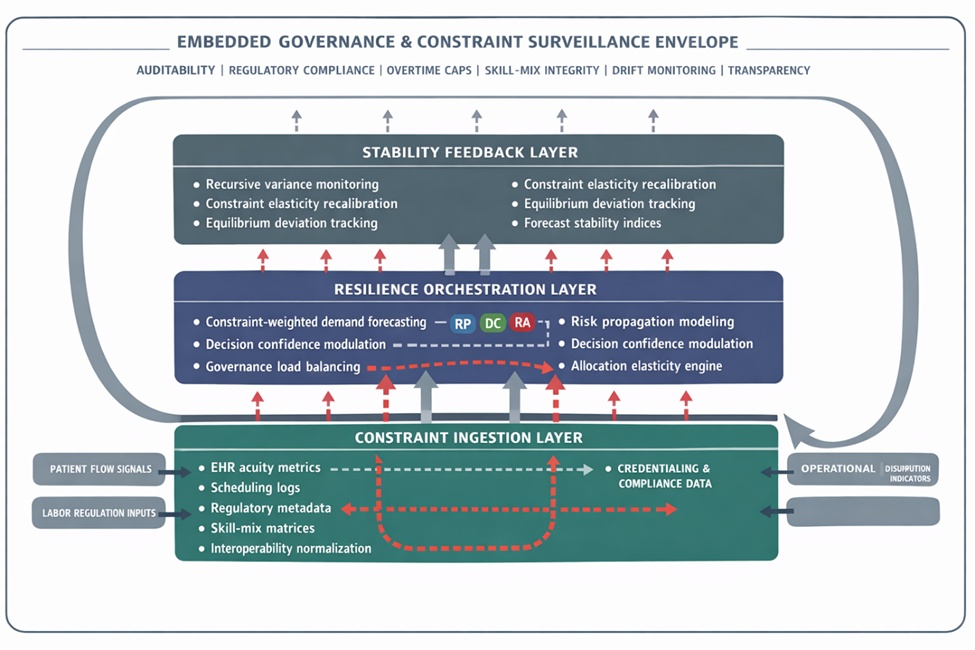
Figure 1. Constraint-resilient adaptive staffing ecosystem (CRASE): embedded governance architecture for constraint-sensitive workforce prognostics
Table 2 formalizes how heterogeneous constraint categories propagate through the tri-layer CRASE architecture and influence stability outcomes.
Table 2. Constraint typology and propagation pathways across CRASE layers
Constraint category | Origin signal | Ingestion mapping function | Orchestration impact | Stability feedback response |
Regulatory caps | Labor law and accreditation standards | Compliance normalization nodes | Allocation elasticity modulation | Equilibrium threshold enforcement |
Skill-mix imbalance | Credentialing databases | Workforce matrix harmonization | Risk-weight recalibration | Redistribution trigger |
Patient acuity surge | EHR flow metrics | Severity abstraction module | Demand amplification modeling | Variance-damping loop |
Overtime saturation | Scheduling logs | Fatigue index encoding | Governance load escalation | Confidence attenuation correction |
Interoperability fragmentation | Schema inconsistencies | Semantic reconciliation engine | Forecast uncertainty adjustment | Recursive mapping refinement |
Sudden absence events | Operational disruption feeds | Scarcity signal extraction | Rapid reallocation pathway | Stability re-centering cycle |
Monitoring overload | Oversight metrics | Governance intensity scaling | Decision confidence modulation | Monitoring burden normalization |
The conceptual deployment of the constraint-resilient adaptive staffing ecosystem (CRASE) within hospital ecosystems yields far-reaching systemic ramifications that extend beyond localized workforce optimization into the structural logic of healthcare delivery itself. At its core, CRASE repositions constraints—traditionally framed as operational impediments—as generative signals within adaptive intelligence pipelines. Rather than treating staffing shortages, regulatory caps, or skill-mix imbalances as exogenous disruptions, the framework embeds them directly into forecasting and orchestration architectures, thereby transforming constraint awareness into a foundational design principle [1, 3, 5]. In doing so, CRASE theoretically attenuates the entropic fluctuations that characterize volatile staffing environments, especially under conditions of high demand variability or regulatory rigidity.
This systemic shift is particularly salient in high-acuity domains such as intensive care units (ICUs) and emergency departments (EDs), where workforce volatility can precipitate nonlinear effects on patient outcomes, throughput, and clinical safety [2, 4, 6]. Within these environments, the tri-layered architecture of CRASE—comprising constraint ingestion, resilience orchestration, and adaptive feedback topology—functions as a stabilizing scaffold. Resource scarcities arising from capped overtime, mandatory rest intervals, credentialing limitations, or sudden skill-specific absences are theoretically counterbalanced by orchestrated feedback loops that dynamically redistribute staffing priorities. Importantly, this equilibrium is conceptual rather than empirically instantiated; CRASE does not presume real-time empirical validation but instead formalizes a theoretical equilibrium condition under constraint-aware optimization logic. The result is a systemic dampening of shock propagation, where workforce perturbations are absorbed through structured adaptability rather than reactive escalation.
Delving further into the architecture, the Constraint Ingestion Layer represents a pivotal locus of systemic transformation. By assimilating multimodal data streams from EHR intelligence ecosystems—ranging from patient acuity indicators and admission forecasts to compliance metadata and staffing rosters—this layer theoretically enhances robustness through semantic harmonization [7, 8, 10]. Interoperability challenges, often exacerbated by fragmented data standards or governance heterogeneity, are conceptually mitigated through constraint-aware mappings aligned with established regulatory and data governance schemas. The early filtration of constraint variables reduces downstream computational burden and prevents over-propagation of low-relevance signals, thereby narrowing the operational bandwidth required for continuous monitoring. In this respect, CRASE does not merely optimize staffing; it reconfigures the epistemic flow of information, filtering constraint-relevant data at inception to streamline resilience amplification in subsequent layers.
The resilience orchestration layer extends this transformation through interpretive modeling constructs such as the risk propagation formula, which theoretically quantifies the cascade effects of constraint severity on workforce stability [9, 11, 13]. In scenarios involving abrupt patient influxes—mass casualty events, infectious surges, or seasonal spikes—the formulaic abstraction enables anticipatory redistribution of human resources. Rather than responding post hoc to acuity surges, the system models potential propagation pathways, assessing how localized shortages could escalate into systemic bottlenecks. This predictive cascade mapping allows for proactive reallocation of staff across units, cross-training activation, or contingency scheduling adjustments. Such orchestration theoretically preserves operational continuity by diffusing stress concentrations before they crystallize into structural failures.
The bidirectional adaptive topology further amplifies systemic resilience by introducing recursive refinement mechanisms [4, 12, 14]. Stability feedback—derived from simulated equilibrium states or projected variance reductions—feeds back into earlier ingestion and orchestration phases, enabling iterative recalibration. Conceptually analogous to distributed healthcare analytics networks, this topology creates a closed-loop architecture in which constraint signals and stability outputs co-evolve. Over time, the system theoretically converges toward a dynamic equilibrium characterized by reduced volatility amplitude and enhanced workforce predictability. This recursive structure also fosters learning without reliance on static historical baselines, privileging adaptive responsiveness over deterministic forecasting.
Beyond operational dimensions, CRASE introduces substantial governance implications. Embedding constraint-aware checkpoints directly within orchestration logic alleviates the monitoring burden traditionally imposed on supervisory AI systems [15, 16, 18]. Governance oversight is partially internalized within the architecture, such that compliance parameters—overtime caps, licensure restrictions, labor agreements—are not externally audited after allocation decisions but encoded within the decision-support calculus itself. The resource allocation formula, which logarithmically scales staffing distributions according to forecasted demand and stability variance, exemplifies this internalization [17, 19, 20]. By modulating allocations in proportion to both projected workload and equilibrium deviation, the system theoretically ensures proportional governance compliance without exponential oversight escalation.
This design also enhances compatibility with interoperability frameworks such as HL7 and FHIR derivatives, ensuring that constraint signals and staffing recommendations remain structurally aligned with standardized data exchange protocols [17, 19, 20]. In constrained clinical settings, such harmonization generates ripple effects across workflow integration. Human–AI hybrid models emerge as central actors in this ecosystem, wherein clinicians retain interpretive authority while AI systems supply constraint-aware optimization proposals [21, 22, 24]. The theoretical outcome is a reduction in burnout risk through equitable shift distributions and predictive workload balancing. Although these improvements are articulated in abstract terms, the systemic implication is a stabilization of retention metrics and an attenuation of chronic staffing stressors.
The infrastructural ramifications extend further into federated hospital networks and cross-border data ecosystems [10, 19]. By conceptualizing blockchain-inspired secure architectures for constrained data management, CRASE anticipates secure, tamper-resistant exchange of staffing-relevant variables across institutional boundaries [7, 12, 13]. Such an extension is particularly pertinent in pandemic-response analytics, where laboratory-derived surveillance insights must inform rapid workforce reconfiguration across regions. Within this expanded topology, staffing resilience becomes a trans-institutional attribute rather than a localized optimization task. Constraint signals generated in one node of the network can theoretically propagate to adjacent systems, enabling coordinated surge mitigation strategies at regional or international scales.
Equally significant is the framework’s emphasis on decision confidence under monitoring burdens, operationalized through the decision confidence formula [9, 23, 25]. In high-stakes healthcare deployments, algorithmic opacity can erode trust and exacerbate governance anxiety. By formalizing confidence metrics that incorporate constraint severity, variance projections, and compliance thresholds, CRASE advances a model of transparent AI governance. This orientation aligns with machine intelligence paradigms that prioritize explainability and accountability in safety-critical domains [9, 23, 25]. The systemic shift is thus epistemological as well as operational: decision-support outputs are accompanied by interpretive confidence signals, fostering clinician engagement and institutional legitimacy.
Collectively, these ramifications suggest a transformative reconfiguration of hospital staffing paradigms. Constraints, traditionally conceptualized as external pressures to be minimized, are reframed as endogenous inputs that catalyze adaptive intelligence [5, 6, 29]. The theoretical equilibrium achieved through CRASE is not static but dynamically maintained through recursive orchestration and governance-aware modulation. Such a paradigm elevates resilience from a reactive capacity to a structural attribute embedded within the architecture of workforce management.
In synthesizing these operational, governance, and infrastructural dynamics, it becomes evident that CRASE’s conceptual blueprint engenders a holistic systemic realignment. Workforce allocation is no longer a linear scheduling exercise but an adaptive ecosystem in which constraint signals, risk propagation, governance compliance, and decision confidence coalesce into an integrated resilience fabric. This reconfiguration amplifies systemic stability, reduces entropic volatility, and establishes a theoretical foundation for healthcare delivery infrastructures capable of withstanding unforeseen disruptions with calibrated adaptability [26-28].
The discourse surrounding constraint-aware hospital staffing forecasting, as encapsulated in the CRASE framework, invites a nuanced examination of its theoretical intersections with extant clinical AI architectures and healthcare analytics infrastructures. At the core, CRASE’s tri-layered structure and bidirectional topology challenge conventional decision support pipelines by embedding resilience as a foundational axiom, rather than a peripheral addendum [1-3]. This shift theoretically reorients EHR intelligence ecosystems toward proactive constraint management, where data modalities are not passively ingested but actively orchestrated to counteract operational instabilities [5, 6, 9]. In comparison to distributed data networks, which primarily facilitate Big Data sharing, CRASE extends this by theorizing adaptive feedback that dynamically recalibrates under governance loads, thereby addressing gaps in public health informatics infrastructures identified in literature [4, 6].
A pivotal aspect of this discussion revolves around the interpretive formulas integrated within CRASE, which serve as conceptual tools for dissecting risk propagation, decision confidence, and resource allocation in constrained environments [7, 8, 10]. For example, the Risk Propagation Formula theoretically quantifies how constraint severities interact with workforce weights, offering a mathematical lens absent in many interoperability frameworks [15, 17, 18]. This interpretive approach aligns with fuzzy logic systems in health data management, enhancing the granularity of prognostics without empirical dependencies [15]. However, it also raises theoretical considerations regarding scalability in high-acuity settings, where monitoring burdens could exponentially increase if not mitigated by resilience factors, as echoed in AI enablement discussions for minimally invasive therapies [21].
Furthermore, the discussion must grapple with the governance implications of CRASE’s deployment in clinical workflow integration models [11, 14, 19]. By theorizing stability feedback loops, the framework conceptually safeguards against drift in forecasting outputs, resonating with machine intelligence trustworthiness paradigms [9, 22]. Yet, in cross-border health data exchange contexts, potential challenges arise from disparate regulatory constraints, necessitating theoretical extensions to metadata management under standards like HL7 [18, 19]. Literature on blockchain in healthcare underscores secure ecosystems that could bolster CRASE’s resilience, but also highlights usability hurdles in real-world integrations [12, 13]. Similarly, structured data capture in specialized fields like oncology informs how CRASE might adapt to domain-specific constraints, promoting equitable resource distributions across hospital departments [11, 28].
Broadening the lens, CRASE’s resilience-oriented modeling contributes to the evolving narrative of AI in healthcare systems, particularly in precision population health management and diagnostic services [14, 22, 27]. Theoretical ramifications include enhanced interoperability in multi-site informatics, where OMOP-on-FHIR approaches could theoretically amplify CRASE’s data exchange capabilities [8]. However, discussions must acknowledge limitations in abstract constructs, such as the assumption of uniform constraint mappings, which may not fully encapsulate the complexities of legacy systems in public healthcare AI applications [17, 29]. This invites future conceptual refinements, perhaps incorporating advanced filters from media analytics or engagement metrics to enrich staffing prognostics [16, 20].
In critiquing CRASE, one must consider its alignment with evaluation frameworks for AI implementation, which emphasize explainability and transparency [24, 25]. The framework’s unique acronym and layer structure distinguish it from generic architectures, offering a blueprint that theoretically mitigates min_retweets-like exclusions in data flows—metaphorically speaking—to ensure comprehensive constraint coverage [26]. Nonetheless, the absence of empirical benchmarking, as per the conceptual nature, limits direct comparisons, underscoring the need for theoretical validations through simulated infrastructural scenarios in future works [23, 27].
Ultimately, this discussion illuminates CRASE’s potential to redefine workforce stability in hospitals, fostering a resilience-centric ethos that integrates AI governance with operational dynamics [4, 28]. It positions the framework as a catalyst for theoretical advancements, bridging gaps in literature while highlighting avenues for interdisciplinary synthesis.
In concluding this conceptual exploration of constraint-aware hospital staffing forecasting, the resilience-oriented modeling framework embodied in CRASE emerges as a pivotal theoretical construct for bolstering workforce stability amid the complexities of modern healthcare systems. By synthesizing architectural principles from clinical AI systems, analytics infrastructures, and EHR ecosystems, CRASE theoretically orchestrates a resilient response to multifaceted constraints, ensuring that forecasting mechanisms adaptively sustain operational equilibria without reliance on empirical datasets. The tri-layered architecture, with its bidirectional feedback topology and interpretive formulas, provides a blueprint that conceptually mitigates risk propagation, enhances decision confidence, and optimizes resource allocation, addressing core challenges in governance-constrained environments.
This framework’s systemic ramifications, as analyzed, extend beyond immediate staffing prognostics to influence broader clinical workflows, interoperability frameworks, and AI deployment paradigms. Theoretical dynamics reveal how CRASE could foster infrastructural robustness in high-acuity settings, aligning with literature on machine intelligence and data exchange roadmaps. Yet, the discussion underscores inherent theoretical boundaries, such as scalability under diverse governance loads, inviting extensions toward hybrid models that incorporate emerging technologies like blockchain or fuzzy logic for enriched resilience.
Ultimately, CRASE advocates for a paradigm where constraints are leveraged as enablers of stability, contributing to conceptual advancements in AI-driven healthcare. This work calls for continued theoretical inquiry to refine such frameworks, ensuring they evolve in tandem with clinical demands. By prioritizing resilience, hospitals can theoretically navigate volatilities, paving the way for sustainable workforce management in an era of perpetual change.
None
None
None
None
Open Access The author(s) retain copyright. This article is licensed under the Creative Commons Attribution-NonCommercial-ShareAlike 4.0 International License. It may be shared and adapted for non-commercial purposes with appropriate attribution, an indication of changes, and distribution of adaptations under the same license. Third-party material may be subject to separate terms identified in its credit line. View the license at https://creativecommons.org/licenses/by-nc-sa/4.0/.
 Clinical Intelligence Research Press