This conceptual manuscript explores design principles for predictive operations in hospital environments, emphasizing safe forecasting mechanisms, equitable resource allocation strategies, and robust capacity governance frameworks. Drawing from theoretical foundations in systems engineering and healthcare informatics, we propose a novel architectural model termed the integrated forecasting and allocation nexus (IFAN), which integrates multilayered predictive intelligence with governance protocols to mitigate risks associated with operational uncertainties. The IFAN architecture features a unique hierarchical structure comprising perception, orchestration, and stewardship layers, interconnected via adaptive feedback loops that ensure ethical alignment and operational resilience. Through a synthesis of peer-reviewed literature from 2017 to 2021, we delineate how such systems can theoretically enhance hospital efficiency without relying on empirical data or performance metrics. Key contributions include interpretive formulas for risk propagation in forecasting pipelines, decision confidence in allocation decisions, and governance load under dynamic capacity demands. We discuss infrastructural implications for clinical deployment, highlighting the need for modular designs that accommodate diverse data modalities and regulatory constraints. Ultimately, this work advocates for a paradigm shift toward proactive, governance-centric predictive systems in healthcare, fostering safer and more sustainable hospital operations. By focusing on architectural integrity and theoretical dynamics, the manuscript provides a blueprint for future conceptual advancements in AI-driven hospital management.
The landscape of hospital operations has increasingly gravitated toward predictive paradigms, where anticipatory analytics play a pivotal role in navigating the complexities of patient inflows, resource demands, and infrastructural capacities. This shift is driven by the imperative to enhance operational safety amid fluctuating clinical demands, ensuring that forecasting, allocation, and governance are harmonized to prevent systemic bottlenecks. In this manuscript, we conceptualize design principles that underpin safe predictive operations, framing them within hospital-specific contexts to address theoretical gaps in integrating AI with healthcare governance.
In contemporary hospital clinical settings, predictive forecasting emerges as a cornerstone for anticipating patient volumes and procedural needs, theoretically reducing wait times and optimizing bed utilization. Drawing from time-series methodologies, such forecasting principles can be abstracted to model inpatient discharges and emergency admissions without empirical validation [1, 2]. The clinical environment, characterized by variable acuity levels and seasonal patterns, necessitates designs that prioritize safety in predictions, mitigating errors that could cascade into resource mismanagement. For instance, theoretical models posit that integrating autoregressive components with smoothing techniques can conceptually stabilize forecasts in high-variability settings like emergency departments [3, 4].
Hospital resource allocation must contend with diverse data modalities, including electronic health records, administrative logs, and real-time monitoring feeds, each contributing to a theoretical mosaic of operational intelligence. Safe allocation principles advocate for modular approaches where resources—such as staffing and equipment—are distributed based on predicted demands, ensuring equity across departments [5, 6]. In governance-constrained environments, these modalities inform allocation heuristics that theoretically balance immediate needs with long-term capacity sustainability, avoiding overcommitment that could compromise patient safety [7, 8].
The deployment of predictive systems in hospital environments requires governance frameworks that account for infrastructural heterogeneity, from urban tertiary centers to rural facilities. Capacity governance principles emphasize theoretical safeguards against overload, incorporating feedback mechanisms to adjust predictions in real-time [9, 10]. Such environments demand designs resilient to data sparsity or integration challenges, where governance acts as a regulatory overlay to ensure ethical forecasting and allocation [11, 12].
Governance constraints, including regulatory compliance and ethical oversight, form the bedrock of safe predictive operations in hospitals. Theoretical constructs suggest that embedding privacy-preserving protocols within forecasting architectures can prevent data misuse while enhancing allocation transparency [13, 14]. These constraints necessitate principles that theoretically align AI outputs with clinical governance standards, fostering trust in capacity management decisions [15, 16].
Intersecting these elements reveals theoretical challenges in integrating forecasting with allocation and governance, such as harmonizing disparate data streams under unified principles. Hospital systems must theoretically navigate these intersections to avoid predictive drift, where initial forecasts diverge from actual capacities, potentially leading to governance failures [17, 18]. This section underscores the need for holistic design principles that theoretically bridge these domains.
The introduction thus sets the stage for a deeper exploration of theoretical underpinnings, advocating for architectures that embody safe, integrated predictive operations. By synthesizing these subdomains, we lay the groundwork for a conceptual framework that advances hospital efficiency through principled design.
This section synthesizes theoretical insights from recent literature on predictive operations in hospitals, focusing on conceptual models for forecasting, resource allocation, and capacity governance. By reviewing peer-reviewed works from 2017 to 2021, we distill key principles that inform safe system designs, emphasizing infrastructural and architectural perspectives without empirical claims.
In hospital clinical settings, theoretical backgrounds highlight the role of time-series analysis in conceptualizing forecasting dynamics for patient flows. Literature posits that combinatorial models, blending autoregressive and exponential smoothing elements, provide a theoretical basis for stable predictions in variable environments like outpatient clinics [1, 19]. Such foundations extend to emergency contexts, where machine learning abstractions theoretically enhance admission predictions, ensuring safer operational planning [4, 20].
Data modalities in healthcare literature offer theoretical lenses for resource allocation, where multimodal inputs theoretically inform equitable distribution strategies. Synthesis reveals that predictive rules derived from vital signs and administrative data can conceptually guide allocation in trauma care, optimizing resource use under capacity constraints [21, 22]. Governance-integrated modalities further emphasize theoretical heuristics for balancing workloads, preventing allocation biases in intensive care units [5, 23].
Theoretical backgrounds in deployment environments underscore orchestration principles for hospital capacity, where mathematical models theoretically cluster wards to enhance planning efficiency [6, 24]. Literature synthesizes how automated learning on diagnostic codes can conceptually forecast national-level demands, informing governance in resource-scarce settings [7, 25]. These theories advocate for adaptive environments that theoretically mitigate overcrowding through predictive orchestration [26, 27].
Governance constraints in the literature provide theoretical safeguards for predictive operations, emphasizing ethical allocation and capacity monitoring. Conceptual reviews highlight rapid response strategies during pandemics, where forecasting models theoretically allocate scarce resources equitably [13, 28]. Synthesis also covers utility analysis for readmission predictions, theoretically reducing governance burdens by prioritizing high-risk cases [18, 29].
The Stewardship Tier imposes governance protocols, theoretically monitoring for ethical compliance and drift detection. This tier’s topology includes recursive checks that feed back to lower tiers, fostering a self-regulating system. Through this recursive architecture, governance is not treated as an external supervisory mechanism but rather as an intrinsic component of infrastructural dynamics. By embedding oversight within the operational topology, the system theoretically ensures that predictive outputs remain aligned with institutional safety thresholds and regulatory expectations. This internalization of governance aligns with broader infrastructural theories that emphasize continuous monitoring and adaptive control as prerequisites for resilient healthcare systems [9, 10].
A defining characteristic of the integrated forecasting and allocation nexus (IFAN) is the presence of dynamic feedback loops that traverse all tiers of the architecture. These loops operate across temporal scales, linking immediate operational forecasts with medium-term resource planning and long-term strategic governance. Within the perception tier, predictive abstractions continuously recalibrate as new patient flows and operational signals emerge. These recalibrations propagate upward to the orchestration tier, where allocation schemas are iteratively adjusted to prevent capacity saturation.
The orchestration tier functions as the operational nexus of the infrastructure. Here, allocation heuristics translate forecast signals into actionable resource distributions across beds, clinical staff, and diagnostic facilities. Priority queues and threshold-based balancing mechanisms theoretically ensure that emergent surges in demand are accommodated without destabilizing baseline hospital operations. Such mechanisms conceptually reflect queueing and systems-theoretic models that describe healthcare capacity management as a dynamic equilibrium between patient inflow and service throughput [8, 15].
Importantly, the feedback mechanisms do not operate solely in a bottom-up manner. Governance signals originating in the Stewardship Tier also propagate downward, shaping both forecasting and allocation processes. For instance, if ethical constraints or safety thresholds are breached—such as occupancy levels approaching critical limits—the Stewardship Tier can impose corrective parameters that modify forecasting sensitivity or restrict allocation thresholds. This bidirectional flow establishes a governance-aware predictive environment in which operational decisions remain continuously aligned with institutional objectives and patient safety imperatives [12, 14].
A central objective of the IFAN architecture is the theoretical assurance of predictive safety. Predictive safety refers to the capacity of forecasting infrastructures to support decision-making without amplifying systemic risks or introducing operational instability. Within hospital environments, inaccurate or poorly governed predictions can lead to cascading consequences, including staff overload, delayed treatments, or compromised care quality.
To mitigate these risks, the proposed architecture incorporates layered safeguards distributed across all tiers. At the Perception Tier, noise filtering and aggregation mechanisms theoretically stabilize predictive signals by minimizing the influence of anomalous data patterns. Such stabilization aligns with machine learning frameworks that emphasize robust feature abstraction as a prerequisite for reliable predictive modeling [2, 16].
Within the orchestration tier, risk mitigation is addressed through capacity-aware allocation algorithms that enforce predefined safety buffers. Rather than allocating resources to the full extent of forecasted demand, the system maintains operational reserves to accommodate unforeseen fluctuations in patient flow. These conceptual buffers function as infrastructural shock absorbers, reducing the likelihood of abrupt capacity collapses during sudden demand surges [11].
At the stewardship tier, risk mitigation becomes an institutional function. Governance mechanisms continuously evaluate predictive outputs against ethical, operational, and regulatory benchmarks. Drift detection mechanisms theoretically identify deviations between predicted and observed outcomes, enabling early interventions before systemic instability emerges. This governance-driven monitoring framework transforms predictive infrastructure from a purely analytical tool into a strategic instrument for institutional resilience [17].
Another critical feature of the IFAN framework is its emphasis on interoperability across heterogeneous hospital systems. Modern healthcare infrastructures comprise numerous data sources and operational subsystems, including electronic health records, staffing management platforms, and bed tracking systems. Without coherent integration mechanisms, predictive models risk operating in informational silos, limiting their practical utility.
The IFAN architecture addresses this challenge through modular interoperability principles embedded within its layered design. Each tier interacts with hospital subsystems through standardized abstraction interfaces, enabling data exchange without tightly coupling predictive models to specific technological platforms. This modularity theoretically enhances the adaptability of the infrastructure, allowing institutions to incorporate additional data streams or analytical modules without destabilizing the broader architecture.
Furthermore, interoperability strengthens the feedback topology that underpins the system. When multiple subsystems contribute to forecasting and allocation processes, the resulting predictive environment becomes more contextually aware, capturing the complex interdependencies that characterize hospital operations. Such infrastructural cohesion is essential for developing predictive ecosystems capable of responding effectively to the nonlinear dynamics of healthcare demand [9, 10].
Beyond operational forecasting, the IFAN architecture facilitates a form of institutional learning. By continuously comparing predictive outputs with observed operational outcomes, the system theoretically generates insights into the evolving dynamics of hospital demand and resource utilization. These insights accumulate within the Stewardship Tier, where governance actors can evaluate long-term performance trends and adjust institutional policies accordingly.
Adaptive governance emerges from this iterative learning process. Rather than relying solely on static planning frameworks, hospital administrators gain access to continuously updated intelligence regarding system capacity, patient flow dynamics, and operational bottlenecks. Over time, this feedback-informed governance structure can inform broader strategic decisions, including infrastructure expansion, staffing policies, and service distribution across hospital departments. Table 1 delineates the functional specialization of IFAN architectural tiers, illustrating how predictive intelligence, operational allocation, and institutional governance are distributed across complementary infrastructural roles.
Table 1. Governance-embedded roles of IFAN architectural tiers in predictive hospital operations
Architectural tier | Core functional role | Analytical mechanisms | Governance integration | Operational output |
Perception tier | Aggregation of multimodal operational signals from hospital subsystems | Signal normalization, temporal aggregation, anomaly filtering | Privacy-preserving data ingestion and modality weighting | Stable predictive inputs representing patient flow and operational demand |
Forecasting engine | Generation of demand forecasts under uncertainty | Time-series modeling, risk propagation attenuation, and variability stabilization | Calibration thresholds governed by institutional safety parameters | Demand forecasts for admissions, discharges, and procedural workloads |
Orchestration tier | Translation of forecasts into operational resource distributions | Allocation heuristics, queue prioritization, and buffer management | Equity-weighted decision utilities and safety thresholds | Dynamic allocation of beds, workforce, and diagnostic resources |
Stewardship tier | Oversight and regulation of predictive operations | Drift detection, capacity risk monitoring, and governance load assessment | Ethical compliance verification and policy enforcement | Corrective governance signals and system recalibration directives |
In this sense, predictive infrastructure becomes not only a tool for short-term operational optimization but also a mechanism for strategic foresight. By embedding learning mechanisms within the architectural topology, IFAN theoretically supports hospitals in transitioning from reactive crisis management toward proactive capacity planning.
The introduction of IFAN contributes to the theoretical discourse on hospital predictive infrastructures by articulating a cohesive architectural model that integrates forecasting, allocation, and governance within a unified system. Previous research has often treated these elements as separate analytical domains—forecasting models operating independently from allocation strategies or governance frameworks. The proposed architecture instead emphasizes their interdependence, conceptualizing hospital operations as an integrated cyber-physical ecosystem.
This integrated perspective highlights the importance of feedback-driven design principles in healthcare infrastructure. Predictive systems cannot operate effectively in isolation; their outputs must be continuously contextualized within operational realities and institutional policies. By embedding bidirectional feedback loops across all architectural layers, IFAN ensures that predictive insights remain actionable, accountable, and aligned with safety imperatives.
Moreover, the architecture underscores the significance of governance-aware machine learning within healthcare environments. As predictive models increasingly influence clinical and administrative decision-making, their integration with oversight mechanisms becomes essential for maintaining trust, transparency, and ethical accountability. The Stewardship Tier of IFAN represents a conceptual step toward such governance-integrated predictive infrastructures.
Ultimately, the architectural orchestration described here aims to advance the development of resilient hospital ecosystems capable of navigating complex and uncertain demand patterns. Hospitals operate within highly dynamic environments where patient flows fluctuate, resources remain constrained, and decisions carry profound consequences for patient outcomes. Predictive infrastructures must therefore balance analytical sophistication with operational reliability and ethical oversight.
The IFAN framework addresses this challenge by combining forecasting intelligence, allocation mechanisms, and governance oversight within a cohesive infrastructural topology. Through layered design and recursive feedback loops, the system theoretically supports continuous adaptation, enabling hospitals to respond effectively to emerging pressures while maintaining safe operational boundaries.
As healthcare systems increasingly adopt data-driven decision-making frameworks, the integration of predictive architectures such as IFAN may become central to the evolution of hospital operations. Future research can further explore how such infrastructures interact with real-world clinical workflows, institutional policies, and emerging technologies, ultimately refining the conceptual foundations of predictive healthcare governance. Figure 1 illustrates the integrated forecasting and allocation nexus (IFAN), a governance-integrated predictive architecture in which multimodal hospital signals are transformed into operational forecasts, translated into allocation decisions, and continuously regulated through stewardship-driven feedback loops.
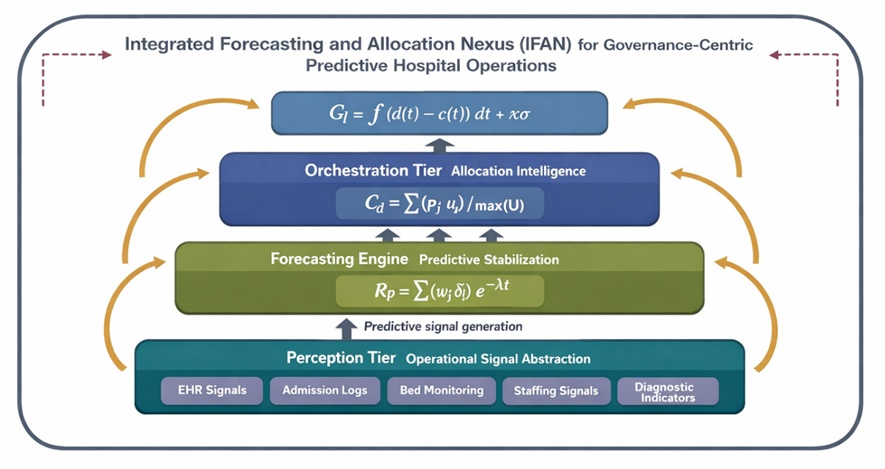
Figure 1. Integrated forecasting and allocation nexus (IFAN): governance-integrated architecture for predictive hospital operations
To formalize key dynamics, we introduce interpretive formulas:
Risk propagation in forecasting:
Decision confidence in allocation:
Governance load under capacity demands:
This architectural orchestration thus provides a theoretical blueprint for safe, integrated predictive operations in hospitals.
The IFAN architecture, through its layered orchestration and adaptive feedback topology, theoretically engenders profound impacts on hospital resilience, operational equity, and long-term sustainability. This section examines these dynamics conceptually, focusing on how integrated predictive principles propagate through clinical ecosystems to reshape capacity governance and resource flows without invoking empirical outcomes.
In theoretical terms, the bidirectional feedback topology of IFAN amplifies hospital resilience by enabling continuous recalibration of forecasts in response to emerging deviations. The Stewardship Tier’s recursive oversight theoretically detects predictive drift—defined as gradual misalignment between forecasted and realized demands—and propagates corrective signals downward. This creates a self-correcting mechanism that conceptually buffers against exogenous shocks, such as sudden surges in acuity or infrastructural disruptions. By embedding governance directives within the feedback pathways, IFAN fosters anticipatory resilience, where resource allocation adjusts preemptively to maintain operational continuity [6, 9, 13, 15].
The perception tier’s aggregation of multimodal data theoretically reduces vulnerability to single-source failures, while the orchestration tier’s priority queuing ensures that critical allocations remain robust under stress. Collectively, these layers contribute to a conceptual resilience multiplier, where the system’s ability to absorb perturbations exceeds that of siloed forecasting approaches. Table 2 synthesizes the safety-oriented mechanisms embedded within the IFAN architecture, demonstrating how predictive stability, risk mitigation, and governance oversight collectively safeguard hospital operational resilience.
Table 2. Conceptual safety mechanisms embedded in the IFAN predictive operations framework
Safety dimension | Architectural location | Conceptual mechanism | Theoretical function | Operational implication |
Predictive stability | Perception and forecasting layers | Noise filtering and multimodal signal aggregation | Reduces volatility in demand predictions | Prevents forecasting shocks that destabilize capacity planning |
Risk propagation control | Forecasting engine | Exponential decay modeling of predictive deviations | Attenuates early prediction errors over time | Enhances the reliability of operational forecasts |
Capacity shock absorption | Orchestration tier | Safety buffers and queue prioritization | Maintains reserve capacity during demand surges | Protects critical care pathways during operational stress |
Governance drift detection | Stewardship tier | Continuous monitoring of forecast–outcome divergence | Identifies predictive misalignment early | Enables corrective intervention before systemic overload |
Equity regulation | Stewardship–orchestration interface | Utility-weighted decision confidence | Aligns allocation decisions with fairness constraints | Prevents resource monopolization across departments |
Institutional learning | Feedback topology | Recursive comparison between predictions and outcomes | Generates adaptive governance insights | Supports long-term strategic capacity planning |
Resource allocation under IFAN theoretically promotes equity by incorporating governance-weighted utilities in decision confidence calculations. The formula
The stewardship tier’s ethical compliance checks further enforce equitable propagation, theoretically preventing scenarios where high-volume departments monopolize resources at the expense of specialized units. Over time, this dynamic could foster a more balanced ecosystem, where predictive intelligence serves as a leveling force rather than an exacerbator of existing inequities.
Theoretically, IFAN synchronizes disparate hospital workflows by aligning forecasting horizons with allocation cycles and governance reviews. The perception tier’s baseline forecasts inform Orchestration Tier heuristics in near-real time, conceptually reducing latency between prediction and action. This synchronization theoretically diminishes bottlenecks in patient flow, such as prolonged emergency department boarding or delayed discharges, by enabling proactive bed turnover planning [1, 19, 20].
Governance load, as captured in
Risk propagation, formalized as
The architecture’s modular design further supports safety by isolating perturbations within tiers, allowing localized corrections without systemic disruption. This containment principle theoretically enhances fault tolerance, ensuring that predictive operations remain reliable even under partial data degradation or integration challenges.
From a sustainability perspective, IFAN’s infrastructure theoretically supports scalable deployment across heterogeneous hospital networks. The hierarchical layering allows for incremental adoption—starting with Perception Tier forecasting in select units and expanding to full orchestration and stewardship—minimizing disruption while building governance maturity. Feedback topology ensures that lessons from one deployment theoretically inform others, fostering evolutionary improvement in design principles [7, 10, 11, 24].
Sustainability also manifests in reduced governance overhead through automated drift detection, conceptually freeing clinical leadership to focus on strategic rather than reactive oversight. This shift theoretically cultivates a culture of proactive capacity management, where predictive intelligence becomes embedded in institutional memory.
These impact dynamics collectively position IFAN as a transformative conceptual paradigm, where safe forecasting principles converge with equitable allocation and robust governance to elevate hospital operations toward greater resilience and fairness.
This section reflects on the broader architectural paradigms embodied in IFAN, situating them within evolving theoretical discourses on predictive healthcare systems. By synthesizing the proposed design with foundational literature, we highlight avenues for conceptual refinement and paradigm advancement.
The multilayered structure of IFAN diverges from traditional monolithic forecasting models by explicitly partitioning responsibilities across perception, orchestration, and stewardship. This separation theoretically enables specialization—Perception focuses on robust abstraction, Orchestration on dynamic heuristics, and Stewardship on ethical alignment—while the feedback topology ensures cohesion [3, 8, 12, 16]. Such partitioning addresses literature-identified limitations in isolated predictive tools, where lack of governance integration often leads to theoretical misalignment with clinical realities [18, 22, 25, 29].
Furthermore, the interpretive formulas provide a novel lens for conceptualizing core tensions in predictive operations. Risk propagation captures temporal attenuation of uncertainties, decision confidence quantifies ethical trade-offs in allocation, and governance load measures systemic strain—offering abstract yet actionable constructs for future architectural iterations [2, 14, 26, 27].
Reflections also extend to interoperability challenges. IFAN’s modular tiers theoretically facilitate integration with existing hospital information systems, accommodating diverse data modalities without requiring wholesale replacement. This adaptability aligns with calls for resilient infrastructures that evolve alongside technological and regulatory landscapes [5, 15, 21, 28].
Ethically, the architecture embeds governance as an intrinsic layer rather than an afterthought, theoretically mitigating risks of algorithmic opacity or bias amplification. By prioritizing stewardship feedback, IFAN advances a paradigm where predictive power is subordinated to principled oversight, fostering trust in AI-augmented operations [13, 17, 23].
In sum, IFAN represents a conceptual maturation toward governance-centric predictive paradigms, where safety, equity, and resilience are not emergent properties but deliberate architectural outcomes.
Predictive operations in hospitals demand architectures that harmonize safe forecasting, equitable resource allocation, and rigorous capacity governance. The integrated forecasting and allocation nexus (IFAN) offers a theoretical blueprint through its unique layered orchestration—perception for foundational intelligence, orchestration for adaptive allocation, and stewardship for ethical governance—interconnected by bidirectional feedback that ensures dynamic alignment and risk mitigation.
Interpretive formulas illuminate key dynamics: attenuated risk propagation safeguards long-term reliability, weighted decision confidence promotes equitable choices, and quantified governance load highlights pathways to operational sustainability. These elements collectively address theoretical gaps in fragmented predictive approaches, proposing an integrated infrastructure resilient to clinical variability and regulatory demands.
By advancing design principles rooted in modular resilience, feedback-driven adaptation, and governance primacy, this conceptual framework charts a course toward proactive hospital ecosystems. Future explorations may refine these principles through expanded interoperability considerations, enhanced drift detection mechanisms, or broader stakeholder-inclusive governance models. Ultimately, embracing such architectures can theoretically transform hospitals from reactive entities into anticipatory systems that prioritize patient safety, resource justice, and enduring operational integrity.
None
None
None
None
Open Access The author(s) retain copyright. This article is licensed under the Creative Commons Attribution-NonCommercial-ShareAlike 4.0 International License. It may be shared and adapted for non-commercial purposes with appropriate attribution, an indication of changes, and distribution of adaptations under the same license. Third-party material may be subject to separate terms identified in its credit line. View the license at https://creativecommons.org/licenses/by-nc-sa/4.0/.
 Clinical Intelligence Research Press