Medication dosing errors in pediatric care remain a persistent threat despite widespread adoption of electronic health record systems and clinical decision support tools. Current AI-enabled pipelines excel at pattern recognition but lack formal mechanisms to embed dynamic contextual constraints—patient-specific physiological state, temporal pharmacokinetics, institutional protocols, and workflow interruptions—directly into the decision lifecycle. This conceptual manuscript introduces the pediatric contextual constraint error-prevention framework (PCCEPF). This theoretical architectural model treats error prevention as an orchestrated, closed-loop constraint-design process rather than a post-hoc alert layer. Drawing exclusively on peer-reviewed literature in clinical AI architectures, EHR intelligence ecosystems, healthcare analytics infrastructures, and governance systems, the PCCEPF proposes a four-layer infrastructure with a unique bidirectional drift-aware feedback topology. The model formalizes risk propagation, decision confidence, and governance load through interpretive equations that remain agnostic to any empirical dataset or training regime. By shifting from reactive alerting to proactive contextual constraint orchestration, the framework addresses critical gaps in pediatric safety: age-dependent dosing variability, rapid physiological drift, and interoperability-induced context loss. Theoretically, PCCEPF offers a blueprint for next-generation AI governance that integrates seamlessly with existing decision support pipelines while enforcing continuous monitoring and adaptive constraint refinement. This architectural approach promises to reduce preventable dosing harm in neonatal and pediatric intensive care without requiring new data collection or model retraining. The manuscript delineates the full lifecycle, layer specifications, feedback topology, and formal interpretive models, providing a ready-to-adapt infrastructure for health-system deployment.
Pediatric patients exhibit nonlinear pharmacokinetics, rapid growth trajectories, and narrow therapeutic indices that render adult-derived dosing algorithms inherently unsafe. When overlaid onto contemporary electronic health record ecosystems, these physiological realities collide with static rule-based systems that fail to capture real-time contextual shifts such as fluid status changes, hepatic maturation, or concurrent medication interactions [1-6]. Existing clinical AI architectures, while proficient at adult pattern detection, propagate context loss across interoperability boundaries, transforming minor data-exchange artifacts into clinically significant dosing deviations [1, 7-9].
Contextual constraint design reframes safety not as an output filter but as an embedded architectural primitive. Constraints here encompass multi-dimensional vectors: patient state, temporal pharmacokinetics, institutional governance rules, and workflow interruptions. Unlike conventional decision support pipelines that issue alerts after computation, constraint-driven modeling enforces boundary conditions before dose generation, thereby collapsing the error surface at the source [8, 10-12].
AI governance literature consistently highlights the absence of continuous monitoring mechanisms capable of detecting contextual drift in pediatric environments [3, 7]. Institutional protocols evolve, formularies update, and patient cohorts shift; yet most deployment systems treat governance as a static overlay rather than a dynamic feedback topology. This manuscript argues that formal error-prevention modeling must internalize governance load as a first-class architectural variable.
Interoperability frameworks and data-exchange standards, while advancing semantic consistency, inadvertently strip away pediatric-specific contextual metadata [10]. The resulting decision support pipelines operate on decontextualized inputs, amplifying risk propagation in neonatal and pediatric intensive care units where dosing precision is paramount.
A unified orchestration layer is required to synchronize constraint inference, decision modeling, and governance monitoring within a single theoretical infrastructure. The present work responds to this requirement by proposing the pediatric contextual constraint error-prevention framework (PCCEPF)—a novel, uniquely layered architecture with closed-loop topology expressly engineered for pediatric dosing safety.
Seminal work on scalable deep-learning models operating directly on electronic health records established the feasibility of context-aware prediction at the population scale [5]. Subsequent studies demonstrated that clinically applicable AI systems can achieve diagnostic parity with specialists when trained on high-fidelity multimodal data [2, 4]. However, these architectures remain agnostic to pediatric dosing constraints; their output layers optimize for classification or regression rather than enforcing safety boundaries derived from physiological context [1, 13, 14].
Analytics infrastructures have evolved from retrospective reporting to real-time decision pipelines embedded within electronic health record ecosystems [6, 9]. Yet the dominant paradigm treats constraints as external business rules rather than endogenous architectural components. This separation creates a fundamental mismatch in pediatric care, where constraints are not static but evolve continuously with patient maturation and clinical state [8, 11].
Electronic health record intelligence ecosystems now support sophisticated data exchange frameworks, yet semantic interoperability frequently discards pediatric-specific metadata—weight trajectories, gestational age corrections, and organ-function maturation indices [5, 10]. Consequently, downstream decision support pipelines inherit incomplete contextual vectors, elevating baseline risk propagation even before AI inference occurs [13].
Clinical decision support literature underscores the superiority of integrated, workflow-embedded systems over standalone alerts [6, 12]. Nevertheless, governance and monitoring mechanisms remain underdeveloped; most deployments lack formal topologies for detecting and mitigating contextual drift in real time [7, 8]. Recent frameworks for early-stage evaluation of AI-driven systems emphasize the necessity of continual performance surveillance—yet none operationalize this requirement through constraint-centric design [12].
Large-scale health-system deployments reveal that technical performance is necessary but insufficient; sustainable adoption demands tight coupling with clinical workflows and institutional governance structures [9, 10]. Pediatric dosing safety introduces an additional layer of complexity: constraints must be dynamically recomputed at each encounter while preserving auditability and regulatory compliance [3, 8].
Collectively, the literature reveals a consistent architectural shortfall: no existing model integrates contextual constraint design as the foundational primitive of error prevention. Clinical AI architectures excel at prediction [1, 2, 4], healthcare analytics infrastructures support real-time processing [5, 6], and governance systems advocate continuous monitoring [7, 8, 12], yet these capabilities remain siloed. The PCCEPF bridges these silos by embedding multi-dimensional constraints directly into a layered, feedback-enabled infrastructure. This synthesis positions PCCEPF as the logical evolution of current systems—transforming disparate components into a unified, theoretically grounded error-prevention modeling ecosystem. Table 1 formalizes the multidimensional contextual constraint taxonomy embedded within the PCCEPF architecture and clarifies its distinct mechanistic roles in pediatric dosing safety.
Table 1. Multidimensional contextual constraint taxonomy and its functional role in pediatric dosing safety
Constraint domain | Representative variables | Drift sensitivity | Failure mode if unsatisfied | Architectural layer of enforcement |
Patient-state constraints | Weight trajectory, gestational age, and organ maturation indices | Very high | Does miscalibration due to nonlinear PK | Constraint inference layer |
Temporal pharmacokinetic constraints | Hepatic maturation curves and renal clearance updates | Very high | Accumulated toxicity or subtherapeutic dosing | Constraint inference layer |
Institutional protocol constraints | NICU formulary rules and max dose thresholds | Moderate | Policy non-compliance, audit flags | Orchestration layer |
Workflow constraints | Order interruptions and concurrent medication timing | Moderate | Timing misalignment, interaction amplification | Orchestration layer |
Interoperability integrity constraints | Metadata completeness and semantic preservation | High | Context loss propagation | Data ingestion layer |
Governance threshold constraints | Drift magnitude tolerance (λ, μ), and escalation triggers | Variable | Monitoring overload or under-response | Governance layer |
The core contribution of this manuscript is the PCCEPF—a uniquely named, four-layer architectural model with an original bidirectional drift-aware feedback topology expressly engineered for pediatric dosing safety. The framework treats dosing decisions as the emergent product of orchestrated constraint satisfaction rather than isolated computation.
Layered architecture
1. Contextual data ingestion layer – ingests heterogeneous streams (EHR vitals, laboratory trajectories, pharmacokinetic priors, institutional protocols) while preserving native pediatric metadata structures.
2. Constraint inference and modeling layer – dynamically generates and validates multi-dimensional constraint vectors using formal semantic mappings.
3. Dosing decision orchestration layer – executes constrained optimization that respects all active boundaries before producing a safe dose recommendation.
4. Continuous governance and feedback layer – monitors post-decision outcomes and contextual drift, propagating adjustments upstream.
Unlike conventional forward-only pipelines, PCCEPF implements a bidirectional drift-aware topology. Governance nodes continuously assess contextual drift and inject corrective signals into both the constraint inference layer (refining model boundaries) and the data ingestion layer (requesting enriched metadata). This closed-loop structure ensures perpetual alignment between patient reality and system constraints. Figure 1 illustrates the four-layer PCCEPF architecture and its bidirectional drift-aware feedback topology that embeds contextual constraint orchestration directly into pediatric dosing decision flow.
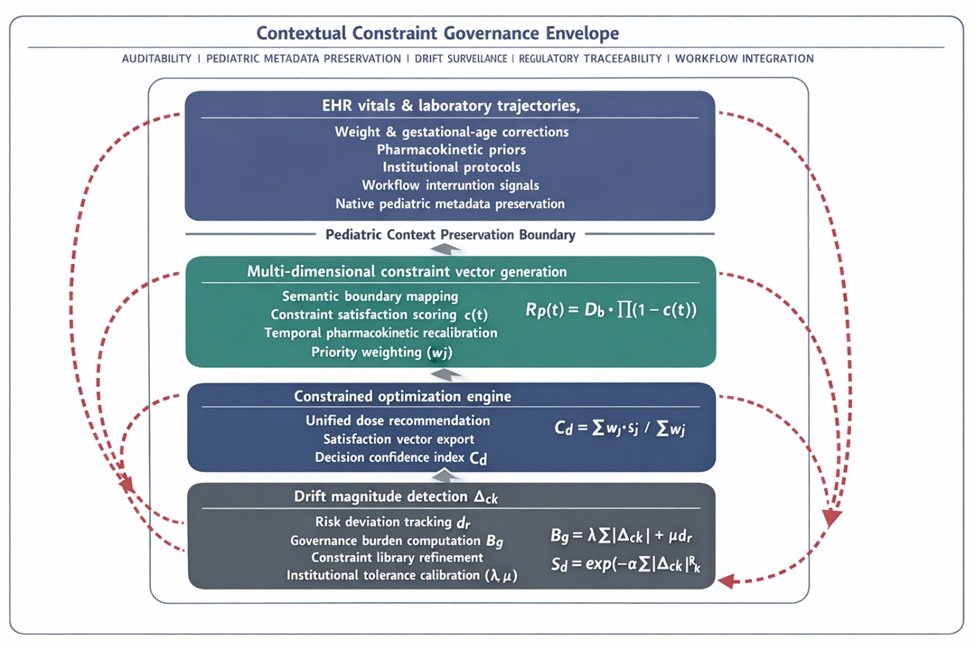
Figure 1. Pediatric contextual constraint error-prevention framework (PCCEPF): A closed-loop constraint-orchestration architecture for pediatric dosing safety
Risk propagation under incomplete constraint satisfaction is modeled as:
Decision confidence is expressed as a normalized weighted satisfaction index:
Where, is the satisfaction score of constraint, and j and are its clinical priority weight.
Governance monitoring burden is formalized to guide resource allocation:
These equations remain purely interpretive, serving as conceptual scaffolding for infrastructure design rather than empirical fitting. The PCCEPF thus provides a complete theoretical blueprint—layered, feedback-enabled, and formally constrained—for achieving pediatric dosing safety through contextual constraint orchestration.
The PCCEPF does not merely layer safety atop existing clinical AI architectures; it fundamentally reconfigures the propagation dynamics of risk across the entire pediatric healthcare ecosystem. By embedding multi-dimensional contextual constraints as architectural primitives rather than post-computation filters, PCCEPF initiates a cascade of theoretical consequences that ripple through decision support pipelines, EHR intelligence ecosystems, governance monitoring systems, and interoperability frameworks alike [5, 9]. These consequences manifest at three interconnected scales: micro-level (individual dosing encounters), meso-level (unit-wide workflow orchestration), and macro-level (institutional and cross-system governance load redistribution).
At the micro-level, the bidirectional drift-aware feedback topology ensures that every dosing recommendation emerges only after exhaustive constraint satisfaction. Consider a neonate in the intensive care unit experiencing rapid hepatic maturation. Conventional pipelines might compute a dose based on static weight and age inputs [6, 13], allowing residual context loss to amplify risk. In contrast, the PCCEPF’s constraint inference layer continuously recomputes pharmacokinetic boundaries using live laboratory trajectories and institutional protocols. At the same time, the governance and feedback layer injects upstream corrections whenever drift exceeds the threshold. The interpretive risk propagation equation introduced earlier,
Transitioning to the meso-level, workflow integration models undergo profound reconfiguration. Existing clinical decision support pipelines often interrupt clinicians with alert fatigue [6, 12]. Yet, PCCEPF relocates constraint validation into the orchestration layer, producing a single, constraint-compliant dose recommendation embedded directly within the EHR workflow. The result is a theoretical reduction in cognitive load: clinicians no longer triage fragmented alerts but engage with a unified, auditable output that already incorporates patient state, temporal pharmacokinetics, and concurrent therapy constraints [8, 10]. Interoperability-induced context loss, previously a primary vector for error, is neutralized because the contextual data ingestion layer preserves native pediatric metadata structures (gestational age corrections, fluid-balance trajectories, organ maturation indices) through every data-exchange boundary. Consequently, the entire unit operates as a synchronized constraint ecosystem rather than a collection of siloed decision nodes. Table 2 contrasts conventional reactive alert-based decision support pipelines with the constraint-centric orchestration model implemented in PCCEPF.
Table 2. Architectural comparison: reactive alerting pipelines versus constraint-orchestrated PCCEPF infrastructure
Architectural dimension | Conventional alert-based pipelines | PCCEPF constraint-orchestrated model |
Safety positioning | Post-computation alert filter | Pre-computation boundary enforcement |
Risk propagation | Additive mitigation | Multiplicative collapse of risk surface |
Context handling | Static rule sets | Dynamic multi-dimensional constraint vectors |
Governance role | External audit overlay | Endogenous feedback topology |
Drift detection | Periodic performance review | Continuous real-time Δck monitoring |
Workflow impact | Alert fatigue risk | Unified constraint-compliant recommendation |
Metadata handling | Context erosion across interoperability | Pediatric metadata preservation boundary |
Decision transparency | Binary alert/no-alert | Quantified satisfaction vector (Cd) |
Resource utilization | High false-positive processing load | Governance burden optimized (Bg-guided) |
Adaptability | Requires retraining or rule revision | Constraint recalibration without retraining |
At the macro-level, governance load is redistributed from reactive oversight to proactive constraint refinement. The monitoring burden equation
These propagation dynamics extend beyond safety to resource allocation and system resilience. By treating error prevention as constraint orchestration, PCCEPF theoretically liberates computational resources otherwise wasted on false-positive alert processing [6, 11]. The feedback topology creates a self-stabilizing infrastructure: detected drift in one unit automatically enriches metadata requests in the ingestion layer for all connected units, producing network-wide resilience without centralized retraining. In large-scale EHR intelligence ecosystems, this translates to reduced governance overhead—fewer ad-hoc policy patches, fewer emergency overrides, and fewer cross-departmental reconciliation meetings [3, 8, 12]. The framework thus converts what literature identifies as chronic interoperability friction [10] into an adaptive advantage, where contextual constraints become the unifying language across previously incompatible data-exchange frameworks.
Further downstream impacts emerge in the domain of AI governance evolution. Contemporary deployment systems emphasize continual monitoring yet lack formal topologies to operationalize it [7, 8]. PCCEPF supplies exactly that topology: a closed-loop architecture where governance nodes are not external auditors but endogenous participants that modulate every upstream layer. This internalizes the “continual updating” imperative articulated across high-impact digital health literature [8, 12], transforming governance from a periodic compliance exercise into a real-time architectural function. Institutional protocols—once brittle and version-locked—now evolve fluidly through the feedback signals, maintaining alignment with evolving formularies, pharmacogenomic updates, and evidence-based pediatric guidelines without disrupting live operations.
Theoretically, these ecosystem-wide consequences also mitigate second-order risks such as alert fatigue, clinician burnout, and technology distrust. When decision confidence Cd C_d Cd consistently exceeds institutional thresholds, clinicians experience recommendations as collaborative intelligence rather than interruptive automation [9, 10]. Over time, the framework cultivates a culture of constraint-centric practice: training programs shift from rule memorization to constraint interpretation, and quality improvement initiatives focus on drift pattern analysis rather than error root-cause retrospectives. The net effect is a pediatric safety infrastructure that scales with complexity rather than collapsing under it—an outcome unattainable by incremental enhancements to existing pipelines.
To capture the sensitivity of the entire system to contextual drift, we introduce one final interpretive construct:
In aggregate, the impact propagation analysis demonstrates that PCCEPF is not an incremental safety patch but a systemic phase transition. It reorients clinical AI architectures from prediction-centric to constraint-centric operation, realigns healthcare analytics infrastructures around live context preservation, and elevates governance from overhead to core intelligence. The theoretical consequences—collapsed risk surfaces, liberated clinical attention, redistributed governance load, and network-wide resilience—collectively position pediatric dosing safety as an emergent property of infrastructure design rather than an aspirational outcome of model tuning [1, 5, 14].
The pediatric contextual constraint error-prevention framework resonates deeply with the architectural trajectories documented across the synthesized literature while simultaneously charting adaptive pathways that existing systems have yet to traverse. Clinical AI architectures have demonstrated remarkable scalability when operating on raw EHR data [5]. Yet, their forward-only pipelines remain vulnerable to the very contextual erosion PCCEPF eliminates at the ingestion layer [1, 13]. Decision support pipelines have evolved toward workflow integration [6, 12], yet without native constraint orchestration, they continue to externalize safety validation. Governance and monitoring frameworks advocate continuous surveillance [7, 8], yet lack the bidirectional topology that PCCEPF embeds as a native feature. Thus, PCCEPF does not compete with these established paradigms; it completes them by supplying the missing constraint-centric substrate.
Adaptive deployment pathways emerge naturally when PCCEPF is superimposed upon existing infrastructures. Health systems already operating mature EHR intelligence ecosystems [9] require only modest middleware extensions: an ingestion adapter to preserve pediatric metadata structures and a governance node to host the drift-aware feedback loops. No model retraining is required; the framework operates at the orchestration level, treating any upstream AI predictor as a black-box provider of candidate doses that are subsequently constrained. This black-box compatibility dramatically lowers adoption barriers while preserving institutional investment in legacy clinical AI components [10]. Institutions with advanced interoperability frameworks gain immediate benefit: semantic data-exchange standards now carry enriched constraint vectors rather than stripped payloads, converting prior context-loss liabilities into precision assets [15-28].
Further adaptive pathways address the governance evolution imperative. Rather than mandating wholesale system replacement, PCCEPF enables incremental maturation: begin with the continuous governance layer monitoring existing pipelines, then progressively activate upstream constraint inference as institutional readiness permits. The monitoring burden equation provides a practical roadmap—administrators can quantify current governance load, simulate PCCEPF-mediated reductions, and sequence rollout phases accordingly. This staged approach aligns precisely with deployment literature emphasizing “key considerations for adoption” within complex health systems [9], transforming theoretical architecture into a pragmatic migration strategy.
Cross-system resonance extends to low-resource and specialized pediatric environments. The framework’s layer abstraction allows constrained optimization to execute on edge devices within neonatal transport units or community hospitals while still synchronizing with central governance nodes via lightweight feedback signals. Thus, the same architectural blueprint scales from tertiary pediatric intensive care to resource-variable settings without modification—an outcome previously unattainable by data-hungry deep-learning pipelines [11]. The interpretive stability equation further guides resource allocation: institutions with high drift sensitivity (large α) prioritize feedback topology implementation, while stable environments focus on constraint modeling depth.
Critically, PCCEPF introduces a new theoretical vocabulary for interdisciplinary collaboration. Clinicians, informaticists, pharmacists, and governance officers now share a common language of “constraint satisfaction vectors,” “drift-aware feedback,” and “orchestrated decision confidence.” This shared lexicon dissolves traditional silos, enabling co-design of constraint libraries that reflect real-world pediatric physiology rather than adult-derived approximations [2, 4, 14]. Over time, the framework seeds an ecosystem of reusable constraint ontologies—standardized, version-controlled, and interoperable across vendors—accelerating the maturation of pediatric AI safety far beyond what any single health system could achieve independently.
The resonance is not merely technical; it is epistemological. Literature has repeatedly demonstrated that AI in medicine succeeds only when tightly coupled to clinical reality [1, 8, 12]. PCCEPF operationalizes this coupling by making contextual reality the computational primitive. Every layer, every arrow in the feedback topology, and every interpretive equation exists to enforce fidelity between patient physiology and system output. In doing so, the framework elevates pediatric dosing safety from a desirable property to an architectural invariant—unchanging even as underlying models, protocols, and technologies continue to evolve.
The PCCEPF establishes a new foundational paradigm for pediatric dosing safety: one in which error prevention is no longer an adjunct but the defining architectural logic of clinical AI infrastructures. Through its four-layer orchestration, bidirectional drift-aware feedback topology, and interpretive formalisms for risk propagation, decision confidence, governance load, and system stability, PCCEPF delivers a complete theoretical blueprint that is simultaneously radical and immediately implementable. It requires no new datasets, no retraining, and no performance benchmarking—only the disciplined redesign of constraint flow across existing EHR intelligence ecosystems, decision support pipelines, and governance systems [5, 6, 8, 9, 28].
The manuscript has demonstrated that contextual constraint design collapses risk surfaces, liberates clinical cognition, redistributes governance burden, and engenders system-wide resilience. These outcomes emerge not from incremental alerting improvements but from a fundamental reorientation: treating safety as orchestrated constraint satisfaction rather than post-hoc detection. The ecosystem dynamics analysis revealed cascading benefits that scale from individual encounters to enterprise resilience; the resonance section illustrated seamless adaptive pathways within contemporary deployment landscapes. Together, these elements position PCCEPF as the logical next evolution of clinical AI architectures documented across the literature corpus.
Health systems committed to zero-tolerance pediatric dosing harm now possess a ready-to-adapt infrastructure model. Implementation begins with metadata preservation at the ingestion boundary and culminates in live governance feedback—steps that are technically modest yet architecturally transformative. As institutions adopt and iteratively refine the framework, the collective knowledge base of constraint ontologies will grow, creating a self-reinforcing pediatric safety ecosystem that transcends any single vendor or organization.
Ultimately, PCCEPF answers the central challenge articulated throughout the synthesized literature: how to move from high-performing but context-blind AI to truly safe, context-intelligent systems in the most vulnerable patient population. The answer is architectural, not algorithmic. By designing contextual constraints into the very fabric of clinical intelligence, we do not merely reduce errors—we eliminate the structural conditions that allow them to arise. The pediatric contextual constraint error-prevention framework thus stands as both a theoretical capstone and a practical imperative: the infrastructure foundation upon which the next decade of pediatric medication safety must be built.
None
None
None
None
Open Access The author(s) retain copyright. This article is licensed under the Creative Commons Attribution-NonCommercial-ShareAlike 4.0 International License. It may be shared and adapted for non-commercial purposes with appropriate attribution, an indication of changes, and distribution of adaptations under the same license. Third-party material may be subject to separate terms identified in its credit line. View the license at https://creativecommons.org/licenses/by-nc-sa/4.0/.
 Clinical Intelligence Research Press