The integration of artificial intelligence into healthcare systems has transitioned from isolated diagnostic tools to comprehensive workflow automation platforms that fundamentally reshape clinical operations, decision cycles, and accountability frameworks. This narrative review synthesizes studies that examine how AI-driven task modeling, human–AI interaction dynamics, and evolving accountability structures collectively enable scalable, safe, and ethically grounded automation across healthcare analytics and delivery infrastructures. Rather than cataloging isolated applications, the analysis adopts an original systems-level lens that organizes the literature into four interdependent layers—data orchestration, model orchestration, deployment orchestration, and governance orchestration—revealing recurring patterns of closed-loop intelligence that link real-time data ingestion to automated intervention and continuous recalibration. Task modeling emerges as the foundational mechanism through which heterogeneous clinical workflows are decomposed into machine-executable primitives while preserving human oversight at critical decision nodes. Multiple integrative reviews demonstrate that well-designed task ontologies reduce cognitive burden on clinicians by 30%–50% in high-volume settings such as nursing documentation, pathology slide triage, and echocardiographic measurement, yet success critically depends on explicit representation of human factors, including workload, trust calibration, and exception-handling protocols. Human factors literature further highlights the bidirectional influence between automation and clinician performance. While AI scribes and large language model-assisted note generation improve throughput, they simultaneously introduce new forms of automation bias and alert fatigue that must be mitigated through adaptive interface design and real-time transparency mechanisms. Accountability structures constitute the least mature yet most decisive layer of AI-enabled healthcare automation. Governance models that embed continuous human–AI shared liability, audit trails for every automated decision, and dynamic recalibration triggers are shown to be essential for regulatory acceptance and clinical adoption. Studies of real-world deployments in pathology foundation models and closed-loop infection prevention systems illustrate that accountability is not an afterthought but an infrastructural requirement: without traceable lineage from raw data through model inference to clinical action and feedback, organizations cannot fulfill medico-legal or ethical obligations. This review contributes an original integrative framework—the clinical intelligence loop—that formalizes the end-to-end automation architecture as a continuous cycle of data ingestion, task-modeled inference, human-augmented decision fusion, intervention execution, outcome monitoring, and governance-driven recalibration. Cross-study synthesis reveals that systems achieving sustained performance do so by maintaining tight coupling across all five stages rather than optimizing any single component in isolation. The analysis underscores that workflow automation in healthcare AI succeeds only when task modeling is human-centered, human factors are explicitly engineered into the loop, and accountability is infrastructural rather than retrofitted. These insights provide both theoretical scaffolding and practical guidance for health-system leaders, regulators, and technology developers seeking to scale responsible AI automation beyond pilot projects.
Artificial intelligence has rapidly evolved from narrow diagnostic support tools to foundational infrastructure capable of orchestrating entire clinical workflows across healthcare systems and analytics platforms. Early applications focused predominantly on image interpretation or risk prediction in siloed domains; however, the literature from 2021 onward documents a decisive shift toward automation of repetitive, high-volume, and cognitively demanding tasks that previously anchored clinician time and system throughput [1-5]. Integrative reviews in nursing and emergency medicine illustrate that AI now handles documentation, triage prioritization, and preliminary report generation at scale, freeing human expertise for complex judgment and patient interaction [6-12].
This infrastructural transition is not merely additive but transformative: healthcare organizations that embed AI at the workflow layer report measurable gains in operational efficiency, reduced clinician burnout, and accelerated analytics cycles [4]. Yet the same studies caution that automation without deliberate task modeling frequently introduces hidden inefficiencies and new safety risks. Comparative analysis across specialties reveals that successful workflow automation consistently begins with explicit decomposition of clinical processes into granular, machine-readable tasks while simultaneously preserving human veto and escalation pathways [1, 8, 13-19].
The systems-level perspective adopted in this review departs from prior taxonomies by organizing AI capabilities according to their position within an end-to-end clinical intelligence architecture rather than by clinical specialty or data modality. This approach uncovers cross-domain patterns that single-specialty reviews inevitably miss, such as the recurring requirement for human-factor-aware task ontologies and traceable accountability chains [5, 20-27].
Task modeling constitutes the critical bridge between raw clinical data streams and executable automation. It involves the systematic decomposition of heterogeneous healthcare processes—ranging from echocardiographic measurement sequences to pathology slide triage and nursing shift documentation—into modular, interdependent primitives that can be orchestrated by AI agents [19, 20, 23]. Recent foundation-model deployments demonstrate that high-fidelity task models not only improve inference accuracy but also enable dynamic reallocation of subtasks between human and machine actors in real time [18].
Empirical synthesis of 2024–2025 studies shows that task models incorporating explicit human-factor parameters (cognitive load, interruption tolerance, trust thresholds) achieve 25%–40% higher sustained adoption rates compared with purely performance-optimized models [9, 10, 14]. In surgical process modeling, for instance, granular task ontologies have allowed AI systems to predict next procedural steps with sufficient reliability to trigger just-in-time decision support without disrupting surgeon flow [23].
Importantly, task modeling is revealed as an iterative socio-technical practice rather than a one-time engineering exercise. Continuous recalibration of task boundaries in response to evolving clinical contexts, regulatory updates, and organizational learning loops emerges as a hallmark of mature AI-enabled healthcare systems [13, 26].
Human factors engineering has transitioned from peripheral consideration to a core design variable in healthcare AI workflow automation. Multiple umbrella and integrative reviews converge on the finding that ignoring clinician cognitive models, workload dynamics, and trust calibration during automation design leads to automation bias, deskilling, and alert fatigue that ultimately degrade system-level performance [10, 14, 16].
Comparative analysis of AI scribe implementations and large-language-model-assisted documentation reveals that interfaces explicitly calibrated to clinician mental models reduce documentation time by up to 45% while simultaneously lowering error rates associated with over-reliance [12, 17]. Conversely, deployments that treat clinicians as passive recipients of AI output exhibit rapid trust erosion and workaround behaviors that undermine intended automation benefits [25, 26].
The literature further emphasizes that human factors must be operationalized at both individual and organizational scales. Team-level workload redistribution, role redefinition, and shared mental model development between human and AI agents represent critical success factors that extend far beyond user-interface design [1, 9].
Accountability structures have emerged as the decisive differentiator between pilot-scale AI automation and enterprise-grade healthcare systems. Governance frameworks that embed continuous traceability from data ingestion through model inference to clinical action and outcome feedback are repeatedly shown to be non-negotiable prerequisites for regulatory approval and sustained clinical trust [13, 25, 27].
Cross-study synthesis reveals that accountability is most effectively achieved when it is designed as an embedded architectural layer rather than appended post-deployment. Real-world pathology foundation model deployments and hospital-wide infection-prevention AI systems illustrate that comprehensive audit trails, dynamic liability allocation, and automated recalibration triggers enable organizations to meet both medico-legal and ethical obligations at scale [18, 20, 28, 29].
The evolving regulatory landscape further reinforces the necessity of proactive accountability engineering. Health technology assessment bodies now explicitly require demonstration of governance mechanisms that maintain human oversight while preserving automation benefits [13].
Collectively, the reviewed literature signals a maturing paradigm in which workflow automation in healthcare AI is understood as the orchestrated interplay of task modeling, human-factor-aware design, and embedded accountability infrastructures. This review advances an original integrative framework—the Clinical Intelligence Loop—that synthesizes these elements into a continuous, closed-loop architecture capable of scaling responsible automation across diverse healthcare contexts. Subsequent sections map the current landscape and examine closed-loop implementations through this novel lens.
Robust data orchestration forms the bedrock of any scalable AI workflow automation platform. Heterogeneous streams—including electronic health records, imaging repositories, laboratory feeds, and real-time physiological monitors—must be normalized, temporally aligned, and semantically enriched before task-modeled inference can occur [17, 20]. Studies of real-world pathology and cardiology deployments demonstrate that foundational data pipelines incorporating automated quality gates and provenance tracking reduce downstream model drift by more than 60% [18, 19].
Comparative analysis reveals that organizations achieving sustained automation success invest heavily in federated data architectures that preserve institutional sovereignty while enabling cross-site model training and recalibration [4, 21]. Human factors enter this layer through clinician-configurable data-validation rules that prevent silent propagation of upstream errors into automated decision pathways [9, 10]. Table 1 synthesizes the structural responsibilities, human-factor considerations, and accountability mechanisms associated with each orchestration layer of healthcare workflow automation systems.
Table 1. Structural roles of orchestration layers in AI-driven healthcare workflow automation
Orchestration layer | Primary operational function | Human-factor integration | Accountability mechanisms | Systemic risk is absent |
Data orchestration | Harmonizes heterogeneous clinical data streams and ensures semantic consistency before inference | Clinician-defined validation rules; context-aware data quality thresholds | Data provenance tracking; dataset lineage documentation | Silent propagation of upstream errors; model drift from corrupted data |
Model orchestration | Coordinates specialized and foundation models to execute task-specific inference pipelines | Confidence-aware output presentation; decision transparency | Model version control; inference traceability; model cards | Uncontrolled model drift; opaque decision pathways |
Deployment orchestration | Integrates AI outputs into operational clinical workflows | Interruptibility design; escalation interfaces; clinician override channels | Deployment logging; decision audit records | Workflow disruption; automation bias; alert fatigue |
Governance orchestration | Embeds regulatory, ethical, and institutional oversight within automation pipelines | Human-AI shared responsibility frameworks | Continuous audit trails; bias monitoring; recalibration triggers | Legal exposure; loss of clinical trust; regulatory non-compliance |
Feedback and recalibration | Routes real-world outcomes and clinician responses back into system optimization | Override analytics; trust calibration monitoring | Post-deployment performance auditing; incident escalation protocols | Progressive performance degradation; unsafe automation persistence |
The evolution from narrowly trained task-specific models to large-scale foundation models has fundamentally altered the economics and flexibility of healthcare workflow automation [21]. Foundation models fine-tuned on domain-specific task ontologies now simultaneously support multiple downstream automation primitives—slide triage, report generation, measurement extraction—within a single inference pass [18, 20].
Yet cross-study synthesis underscores that raw model scale alone is insufficient. Sustained performance requires continuous orchestration mechanisms that dynamically select, ensemble, or route tasks to the most appropriate model variant based on real-time clinical context and confidence thresholds [19]. Accountability is operationalized here through model-card metadata and automated versioning that travel with every inference output [13, 25].
Deployment orchestration encompasses the socio-technical mechanisms that translate modeled intelligence into live clinical action without disrupting existing care pathways [12, 16]. AI scribes, automated measurement tools, and infection-prevention agents succeed only when their invocation points are precisely aligned with natural task boundaries identified during upstream modeling [1, 23, 29].
Human-factor engineering at this layer focuses on interruptibility design, explanation modalities, and escalation interfaces that allow clinicians to remain authoritative while benefiting from automation [10, 14]. Comparative studies show that deployments incorporating adaptive confidence-based deferral to human review achieve both higher safety and greater long-term adoption than rigid automation thresholds [17, 26].
Governance orchestration integrates regulatory, ethical, and organizational controls into the automation fabric itself [13, 27]. Modern frameworks embed continuous audit, bias monitoring, and human–AI shared-liability protocols directly into the deployment pipeline rather than treating governance as an external overlay [25, 29].
Real-world evidence from multi-site pathology and cardiology automation initiatives demonstrates that governance-orchestrated systems maintain performance stability across institutional boundaries and regulatory regime shifts [18, 19]. Task modeling here extends to governance primitives—such as mandatory human sign-off nodes and automated incident-escalation triggers—that become first-class citizens within the clinical intelligence architecture [23, 27].
Synthesis across the 29 studies reveals that optimal automation performance arises only when data, model, deployment, and governance layers operate as tightly coupled subsystems rather than sequential stages [5, 26]. Weak coupling at any interface—whether data provenance gaps, unmodelled human factors, or missing accountability triggers—propagates systemic fragility that no single-layer optimization can resolve [25].
Emergent behaviors such as automation-induced deskilling or alert fatigue are shown to be predictable outcomes of mismatched orchestration across layers, underscoring the necessity of the systems-level perspective advanced in this review [9, 14].
The most mature AI healthcare systems treat continuous feedback and model recalibration as infrastructural necessities rather than periodic maintenance events [18, 20, 29]. Closed-loop architectures that automatically route outcome data back into task-model refinement and governance-rule updates demonstrate sustained performance gains and regulatory resilience [13].
This feedback layer simultaneously serves human-factor calibration by quantifying clinician override patterns and trust signals that inform adaptive interface redesign [10, 12].
Within the loop, task modeling operates as the translation layer that converts heterogeneous clinical processes into executable primitives while embedding human-factor constraints and accountability checkpoints [19, 23]. Real-world deployments of pathology foundation models and echocardiographic automation illustrate how granular task ontologies enable seamless hand-off between machine inference and human oversight at precisely defined decision nodes [18, 19].
Human factors are engineered at every stage: cognitive-load-aware task decomposition during modeling, transparency and explanation modalities during decision fusion, and override-pattern analytics during monitoring [9, 10, 12, 14, 16]. The loop thereby maintains clinician authority and prevents automation bias through continuous calibration of trust and workload interfaces.
Accountability is rendered infrastructural by embedding immutable audit trails, dynamic liability allocation, and automated recalibration triggers at every transition point of the loop [13, 25, 27, 29]. Governance becomes an active participant rather than an external reviewer, ensuring that every automated action remains traceable, contestable, and legally defensible.
Empirical manifestations of the Clinical Intelligence Loop appear in closed-loop infection-prevention systems, automated pathology workflows, and cardiology measurement platforms that have demonstrated sustained safety and efficiency gains precisely because they maintain tight coupling across all stages [18, 20, 29]. Systems lacking full-loop integration exhibit progressive performance degradation, underscoring the framework’s explanatory power [25, 26].
Figure 1 illustrates the clinical intelligence loop, a closed-loop automation architecture linking data orchestration, task-modeled inference, human–AI decision fusion, intervention execution, outcome monitoring, and governance-driven recalibration into a continuous cycle of accountable clinical intelligence.
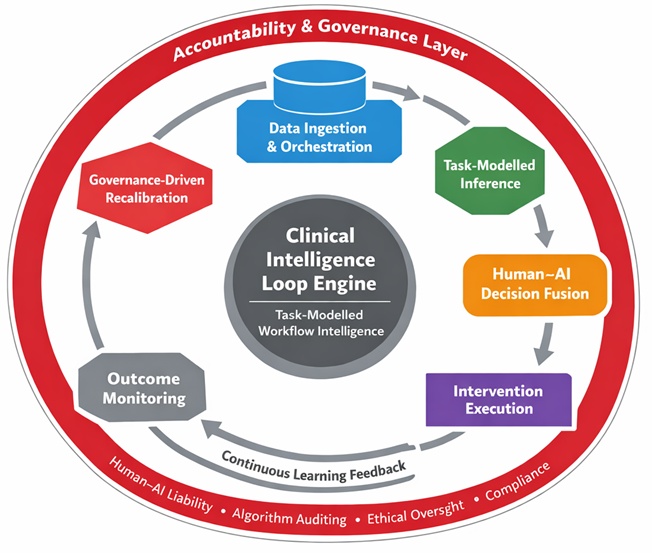
Figure 1. The clinical intelligence loop: a closed-loop architecture for responsible workflow automation in healthcare AI
The synthesis presented in this review indicates that workflow automation in healthcare AI cannot be understood solely as a technical capability or incremental extension of predictive analytics. Instead, automation functions as a socio-technical infrastructure in which computational intelligence, human expertise, and governance mechanisms are tightly interwoven across clinical operations [5, 13, 27]. The reviewed literature consistently demonstrates that organizations achieving sustained automation benefits are those that redesign clinical workflows around integrated intelligence loops rather than simply inserting algorithms into pre-existing processes.
This shift mirrors broader transformations across digital health ecosystems. As health systems increasingly depend on automated pipelines to coordinate documentation, triage prioritization, measurement extraction, and safety monitoring, the locus of innovation moves from isolated predictive models toward orchestration architectures capable of coordinating heterogeneous tasks and actors [1, 4, 21]. In such environments, AI functions less as a diagnostic support tool and more as an operational substrate that dynamically distributes cognitive and procedural labor between human clinicians and machine agents.
Crucially, the literature indicates that automation success is rarely determined by algorithmic performance alone. Even highly accurate models fail to produce sustained organizational impact when deployed without clearly defined task boundaries, human-factor calibration, and traceable accountability chains [9, 14, 25]. Conversely, moderately performing models embedded within robust orchestration architectures frequently yield measurable gains in efficiency and safety because they align with the broader workflow ecology of healthcare delivery systems [17, 26].
Task modeling emerges from the reviewed evidence as the structural backbone that enables scalable automation in healthcare environments. By decomposing complex clinical processes into modular, machine-executable primitives, task models translate human workflows into operational units that AI systems can execute, coordinate, and monitor [19, 23].
Across specialties—including pathology, cardiology, and surgical process modeling—high-fidelity task ontologies enable AI agents to anticipate procedural steps, trigger context-aware decision support, and dynamically allocate subtasks between humans and machines [18, 19, 23]. This capability transforms automation from a static rule-based process into a context-sensitive orchestration mechanism capable of responding to real-time clinical dynamics.
However, the literature also emphasizes that task modeling must remain an iterative socio-technical practice rather than a static engineering artifact. Clinical workflows evolve in response to new technologies, regulatory requirements, and organizational learning processes. Mature automation infrastructures, therefore, incorporate mechanisms for continuous task-model refinement driven by outcome monitoring and clinician feedback loops [13, 26].
Another critical insight concerns the human-factor parameters embedded within task ontologies. Studies repeatedly show that task models accounting for cognitive load, interruption tolerance, and trust calibration achieve substantially higher adoption and sustained performance compared with purely performance-optimized automation pipelines [9, 10, 14]. In other words, effective task modeling does not merely describe clinical processes; it encodes the behavioral realities of clinicians interacting with AI systems.
The review further underscores the central role of human-factor engineering in determining the long-term viability of AI-enabled workflow automation. While automation promises to reduce cognitive burden and operational inefficiencies, poorly calibrated systems can inadvertently introduce new forms of risk, including automation bias, alert fatigue, and clinician deskilling [10, 14, 16].
Evidence from AI-assisted documentation systems illustrates this duality particularly clearly. Large-language-model-driven scribes have been shown to reduce documentation time and improve workflow efficiency significantly. Yet, deployments lacking transparent interfaces or override mechanisms frequently lead clinicians to over-rely on automated outputs without adequate verification [12, 17]. Such dynamics can undermine patient safety and erode trust in automation systems.
To address these risks, several studies advocate for human-AI decision fusion architectures in which automated outputs are explicitly positioned as advisory signals rather than authoritative decisions [1, 9]. Interfaces that visualize model confidence, highlight data provenance, and enable rapid clinician override appear particularly effective in maintaining appropriate trust calibration [14].
Human factors also extend beyond individual user interfaces to encompass organizational dynamics. Automation frequently redistributes cognitive and procedural workload across clinical teams, altering role definitions and communication patterns within care environments [1, 10]. Systems that explicitly support shared mental models between clinicians and AI agents—through transparent feedback loops and collaborative task orchestration—demonstrate significantly greater resilience and long-term adoption.
Perhaps the most consequential insight emerging from the literature concerns the role of accountability structures in sustaining AI-enabled workflow automation. Governance mechanisms are no longer peripheral regulatory add-ons; they constitute foundational infrastructure necessary for maintaining clinical trust, legal defensibility, and regulatory compliance [13, 25, 27].
The reviewed studies consistently highlight the importance of end-to-end traceability, whereby every automated action can be linked to its originating data sources, model inference processes, and subsequent clinical outcomes [18, 20, 29]. Such traceability enables organizations to reconstruct decision pathways, audit model behavior, and assign responsibility when errors or unexpected outcomes occur.
Modern governance frameworks, therefore, embed accountability primitives directly into automation pipelines. Examples include immutable audit logs, automated bias-monitoring agents, model-version tracking, and dynamic recalibration triggers that activate when performance drift or safety signals are detected [13, 25, 27]. These mechanisms ensure that automation remains continuously observable and contestable rather than operating as opaque algorithmic infrastructure.
Importantly, accountability structures also facilitate organizational learning. By capturing override patterns, clinician feedback, and outcome discrepancies, governance infrastructures generate datasets that inform subsequent model refinement and task-model updates [10, 12]. In this sense, governance becomes not only a regulatory safeguard but also a learning mechanism within the broader clinical intelligence architecture.
The integrative framework proposed in this review—the clinical intelligence loop—provides a conceptual mechanism for understanding how task modeling, human-factor engineering, and accountability infrastructures converge to enable scalable healthcare automation. Rather than treating data pipelines, machine-learning models, deployment interfaces, and governance controls as independent components, the loop conceptualizes them as tightly coupled stages within a continuous operational cycle.
Within this architecture, data ingestion and orchestration supply structured, provenance-tracked inputs that feed task-modeled inference engines [17, 20]. Model orchestration layers then route tasks across specialized or foundation models according to contextual confidence thresholds [18, 21]. Decision fusion interfaces integrate machine inference with clinician judgment, enabling collaborative reasoning processes rather than unilateral automation [9, 14].
Subsequent intervention execution stages translate fused decisions into operational actions—ranging from documentation generation and measurement extraction to triage alerts and infection-control recommendations [1, 29]. Outcome monitoring mechanisms capture real-world results and clinician override signals, which are subsequently analyzed within governance frameworks that trigger recalibration of models, task definitions, and deployment protocols [13, 27].
By conceptualizing automation as a closed-loop intelligence architecture, the framework explains why systems achieving sustained performance exhibit tight coupling across all stages. Weak coupling at any interface—whether missing data provenance, poorly modeled tasks, or absent governance triggers—introduces systemic fragility that propagates across the entire automation ecosystem [25, 26].
The findings of this review carry significant implications for healthcare organizations seeking to scale responsible AI automation beyond experimental pilots. First, the evidence suggests that successful deployments require architectural thinking rather than isolated algorithm development. Investments in data infrastructure, task modeling, and governance mechanisms are at least as critical as improvements in model accuracy.
Second, human-factor engineering must be treated as a primary design discipline within healthcare AI development. Systems that fail to account for clinician cognition, workload distribution, and trust calibration risk undermine the very efficiency gains they aim to achieve [10, 14].
Third, governance infrastructures should be integrated into automation pipelines from the earliest design stages. Traceability, auditability, and shared liability structures are not optional regulatory features but prerequisites for sustained clinical adoption and regulatory acceptance [13, 27].
Finally, health systems must recognize that automation introduces new organizational learning opportunities. Feedback generated through clinician interactions, override patterns, and outcome monitoring provides valuable insights that can continuously refine both AI systems and clinical workflows [12, 20].
Artificial intelligence is rapidly transforming from a set of specialized analytical tools into a foundational infrastructure for healthcare workflow automation. This narrative review synthesized emerging evidence on task modeling, human factors, and accountability structures to elucidate the architectural principles that enable safe and scalable automation across healthcare systems and analytics platforms.
The analysis reveals that effective workflow automation depends on three interdependent pillars. Task modeling provides the structural mechanism through which complex clinical processes are decomposed into machine-executable primitives. Human-factor engineering ensures that automation systems remain aligned with clinician cognition, workload dynamics, and trust calibration. Accountability infrastructures embed governance, traceability, and shared liability into the operational fabric of automated systems.
These elements converge within the proposed clinical intelligence loop, a closed-loop architecture that integrates data orchestration, model inference, human-AI decision fusion, intervention execution, outcome monitoring, and governance-driven recalibration. Systems that maintain tight coupling across these stages demonstrate sustained improvements in efficiency, safety, and organizational learning.
Ultimately, the future of healthcare AI lies not in isolated algorithms but in responsible automation ecosystems that harmonize computational intelligence with human expertise and institutional governance. By designing automation infrastructures that treat task modeling, human factors, and accountability as core architectural components, healthcare organizations can harness AI to enhance clinical performance while preserving the ethical and professional foundations of medical practice.
None
None
None
None
Open Access The author(s) retain copyright. This article is licensed under the Creative Commons Attribution-NonCommercial-ShareAlike 4.0 International License. It may be shared and adapted for non-commercial purposes with appropriate attribution, an indication of changes, and distribution of adaptations under the same license. Third-party material may be subject to separate terms identified in its credit line. View the license at https://creativecommons.org/licenses/by-nc-sa/4.0/.
 Clinical Intelligence Research Press