Clinical decision latency, defined as the temporal interval from the moment actionable clinical data becomes available to the initiation of a corresponding therapeutic or diagnostic action, constitutes an under-recognized yet critical safety variable in contemporary healthcare delivery. Prevailing patient safety paradigms predominantly concentrate on categorical errors of commission or omission while largely treating time as an exogenous operational factor rather than an intrinsic propagative risk element capable of independently driving harm. This conceptual systems article reframes clinical decision latency as a primary, quantifiable, and governable safety variable. It proposes the clinical latency oversight lattice (CLOL)—an original infrastructural framework specifically designed to detect, quantify, assign accountability for, and interrupt harmful temporal delays across care pathways. Drawing on a targeted synthesis of literature that collectively addresses clinical decision support limitations, diagnostic uncertainty propagation, consequences of treatment delays, health IT-induced temporal vulnerabilities, and AI integration challenges, the manuscript argues that latency functions not as mere logistical inefficiency but as a dynamic, modality-sensitive, context-dependent risk multiplier. The CLOL architecture organizes temporal accountability into four interdependent lattice layers linked by a bidirectional feedback topology that enables real-time drift monitoring, explicit actor/system responsibility mapping, safety-variable score propagation, and orchestrated mitigation responses. Three interpretive mathematical expressions capture core dynamics: risk propagation across pathways, exponential decay of decision confidence under accumulating latency, and cumulative governance/monitoring burden. By institutionalizing latency as a traceable safety variable within a closed-loop accountability structure, CLOL offers healthcare analytics and AI system designers a theoretical and architectural foundation for shifting from retrospective error analysis toward prospective temporal harm prevention in high-stakes clinical environments.
The accelerating integration of continuous physiologic monitoring, automated laboratory reporting, point-of-care imaging, and predictive AI models into acute care settings has dramatically increased the volume and velocity of clinically relevant data available to decision-makers [1-3]. Paradoxically, this data-rich environment has not proportionally reduced preventable harm; instead, numerous studies document that critical therapeutic windows continue to close due to delays between data availability and clinician action [4-6]. In high-acuity domains such as intensive care, trauma resuscitation, sepsis management, and intraoperative decision-making, even relatively short latency periods—measured in minutes to hours—can initiate irreversible physiologic cascades [7-11]. These observations compel a paradigm shift: clinical decision latency should no longer be conceptualized as background process friction or a quality-of-care efficiency indicator, but rather elevated to the status of a primary safety variable whose magnitude, direction, and propagation directly modulate patient risk independent of the correctness of the eventual decision [1, 6]. Treating latency in this manner aligns with emerging systems-thinking approaches to patient safety that seek to identify latent preconditions of harm before adverse events materialize [3, 12-17].
Modern electronic health record ecosystems aggregate information from fundamentally dissimilar sources: high-frequency streaming data from bedside monitors (seconds-level resolution), intermittent laboratory results (minutes to hours), radiology reports and images (tens of minutes to hours), and unstructured clinician documentation (variable) [18-25]. Each modality carries its own intrinsic temporal semantics and clinically acceptable latency envelope. Yet most existing decision-support and alerting infrastructures apply uniform or arbitrary time thresholds—if they consider time at all—creating a mismatch that systematically under-detects harmful delays in slower modalities while generating excessive noise in faster ones [5, 12]. For instance, a 45-minute delay in troponin result acknowledgment may represent catastrophic latency in suspected acute coronary syndrome, whereas the same interval is inconsequential for routine thyroid-function testing [4, 14]. A robust temporal accountability system must therefore incorporate modality-stratified, context-aware thresholds that reflect physiologic urgency, evidence-based intervention windows, and severity-adjusted risk gradients rather than calendar time alone [13, 14, 26-29]. Failure to do so renders downstream AI tools—however accurate—vulnerable to propagating already-delayed decisions [10, 24].
Implementing continuous latency surveillance faces formidable infrastructural barriers. Most hospital information systems were architected for episodic documentation and billing rather than real-time temporal auditing [17]. Interoperability standards (e.g., HL7 FHIR, older CDA) rarely mandate sub-minute timestamp precision or latency metadata propagation across components [2, 8]. Alert engines prioritize content relevance over timeliness-of-response tracking. When they do monitor response intervals, they frequently do so only after alerts have fired—missing pre-alert latency entirely [2, 7]. Cloud-based analytics platforms introduce additional latency through data ingestion queues, model inference times, and result delivery. Yet, few incorporate mechanisms to expose or govern these pipeline delays as safety-relevant variables [17, 27]. These architectural legacies collectively render harmful decision delays invisible until downstream harm manifests, at which point root-cause analysis is retrospective and punitive rather than prospective and preventive [18, 20]. A purpose-built temporal accountability layer must therefore operate orthogonally to existing infrastructures, intercepting timestamped events at ingestion points and enforcing accountability without requiring wholesale system replacement.
Current regulatory, accreditation, and institutional governance structures lack explicit constructs for temporal accountability. Adverse-event reporting taxonomies capture “delay in diagnosis/treatment” as a secondary descriptor rather than a root causal pathway [14, 16, 18]. Ethical guidelines for AI in healthcare emphasize explainability, fairness, and bias mitigation but rarely address timeliness as a dimension of trustworthiness [6, 9]. When AI augments human decision-making, latency introduced by model computation, result review, or overridden alerts creates shared-responsibility zones where accountability diffuses [1, 9]. Without a formal governance topology that traces latency accumulation to specific nodes (human, algorithmic, infrastructural), these zones become liability black holes. The proposed framework directly confronts this deficit by instituting a closed-loop accountability lattice that records, scores, and escalates temporal deviations in real time while supporting retrospective forensic auditing and prospective threshold refinement [3, 6]. Table 1 defines how harmful clinical decision latency differs across data modalities by aligning temporal signal structure, failure mode, accountability locus, and governance requirement within the CLOL framework.
Table 1. Temporal accountability matrix across clinical data modalities, urgency contexts, and latency failure modes
Clinical data modality | Temporal signal characteristics | Typical decision dependency | Harm sensitivity to delay | Dominant latency failure mode | Accountability locus is most likely implicated | Governance implications within CLOL |
Continuous physiologic monitoring | High-frequency and second-level streaming data | Immediate recognition of physiologic instability | Very high in acute deterioration states | Silent acknowledgment delay despite data availability | Bedside clinician, alert routing logic, monitor–EHR interface | Requires narrow thresholds, continuous drift sensing, and rapid escalation pathways |
Discrete laboratory results | Intermittent, batch-like release with timestamped completion | Confirmation or exclusion of emergent diagnostic/treatment decisions | High when linked to time-sensitive syndromes | Result available but unreviewed, or reviewed without action initiation | Ordering clinician, inbox workflow, result-delivery middleware | Requires result-to-review latency tracking and accountable review ownership |
Imaging/report outputs | Acquisition-to-interpretation-to-action sequence | Escalation of treatment, triage change, or procedural intervention | Moderate to very high, depending on scenario | Interpretive bottleneck or report-action disconnect | Radiology workflow, requesting team, report notification channel | Requires multi-step latency decomposition rather than a single total-delay measurement |
Unstructured clinical documentation | Variable, asynchronous authoring and retrieval | Context consolidation, handoff continuity, and deferred decision support | Moderate but cumulatively important | Critical context documented too late for operational use | Documenting clinician, note-finalization process, EHR retrieval design | Requires provenance-aware timestamping and delayed-context visibility rules |
AI/CDSS output streams | Event-triggered inference with processing and review delay | Prioritization, prediction-assisted action, or override support | High when clinical windows are narrow | Accurate output delivered too late or not acted upon | Model pipeline, result presentation layer, clinician reviewer | Requires end-to-end latency accountability beyond model discrimination performance |
Referral / cross-service communication | Episodic, organizationally mediated transfer events | Specialist evaluation, procedural authorization, or cross-team decision progression | High in fragmented pathways | Handoff delay with diffused ownership across teams | Referring service, receiving service, and the administrative routing system | Requires explicit responsibility transfer nodes and escalation for unresolved ownership |
These interlocking dimensions—acute-care urgency, modality heterogeneity, infrastructural opacity, and governance vacuum—collectively justify the development of a dedicated temporal accountability architecture. The following sections synthesize the evidentiary foundation and present the clinical latency oversight lattice (CLOL) as a coherent systems-level response.
Clinical decision support systems (CDSS) have matured considerably since the mid-2010s, with substantial literature addressing alert fatigue, override rates, and content appropriateness [2, 7]. However, temporal performance remains a glaring blind spot. Multiple studies document that even well-tuned alerts frequently fail to alter clinician behavior when the time between alert delivery and required action exceeds narrow safety windows [2]. In anesthesia and perioperative domains, intraoperative CDSS tools detect physiologic deviations promptly but suffer from silent accumulation of response latency until critical events occur [11]. Surgical AI-augmented decision-making similarly reveals that model outputs, while accurate, arrive too late in fast-moving scenarios to influence outcomes meaningfully [1]. These patterns indicate that conventional CDSS architectures treat time as an external constraint rather than an internal variable requiring active governance—leaving latency-induced harm unaddressed even when content-level support functions optimally [6, 9].
Diagnostic error remains one of the most prevalent and costly forms of medical harm, with delay consistently identified as a leading subtype [14, 16]. Emergency department reviews show that uncertainty compounds nonlinearly when temporal windows for confirmatory testing (imaging, labs) are missed, converting ambiguous presentations into definitive adverse events [4]. In pediatrics and ambulatory care, fragmented referral loops—where latency between initial suspicion and specialist evaluation exceeds governance limits—produce cascading diagnostic failures that evade standard safety classification schemes [16, 18]. Perhaps most compellingly, large-scale meta-analyses of antifibrinolytic administration in acute severe bleeding establish a clear temporal dose-response curve: mortality reduction degrades continuously and measurably with each incremental minute of delay [13]. Together, these bodies of work elevate delay from an incidental factor to a mechanistically central driver of harm propagation, warranting its reconceptualization as a standalone safety variable amenable to targeted infrastructural intervention [14, 18].
Recent AI applications in healthcare showcase impressive discriminative performance across domains: continuous cardiac-signal classification, multiparametric prostate MRI interpretation, longitudinal EHR trajectory reconstruction, real-time antibiotic dosing, and acute-kidney-injury early warning [24–27, 29]. Yet virtually every implementation inherits the temporal vulnerabilities of the underlying data pipelines and human–machine interfaces. When inference latency, result delivery delay, or clinician review time push total decision latency beyond clinical thresholds, superior model accuracy provides little protective value [10, 24]. Moreover, AI can inadvertently exacerbate drift: automated alerts may desensitize users (increasing response latency), while black-box outputs may prolong interpretive time compared with simpler rules-based systems [9]. These dynamics underscore an urgent architectural requirement: any AI augmentation layer must be nested within a latency-aware governance superstructure capable of monitoring, scoring, and mitigating temporal degradation end-to-end [6, 10, 25].
Health IT-related adverse events frequently involve temporal dimensions that current reporting systems under-specify [17]. Configuration errors, interface incompatibilities, alert suppression logic, and data-synchronization failures all inflate end-to-end decision latency without triggering conventional safety alarms [17, 20]. Patient-safety culture assessments link inadequate temporal monitoring practices to elevated diagnostic error rates across settings [20]. Conversely, diagnostic-stewardship programs that enforce strict timing rules for high-risk tests (e.g., Clostridioides difficile assays) achieve significant reductions in unnecessary testing and downstream harm, indirectly demonstrating the protective potential of enforced temporal boundaries [22, 23]. Spanning critical care, radiology error analysis, nephrology prediction tools, infectious-disease stewardship, and oncology diagnostic pathways, this diverse evidence base converges on a single structural conclusion: undetected or ungoverned clinical decision latency functions as a systemic precondition for preventable harm. It therefore demands dedicated architectural attention [1, 3, 6, 9, 17].
The clinical latency oversight lattice (CLOL) constitutes a purpose-designed, infrastructural response to the temporal accountability deficit identified above. Unlike conventional linear pipelines or hierarchical CDSS architectures, CLOL organizes temporal governance as a four-layer lattice whose nodes and edges explicitly represent decision points, latency vectors, accountability mappings, and bidirectional feedback flows.
All incoming clinical data streams—continuous vital signs, discrete laboratory values, imaging metadata with acquisition timestamps, free-text notes with dictation times—are captured at source with high-fidelity timestamps [25, 27]. Dedicated ingestion adapters normalize heterogeneous update frequencies into a common temporal-event format, producing per-decision-node latency vectors that carry forward provenance information (source modality, generation time, transmission delays). This layer establishes the foundational data substrate for all subsequent accountability computations without altering original clinical workflows.
A continuously operating drift engine evaluates each latency vector against a library of context-conditioned thresholds. Thresholds are stratified by clinical urgency tier (e.g., life-threatening, serious but stable, routine), modality velocity class, and institutional governance policies [8, 10]. Deviations trigger immediate accountability mapping: responsibility is attributed to the most proximal accountable entity—human clinician, automated agent, interface component, or infrastructure layer—using metadata trails preserved from layer 1. Mapping occurs at the earliest detectable point to minimize diffusion of responsibility.
Latency is elevated to an explicit, dynamic safety variable through quantitative scoring. Risk propagation across sequential or parallel care-pathway segments is formalized as:
Decision-confidence decay under accumulating latency follows an exponential model motivated by psychophysical and physiologic time-sensitivity literature:
with C(t) residual confidence, baseline, α decay rate (higher for time-critical states), cumulative latency, and f(context) a context-sensitivity adjustment [14].
When aggregated risk or confidence C(t) breaches predefined escalation thresholds, layer 4 instantiates tiered responses: passive logging → visible escalation alerts → forced handoff → resource reallocation prompts → executive dashboard flagging for oversight committees. The governance burden imposed by continuous monitoring is modeled as:
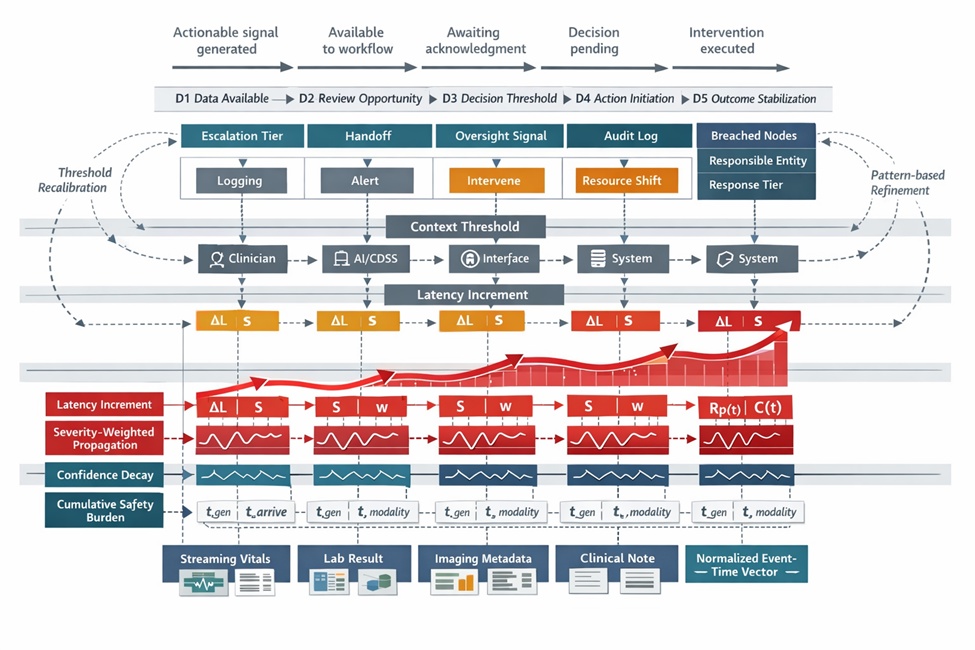
Figure 1. Clinical latency oversight lattice (CLOL) for temporal accountability in care pathways. The figure depicts the manuscript’s proposed four-layer bidirectional architecture for governing clinical decision latency as an explicit safety variable. Multimodal time-stamped clinical inputs are first normalized into latency-aware event vectors, then evaluated against context-conditioned temporal thresholds to identify harmful drift and assign accountability to the most proximal responsible actor or system component. Detected delays are transformed into dynamic safety scores through propagated risk accumulation and decision-confidence decay across sequential care-pathway nodes. When threshold breaches occur, tiered governance responses are triggered, ranging from passive logging to escalation, handoff, resource reallocation, and oversight review. Dashed backward feedback arcs indicate prospective threshold refinement and retrospective learning, distinguishing CLOL from conventional feed-forward decision-support designs. Table 2 analytically differentiates the four CLOL layers by specifying the distinct inputs, operations, outputs, accountability roles, and failure-containment functions that together enable prospective temporal harm governance.
Table 2. Conceptual differentiation of the four CLOL layers: inputs, core operations, outputs, accountability role, and failure containment function
CLOL layer | Primary analytical input | Core operation | Immediate output | Accountability function | Failure containment role | Consequence if absent |
Layer 1: Latency sensing and multimodal ingestion | Source-level timestamps, modality provenance, transmission metadata, event-generation times | Normalize heterogeneous clinical events into comparable latency-aware vectors | Structured temporal event stream with preserved provenance | Establishes evidentiary traceability for all subsequent attribution | Prevents invisibility of delay at the data-capture stage | Harmful latency remains hidden within fragmented systems and cannot be reliably measured |
Layer 2: Temporal drift analysis and accountability mapping | Normalized latency vectors plus urgency-, modality-, and policy-conditioned threshold library | Detect deviation from acceptable temporal envelopes and assign responsibility to the most proximal accountable actor or component | Drift flags, breach states, and the responsibility map | Converts delay from an abstract system problem into a traceable accountability event | Prevents diffusion of responsibility and delayed recognition of threshold breach | Delays are noticed only retrospectively, and accountability becomes ambiguous |
Layer 3: Safety variable scoring and risk propagation | Drift events, latency increments, severity multipliers, modality weights, mitigation terms, and cumulative elapsed time | Compute propagated risk and confidence erosion across sequential care nodes | Dynamic risk trajectory and confidence-decay profile, pathway-level temporal burden signal | Quantifies the safety significance of delay rather than treating all breaches as equivalent | Prevents underestimation of cumulative harm from serial small delays | Decision-makers lack a principled way to prioritize which delays warrant escalation |
Layer 4: Governance response and feedback orchestration | Risk thresholds, confidence thresholds, responsibility map, audit context, and resource burden indicators | Trigger tiered mitigation and feed lessons backward for recalibration and policy refinement | Escalation action, handoff, resource prompt, oversight signal, and learning loop | Links measurement to action and institutional governance | Prevents static surveillance without interruption or adaptive learning | The system detects latency but fails to mitigate, institutionalize, or learn from it |
The bidirectional topology fundamentally differentiates CLOL from feed-forward designs: forward flows enable immediate harm interruption, while backward flows support continuous model refinement, cross-institutional pattern sharing, and governance policy evolution—all without requiring empirical training or performance benchmarking at this conceptual stage [1, 6, 9].
The CLOL introduces a fundamental reconfiguration of how temporal dimensions influence safety, workflow, resource utilization, and institutional governance within healthcare delivery systems [3, 6, 9]. By designating clinical decision latency as an explicit safety variable and embedding it within a layered, bidirectional accountability architecture, CLOL generates cascading effects across multiple subsystems—clinical, operational, technological, economic, and regulatory—without presupposing specific implementation outcomes or quantitative performance gains [1, 17, 20]. This section explores these dynamics in depth, examining how the lattice’s layers and feedback topology interact with existing healthcare ecosystems to foster temporal harm prevention while addressing potential frictions in adoption and scalability.
Integration of CLOL shifts clinician attention from reactive error recovery toward proactive temporal risk management [1, 6, 11]. In high-velocity environments such as emergency departments or intensive care units, where data streams arrive asynchronously from physiologic monitors, laboratory interfaces, and imaging systems, the lattice’s layer 1 ingestion and layer 2 drift analysis provide continuous visibility into accumulating latency vectors [25, 27]. This visibility enables clinicians to prioritize actions based on propagated risk scores rather than solely on clinical urgency cues or interruptive alerts, potentially transforming disjointed workflows into temporally orchestrated sequences [2, 7, 10]. For example, in surgical decision-making contexts, where intraoperative delays can compound silently, CLOL’s real-time drift mapping ensures that accountability is assigned at the point of deviation, encouraging preemptive adjustments before critical thresholds are breached [1, 11]. The bidirectional feedback topology further supports symbiosis between human judgment and infrastructural monitoring: forward propagation interrupts imminent harm through escalation protocols, while backward loops allow clinicians to annotate latency events, refining threshold models over time without requiring external recalibration [3, 6, 8]. Such closed-loop interaction mitigates automation bias by keeping temporal accountability transparent and contestable, ensuring that AI-augmented pathways remain human-centered rather than algorithmically dominant [9, 25]. In diagnostic pathways characterized by uncertainty—such as those in emergency or pediatric settings—the exponential confidence-decay model formalized in layer 3 quantifies how prolonged latency erodes interpretive reliability, prompting earlier escalation or parallel testing strategies and thereby reducing the propagation of diagnostic errors into treatment phases [4, 14, 16]. This realignment not only enhances individual clinician efficacy but also promotes team-level coordination, as shared latency dashboards could facilitate handover communications, minimizing information loss during shift changes or multidisciplinary rounds [18, 20].
CLOL’s governance-load formula
In environments transitioning toward value-based reimbursement, where penalties for readmissions, prolonged lengths of stay, and preventable complications are increasingly tied to temporal performance metrics, CLOL offers a theoretical scaffold for linking latency governance to financial accountability [15, 20]. Propagated risk scores serve as proxies for downstream harm probability, enabling institutions to demonstrate proactive mitigation of costly delays (e.g., in sepsis bundles, acute myocardial infarction reperfusion, or postoperative deterioration) through auditable temporal logs [10, 13, 16]. Backward feedback loops facilitate institutional learning that refines latency thresholds based on observed harm patterns, supporting continuous quality improvement programs eligible for shared-savings arrangements under models like accountable care organizations [15, 20]. From a payer perspective, standardized latency metadata propagated through the lattice could underpin new reimbursement modifiers—rewarding systems that maintain low cumulative in high-risk cohorts or penalizing persistent drift beyond governance-defined envelopes, thereby incentivizing infrastructural upgrades [15]. This alignment creates economic incentives for investment in temporal accountability, shifting cost structures from reactive harm remediation (e.g., litigation, extended hospitalizations) toward preventive temporal optimization [16, 18, 21]. In specialized domains like oncology or rare genetic diseases, where diagnostic delays incur substantial economic burdens through missed therapeutic windows, CLOL’s modality-specific scoring could justify tiered reimbursement for accelerated pathways, fostering equity in resource distribution across patient populations [21, 26]. Moreover, by quantifying governance load, the framework aids in cost-benefit analyses for AI adoption, highlighting scenarios where latency reduction offsets implementation expenses [1, 9, 24].
CLOL addresses a core deficit in existing governance frameworks: the absence of mechanisms to trace and assign responsibility for temporal drift in AI-augmented pathways [3, 6, 9]. By mapping deviations to specific nodes (human, algorithmic, infrastructural) at the earliest detectable stage, the lattice establishes auditable temporal accountability chains that support forensic review following adverse events, aligning with patient-safety reporting requirements [14, 17, 18]. This traceability aligns with emerging ethical imperatives for AI in healthcare, where explainability must extend beyond diagnostic reasoning to include timeliness of reasoning, as delays can exacerbate inequities in access or outcomes [6, 9, 21]. Regulatory bodies could leverage CLOL-derived metadata to define latency-related performance boundaries for non-device clinical decision support software, particularly in time-sensitive contexts where independent clinician review is constrained by workflow pressures [1, 3, 8]. The bidirectional topology further enables prospective governance evolution: learned patterns from institutional deployments inform threshold harmonization across organizations, fostering standardized temporal safety benchmarks without mandating centralized control or compromising institutional autonomy [6, 20]. Ethically, explicit scoring of decision-confidence decay under latency reinforces the principle of non-maleficence by quantifying how delay undermines beneficent action, providing a conceptual basis for justifying escalation protocols even when immediate clinical indicators remain equivocal [14, 16]. In pandemic-era diagnostics or telemedicine scenarios, where temporal errors amplified harm, CLOL’s architecture could integrate with regulatory audits to ensure equitable temporal governance across diverse deployment environments [19, 28].
The lattice’s backward feedback arcs enable propagation of temporal patterns beyond single institutions—aggregated anonymized latency-event data could inform cross-system threshold models, accelerating identification of systemic vulnerabilities (e.g., interoperability-induced delays in regional health information exchanges or supply-chain latencies in global pandemics) [17, 19, 27]. This scalability distinguishes CLOL from localized quality initiatives: forward prevention remains institution-specific, while backward learning supports ecosystem-wide resilience against shared temporal risks [6, 9, 20]. However, scalability introduces governance challenges—data-sharing protocols must preserve patient privacy while enabling pattern mining, and institutional autonomy must be balanced against collective safety gains, potentially requiring federated learning paradigms [25, 27, 28]. The architecture accommodates such approaches, where local lattices exchange threshold refinements without centralizing raw latency vectors, preserving data sovereignty while advancing temporal accountability at scale [27]. In multi-site research consortia or national health systems, this could facilitate benchmarking of latency norms across demographics, revealing disparities (e.g., higher delays in underserved areas) and guiding policy interventions [21, 28]. Overall, these dynamics position CLOL as a catalyst for scalable, interconnected temporal governance, evolving healthcare ecosystems toward greater temporal resilience [1, 3, 17].
The repositioning of clinical decision latency as a primary safety variable through the CLOL framework confronts a persistent structural blind spot in healthcare systems and AI augmentation strategies [1, 3, 6]. Traditional patient-safety paradigms—rooted in taxonomies of error commission, omission, or process deviation—treat time as an implicit background variable, rarely subjecting it to the same rigorous governance applied to diagnostic accuracy or medication correctness [14, 16, 17]. Yet the synthesized evidence underscores that latency operates as a propagative multiplier: modest delays in data acknowledgment or action initiation cascade into disproportionate harm, particularly in time-sensitive domains where physiologic windows close irreversibly, as seen in hemorrhage management, acute kidney injury, or intraoperative crises [10, 13, 29].
By formalizing latency within an explicit architectural lattice, CLOL bridges this conceptual gap, providing infrastructure that makes temporal risk visible, measurable, and accountable across modalities and actors [3, 6, 9]. The four-layer design—ingestion for multimodal normalization, drift analysis for deviation mapping, scoring/propagation for risk quantification, and orchestrated response for mitigation—combined with bidirectional feedback, creates a closed temporal governance loop absent in linear CDSS pipelines [2, 7, 8]. The interpretive formulas advance theoretical understanding: risk propagation captures inter-pathway amplification with modality weights and severity multipliers, confidence decay models psychophysiologic erosion of judgment reliability under cumulative latency, and governance-load quantification highlights the resource trade-offs inherent in continuous surveillance, offering tools for theoretical simulation of system behaviors [13, 14, 29].
Several limitations must be acknowledged at the conceptual level. The framework assumes availability of high-fidelity timestamps and metadata provenance across heterogeneous systems—an assumption challenged by legacy infrastructures and interoperability failures documented in health IT adverse-event analyses [17]. Threshold calibration remains context-dependent and institution-specific, requiring iterative refinement that the backward loops support but do not automate, potentially leading to initial inconsistencies in multi-site deployments [8, 20]. Ethical tensions arise in balancing proactive escalation (potentially increasing interruptive burden and alert fatigue) against watchful waiting, particularly when confidence decay models predict erosion without overt clinical deterioration, as in diagnostic uncertainty scenarios [2, 4, 14]. Economic modeling of latency governance requires further elaboration to quantify return on infrastructural investment in diverse reimbursement environments, where value-based care incentives may vary by jurisdiction [15]. Additionally, while CLOL mitigates AI-amplified latency drift, it does not inherently address upstream data-quality issues (e.g., sensor inaccuracies or EHR entry errors) that could confound latency vectors [12, 25, 27].
Despite these boundaries, CLOL offers a coherent path forward for healthcare analytics and AI system architects [1, 6, 9]. It reframes temporal performance from an operational nuisance to a core safety domain, aligning with broader movements toward proactive, systems-level harm prevention in critical care, radiology, and stewardship programs [3, 11, 22]. Future conceptual extensions could incorporate multi-agent coordination (e.g., across interprofessional care teams or federated institutions), integration with emerging real-time predictive models for anticipatory latency adjustment, or expansion to non-acute settings like chronic disease management, always preserving the foundational commitment to explicit accountability [24, 25, 28]. By synthesizing gaps in diagnostic error, treatment delay, and IT vulnerabilities, the framework underscores the need for temporal-centric redesigns in AI-driven healthcare [14, 16, 17].
Clinical decision latency, long treated as an invisible operational artifact, warrants recognition as a primary, propagative safety variable whose governance is essential for safe, equitable, and effective modern healthcare. The CLOL provides a novel architectural response: a four-layer, bidirectional lattice that senses, analyzes, scores, and orchestrates temporal accountability across modalities, actors, and institutions.
Through modality-stratified ingestion normalizing heterogeneous data velocities, explicit drift mapping assigning responsibility at deviation points, dynamic risk/confidence propagation quantifying harm potential, and tiered governance responses enabling mitigation, CLOL institutionalizes proactive temporal harm interruption while supporting continuous system learning via feedback loops. The interpretive formalisms—risk propagation with weighted summation for pathway interdependencies, confidence decay exponentially modeling judgment erosion, and governance-load integration capturing monitoring costs—supply theoretical rigor to an area previously lacking structured conceptualization, facilitating deeper analysis of temporal dynamics in diverse clinical contexts.
By elevating latency to an explicit safety variable embedded in infrastructural accountability, this framework advances AI-augmented healthcare from reactive error mitigation toward preventive delay governance, addressing vulnerabilities in CDSS, diagnostic pathways, and health IT ecosystems. Implementation pathways remain open for empirical validation in settings like critical care or oncology, but the conceptual foundation establishes temporal accountability as indispensable for next-generation clinical systems. Ultimately, recognizing and governing decision latency as a core safety construct promises to narrow preventable-harm windows, optimize resource deployment across economic models, reinforce ethical traceability in AI integration, and enhance scalability through pattern propagation—fostering resilient healthcare ecosystems capable of minimizing temporal-induced harm.
None
None
None
None
Open Access The author(s) retain copyright. This article is licensed under the Creative Commons Attribution-NonCommercial-ShareAlike 4.0 International License. It may be shared and adapted for non-commercial purposes with appropriate attribution, an indication of changes, and distribution of adaptations under the same license. Third-party material may be subject to separate terms identified in its credit line. View the license at https://creativecommons.org/licenses/by-nc-sa/4.0/.
 Clinical Intelligence Research Press