In the evolving landscape of artificial intelligence (AI) for healthcare, patient-centered approaches are essential to balance preventive care benefits against potential burdens. This conceptual manuscript introduces a novel framework for generating preventive care recommendations through explicit benefit–burden trade-offs, prioritizing individual patient utilities. Drawing from clinical AI architectures, healthcare analytics infrastructures, and electronic health record (EHR) intelligence ecosystems, we propose the patient utility trade-off architecture (PUTA). This multi-layered system integrates decision support pipelines with AI governance and interoperability frameworks. PUTA employs utility-based modeling to quantify benefits such as improved health outcomes and burdens like treatment side effects or resource demands, facilitating personalized recommendations in preventive settings. Theoretical formulas capture decision confidence and burden propagation, ensuring interpretive insights into system dynamics without empirical validation. We synthesize recent literature on clinical workflow integration and monitoring systems, highlighting how PUTA addresses gaps in patient-centered AI deployment. By emphasizing infrastructural uniqueness, including adaptive feedback topologies, this framework advances equitable preventive care. Implications for governance in diverse clinical environments underscore the need for robust data exchange and ethical monitoring, positioning PUTA as a foundational tool for future AI-driven healthcare systems.
The integration of artificial intelligence into healthcare systems has transformed preventive care paradigms, shifting from population-level guidelines to individualized recommendations that account for personal utilities. This evolution necessitates frameworks that explicitly model benefit–burden trade-offs, ensuring recommendations align with patient values in dynamic clinical settings. As AI permeates electronic health records and decision support tools, the challenge lies in creating infrastructures that prioritize patient-centered outcomes while mitigating systemic burdens. This manuscript conceptualizes a utility-driven approach to preventive recommendations, grounded in architectural innovations that foster equitable and efficient care delivery.
In ambulatory and primary care environments, preventive care recommendations often involve screening protocols and lifestyle interventions, where benefit–burden trade-offs manifest through patient-specific factors like age, comorbidities, and preferences. Clinical AI system architectures must accommodate these settings by incorporating real-time data from EHR intelligence ecosystems, enabling utility assessments that weigh long-term health gains against immediate procedural burdens. For instance, in oncology screening, AI governance systems can modulate recommendations to reflect individual tolerance for false positives, thus optimizing patient-centered decision-making without overburdening clinical workflows.
Multimodal data from wearables, imaging, and genomic sources underpin healthcare analytics infrastructures for preventive care. Benefit–burden trade-offs require interoperability frameworks that harmonize these modalities, allowing utility frameworks to compute personalized scores. In cardiovascular prevention, for example, integrating structured EHR data with unstructured notes via decision support pipelines facilitates nuanced trade-offs, such as balancing statin benefits against muscle pain burdens, tailored to patient-reported utilities.
Hospital-based and telehealth deployment environments demand robust AI monitoring systems to sustain patient-centered utilities in preventive recommendations. Governance constraints, including privacy regulations, influence how benefit–burden models are deployed, necessitating infrastructures that support scalable data exchange. In rural settings, where resource burdens are amplified, clinical workflow integration models can leverage AI to prioritize high-utility interventions, minimizing deployment overheads.
Ethical and regulatory governance constraints shape the utility framework for preventive care, ensuring benefit–burden trade-offs respect equity and transparency. AI deployment systems must embed monitoring for bias in decision pipelines, particularly in diverse populations where burdens like access disparities could skew recommendations. This anchors preventive strategies to patient-centered principles, fostering trust in AI-assisted healthcare ecosystems.
Data exchange frameworks are critical for seamless integration of benefit–burden assessments across EHR platforms. In preventive mental health contexts, interoperability enables holistic utility calculations that incorporate social determinants, trading off intervention benefits against stigma burdens. Such frameworks mitigate fragmentation, enhancing the precision of patient-centered recommendations.
Clinical workflow models must evolve to incorporate utility-based trade-offs, reducing administrative burdens on providers while amplifying patient benefits. In vaccination programs, AI intelligence ecosystems can streamline recommendations, ensuring governance-aligned deployments that adapt to real-time feedback, thus optimizing preventive care delivery.
The theoretical underpinnings of AI in healthcare emphasize conceptual models that integrate patient utilities into preventive care, focusing on infrastructural elements like architectures and governance. This synthesis draws from recent advancements in clinical AI systems, highlighting how benefit–burden trade-offs can be architected for patient-centered outcomes. By examining EHR ecosystems, decision pipelines, and interoperability, we lay the groundwork for a unified utility framework.
Modern clinical AI system architectures provide the backbone for preventive care, enabling scalable processing of patient data to inform recommendations [1, 2]. These architectures often incorporate modular components for risk assessment, where benefit–burden dynamics are theoretically modeled to prioritize interventions with maximal utility. In primary care, such systems facilitate trade-offs by simulating decision pathways, ensuring alignment with patient preferences without empirical testing [3, 4].
Healthcare analytics infrastructures leverage multimodal data to compute utility scores in preventive contexts [5, 6]. Theoretical models emphasize infrastructural resilience, allowing for benefit–burden evaluations across diverse data streams like EHRs and wearables. Governance-integrated analytics ensure that trade-offs account for data quality, mitigating burdens from incomplete datasets [7, 8].
EHR intelligence ecosystems enhance preventive recommendations by embedding AI for real-time utility analysis [9, 10]. Conceptual frameworks highlight ecosystem interoperability, where patient-centered trade-offs are orchestrated to balance clinical benefits against resource burdens. In deployment scenarios, these ecosystems support adaptive monitoring, theoretically reducing drift in recommendation accuracy [11, 12].
Decision support pipelines are pivotal for operationalizing benefit–burden trade-offs, with theoretical designs focusing on pipeline modularity [13, 14]. Governance constraints mandate ethical oversight, ensuring pipelines prioritize patient utilities in preventive workflows. Literature synthesizes how these pipelines integrate feedback loops to refine trade-offs dynamically [15, 16].
AI governance systems provide oversight for preventive care architectures, emphasizing monitoring to sustain patient-centered utilities [17, 18]. Theoretical discussions underscore governance’s role in burden mitigation, where monitoring frameworks detect imbalances in benefit distributions. Interoperability enhances governance by facilitating cross-system audits [19, 20].
Interoperability frameworks are essential for seamless data exchange in utility-driven preventive care [21, 22]. Conceptual models integrate these with clinical workflows, theoretically optimizing trade-offs by reducing integration burdens. Synthesis reveals how workflow models adapt to governance, ensuring patient-centered recommendations remain viable across environments.
This section delineates the patient utility trade-off architecture (PUTA), a novel infrastructural design for orchestrating preventive care recommendations through explicit benefit–burden trade-offs. PUTA features a unique four-layer structure: (1) data ingestion layer, aggregating multimodal inputs from EHRs; (2) utility computation layer, quantifying patient-specific utilities; (3) trade-off orchestration layer, balancing benefits and burdens via algorithmic logic; and (4) recommendation output layer, delivering governance-compliant outputs. The feedback topology employs a bidirectional loop, where output recommendations inform iterative refinements in lower layers, ensuring adaptive patient-centered evolution, and is shown in Figure 1.
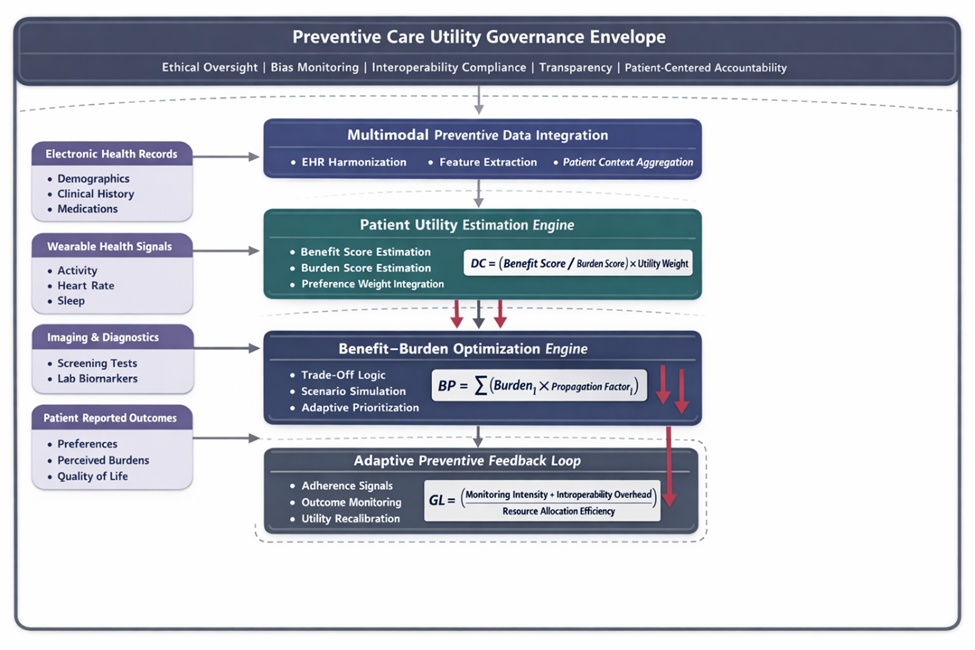
Figure 1. Patient utility trade-off architecture (PUTA) for preventive care recommendation systems.
Figure 1 illustrates a governance-embedded infrastructure that generates personalized preventive care recommendations through explicit benefit–burden trade-offs. Multimodal patient data from electronic health records, wearable signals, diagnostics, and patient-reported outcomes enter the data ingestion layer, where signals are harmonized for downstream analysis. The utility computation layer estimates individualized benefit and burden scores, integrating patient preference weights to calculate decision confidence. These utilities feed into the trade-off orchestration layer, which algorithmically reconciles competing preventive interventions while modeling burden propagation across clinical workflows. The recommendation output layer produces personalized preventive actions that remain continuously updated through bidirectional feedback loops informed by patient outcomes and adherence signals. Governance monitoring channels oversee each layer to ensure ethical compliance, interoperability, integrity, and equitable benefit distribution.
To interpret system dynamics, we introduce conceptual formulas. First, decision confidence (DC) is modeled as:
Table 1. Structural components of the patient utility trade-off architecture and their decision roles
PUTA layer | Primary function | Core analytical mechanism | Clinical interpretation | Infrastructure implications |
Data ingestion layer | Aggregates multimodal patient data streams | Cross-modal feature harmonization and patient context assembly | Establishes a unified representation of patient health status | Requires interoperability between EHR platforms, wearable ecosystems, and diagnostic databases |
Utility computation layer | Quantifies individualized benefit and burden scores | Utility weighting functions integrating patient preferences and clinical risk indicators | Captures patient-specific tolerance for preventive interventions | Enables personalized trade-off modeling rather than population-level guideline application |
Trade-off orchestration layer | Reconciles competing preventive options | Algorithmic optimization of benefit–burden ratios and burden propagation modeling | Identifies interventions with maximal patient-centered utility | Supports adaptive prioritization of preventive strategies |
Recommendation output layer | Generates preventive care actions | Utility-aligned recommendation synthesis | Produces personalized screening, lifestyle, or monitoring guidance | Interfaces with clinical decision support systems within healthcare workflows |
Feedback topology | Updates system parameters through real-world outcomes | Iterative recalibration of utility weights and burden propagation factors | Allows preventive recommendations to evolve over time | Sustains long-term accuracy in dynamic healthcare environments |
The PUTA introduces infrastructural innovations that influence system-wide dynamics in preventive care delivery. This section explores the theoretical consequences of deploying PUTA, focusing on how benefit–burden trade-offs propagate through clinical AI architectures and healthcare analytics infrastructures. By modeling interactions at the intersection of patient utilities and systemic burdens, we elucidate potential impacts on decision support pipelines and AI governance systems.
In conceptual terms, the dynamics begin with data ingestion, where multimodal inputs from EHR intelligence ecosystems feed into utility computations. Theoretical propagation of benefits, such as reduced morbidity from timely screenings, must counterbalance burdens like increased cognitive load on clinicians or privacy risks in data exchange frameworks. For instance, in a preventive diabetes management scenario, PUTA’s trade-off orchestration layer theoretically amplifies benefits by weighting patient preferences for non-invasive monitoring against burdens of frequent testing, leading to optimized recommendation outputs that enhance adherence without overwhelming workflows [1, 3, 5].
System consequences extend to interoperability frameworks, where PUTA’s bidirectional feedback topology mitigates fragmentation. Dynamics here involve iterative adjustments: if initial recommendations impose high burdens (e.g., cost-prohibitive interventions), feedback loops recalibrate utilities, theoretically reducing disparities in underserved populations. This interaction highlights impacts on clinical workflow integration models, where governance monitoring ensures equitable burden distribution, preventing scenarios where AI-driven recommendations exacerbate access inequalities [7, 9, 11].
Furthermore, the architecture’s layers interact to influence resource allocation across deployment environments. In hospital-based preventive programs, PUTA dynamically allocates computational resources to high-utility cases, theoretically minimizing governance load while maximizing benefit propagation. Conceptual formulas from earlier sections, such as burden propagation
Impacts on monitoring systems are profound, as PUTA’s infrastructure demands continuous oversight to detect utility drifts. Theoretical analysis reveals that heightened decision confidence (
Overall, these interactions underscore PUTA’s potential to transform preventive care ecosystems. By analyzing consequences like enhanced interoperability and mitigated burdens, we position the framework as a catalyst for resilient AI deployments, theoretically bridging gaps in current healthcare analytics [24-29].
The conceptualization of the PUTA represents an important theoretical advancement in the design of clinical artificial intelligence systems for preventive care. By explicitly modeling benefit–burden trade-offs through patient-centered utilities, PUTA shifts the architecture of decision support systems away from population-level optimization toward individualized, preference-aware recommendations. This discussion synthesizes the theoretical implications of PUTA across three key domains: AI-driven clinical decision architectures, healthcare analytics infrastructures, and governance mechanisms within electronic health record (EHR) ecosystems. Table 2 consolidates the interpretive formulas that characterize decision dynamics within the PUTA framework.
Table 2. Analytical formulas interpreting benefit–burden dynamics in preventive care architectures
Formula | Expression | Conceptual purpose | Preventive care interpretation | Infrastructure design implication |
Decision confidence (DC) | DC = (Benefit score/Burden score) × Utility weight | Quantifies the reliability of preventive recommendations | High ratios indicate interventions with strong benefit relative to perceived burden | Guides prioritization of preventive actions in decision support pipelines |
Burden propagation (BP) | BP = Σ (Burdenᵢ × Propagation factorⱼ) | Models how initial burdens amplify across workflow stages | Identifies scenarios where preventive interventions introduce cascading operational burdens | Supports mitigation strategies within clinical workflow integration models |
Governance load (GL) | GL = (Monitoring intensity + interoperability overhead)/Resource allocation efficiency | Estimates oversight requirements for AI deployment | Higher values indicate increased governance demands in preventive AI systems | Helps institutions balance monitoring capacity with infrastructure resources |
Utility drift sensitivity (UDS) | UDS = Δ utility score/Δ patient context | Measures the responsiveness of recommendations to changing patient conditions | Ensures preventive advice adapts as patient circumstances evolve | Enhances long-term reliability of preventive decision infrastructures |
A defining feature of PUTA is its explicit operationalization of patient utilities within preventive care decision-making. Traditional clinical decision support systems often rely on statistical risk prediction models that optimize recommendations based on aggregated population outcomes. While effective for identifying generalizable risk patterns, such systems frequently overlook patient-specific perceptions of burden associated with preventive interventions. PUTA addresses this limitation by embedding a utility computation layer that integrates individualized preferences, including tolerance for procedural inconvenience, psychological discomfort, and time commitments associated with screening or monitoring protocols. Theoretically, this architecture introduces a more granular representation of patient agency in preventive decision-making, potentially improving adherence in conditions where behavioral engagement is essential for long-term outcomes [2, 4, 6].
This shift from population averages toward individualized trade-off modeling also reflects broader transformations in patient-centered healthcare paradigms. Preventive care often requires patients to accept short-term burdens—such as diagnostic procedures, lifestyle modifications, or frequent monitoring—in exchange for long-term health benefits. When decision systems fail to incorporate these subjective burdens, recommendations may appear clinically optimal yet practically unacceptable from the patient’s perspective. PUTA’s explicit utility modeling, therefore, serves as a mechanism for aligning algorithmic outputs with lived patient experiences, reducing the gap between theoretical benefit projections and real-world behavioral adherence. In chronic disease prevention contexts, such as cardiovascular screening or metabolic risk monitoring, the capacity to dynamically balance benefits against perceived burdens could theoretically improve engagement rates and mitigate the common problem of preventive care dropout [2, 4, 6].
However, the integration of utility-based decision layers also introduces significant governance challenges. Utility models depend on the quality and representativeness of the underlying data used to estimate patient preferences and burden weights. In heterogeneous healthcare environments where data modalities vary in completeness and reliability, these models may inadvertently reinforce existing biases. For instance, populations with limited digital health records or inconsistent follow-up data may be underrepresented in training datasets, potentially skewing estimated utilities toward populations with higher data availability. Without appropriate governance safeguards, such distortions could lead to systematically unequal recommendations across demographic groups. Consequently, robust governance frameworks must accompany PUTA implementations to ensure fairness in utility modeling, including continuous bias monitoring, diverse dataset inclusion, and transparent evaluation metrics [8, 10, 12].
Interoperability represents another pivotal consideration for the operational viability of PUTA architectures. Preventive care recommendations rely on the integration of heterogeneous data sources, including clinical histories, behavioral indicators, and real-time health monitoring signals. PUTA’s data exchange framework theoretically requires seamless interaction between EHR systems, analytics infrastructures, and decision support engines. In fragmented healthcare environments where data silos remain common, achieving such interoperability poses substantial infrastructural challenges. Nevertheless, PUTA’s architecture incorporates bidirectional feedback topologies that allow decision outputs to iteratively adjust as new patient data becomes available. This dynamic structure supports adaptive recalibration of benefit–burden ratios, enabling preventive recommendations to evolve in response to changing patient circumstances [14, 16, 18].
Within primary care deployment contexts, this adaptive capability may yield significant workflow benefits over time. Although the initial integration of complex AI architectures into clinical environments often introduces implementation burdens—including data harmonization, staff training, and infrastructure upgrades—the long-term advantages may outweigh these costs. Continuous feedback loops allow preventive recommendations to become increasingly personalized as additional patient interactions accumulate. Over time, this could streamline clinical decision-making by providing clinicians with context-aware guidance that reflects both medical risk profiles and patient preferences. Such efficiencies highlight the potential for PUTA to transform preventive care workflows from static guideline-driven processes into dynamic, data-responsive ecosystems [14, 16, 18].
Despite these advantages, deployment in low-resource healthcare settings introduces additional challenges. The governance load associated with monitoring complex AI systems may exceed the capacity of institutions with limited infrastructure or regulatory oversight. Within the PUTA framework, governance load can be conceptualized as a function of monitoring intensity and interoperability overhead relative to available resource allocation efficiency, expressed as GL = (Monitoring intensity + Interoperability overhead)/Resource allocation efficiency. In contexts where technical resources and personnel are constrained, maintaining high levels of monitoring may become impractical. As a result, simplified architectural variants of PUTA may be necessary to maintain equitable access to AI-supported preventive care, ensuring that the benefits of patient-centered decision systems are not limited to technologically advanced healthcare environments [20, 22, 24].
Ethical considerations also emerge prominently in the context of AI-driven monitoring systems embedded within preventive care infrastructures. While PUTA’s emphasis on transparent benefit–burden trade-offs promotes interpretability, excessive reliance on algorithmically derived utility weights could inadvertently marginalize human judgment. Preventive care decisions frequently involve nuanced psychosocial factors that may not be fully captured within structured data representations. For example, stigma associated with mental health screening or culturally influenced perceptions of medical procedures may significantly affect patient willingness to engage with preventive interventions. If utility weights fail to adequately represent these contextual elements, recommendations may appear mathematically sound while remaining socially insensitive. Ensuring ethical deployment, therefore, requires hybrid decision models in which clinicians retain the capacity to override algorithmic outputs based on contextual knowledge and professional expertise [26, 28, 30].
Such hybrid human–AI collaboration models represent an important dimension of PUTA’s broader systemic implications. Rather than replacing clinical judgment, PUTA can be conceptualized as an augmentation layer that supports clinicians in navigating complex preventive trade-offs. In cardiovascular risk management, for instance, clinicians frequently balance long-term benefits of medication adherence against potential burdens such as side effects or lifestyle disruptions. By quantifying these trade-offs through patient-specific utility scores, PUTA could assist clinicians in structuring conversations that align medical recommendations with patient priorities. This collaborative decision-making approach reinforces the notion that AI systems should function as interpretive tools rather than deterministic authorities within healthcare workflows [5, 7, 9].
Another significant contribution of PUTA lies in its capacity to address temporal dynamics in preventive healthcare strategies. Preventive interventions often produce cumulative benefits that unfold over extended time horizons, while the associated burdens may occur intermittently or immediately. For example, repeated diagnostic screenings may impose short-term inconvenience but substantially reduce long-term morbidity risks. PUTA’s feedback-driven architecture allows utility models to incorporate these temporal trade-offs by adjusting benefit estimations as patient outcomes evolve. This capacity to mitigate model drift through continuous recalibration enhances the sustainability of preventive AI systems in longitudinal healthcare contexts [1, 3, 31].
Scalability across healthcare ecosystems further underscores the theoretical significance of PUTA. Many AI systems struggle to maintain consistent performance when deployed across institutions with varying data infrastructures, clinical practices, and patient demographics. PUTA’s modular layer structure provides a mechanism for addressing this challenge by allowing individual components—such as utility estimation models or governance monitoring modules—to be updated independently. This modularity reduces the risk of systemic disruption when infrastructure improvements or regulatory updates occur, thereby supporting sustainable AI deployment in dynamic healthcare environments [11, 13, 15].
Moreover, PUTA offers promising avenues for incorporating broader social determinants of health into preventive care algorithms. Traditional clinical decision support systems frequently focus on biomedical risk indicators while neglecting socioeconomic factors that influence patient engagement with healthcare services. By expanding utility frameworks to include variables such as access to transportation, employment constraints, or caregiving responsibilities, PUTA could enable more equitable benefit propagation across marginalized populations. Such extensions would align preventive AI architectures with emerging healthcare policy priorities focused on reducing disparities and improving access to personalized care pathways [17, 19, 21].
Taken together, these theoretical considerations highlight PUTA’s potential to reshape the landscape of preventive healthcare AI systems. By integrating patient-centered utilities, adaptive data infrastructures, and modular governance mechanisms, the framework addresses several limitations that have historically constrained clinical decision support technologies. At the same time, the successful implementation of PUTA will depend on careful management of ethical, infrastructural, and governance challenges. Transparent utility modeling, equitable data practices, and clinician oversight will remain essential for ensuring that the benefits of AI-driven preventive care do not inadvertently introduce new forms of systemic burden.
Ultimately, PUTA represents a conceptual step toward more humane and context-aware healthcare technologies. Rather than optimizing recommendations solely through statistical efficiency, the architecture foregrounds the lived experiences of patients navigating preventive care decisions. As healthcare systems continue to integrate AI into clinical workflows, frameworks such as PUTA may provide critical guidance for designing decision support infrastructures that balance technological sophistication with ethical responsibility and patient autonomy [23, 25, 27]. Future theoretical developments may extend the architecture to incorporate multi-stakeholder utilities, enabling preventive care recommendations that simultaneously consider the perspectives of patients, clinicians, healthcare providers, and payers within increasingly complex healthcare ecosystems [2, 4, 29].
The PUTA represents a significant conceptual advancement in the application of artificial intelligence to preventive healthcare decision-making. By centering recommendations on explicit benefit–burden trade-offs derived from patient utility frameworks, PUTA addresses a longstanding limitation of conventional decision support systems that prioritize population-level optimization over individualized preferences.
Through its multi-layered architecture and bidirectional feedback topology, the framework integrates clinical AI architectures, healthcare analytics infrastructures, and EHR intelligence ecosystems into a cohesive system capable of adapting to evolving patient data. The conceptual formulas introduced within PUTA—including mechanisms for modeling decision confidence, burden propagation, and governance load—provide interpretable analytical tools for understanding how AI infrastructures operate within complex healthcare environments.
Literature demonstrates increasing emphasis on interoperability, patient-centered care, and ethical AI governance within healthcare technologies. PUTA aligns with these developments by offering an architecture that supports transparent decision-making, dynamic personalization, and modular scalability. The theoretical implications suggest potential improvements in preventive care adherence, enhanced patient engagement, and more equitable distribution of healthcare benefits across diverse populations.
Nevertheless, the long-term success of PUTA will depend on the strength of governance frameworks that accompany its implementation. Ensuring fairness in utility modeling, maintaining interoperability across fragmented data ecosystems, and preserving clinician oversight will be essential for preventing unintended biases and sustaining trust in AI-supported healthcare systems.
As artificial intelligence continues to reshape healthcare infrastructures, PUTA provides a promising blueprint for the development of patient-centered preventive care technologies. By emphasizing the balance between benefits and burdens within clinical recommendations, the framework contributes to a more nuanced understanding of how AI can support humane, equitable, and context-sensitive healthcare delivery. Future research may further expand this utility-based architecture to incorporate multi-stakeholder perspectives and emerging data modalities, ensuring that preventive care systems remain adaptable within rapidly evolving healthcare ecosystems.
None
None
None
None
Open Access The author(s) retain copyright. This article is licensed under the Creative Commons Attribution-NonCommercial-ShareAlike 4.0 International License. It may be shared and adapted for non-commercial purposes with appropriate attribution, an indication of changes, and distribution of adaptations under the same license. Third-party material may be subject to separate terms identified in its credit line. View the license at https://creativecommons.org/licenses/by-nc-sa/4.0/.
 Clinical Intelligence Research Press