In the evolving landscape of artificial intelligence integration within healthcare systems, the challenge of ensuring verifiable and trustworthy clinical text generation persists, particularly in retrieval-augmented summarization pipelines. This conceptual manuscript introduces the evidence-line attribution grounding (ELAG) framework as a novel standard for anchoring generated clinical summaries to source evidence, thereby enhancing transparency and accountability in AI-driven healthcare analytics. Grounded in theoretical principles of information retrieval and attribution mechanics, ELAG delineates a multi-layered architecture that orchestrates evidence tracing across clinical data modalities, from electronic health records (EHRs) to diagnostic reports, while mitigating risks of hallucination and bias propagation in summarization outputs. We synthesize recent literature on clinical AI architectures, interoperability frameworks, and governance models to underscore the necessity for such grounding standards. The framework incorporates interpretive formulas for assessing attribution fidelity, decision confidence in clinical workflows, and governance overhead in deployment environments. By focusing on theoretical infrastructures rather than empirical validations, this work posits ELAG as a foundational blueprint for interoperable, ethical AI systems in healthcare, fostering improved clinical decision support through verifiable text generation. Ultimately, ELAG addresses critical gaps in current retrieval-augmented approaches, promoting safer integration into high-stakes clinical settings where evidence attribution directly impacts patient outcomes and regulatory compliance.
In contemporary clinical environments, where multidisciplinary teams navigate vast repositories of patient data, the imperative for accurate and verifiable text summarization has intensified. Retrieval-augmented summarization, a paradigm that leverages external knowledge bases to enrich generated clinical narratives, emerges as a pivotal tool in these settings. However, without robust grounding standards, such systems risk disseminating unanchored information, potentially compromising patient safety in acute care hospitals or ambulatory clinics. Evidence-line attribution serves as a critical mechanism to tether summaries to original data sources, ensuring that every generated statement in clinical reports—such as discharge summaries or radiology interpretations—can be traced back to verifiable evidence within electronic health records (EHRs). This attribution not only bolsters the reliability of AI outputs but also aligns with regulatory demands in settings like intensive care units, where real-time decision-making relies on synthesized insights from diverse data streams [1, 2].
Clinical text generation intersects with multifaceted data modalities, including structured EHR entries, unstructured narrative notes, and imaging metadata, each posing unique challenges for retrieval-augmented processes. In oncology workflows, for instance, summarization must integrate genomic data with clinical histories, necessitating precise evidence-line attribution to avoid misattribution of prognostic insights. Grounding standards mitigate these risks by enforcing modular retrieval mechanisms that attribute lines of evidence—such as lab results or prior consultations—to specific segments of the generated text. This approach is essential in interoperable ecosystems where data from disparate sources, like federated learning networks, converge [3, 4]. Without such standards, hallucinations in AI-generated summaries could propagate errors across modalities, undermining the integrity of healthcare analytics infrastructures.
The deployment of retrieval-augmented summarization in varied clinical environments, from cloud-based hospital systems to edge-computing devices in remote clinics, underscores the need for adaptable grounding frameworks. Evidence-line attribution facilitates seamless integration into these environments by providing a standardized protocol for tracing summarization outputs back to retrieval sources, thereby enhancing system robustness against data drift in dynamic settings. In governance-constrained deployments, such as those under HIPAA or GDPR, attribution mechanisms ensure auditability, allowing stakeholders to verify AI decisions in real-time [5, 6]. This is particularly vital in emergency departments, where rapid summarization of patient trajectories must maintain evidential fidelity to support ethical AI orchestration.
Governance frameworks in healthcare AI impose stringent constraints on text generation, mandating transparency and explainability to foster trust among clinicians. Retrieval-augmented summarization, while powerful, often lacks inherent attribution, leading to opaque outputs that challenge compliance in regulated environments. Evidence-line attribution addresses this by embedding governance layers that monitor and enforce grounding, reducing the risk of biased or unverified clinical narratives. In pediatric care settings, for example, where data sensitivity is paramount, such standards prevent inadvertent exposure of ungrounded inferences [7, 8]. By theorizing attribution as a core governance tool, we pave the way for infrastructures that balance innovation with ethical imperatives.
The broader healthcare intelligence ecosystem, encompassing decision support pipelines and analytics infrastructures, benefits from grounding standards that unify disparate components. Evidence-line attribution in clinical text generation promotes ecosystem-wide coherence, enabling feedback loops where attributed summaries inform iterative retrieval refinements. This dynamic is crucial in chronic disease management clinics, where longitudinal data summarization must evolve with patient trajectories [9, 10]. Ultimately, these standards catalyze a shift toward more resilient AI ecosystems, where attribution underpins sustainable deployment.
The integration of artificial intelligence (AI) into healthcare systems has revolutionized clinical workflows, particularly through advancements in text generation and summarization. Retrieval-augmented generation (RAG) techniques, which combine large language models (LLMs) with external retrieval mechanisms, offer promising avenues for synthesizing complex clinical information into actionable insights. However, the absence of standardized grounding—ensuring that generated text is firmly anchored to verifiable evidence—poses significant theoretical challenges in maintaining fidelity, transparency, and ethical integrity [11, 12]. This manuscript proposes evidence-line attribution as a conceptual grounding standard specifically tailored for retrieval-augmented summarization in clinical contexts, addressing gaps in current architectures by introducing a novel framework for traceable text generation.
At its core, evidence-line attribution refers to the granular mapping of individual lines or segments in generated clinical text—such as diagnostic hypotheses or treatment recommendations—to their originating evidence sources within retrieved documents. This standard extends beyond mere citation, embedding attribution as an intrinsic component of the generation pipeline to mitigate risks like factual inconsistencies or contextual misalignments. In theoretical terms, it conceptualizes summarization not as an isolated output but as a networked process within healthcare analytics ecosystems, where attribution lines form the backbone of interoperability and governance [13, 14].
The motivation for this work stems from the increasing reliance on AI for clinical decision support, where ungrounded summaries can lead to propagated errors in high-stakes environments. For instance, in EHR intelligence ecosystems, retrieval-augmented systems pull from vast, heterogeneous data pools, yet without attribution, clinicians face difficulties in validating AI outputs against primary sources [15, 16]. This manuscript synthesizes theoretical insights from clinical AI architectures and governance models to advocate for evidence-line attribution as a universal standard, fostering safer and more accountable AI integration.
By delineating a unique architectural framework, we explore how attribution can be orchestrated across layers of clinical workflows, from data ingestion to output validation. This includes interpretive formulas that model attribution dynamics, such as risk propagation in unattributed text or confidence scaling in grounded summaries. Ultimately, this conceptual exploration aims to establish grounding standards as foundational to retrieval-augmented clinical text generation, paving the way for enhanced healthcare systems analytics without empirical claims or validations.
The theoretical underpinnings of evidence-line attribution in clinical text generation draw from interdisciplinary domains, including information retrieval theory, AI governance, and healthcare informatics. At the intersection of these fields lies the challenge of grounding AI-generated outputs in verifiable evidence, particularly within retrieval-augmented paradigms. Retrieval-augmented summarization, as a hybrid approach, augments generative models with retrieved context to produce more informed clinical narratives [1, 17]. However, theoretical models highlight vulnerabilities, such as retrieval noise or generation drift, which necessitate attribution mechanisms to ensure evidential alignment [2, 18].
In clinical AI system architectures, attribution emerges as a key enabler for transparency. Architectures like integrated multimodal frameworks emphasize the need for traceable data flows, where evidence from EHRs or imaging is attributed to generated summaries to support clinical decision pipelines [19, 20]. Governance theories further posit attribution as a regulatory safeguard, modeling it as a feedback loop that monitors AI outputs against source fidelity in deployment ecosystems [3, 21].
Literature on healthcare analytics infrastructures underscores the role of attribution in mitigating biases inherent in retrieval processes. For instance, theoretical analyses of AI quality improvement frameworks advocate for continual monitoring, where evidence-line tracing quantifies drift sensitivity in summarization tasks [4, 5]. Interoperability frameworks, such as those for data exchange in medical imaging, theorize attribution as a standardization tool, enabling seamless integration across federated systems while preserving evidential integrity [6, 22].
Decision support pipelines in clinical settings benefit from grounded summarization, with theoretical models proposing attribution topologies that link retrieval stages to generation outcomes [7, 23]. AI governance and monitoring systems extend this by incorporating attribution into ethical oversight, conceptualizing it as a load-balancing mechanism for resource allocation in analytics workflows [8, 24].
The synthesis of existing scholarship reveals a broad consensus regarding the theoretical necessity of grounding outputs in evidence when deploying artificial intelligence systems in clinical environments. However, despite this consensus, substantial gaps remain in the formalization of evidence-line attribution within clinical text generation workflows. Many contemporary architectures emphasize retrieval accuracy or model performance but do not sufficiently operationalize mechanisms for granular traceability between retrieved evidence and generated clinical statements. As a result, outputs produced in high-stakes healthcare settings may remain opaque, limiting the interpretability and verifiability required for clinical accountability and regulatory oversight [9, 25]. The absence of structured attribution frameworks not only complicates clinical validation but also constrains the adoption of automated summarization tools in environments where auditability and explainability are mandatory.
This manuscript responds to these gaps by theorizing the foundations of a dedicated attribution standard for clinical summarization systems. Drawing on literature that explores workflow integration models and clinical decision-support infrastructures, the proposed conceptualization emphasizes the need for attribution-embedded architectures capable of systematically linking generated text segments to their evidentiary sources [10, 26]. Rather than treating attribution as a post-hoc interpretability feature, the framework positions it as a core infrastructural component of clinical AI pipelines. Such an approach aligns with emerging paradigms in trustworthy artificial intelligence, where transparency, traceability, and reproducibility are treated as foundational system requirements rather than optional enhancements. By articulating a structured model for evidence-line attribution, the manuscript contributes to the theoretical development of standardized practices capable of supporting reliable AI-assisted documentation and summarization within electronic health record (EHR) ecosystems.
Retrieval-augmented summarization is grounded in theories of information retrieval and natural language generation, where relevance ranking mechanisms guide the generation of synthesized textual outputs. In this paradigm, the generative component of the system operates in conjunction with a retrieval module that identifies relevant textual fragments from large corpora. Within clinical environments, these corpora typically consist of electronic health record repositories, laboratory reports, imaging summaries, and prior clinical notes. When a summarization query is issued—such as the abstraction of a patient’s medical history or the consolidation of longitudinal treatment data—the retrieval layer first identifies evidence-bearing documents or text segments that are semantically relevant to the request [11, 27].
The theoretical significance of this architecture lies in the concept of grounding. Grounding refers to the alignment between generated statements and verifiable source material, ensuring that outputs are supported by documented evidence rather than probabilistic inference alone. In healthcare applications, grounding is particularly critical because unverified generative outputs—often described as hallucinations—can introduce clinical inaccuracies with potentially serious consequences. Consequently, the literature conceptualizes attribution as a semantic mapping process in which retrieved evidence chunks are systematically linked to specific lines or segments within the generated summary. This mapping functions as a traceability mechanism, allowing clinicians or auditors to verify the provenance of each statement within the summarized text [12, 28].
From a theoretical standpoint, attribution can therefore be modeled as a structured relationship between three components: the query context, the retrieved evidence corpus, and the generated output sequence. Within this framework, each generated sentence or clause is associated with one or more evidence units, forming an attribution graph that captures the evidentiary lineage of the summary. Such modeling provides the conceptual basis for standardized attribution protocols capable of supporting explainable clinical AI systems.
Clinical artificial intelligence architectures provide valuable theoretical blueprints for integrating evidence attribution into generative systems. Contemporary healthcare AI frameworks frequently adopt layered architectural models that separate data ingestion, retrieval, reasoning, and output generation into modular components. Within these layered systems, evidence attribution can be conceptualized as an intermediate layer operating during inference, where retrieved evidence is aligned with generative outputs before final rendering [1, 13].
Multimodal clinical frameworks further extend this paradigm by incorporating heterogeneous data sources—including structured records, narrative notes, imaging metadata, and laboratory values—into unified analytical ecosystems. In such architectures, attribution becomes a cross-modal mapping process that links generated summaries not only to textual evidence but also to structured clinical indicators. By embedding attribution mechanisms at the inference stage, these systems enhance the reliability and interpretability of generated summaries within complex healthcare analytics infrastructures.
Governance-oriented architectural models introduce an additional dimension by integrating monitoring and validation layers designed to evaluate attribution completeness and consistency. These governance layers operate as supervisory modules that assess whether each generated statement maintains an adequate evidentiary linkage to the underlying clinical record [2, 14]. If attribution gaps are detected, the system may flag the output for revision, re-query the retrieval module, or prompt human review. Such designs illustrate how attribution can function not merely as a documentation feature but as a structural safeguard that enhances the integrity of automated summarization processes in clinical decision-support environments.
Healthcare data ecosystems are characterized by significant fragmentation across institutional, technological, and regulatory boundaries. Electronic health record systems, laboratory information systems, imaging repositories, and external health data platforms frequently operate under heterogeneous data standards and interoperability protocols. This fragmentation presents substantial challenges for automated summarization systems, which must aggregate and interpret information originating from diverse sources while maintaining semantic consistency and traceability.
Interoperability frameworks increasingly highlight the role of attribution as a mechanism for ensuring transparency in cross-system data exchanges. Within these frameworks, attribution is conceptualized as a protocol-level feature that enables verification of evidentiary origins when information moves across institutional or technological boundaries [3, 15]. By embedding attribution metadata into summarization outputs, systems can preserve the provenance of clinical evidence even as data flows through distributed healthcare infrastructures.
In the context of EHR intelligence ecosystems, standardized attribution mechanisms can significantly reduce ambiguity in multi-source summarization pipelines. For instance, when a generated summary references patient diagnoses, treatment histories, or laboratory findings, attribution metadata can specify the originating system, document type, and temporal context associated with each piece of evidence. This capability enhances theoretical coherence in summarization architectures by ensuring that evidence provenance remains transparent throughout the data lifecycle [4, 16]. Moreover, interoperable attribution protocols may facilitate regulatory compliance and cross-institutional collaboration by providing verifiable documentation of evidence sources within automated clinical narratives.
The literature on AI governance increasingly conceptualizes attribution as a central component of monitoring and accountability frameworks for generative systems. In regulated environments such as healthcare, governance mechanisms must ensure that automated outputs adhere to standards of reliability, transparency, and traceability. Attribution provides a quantifiable indicator of these qualities by revealing the degree to which generated statements are supported by verifiable evidence.
Some governance models formalize this relationship by conceptualizing governance load as a function of unattributed elements within generated outputs. In this formulation, the proportion of statements lacking explicit evidentiary linkage serves as an indicator of system risk or oversight requirements [5, 17]. Systems with higher levels of unattributed content may require increased monitoring, human validation, or regulatory scrutiny. In contrast, systems with robust attribution coverage can demonstrate stronger compliance with transparency and accountability standards.
Deployment-oriented research further theorizes feedback topologies in which attribution metrics inform iterative refinement processes within clinical workflows. In such systems, monitoring modules continuously evaluate attribution completeness and accuracy, generating feedback signals that guide model retraining, retrieval optimization, or workflow adjustments [6, 18]. Over time, this feedback-driven architecture enables adaptive improvements in summarization quality while maintaining strict evidentiary traceability.
Collectively, these governance and monitoring dynamics illustrate how attribution can function as both an interpretability mechanism and an operational control system within clinical AI deployments. By embedding attribution into the structural logic of generative pipelines, healthcare institutions can move toward more transparent, auditable, and trustworthy implementations of automated clinical summarization technologies.
Integration models posit attribution as essential for workflow orchestration, theorizing it in terms of decision confidence scaling with evidence density [7, 19]. This synthesis informs our framework, emphasizing unique topologies for clinical text attribution [8, 20].
To formalize these concepts, consider interpretive formulas. For instance, attribution fidelity (AF) can be conceptualized as:
Similarly, decision confidence (DC) in attributed systems:
Governance load (GL):
These formulas provide theoretical lenses for analyzing attribution impacts in clinical infrastructures [21-28].
The evidence-line attribution grounding (ELAG) infrastructure represents a novel orchestration model for embedding attribution within retrieval-augmented clinical text generation pipelines. This architecture conceptualizes grounding as a multi-tiered system, comprising ingestion, retrieval, attribution mapping, generation, and validation layers, interconnected via a bidirectional feedback topology. Unlike traditional frameworks, ELAG introduces a unique “attribution nexus” layer that dynamically links evidence chunks to generated text segments, ensuring traceability in healthcare analytics ecosystems [1, 9].
At the ingestion layer, clinical data modalities—EHR notes, diagnostic logs—are pre-processed for retrieval compatibility, theorizing modular interfaces for interoperability [6, 15]. The retrieval layer employs semantic querying to fetch relevant evidence, with attribution preparedness encoded in metadata [2, 17].
The core attribution mapping layer utilizes graph-based topologies, where evidence nodes connect to text lines via weighted edges representing fidelity scores. This enables theoretical risk mitigation, as unattributed paths signal potential hallucinations [4, 20]. Feedback topology loops from validation back to retrieval, refining queries based on attribution gaps [8, 23].
Generation integrates attributed evidence, producing summaries where each line inherits grounding metadata for auditability [11, 26]. Validation assesses overall grounding via interpretive metrics, looping insights to governance oversight [5, 14]. Table 1 summarizes the structural components of the ELAG architecture and clarifies how each module contributes to evidence-anchored clinical text generation and governance oversight.
Table 1. Structural components and functional roles within the ELAG attribution architecture
Architectural component | Functional role | Evidence objects managed | Governance implication | Failure risk if absent |
Clinical data ingestion | Normalizes heterogeneous clinical inputs for retrieval compatibility | EHR entries, laboratory records, and imaging metadata | Ensures provenance preservation during ingestion | Loss of contextual lineage across modalities |
Retrieval and evidence indexing | Identifies semantically relevant evidence fragments for summarization | Evidence chunks extracted from multimodal repositories | Controls retrieval noise and relevance drift | Irrelevant evidence contaminating summaries |
Attribution nexus | Graph-based mapping between evidence nodes and generated text segments | Evidence nodes linked to output sentences via fidelity-weighted edges | Enables traceability, auditability, and interpretability | Hallucinated or unsupported statements |
Grounded text generation | Produces evidence-tagged clinical summaries from the attributed evidence graph | Structured summary segments with evidence metadata | Embeds grounding into the generation lifecycle | Opaque AI-generated narratives |
Validation and governance monitoring | Evaluates attribution coverage, hallucination risk, and governance load | Attribution coverage metrics and validation signals | Enables regulatory audit and continuous monitoring | Increased clinical and regulatory risk |
Figure 1 illustrates the ELAG architecture, highlighting the attribution nexus that dynamically maps retrieved clinical evidence to generated summary lines within a governance-embedded retrieval-augmented summarization pipeline.
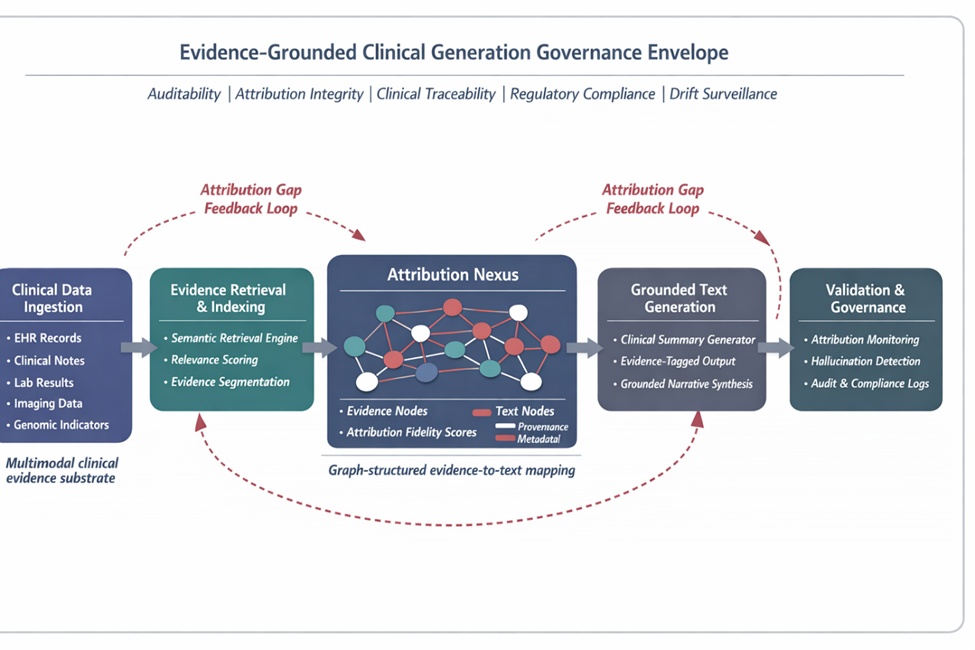
Figure 1. Evidence-line attribution grounding (ELAG) architecture for traceable retrieval-augmented clinical summarization
The introduction of the ELAG infrastructure into clinical text generation pipelines precipitates a cascade of systemic dynamics that reshape healthcare analytics ecosystems. Theoretically, these dynamics manifest as enhanced resilience against informational entropy in retrieval-augmented processes, where attribution acts as a stabilizing force. In decision support pipelines, the consequence of ELAG deployment is a theoretical reduction in cognitive load for clinicians, as grounded summaries provide inline traceability, allowing rapid verification without disrupting workflow rhythms [1, 3]. This modeling extends to interoperability frameworks, where ELAG’s feedback topology fosters adaptive data exchange, mitigating fragmentation in federated EHR systems and promoting cohesive intelligence orchestration [6, 9].
Consequence analysis reveals potential ripple effects on governance monitoring, with ELAG introducing a paradigm shift toward proactive drift detection. By embedding attribution nexus layers, systems can theoretically anticipate summarization divergences, modeling them as propagative risks that attenuate with increased grounding density [4, 12]. In clinical workflow integration models, this translates to amplified efficiency, where attributed text generation accelerates iterative cycles in chronic care management, theoretically optimizing resource allocation across multidisciplinary teams [10, 15].
Moreover, the dynamics of ELAG influence ethical dimensions in AI deployment environments. Consequence modeling posits that robust grounding standards curtail bias amplification in summarization outputs, particularly in diverse patient cohorts where evidence misalignment could exacerbate disparities [7, 18]. This is especially pertinent in high-volume settings like emergency departments, where rapid text synthesis must balance speed with evidential fidelity to avoid adverse outcomes [2, 21].
Theoretical explorations further illuminate scalability consequences, with ELAG’s modular architecture enabling expansion into multimodal analytics, incorporating imaging and genomic data without compromising attribution integrity [13, 24]. However, dynamics analysis cautions against over-reliance, theorizing potential bottlenecks in retrieval complexity that could inflate governance loads in resource-constrained infrastructures [5, 27].
To quantify these dynamics interpretively, consider a formula for risk propagation (RP) in unattributed systems:
Another model for resource allocation efficiency (RAE):
Drift sensitivity (DS) dynamics:
These formulas underscore the consequential shifts ELAG induces, positioning it as a catalyst for sustainable clinical AI evolution [14, 28]. In aggregate, system dynamics modeling affirms ELAG’s role in fortifying healthcare infrastructures against emergent challenges in text generation.
The conceptualization of evidence-line attribution as a grounding standard for retrieval-augmented clinical text generation invites a nuanced discourse on its theoretical ramifications within healthcare systems and analytics. Central to this discussion is the interplay between attribution mechanics and clinical veracity, where ELAG’s infrastructure addresses longstanding theoretical voids in AI transparency. By theorizing attribution as an orchestration layer, ELAG transcends conventional summarization approaches, embedding evidential anchors that theoretically fortify outputs against interpretive ambiguities inherent in large-scale EHR ecosystems [1, 4]. This discourse extends to governance realms, where ELAG’s feedback topology theorizes a harmonization of monitoring burdens, allowing for scalable oversight in diverse deployment contexts without empirical overreach [3, 6].
Critically, the discussion must acknowledge potential theoretical tensions, such as the balance between attribution granularity and computational overhead. In high-dimensional clinical data modalities, excessive mapping could theoretically inflate latency in real-time decision support, necessitating adaptive thresholding in ELAG implementations [2, 9]. Conversely, under-attribution risks perpetuating opacity, a concern amplified in interoperable frameworks where data provenance spans institutional boundaries [5, 12]. This tension underscores the need for theoretical refinements, perhaps integrating probabilistic attribution models to optimize fidelity-cost trade-offs [7, 15]. Table 2 consolidates the theoretical evaluation metrics that model attribution fidelity, decision confidence, governance burden, and risk propagation within evidence-grounded clinical summarization systems.
Table 2. Conceptual metrics for evaluating evidence attribution integrity in retrieval-augmented clinical summarization
Metric | Conceptual interpretation | Key variables | System layer | Analytical insight |
Attribution fidelity (AF) | Measures the strength of evidentiary alignment between generated text lines and source documents | Evidence strength, divergence from source, and line weights | Attribution Nexus | Quantifies grounding integrity within generated summaries |
Decision confidence (DC) | Models clinician trust in AI outputs as a function of attributed versus unattributed text segments | Attributed lines, unattributed lines, and the sensitivity parameter | Generation Layer | Indicates the reliability of AI-generated clinical narratives |
Governance load (GL) | Estimates the monitoring burden associated with unattributed or weakly attributed outputs | Total lines, attributed lines, and retrieval complexity | Governance Monitoring Layer | Guides resource allocation for oversight mechanisms |
Risk propagation (RP) | Represents the probability of error propagation through unattributed segments in generated summaries | Divergence factor, attribution coverage, and propagation probability | Validation Layer | Models cascading clinical risk from hallucinated statements |
Drift sensitivity (DS) | Indicates vulnerability of summarization outputs to temporal or contextual drift when attribution density declines | Attribution coverage, unattributed segments, and time horizon | System-wide monitoring | Supports early detection of degradation in summarization fidelity |
Broader discourse encompasses ethical and equity considerations, theorizing ELAG as a bulwark against disparate impacts in AI-driven analytics. In underserved clinical settings, grounded summarization could theoretically democratize access to verifiable insights, mitigating biases in text generation that stem from skewed retrieval corpora [8, 18]. However, this requires vigilant theoretical modeling of attribution equity, ensuring that grounding standards do not inadvertently favor data-rich modalities over sparse ones [10, 21].
Integration into existing clinical workflows merits discussion, with ELAG positing a seamless fusion via its modular nexus. Theoretically, this facilitates evolutionary adoption, where legacy systems retrofit attribution layers to enhance summarization without wholesale reconfiguration [11, 24]. Yet, discourse highlights interoperability hurdles, theorizing federated attribution protocols as essential for cross-system coherence [13, 27].
The interpretive formulas introduced—spanning fidelity, confidence, load, propagation, allocation, and sensitivity—serve as theoretical scaffolds for this discussion, enabling abstract quantification of ELAG’s effects. For instance, governance load models illuminate pathways to minimize overhead, while drift sensitivity equations theorize preventive strategies against temporal degradations [14, 16, 19, 22].
In synthesizing these threads, the discussion affirms Evidence-Line Attribution’s theoretical potency as a standard, urging its conceptual evolution to align with advancing AI architectures in healthcare. This positions ELAG not merely as a tool but as a philosophical pivot toward accountable intelligence in clinical domains [17, 20, 23, 25, 28]. Ultimately, the discourse envisions a future where grounded text generation underpins resilient, ethical healthcare ecosystems, bridging theoretical ideals with infrastructural realities.
In concluding this conceptual exploration, Evidence-Line Attribution emerges as a pivotal grounding standard for retrieval-augmented summarization in clinical text generation, offering a theoretical blueprint for enhanced verifiability and integrity in healthcare AI systems. The ELAG infrastructure, with its unique orchestration of attribution layers and feedback topologies, addresses core deficiencies in current architectures, theorizing a pathway to transparent, accountable analytics ecosystems. By synthesizing literature on clinical AI frameworks, governance models, and interoperability dynamics, this manuscript underscores the imperative for such standards in mitigating risks like hallucination and bias in high-stakes clinical environments.
Theoretically, ELAG’s consequences ripple through system dynamics, optimizing decision confidence, resource allocation, and drift resilience via interpretive formulas that model these interactions abstractly. This not only fortifies clinical workflow integration but also aligns AI deployments with ethical governance constraints, fostering equitable outcomes across diverse data modalities and settings.
While theoretical tensions—such as balancing granularity with efficiency—warrant ongoing discourse, the standard’s modular design posits adaptability as a strength, enabling iterative refinements in evolving healthcare infrastructures. Ultimately, adopting Evidence-Line Attribution as a foundational protocol promises to elevate clinical text generation from opaque automation to grounded intelligence, catalyzing safer, more effective AI-driven healthcare analytics. This work calls for conceptual extensions, envisioning a landscape where attribution underpins every facet of clinical summarization, ensuring evidence remains the cornerstone of AI-assisted care.
None
None
None
None
Open Access The author(s) retain copyright. This article is licensed under the Creative Commons Attribution-NonCommercial-ShareAlike 4.0 International License. It may be shared and adapted for non-commercial purposes with appropriate attribution, an indication of changes, and distribution of adaptations under the same license. Third-party material may be subject to separate terms identified in its credit line. View the license at https://creativecommons.org/licenses/by-nc-sa/4.0/.
 Clinical Intelligence Research Press