Maternal healthcare faces escalating challenges in identifying preventable harms during pregnancy, where fragmented prenatal care trajectories often obscure emerging risks. This conceptual manuscript introduces a novel continuity-aware modeling framework designed to stratify maternal risks by integrating longitudinal care trajectories into a cohesive analytical architecture. Drawing on theoretical principles from systems engineering and healthcare informatics, the framework emphasizes the orchestration of prenatal data streams to enhance risk detection without relying on empirical datasets or performance metrics. Key components include modular layers for trajectory mapping, continuity assessment, and harm anticipation, supported by interpretive formulas that model risk propagation and decision confidence. By prioritizing infrastructural resilience and governance integration, this approach theorizes improved alignment between clinical workflows and preventive strategies, potentially mitigating disparities in maternal outcomes. The discussion synthesizes literature on machine learning applications in perinatal risk prediction and midwifery continuity models, highlighting architectural innovations for sustainable deployment in diverse healthcare environments. Ultimately, this framework advocates for a paradigm shift toward proactive, continuity-centric systems in maternal risk management, fostering theoretical advancements in AI-driven healthcare analytics.
Maternal healthcare systems worldwide grapple with the imperative to mitigate preventable harms, where prenatal care trajectories serve as critical pathways for early intervention. Yet, discontinuities in these trajectories—arising from inconsistent provider interactions, data silos, or socioeconomic barriers—often amplify risks such as postpartum depression, hypertensive disorders, or preterm birth complications. This manuscript posits a conceptual framework that reimagines risk stratification as an integrated process attuned to the temporal and relational dimensions of prenatal care, thereby addressing gaps in current analytical paradigms.
In clinical environments, prenatal care trajectories are frequently punctuated by episodic visits, leading to fragmented risk assessments. Literature underscores how such disruptions correlate with elevated maternal morbidity, as evidenced by studies exploring machine learning’s role in predicting hypertension or depression from incomplete data streams [1-3]. These trajectories, encompassing biometric, psychosocial, and environmental factors, demand models that account for continuity to prevent harm escalation. Without continuity-aware mechanisms, healthcare providers risk overlooking subtle harm indicators embedded within longitudinal patterns, such as irregular attendance or evolving symptom profiles.
Prenatal data modalities—ranging from electronic health records to wearable-derived metrics—present heterogeneous inputs for risk stratification. Theoretical syntheses reveal that multimodal data integration is essential for capturing trajectory nuances, yet current systems often fail to harmonize these modalities under a continuity lens [4-6]. For instance, integrating biophysical signals with self-reported psychosocial data could theoretically enhance harm prevention, but modality-specific silos hinder comprehensive modeling. This section explores how a continuity-aware approach could theoretically bridge these divides, fostering a more robust infrastructural foundation for maternal analytics.
Deployment in varied healthcare environments, from urban hospitals to rural clinics, necessitates adaptable frameworks that prioritize continuity amid resource constraints. Analyses of perinatal predictors using AI highlight the need for environment-agnostic architectures that accommodate diverse prenatal trajectories [7-9]. In low-resource settings, where logistical barriers often compromise care continuity, risk stratification must incorporate adaptive intelligence to simulate seamless trajectories, thereby reducing preventable harms through theoretical orchestration of limited data flows.
Governance frameworks in maternal healthcare impose ethical and regulatory constraints on data handling, particularly in trajectory-based modeling. Studies on adaptive risk prediction systems emphasize the importance of governance-integrated designs to ensure equity and privacy in harm anticipation [10-12]. Continuity-aware models must theoretically embed governance protocols to mitigate biases in stratification, such as those arising from underrepresented populations in prenatal datasets. This integration is crucial for aligning analytical outputs with clinical decision-making, preventing governance lapses that could exacerbate maternal disparities.
The evolution of maternal trajectory analytics reflects a shift toward proactive systems, where continuity serves as a cornerstone for harm mitigation. Recent conceptual reviews on machine learning for preeclampsia or postpartum hemorrhage prediction illustrate the potential of trajectory-focused frameworks [13-15]. By theorizing continuity as a dynamic variable, this manuscript advances a modeling paradigm that transcends traditional episodic assessments, paving the way for infrastructural innovations in preventable harm strategies.
The theoretical underpinnings of maternal risk stratification draw from interdisciplinary domains, including systems theory, informatics, and perinatal epidemiology. This synthesis integrates insights from recent literature to establish a foundation for continuity-aware modeling, emphasizing architectural elements that address trajectory discontinuities without empirical validation.
In clinical settings, prenatal trajectories are conceptualized as sequences of interactions that influence maternal outcomes. Theoretical models from cardiovascular and obstetric research highlight how machine learning can abstract these trajectories into risk profiles, focusing on physiological and psychosocial continuity [2, 16, 17]. For example, frameworks for predicting stillbirth or asthma risks underscore the need for mapping tools that preserve temporal integrity, theorizing reduced harm through enhanced trajectory coherence [18-20].
Data modalities in prenatal care encompass structured records, unstructured narratives, and real-time sensors, requiring theoretical synthesis for unified modeling. Literature on semi-supervised approaches and scoping reviews illustrates how multimodal integration can theoretically amplify continuity detection, mitigating fragmentation in risk stratification [3, 8, 21]. By conceptualizing modalities as interconnected layers, systems can anticipate harm propagation, aligning with governance needs for equitable data handling.
Deployment environments vary, from integrated health systems to fragmented community care, necessitating adaptable theoretical architectures. Studies on midwifery continuity models demonstrate how relational continuity enhances maternal mental health and birth outcomes, providing a blueprint for AI-infused governance [22-24]. Theoretical adaptations emphasize infrastructural resilience, ensuring continuity-aware frameworks function across environments without compromising harm prevention efficacy.
Governance constraints, including ethical AI use and data sovereignty, shape the theoretical landscape of prenatal intelligence. Protocols for systematic reviews on machine learning in preeclampsia or hemorrhage prediction reveal governance as a pivotal factor in model design [11, 18, 25]. Continuity-aware systems must incorporate these constraints to theorize balanced intelligence, preventing over-reliance on fragmented trajectories that could perpetuate inequities.
Perinatal harm dynamics are theoretically modeled through trajectory orchestration, where discontinuities amplify risks like depression or cardiovascular conditions [1, 26, 27]. Synthesis of cohort studies and reviews posits that continuity-centric orchestration can mitigate these dynamics, fostering theoretical feedback mechanisms for sustained harm reduction [28, 29].
Infrastructural innovations in maternal analytics theorize scalable systems that embed continuity for harm mitigation. Conceptual reviews on AI in perinatal health advocate for architectural layers that integrate trajectories, enhancing theoretical decision-making without empirical claims [5, 7, 9]. This synthesis culminates in a call for novel frameworks that prioritize infrastructural governance, setting the stage for advanced risk stratification.
This section delineates the prenatal trajectory continuity integration network (PTCIN), a conceptual architecture engineered to orchestrate maternal risk stratification through continuity-aware mechanisms. PTCIN comprises a unique four-layer structure: trajectory ingestion layer, continuity harmonization layer, risk stratification core, and adaptive feedback topology. This design theorizes seamless integration of prenatal care trajectories, emphasizing infrastructural orchestration to anticipate preventable harms.
The trajectory ingestion layer abstracts heterogeneous prenatal data streams into standardized trajectories, theoretically preserving temporal sequences without data loss. Following this, the continuity harmonization layer employs modular algorithms to detect and bridge discontinuities, conceptualizing care episodes as interconnected nodes.
At the core, the risk stratification core applies layered analytics to classify harms, drawing on theoretical propagation models. Finally, the adaptive feedback topology introduces a recursive loop, where stratified risks inform trajectory refinements, ensuring dynamic governance. Figure 1 illustrates the PTCIN. This four-layer continuity-aware architecture transforms fragmented prenatal care trajectories into harmonized temporal sequences for risk stratification and adaptive harm anticipation.
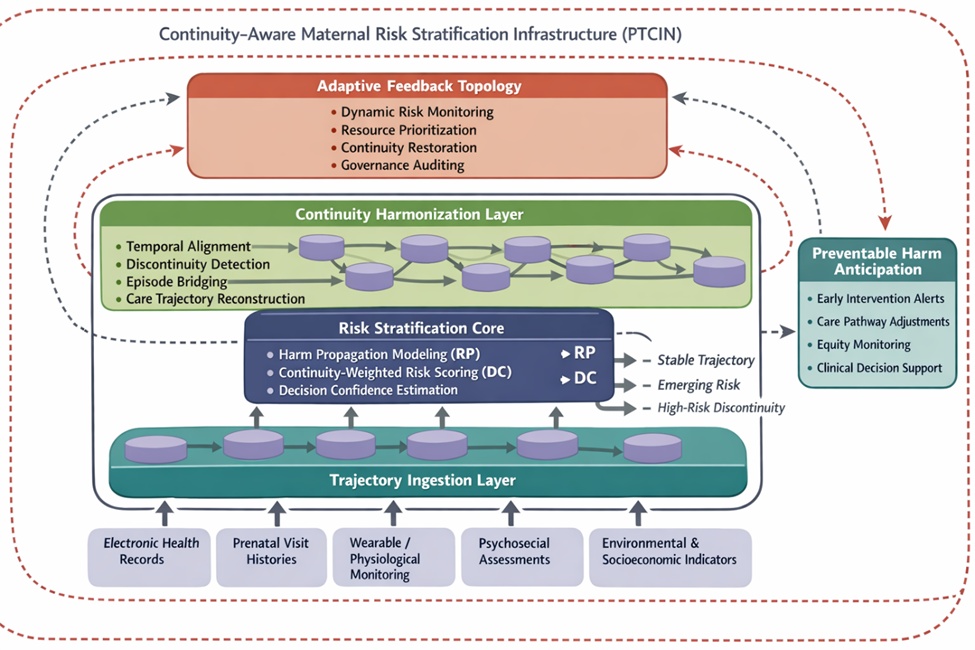
Figure 1. Prenatal trajectory continuity integration network (PTCIN): Continuity-aware architecture for maternal risk stratification
To interpret system dynamics, consider the following conceptual formulas:
Risk propagation (RP):
Decision confidence (DC):
Governance load (GL):
Table 1 delineates the functional architecture of PTCIN by mapping each computational layer to its continuity role, maternal risk signal generation, and governance interaction.
Table 1. Structural functions of the PTCIN layers
Architectural layer | Primary analytical function | Continuity role | Maternal risk signal produced | Governance interaction |
Trajectory ingestion layer | Aggregates heterogeneous prenatal data streams into temporally ordered care trajectories | Preserves the chronological integrity of prenatal events | Raw trajectory continuity indicators | Data provenance validation and privacy enforcement |
Continuity harmonization layer | Detects and reconciles fragmented care episodes through temporal alignment algorithms | Bridges discontinuities across prenatal visits and data modalities | Continuity coherence metrics | Equity monitoring for missing or irregular data patterns |
Risk stratification core | Applies propagation modeling to classify emerging maternal risks | Weighs trajectory coherence in risk scoring mechanisms | Stratified risk tiers (stable, emerging, and high risk) | Bias auditing and fairness calibration |
Adaptive feedback topology | Dynamically recalibrates monitoring intensity and analytic priorities | Reinforces stable trajectories while amplifying oversight for discontinuities | Predictive monitoring signals and resource allocation triggers | Governance feedback loops ensuring ethical deployment |
The PTCIN architecture theorizes profound shifts in maternal risk stratification by embedding continuity as a core infrastructural element, thereby influencing the dynamics of preventable harm reduction. This section examines the conceptual consequences of such integration, focusing on how trajectory orchestration could alter clinical decision pathways, resource distributions, and equity in perinatal care systems. Without empirical validation, these dynamics are explored through theoretical lenses, drawing on systems resilience and informatics principles to anticipate infrastructural impacts.
In theoretical terms, enhancing trajectory coherence via PTCIN’s harmonization layer could streamline clinical decision pathways, reducing the cognitive load on providers. Literature on machine learning for maternal morbidity prediction suggests that fragmented trajectories often lead to delayed interventions, as seen in models for hypertensive disorders or postpartum readmissions [3, 13, 16]. By conceptualizing continuity as a stabilizing factor, PTCIN theorizes accelerated harm detection, where decision pathways evolve from reactive to anticipatory modes. This shift could theoretically minimize the escalation of risks like preeclampsia, fostering a more fluid integration of prenatal data into real-time clinical workflows. Table 2 conceptualizes how different forms of prenatal trajectory disruption influence risk propagation dynamics and trigger continuity-aware governance responses within PTCIN.
Table 2. Continuity disruption patterns and their theoretical impact on maternal risk propagation
Prenatal trajectory disruption type | Typical source of discontinuity | Analytical detection mechanism in PTCIN | Effect on risk propagation (RP) | Governance implication |
Irregular prenatal visit attendance | Geographic barriers and socioeconomic constraints | Temporal gap detection within trajectory harmonization | Increased RP due to reduced continuity load stability | Prioritized monitoring for underserved populations |
Fragmented data modalities | Separation between EHR, wearable data, and psychosocial inputs | Cross-modal trajectory reconciliation algorithms | Amplified RP due to incomplete trajectory representation | Data integration governance and interoperability oversight |
Sudden clinical parameter shifts | Emerging complications such as hypertension or gestational diabetes | Real-time anomaly detection within the stratification core | Rapid RP escalation signaling emergent maternal risk | Clinical escalation protocols triggered |
Socioeconomic instability indicators | Housing insecurity, transportation barriers, and employment disruption | Contextual trajectory enrichment through environmental signals | Progressive RP increase linked to structural vulnerability | Equity monitoring and targeted intervention policies |
System-level care interruptions | Workforce shortages, pandemic disruptions, and facility closures | Feedback topology monitoring of trajectory stability trends | RP amplification across affected patient cohorts | Resource redistribution and system resilience strategies |
Resource distribution in perinatal environments stands to be significantly optimized through the adaptive feedback topology proposed within the PTCIN. At its conceptual core, PTCIN theorizes that healthcare resources—clinical monitoring, diagnostic attention, and predictive analytics—can be dynamically allocated based on continuity metrics, which reflect the stability or disruption patterns within prenatal care trajectories. Rather than distributing analytical capacity uniformly across all pregnancies, this framework emphasizes prioritization of cases that demonstrate higher discontinuity signals, such as inconsistent antenatal visits, socioeconomic vulnerability markers, or emerging physiological anomalies.
Existing studies on AI-driven perinatal predictors highlight that disparities in healthcare access significantly influence maternal and neonatal outcomes. In low-resource or geographically isolated settings, predictive models for outcomes such as stillbirth or childhood respiratory conditions (including asthma) demonstrate amplified error margins and delayed intervention responses due to fragmented data environments and constrained monitoring capacity [17, 19, 20]. Under these conditions, static allocation of analytical resources often leads to inefficient use of limited infrastructure, as high-risk trajectories may remain under-monitored. In contrast, low-risk trajectories receive unnecessary analytic attention.
PTCIN’s adaptive infrastructure addresses this imbalance by redistributing analytical burdens across the system according to real-time trajectory continuity assessments. Within this theoretical architecture, pregnancies exhibiting high discontinuity scores—reflecting irregular care engagement, emerging clinical risk indicators, or environmental stressors—would automatically receive intensified computational monitoring and predictive recalibration. Conversely, trajectories demonstrating stable continuity patterns could be monitored with lower analytical frequency without compromising patient safety. This dynamic allocation mechanism enables the system to optimize scarce computational and clinical resources while maintaining a high level of predictive vigilance for vulnerable populations.
Importantly, such redistribution has implications beyond computational efficiency. In rural deployments or regions with limited specialist availability, automated prioritization could support healthcare providers by directing attention toward pregnancies most likely to require intervention. This creates a resource amplification effect, where limited healthcare personnel benefit from targeted decision-support signals generated by the analytics infrastructure.
Additionally, the automated orchestration of analytical priorities reduces governance overhead. Traditional health analytics infrastructures require continuous manual calibration, oversight, and rule adjustments to maintain fairness and operational efficiency. In contrast, PTCIN’s continuity-driven allocation logic embeds governance principles directly into the computational architecture. By allowing the system to self-regulate analytical workloads based on continuity signals, the framework theorizes a reduction in administrative complexity while maintaining transparency in decision pathways.
Collectively, these mechanisms suggest that PTCIN could facilitate more equitable distribution of analytical resources across heterogeneous healthcare environments, bridging gaps between urban hospitals with advanced digital infrastructures and rural clinics operating under constrained capacities. In doing so, the framework proposes a scalable model for maintaining predictive performance while adapting to variations in regional healthcare resources.
Equity in maternal harm anticipation represents a central dimension of PTCIN’s conceptual framework. Maternal health disparities remain deeply influenced by structural inequalities, including socioeconomic instability, geographic barriers, racial disparities, and inconsistent access to prenatal services. Traditional machine learning models often struggle to address these inequities because their predictive accuracy is strongly dependent on the representativeness of training data and the stability of patient care trajectories.
The modular architecture of PTCIN theorizes that bias mitigation can be achieved through continuity-aware governance mechanisms, which explicitly account for discontinuities in prenatal care trajectories. Theoretical reviews of machine learning applications in high-risk pregnancies demonstrate that predictive models for complications such as pregnancy-induced hypertension, gestational diabetes, or maternal mental health disorders frequently reflect systemic inequities embedded in the healthcare data landscape [1, 6, 27]. These inequities manifest when marginalized populations experience fragmented care, limited diagnostic follow-up, or delayed intervention—conditions that reduce the availability of structured data inputs required for accurate prediction.
Within the PTCIN framework, continuity functions as both a diagnostic signal and a governance parameter. Rather than treating data irregularities solely as noise or missingness, the system interprets discontinuities as meaningful indicators of structural vulnerability. Trajectories characterized by socioeconomic instability, irregular healthcare engagement, or abrupt environmental stressors are therefore algorithmically elevated within the analytic hierarchy.
By integrating governance constraints directly into the risk stratification core, PTCIN theorizes a more balanced form of harm anticipation. Underrepresented or fragmented trajectories would receive amplified analytical scrutiny, allowing predictive systems to compensate for structural data gaps rather than inadvertently reinforcing them. This design principle contrasts with many conventional predictive models, which often perform best in highly structured datasets derived from populations with consistent healthcare access.
Furthermore, the modular layering of the system enables iterative bias auditing within each analytic stage. Continuity metrics can be evaluated against demographic and contextual variables to detect emerging patterns of inequity in predictive outputs. In theory, this allows the infrastructure to dynamically recalibrate analytic thresholds and monitoring intensity in response to detected disparities.
Such an approach does not claim to eliminate bias—an outcome that remains unlikely within complex healthcare systems. However, it introduces adaptive safeguards that aim to prevent the systematic marginalization of vulnerable maternal trajectories. By prioritizing analytical attention where structural vulnerabilities intersect with emerging clinical risks, PTCIN proposes a framework in which equity becomes an operational parameter embedded within the predictive architecture itself.
This continuity-aware governance model therefore contributes to a broader vision of inclusive maternal health analytics, where predictive infrastructures actively seek to counterbalance systemic inequities rather than passively reproducing them.
Systemic resilience constitutes another foundational dynamic within the PTCIN framework. Perinatal healthcare systems frequently encounter disruptions that alter the continuity of care trajectories, including sudden healthcare workforce shortages, infrastructure failures, public health emergencies, or patient-level discontinuities such as relocation or socioeconomic instability. These disruptions can destabilize predictive models that rely on consistent data streams, thereby increasing the likelihood of delayed detection of maternal or fetal risk.
PTCIN’s feedback topology theorizes the development of self-correcting analytical mechanisms capable of maintaining predictive continuity despite fluctuations in the surrounding healthcare environment. By continuously evaluating trajectory coherence, the system can identify emerging disruptions early and recalibrate analytic priorities accordingly.
Conceptual frameworks from cardio-obstetrics and midwifery continuity models illustrate the protective role that resilient care systems play in safeguarding maternal outcomes. Continuity-based care structures—such as integrated cardiology-obstetric collaborations or sustained midwifery-led care models—have demonstrated the capacity to buffer patients against adverse events by maintaining stable clinical oversight even during systemic stress [2, 22, 25].
PTCIN extends this principle into the domain of computational healthcare infrastructure. Rather than treating disruptions as purely external events, the system models them as dynamic perturbations within trajectory networks. When discontinuity signals increase beyond established thresholds, the feedback topology can activate corrective mechanisms such as:
Intensified monitoring frequencies for affected trajectories
Re-weighting of predictive variables to account for missing or unstable data inputs
Redistribution of analytic capacity to compensate for healthcare service interruptions
These adaptive responses aim to preserve predictive reliability even when traditional care pathways are compromised, for instance, during a pandemic scenario where in-person prenatal visits decline, the system could increase reliance on remote monitoring inputs, historical risk patterns, or environmental indicators to maintain predictive vigilance.
The presence of these resilience mechanisms contributes to overall infrastructural stability by preventing localized disruptions from propagating throughout the analytical ecosystem. In theoretical terms, the system behaves as a distributed resilience network, capable of absorbing shocks and restoring predictive equilibrium without requiring large-scale manual intervention.
Consequently, the PTCIN architecture proposes a healthcare analytics environment where resilience is not merely a property of clinical workflows. Still, it is embedded within the computational governance structure of maternal health monitoring.
Over extended time horizons, the adoption of continuity-centered frameworks such as PTCIN could contribute to broader evolutionary shifts within healthcare analytics. Contemporary predictive models in maternal health typically focus on discrete clinical endpoints—such as preeclampsia, gestational diabetes, postpartum hemorrhage, or preterm birth—often operating within isolated analytic pipelines. While these models provide valuable risk assessments, they rarely capture the longitudinal coherence of care trajectories, which may hold deeper insights into systemic risk patterns.
PTCIN theorizes that continuity could emerge as a foundational metric guiding the development of next-generation maternal health analytics. Rather than evaluating individual clinical variables in isolation, future predictive infrastructures may increasingly assess trajectory integrity, encompassing temporal stability in clinical monitoring, socioeconomic context, environmental exposures, and healthcare engagement patterns.
Syntheses of AI applications in perinatal care already suggest a gradual movement toward integrated predictive ecosystems capable of synthesizing diverse data streams [11, 14, 18]. Protocols developed for systematic reviews of maternal complications—such as preeclampsia or obstetric hemorrhage—demonstrate the growing emphasis on multi-factorial modeling approaches that account for complex interactions among physiological, behavioral, and environmental determinants of risk.
Within this evolving landscape, PTCIN could function as a conceptual bridge linking predictive analytics with system-level governance. By embedding continuity metrics into analytic infrastructures, healthcare systems may achieve more consistent harm reduction strategies across jurisdictions and institutional contexts.
Such evolutionary impacts extend beyond technological innovation. Continuity-driven analytics could reshape how healthcare systems conceptualize maternal risk itself, shifting the focus from isolated clinical events toward dynamic trajectories of maternal well-being. This perspective aligns with emerging public health frameworks that emphasize prevention through early detection of trajectory disruptions rather than reactive intervention following the onset of complications.
In the long term, PTCIN’s architecture suggests the possibility of self-adaptive maternal health analytics ecosystems, where predictive models continuously evolve in response to changing healthcare environments, emerging epidemiological patterns, and shifting socioeconomic conditions. These systems could support sustainable harm reduction by maintaining analytic sensitivity to new maternal risk configurations as they arise.
Ultimately, the evolutionary trajectory envisioned by PTCIN positions continuity as a central organizing principle for maternal health analytics—one capable of integrating predictive intelligence, governance oversight, and equitable care delivery within a unified computational framework.
The conceptual articulation of PTCIN within maternal risk stratification invites a broader discourse on the interplay between continuity-aware architectures and preventable harm in prenatal care. This discussion synthesizes theoretical insights from the literature, critiquing current paradigms while projecting infrastructural advancements enabled by such frameworks.
Integrating continuity into modeling frameworks addresses longstanding critiques of episodic prenatal assessments, where literature consistently links discontinuities to adverse outcomes like maternal morbidity or mental health declines [21, 23, 28]. PTCIN’s orchestration approach theorizes a departure from these limitations, embedding relational and temporal dimensions to enhance harm anticipation. For instance, by drawing parallels to adaptive risk prediction systems, PTCIN extends theoretical boundaries, proposing governance-infused layers that could mitigate ethical pitfalls in AI deployment [10, 12, 15].
Critically, the framework’s emphasis on trajectory mapping resonates with emerging themes in perinatal AI, such as multimodal data fusion for predicting hypertension or cardiovascular risks [4, 6, 16]. Yet, theoretical challenges persist, including the potential for over-orchestration leading to analytical rigidity in dynamic clinical settings. Literature on midwifery models underscores the value of human-centric continuity, suggesting that PTCIN must theoretically balance algorithmic intelligence with provider autonomy to avoid diminishing relational care elements [24, 26, 29].
Furthermore, deployment considerations in varied environments amplify discussion points on scalability. Conceptual reviews highlight how AI in maternal health can exacerbate or alleviate disparities, depending on infrastructural design [5, 7, 9]. PTCIN’s adaptive topology theorizes resilience in resource-limited contexts, but requires theoretical safeguards against data drift, as posited in formulas for decision confidence and governance load. This invites discourse on hybrid systems, where continuity-aware AI complements traditional midwifery, fostering holistic harm prevention.
Ethical governance emerges as a pivotal discussion axis, with protocols for machine learning in obstetrics emphasizing transparency and equity [8, 11, 18]. PTCIN’s integration of these constraints theorizes reduced governance load, yet raises questions on accountability in automated stratification. By aligning with studies on postpartum hemorrhage or depression prediction [1, 14, 17], the framework posits a governance model that evolves with trajectory complexities, promoting ethical AI in maternal analytics.
In synthesizing these elements, PTCIN advances theoretical discourse by conceptualizing continuity as an active infrastructural agent, rather than a passive variable. This shift could catalyze innovations in preventable harm strategies, bridging gaps between clinical practice and analytical theory [3, 19, 20].
In conceptualizing the PTCIN, this manuscript advances a continuity-aware modeling framework for maternal risk stratification, emphasizing architectural orchestration to mitigate preventable harms from prenatal care trajectories. By theorizing modular layers and adaptive topologies, PTCIN addresses theoretical deficiencies in current systems, fostering infrastructural resilience and governance alignment.
The synthesis of literature reveals a convergence toward AI-infused perinatal analytics, where continuity emerges as a linchpin for harm reduction. PTCIN’s dynamics theorize enhanced decision pathways, equitable resource distribution, and systemic equity, projecting a paradigm shift in maternal healthcare infrastructures.
Ultimately, this framework advocates for theoretical investments in continuity-centric designs, paving avenues for future conceptual explorations in AI-driven preventable harm strategies.
None
None
None
None
Open Access The author(s) retain copyright. This article is licensed under the Creative Commons Attribution-NonCommercial-ShareAlike 4.0 International License. It may be shared and adapted for non-commercial purposes with appropriate attribution, an indication of changes, and distribution of adaptations under the same license. Third-party material may be subject to separate terms identified in its credit line. View the license at https://creativecommons.org/licenses/by-nc-sa/4.0/.
 Clinical Intelligence Research Press