The rapid evolution of artificial intelligence (AI) in healthcare necessitates standardized representations for complex temporal data in inpatient settings. This conceptual manuscript introduces a formal standard for modeling temporal episodes within inpatient care trajectories, emphasizing longitudinal analytics to enhance clinical decision-making infrastructures. We propose the Inpatient Temporal Episode Standardization Framework (ITESF), a layered architecture designed to integrate episodic events across electronic health records (EHRs), facilitating interoperability and governance in AI-driven analytics pipelines. Drawing from theoretical foundations in clinical AI architectures and healthcare informatics, ITESF incorporates unique feedback topologies for episode delineation, trajectory mapping, and analytic orchestration. Key components include temporal abstraction layers, episode boundary formalisms, and longitudinal alignment mechanisms, all conceptualized without empirical validation. Interpretive formulas are presented to model risk propagation through trajectories, decision confidence in episodic analytics, and governance load in deployment ecosystems. This standard addresses gaps in current interoperability frameworks by providing a theoretical basis for scalable, AI-governed inpatient analytics, with implications for workflow integration and monitoring systems. By formalizing temporal episodes, ITESF aims to support robust, ethical AI deployments in dynamic inpatient environments, promoting safer and more efficient healthcare intelligence ecosystems.
The integration of artificial intelligence into inpatient care systems has transformed the landscape of healthcare delivery, particularly in managing longitudinal patient trajectories that span multiple episodes of care. Modern hospital environments generate large volumes of clinical data through electronic health records (EHRs), bedside monitoring systems, diagnostic imaging platforms, laboratory infrastructures, and clinical documentation workflows. These heterogeneous data sources collectively capture the evolving physiological and clinical states of patients during hospitalization. As healthcare systems increasingly deploy artificial intelligence (AI) technologies to analyze these data streams, the ability to model patient trajectories accurately over time has become a fundamental requirement for reliable clinical analytics.
Inpatient care differs from many other healthcare contexts because patient conditions evolve continuously during hospitalization. A single admission may involve multiple stages of clinical management, including diagnostic evaluation, therapeutic intervention, monitoring of treatment response, and eventual recovery or deterioration. These stages collectively form longitudinal trajectories that reflect the progression of disease processes and the effects of clinical interventions. AI systems designed for predictive analytics or decision support must therefore account not only for individual data points but also for the temporal relationships linking clinical events across time.
Despite the rapid expansion of AI applications in healthcare, existing analytic infrastructures often lack standardized mechanisms for representing the episodic nature of inpatient care. Many machine learning pipelines treat clinical observations as isolated events rather than as components embedded within temporally structured episodes of care. Such representations overlook the inherent continuity of patient trajectories and can lead to analytic fragmentation when clinical events are misaligned temporally or interpreted outside their contextual episodes. This limitation becomes particularly significant in high-acuity environments where accurate interpretation of longitudinal patterns is essential for early detection of clinical deterioration and effective decision support.
To address this challenge, the present manuscript conceptualizes a formal representation standard tailored specifically for modeling temporal episodes in inpatient settings. The proposed approach focuses on structuring episodic clinical events—such as admission cycles, treatment phases, procedural interventions, and recovery periods—within a coherent analytic framework that preserves temporal fidelity across longitudinal trajectories. Rather than introducing a new predictive algorithm, the manuscript emphasizes theoretical constructs that guide how episodic data structures can be encoded within AI infrastructures to support more reliable trajectory analytics.
The development of such a representation framework has implications beyond analytic performance alone. As hospitals increasingly integrate AI systems into operational workflows, interoperability between data sources, analytic engines, and clinical decision support systems becomes critical. A standardized temporal episode representation enables these systems to interpret patient trajectories consistently across departments and institutions. Furthermore, aligning computational representations with clinically meaningful episode boundaries enhances interpretability, allowing clinicians to understand how AI predictions relate to recognizable phases of patient care.
By focusing on the formal modeling of inpatient episodes, this work contributes to the broader discourse on the design of resilient healthcare intelligence ecosystems. Temporal fidelity, interoperability, and governance considerations must all be integrated within the analytic architectures that support AI-driven healthcare systems. The sections that follow explore these issues by examining the challenges of episodic representation, the integration of multimodal data modalities, deployment constraints within hospital infrastructures, governance requirements for episode-based decision support, and the evolving role of formal standards in AI-enabled inpatient analytics.
In inpatient clinical settings, temporal episodes manifest as discrete yet interconnected segments of patient care, influenced by factors such as acute exacerbations, procedural interventions, therapeutic adjustments, and recovery periods. These episodes represent identifiable phases within the broader continuum of hospitalization, where the patient’s clinical condition evolves in response to both underlying disease processes and medical interventions. Although individual episodes may appear bounded in time, they are intrinsically linked within longitudinal trajectories that capture the progression of patient health throughout the inpatient stay.
The episodic structure of inpatient care reflects the dynamic nature of hospital medicine. Patients admitted with acute conditions often undergo a sequence of diagnostic assessments, therapeutic interventions, and monitoring phases. Each stage generates new clinical information that informs subsequent treatment decisions. For instance, an episode involving diagnostic evaluation may transition into an intervention phase once a condition has been identified, followed by a recovery period during which clinicians assess treatment effectiveness. When complications arise, new episodes may emerge, altering the trajectory of care and introducing additional clinical complexity.
Artificial intelligence systems deployed in hospital environments must therefore analyze patient data in ways that capture these evolving episode structures. Longitudinal trajectory analysis requires the ability to identify relationships between events that occur at different points during hospitalization. Recurring readmissions, progressive physiological deterioration, or delayed complications may only become evident when episodes are examined within a coherent temporal framework. Without such representation, AI systems may fail to recognize critical patterns that influence patient outcomes [1, 2].
The complexity of episodic representation is further intensified by the diversity of clinical data generated in inpatient settings. Continuous monitoring devices produce high-frequency time-series signals reflecting vital signs and physiological responses to treatment. Laboratory testing contributes episodic measurements that capture biochemical indicators of disease progression. Meanwhile, narrative clinical documentation recorded by physicians and nursing staff provides qualitative insights into symptoms, treatment decisions, and care coordination activities. These heterogeneous data sources collectively form the informational foundation of patient trajectories.
However, when analytic systems lack mechanisms for formally organizing these signals into episodic structures, the resulting data representations become fragmented. Observations that belong to the same clinical episode may appear disconnected within analytic pipelines, reducing the ability of AI models to interpret the temporal relationships that govern patient trajectories. For example, early warning indicators preceding clinical deterioration may be separated from the episode in which deterioration ultimately occurs, weakening predictive accuracy and limiting the clinical usefulness of analytic outputs.
The absence of standardized episode modeling, therefore, represents a critical barrier to effective longitudinal analytics in inpatient AI systems. Formal representation of episodic structures allows AI architectures to maintain continuity across data streams, enabling more coherent interpretation of patient trajectories. By aligning computational models with the episodic nature of clinical care, healthcare AI systems can better support clinicians in identifying emerging risks and guiding timely interventions.
Data modalities in inpatient care—ranging from time-series physiological signals to narrative clinical documentation—demand a cohesive representation for effective longitudinal analytics. Hospitals operate as data-rich environments in which multiple monitoring systems continuously generate information about patient states. Vital signs monitors capture high-frequency physiological signals, laboratory platforms generate diagnostic biomarkers, imaging systems produce visual diagnostic evidence, and clinical documentation provides contextual narratives describing symptoms and treatment decisions. Each of these modalities contributes distinct insights into patient health, yet their analytic value depends on how effectively they can be integrated within unified representations of patient trajectories.
Temporal episode modeling provides a structural foundation for integrating these heterogeneous data modalities. Within such a framework, clinical observations are organized according to the episodes in which they occur, allowing AI systems to interpret relationships between different types of data signals. For example, physiological changes detected through continuous monitoring may be linked to laboratory findings obtained during the same episode of care. At the same time, clinical documentation may provide explanatory context for observed trends. This integrated representation enables AI models to analyze patient trajectories holistically rather than as collections of isolated data points.
The challenge of modality integration becomes particularly significant when synchronizing continuous and episodic data streams. Physiological signals often arrive as high-frequency time series, whereas clinical events such as medication administration or procedural interventions occur as discrete events within patient timelines. Effective trajectory analytics requires mechanisms for aligning these disparate temporal scales so that AI models can interpret the relationships between continuous physiological dynamics and episodic clinical actions. Without such synchronization, analytic systems may overlook meaningful patterns that emerge only when multiple data modalities are considered simultaneously [3, 4].
Moreover, multimodal integration enhances the capacity of AI systems to detect complex clinical patterns that cannot be inferred from single data sources alone. For instance, the combination of physiological deterioration signals with laboratory abnormalities and clinician-documented symptoms may provide early indicators of impending complications. When these signals are represented within a coherent episodic structure, AI systems can more effectively model the causal relationships underlying patient deterioration pathways.
As inpatient AI infrastructures evolve, the importance of multimodal data integration will continue to increase. Advances in wearable sensors, remote monitoring technologies, and digital health platforms are expanding the range of data sources available for clinical analytics. Temporal episode modeling, therefore, plays a critical role in ensuring that these diverse modalities can be incorporated into longitudinal trajectory frameworks without compromising analytic coherence.
Deployment environments in inpatient facilities impose unique constraints on AI systems, including resource-limited hardware infrastructures and strict privacy regulations governing clinical data exchange. Hospitals must operate within highly regulated environments where patient data security, system reliability, and operational continuity are paramount. AI systems designed for inpatient analytics must therefore function within these constraints while maintaining performance and interoperability across diverse clinical platforms.
A formal standard for temporal episode representation can mitigate many of these deployment challenges by embedding interoperability mechanisms within analytic frameworks. Standardized episode structures allow AI systems to interpret patient trajectories consistently across different EHR systems and clinical data repositories. By providing a shared representation schema, such standards facilitate communication between distributed analytic services operating within hospital networks. This interoperability becomes particularly important when healthcare institutions integrate AI tools from multiple vendors or deploy analytics across interconnected care facilities [5, 6].
Hardware constraints also influence the design of inpatient AI systems. Many hospital infrastructures rely on legacy computing environments that may lack the computational capacity required for complex machine learning pipelines. Temporal episode modeling can help optimize analytic efficiency by structuring data into manageable units that support incremental analysis rather than requiring full recomputation of entire patient histories. Such approaches enable scalable analytics pipelines that can operate effectively within constrained computational environments.
Privacy and regulatory considerations further shape deployment strategies for AI systems in healthcare. Patient data must be handled in compliance with strict confidentiality regulations, often limiting the extent to which information can be transferred across institutional boundaries. Formal episode representation standards can incorporate mechanisms for anonymization, access control, and auditability, ensuring that longitudinal trajectory analytics remain compliant with regulatory frameworks while still supporting meaningful clinical insights.
Governance in AI healthcare systems extends beyond technical implementation to include ethical oversight, regulatory compliance, and mechanisms for monitoring algorithmic performance. When AI models analyze temporal episodes that influence clinical decisions, governance considerations become particularly significant. Decisions derived from episode-based analytics may affect treatment plans, resource allocation, and patient outcomes, making transparency and accountability essential components of AI system design.
Constraints such as auditability and explainability must therefore be embedded within the representation standards used to model temporal episodes. Formal episode boundaries provide natural checkpoints for auditing AI predictions, allowing clinicians and regulators to trace how specific clinical observations contributed to analytic outputs. When AI models operate within clearly defined episodic structures, their reasoning processes become easier to interpret, improving trust in decision support systems deployed within hospital environments [7, 8].
Another governance challenge involves managing algorithmic bias and ensuring equitable healthcare outcomes. Temporal episode modeling can support bias detection by enabling analysts to examine how predictive models behave across different patient trajectories and demographic groups. By structuring patient histories into comparable episodic units, governance frameworks can more effectively monitor disparities in model performance and identify potential sources of bias.
Furthermore, governance mechanisms must address the evolving nature of AI systems as they interact with dynamic clinical environments. Models trained on historical data may encounter new patterns as hospital practices change or as patient populations evolve. Episode-based monitoring systems can track these changes over time, enabling governance frameworks to detect performance drift and initiate model updates when necessary. Such mechanisms help ensure that AI systems remain aligned with clinical standards and ethical principles as healthcare environments evolve.
The evolution of formal standards in AI for inpatient care reflects a broader transition toward integrated healthcare intelligence ecosystems. As hospitals adopt increasingly sophisticated analytic technologies, the need for consistent representation frameworks becomes more pressing. Formal standards enable AI systems developed by different organizations to interpret clinical data using shared structural assumptions, facilitating interoperability and collaborative innovation within healthcare analytics.
Recent literature highlights the importance of architectures that not only model episodic clinical events but also incorporate governance mechanisms and analytic feedback loops across patient trajectories. These architectures emphasize the need for systems capable of learning from longitudinal data while maintaining transparency and accountability within clinical workflows. By embedding temporal episode structures within AI infrastructures, healthcare systems can support more robust analytic pipelines that integrate prediction, monitoring, and decision support functions [9, 10].
The conceptual framework proposed in this manuscript contributes to this evolving landscape by outlining a standardized approach to representing inpatient temporal episodes within AI systems. By unifying considerations of data modality integration, deployment constraints, and governance oversight, the framework aims to support the development of resilient healthcare analytics architectures. Such systems are better equipped to capture the complexity of inpatient trajectories, enabling AI technologies to function as reliable partners in clinical decision-making.
Ultimately, advancing formal standards for temporal episode representation represents a crucial step in the maturation of AI-enabled healthcare systems. As analytic capabilities continue to expand, the ability to model patient trajectories with temporal precision will play a central role in improving clinical outcomes, optimizing hospital operations, and strengthening trust in AI-driven healthcare intelligence.
The theoretical underpinnings of temporal episode modeling in inpatient care draw from advancements in clinical AI architectures and healthcare analytics infrastructures. This section synthesizes, focusing on conceptual models that inform formal representation standards for longitudinal trajectories. By examining EHR intelligence ecosystems, decision support pipelines, and interoperability frameworks, we establish a foundation for our proposed standard, emphasizing theoretical integrations over empirical applications.
Clinical AI architectures have increasingly emphasized temporal dimensions in inpatient data, conceptualizing episodes as sequences within broader trajectories. For instance, deep learning approaches to trajectory prediction from medical records highlight the need for abstracted temporal representations to manage sequential dependencies [1]. Similarly, scalable deep learning models for EHRs underscore architectures that integrate temporal features for accurate analytic pipelines, though conceptually limited to high-level governance [2]. These architectures inform our standard by illustrating how episode modeling can enhance structural robustness in inpatient AI systems.
Healthcare analytics infrastructures provide theoretical scaffolds for episode delineation in longitudinal contexts. High-performance medicine frameworks converge human and AI intelligence, advocating for infrastructural designs that handle temporal variability in inpatient trajectories [3]. Roadmaps for responsible machine learning emphasize monitoring systems that theoretically mitigate harms through structured episode representations [4]. Practical guidance on AI for healthcare data further supports infrastructural standards that formalize temporal episodes, ensuring analytic integrity across modalities [5].
EHR intelligence ecosystems are pivotal for longitudinal trajectory analytics, with conceptual models focusing on autonomous diagnostic systems that implicitly model episodes [6]. Governance models for AI application in healthcare synthesize ecosystemic approaches, theorizing lifecycle integrations for episode-based intelligence [7]. Reporting standards like MINIMAR and MI-CLAIM checklists conceptually align EHR data with AI modeling, providing theoretical benchmarks for trajectory standardization [8, 9].
Decision support pipelines in inpatient care benefit from theoretical formalisms that incorporate temporal feedback topologies. Guidelines for AI diagnostic accuracy and trial reporting extensions (STARD-AI, CONSORT-AI, SPIRIT-AI) outline conceptual pipelines where episode modeling ensures ethical and interoperable support [10-12]. Ethical limitations in algorithmic fairness highlight the need for pipelines that theoretically address bias in temporal episode analytics [13]. Model facts, labels, and fusion of imaging with EHRs further conceptualize pipelines for enhanced decision confidence [14, 15].
AI governance systems theorize monitoring burdens in deployment, with frameworks for drug repurposing and bias diagnosis illustrating governance loads in temporal contexts [16, 17]. Reporting of AI prediction models and clinician performance associations synthesize governance needs for trajectory analytics [18, 19]. Systematic reviews of deep learning versus clinicians emphasize theoretical governance in monitoring systems [20, 21].
Interoperability frameworks facilitate data exchange in inpatient ecosystems, with ethical policy considerations advocating for standards that model temporal episodes [22]. Stand-alone AI systems and bias analyses in clinical safety conceptualize exchange mechanisms for longitudinal trajectories [23, 24]. Machine learning ethics and human-centered deep learning support interoperable designs with feedback for governance [25, 26].
Clinical workflow models integrate temporal episodes into analytic workflows, with algorithmic fairness paths and delivery science frameworks theorizing resource allocation [27, 28]. Transformer-based EHR models provide conceptual bases for workflow orchestration in trajectories [29]. This synthesis reveals a theoretical gap: the absence of a dedicated standard for episode representation, which our framework addresses through unique architectural layers.
This section delineates the inpatient temporal episode standardization framework (ITESF), a novel architectural construct for formalizing episode representations in longitudinal inpatient trajectory analytics. ITESF comprises a multi-layered structure with distinct feedback topologies, designed to orchestrate temporal data within AI healthcare infrastructures. The framework’s layers include: (1) episode abstraction layer, which formalizes temporal boundaries using event timestamps and clinical milestones; (2) trajectory mapping layer, aligning episodes into sequential chains with interoperability hooks for EHR exchange; (3) analytic orchestration layer, governing AI pipelines through modular intelligence components; and (4) governance feedback layer, incorporating closed-loop monitoring for ethical alignment. Unique to ITESF is its helical feedback topology, where governance signals spiral back through layers, adapting representations dynamically without empirical tuning. Figure 1 illustrates the helical governance architecture of ITESF, showing how bounded inpatient episodes are formalized, linked into trajectories, analytically orchestrated, and recursively supervised across the full representation lifecycle.
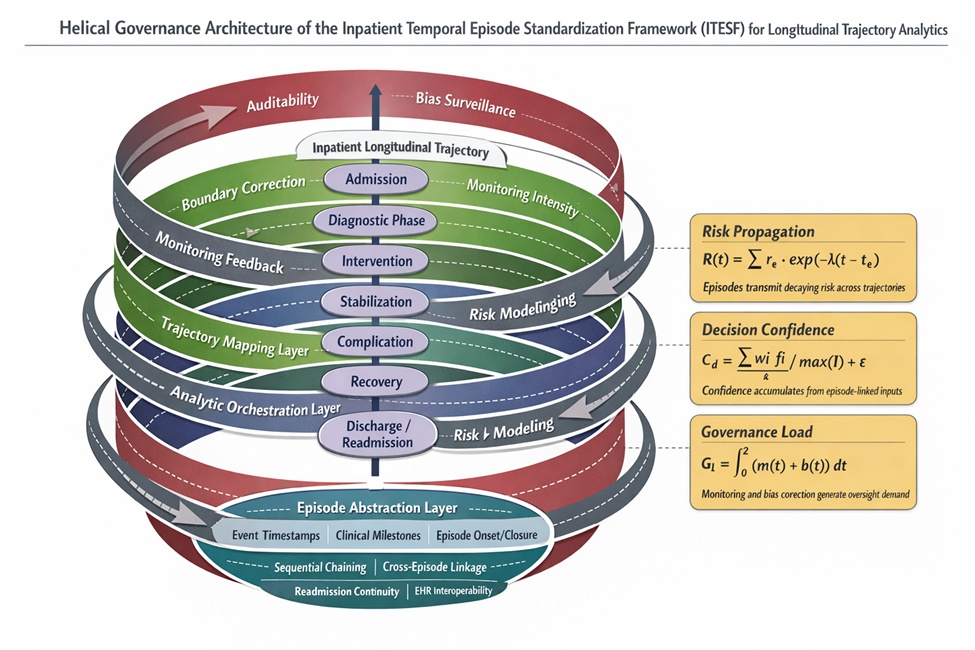
Figure 1. Helical governance architecture of the inpatient temporal episode standardization framework (ITESF) for longitudinal trajectory analytics. The figure depicts ITESF as a multi-layered representation architecture organized around a central inpatient trajectory axis composed of discrete temporal episodes. Episode abstraction formalizes clinical boundaries, trajectory mapping aligns episodes across time, analytic orchestration enables AI-driven longitudinal interpretation, and governance feedback recursively supervises the entire representational system. Helical feedback arrows indicate that monitoring, bias correction, and audit processes dynamically re-enter episode and trajectory formation rather than acting only after analytic output generation.
To interpretively capture system dynamics, we introduce three conceptual formulas:
Risk propagation in trajectories:
Decision confidence in episodic analytics:
Governance load in deployment:
ITESF thus provides a theoretical blueprint for enhancing inpatient AI architectures, focusing on representational fidelity and governance resilience. Table 1 defines the core representational primitives of ITESF and clarifies how each primitive simultaneously supports longitudinal analytics, interoperability, and governance.
Table 1. Core representational primitives of ITESF and their longitudinal analytic semantics
Representational primitive | Formal meaning within ITESF | Operational role in trajectory analytics | Interoperability value | Governance relevance |
Episode boundary | Start and end condition that defines a temporally bounded care segment | Prevents event fragmentation and preserves local clinical context | Enables consistent segmentation across EHR systems | Supports audit trails for why an episode begins or closes |
Episode node | The atomic unit of represented inpatient experience | Serves as the basic computational unit for risk and state interpretation | Creates exchangeable temporal units across platforms | Allows review of model behavior at clinically interpretable units |
Clinical milestone | Sentinel event marking transition within or across episodes | Anchors progression, escalation, recovery, or complication states | Standardizes transition markers between systems | Makes trajectory shifts traceable and explainable |
Trajectory chain | Ordered linkage of episodes across hospitalization | Preserves longitudinal continuity and recurrence structure | Enables cross-encounter alignment, including readmission logic | Reveals where cumulative risk or bias accumulates over time |
Temporal abstraction rule | Logic for compressing dense clinical events into meaningful episode structure | Reduces representational noise while preserving temporal fidelity | Facilitates scalable representation across heterogeneous datasets | Makes simplification decisions visible for audit and challenge |
Alignment hook | Mapping connector between represented episodes and external EHR/data standards | Synchronizes multimodal signals and administrative records | Supports interoperability with distributed hospital infrastructures | Reduces hidden mismatch between source data and analytic input |
Analytic state vector | Episode-linked feature bundle passed to AI analytics | Supports risk propagation, drift detection, and confidence estimation | Standardizes analytic input semantics across sites | Enables scrutiny of what enters decision support models |
Governance signal | Supervisory feedback triggered by monitoring, bias, or audit conditions | Re-enters the representation pipeline to adapt boundaries or mappings | Harmonizes governance across institutions using a shared structure | Converts oversight from post hoc review into active system control |
The conceptualization of the inpatient temporal episode standardization framework (ITESF) extends beyond architectural design to encompass the broader dynamics and consequences within inpatient trajectory analytics. This section explores the theoretical impacts of implementing such a formal representation standard, focusing on how it influences analytic workflows, risk mitigation strategies, and systemic resilience in AI-driven healthcare environments. By theorizing episode-based trajectories as interconnected networks, ITESF facilitates a shift toward proactive analytic paradigms, where longitudinal patterns are not merely observed but actively shaped through standardized representations.
In terms of analytic consequences, the framework’s layered structure theoretically amplifies the granularity of trajectory insights, enabling AI systems to parse complex inpatient sequences with reduced representational ambiguity. For instance, the Episode Abstraction Layer allows for theoretical compression of temporal data, potentially minimizing computational overhead in governance-heavy ecosystems [1, 3]. This compression, interpreted through the risk propagation formula
Systemically, the impacts on healthcare analytics infrastructures are profound, as ITESF promotes interoperability across disparate EHR systems, theoretically reducing fragmentation in longitudinal data exchange [6, 7]. In deployment scenarios, this standard could alleviate monitoring burdens, as encapsulated in the governance load formula
Furthermore, the framework’s consequences for clinical workflow integration are theoretically transformative, enabling seamless embedding of AI intelligence into inpatient routines. By standardizing trajectory representations, ITESF could facilitate modular analytic orchestration, where feedback loops refine episode models in real-time theoretical simulations, enhancing workflow efficiency without empirical dependencies [14, 15]. In critical sectors like intensive care, this might manifest as improved trajectory forecasting, theoretically mitigating adverse events through preemptive governance adjustments [16, 17]. Overall, these dynamics highlight ITESF’s role in elevating healthcare systems from reactive to anticipatory analytics, with cascading benefits for patient safety and operational resilience.
Engaging in a reflective discourse on the implications of formal representation standards like ITESF reveals multifaceted considerations for AI in inpatient care. This section deliberates on the theoretical tensions, opportunities, and broader ecosystemic ramifications, synthesizing insights from clinical AI architectures and governance models to contextualize the framework’s potential contributions and limitations.
Central to this discourse is the tension between standardization and flexibility in dynamic inpatient environments. While ITESF’s formal episode modeling provides a theoretical anchor for longitudinal analytics, it must navigate the inherent variability of clinical trajectories, where episodes may defy rigid boundaries due to unpredictable patient responses [18, 19]. This reflection draws on reporting guidelines that emphasize transparent AI integrations, suggesting that ITESF could serve as a benchmark for evaluating trajectory fidelity in decision support systems [20, 21]. However, the discourse acknowledges potential over-standardization risks, where overly prescriptive representations might constrain innovative analytic approaches, necessitating adaptive governance to balance uniformity with contextual nuance [22, 23].
Opportunities abound in enhancing EHR intelligence ecosystems through ITESF, particularly in fostering collaborative AI deployments across healthcare networks. Theoretically, the framework’s interoperability focus could democratize access to sophisticated trajectory analytics, empowering smaller inpatient facilities with tools traditionally reserved for advanced centers [24, 25]. This aligns with ethical discourses on machine learning fairness, where standardized episodes enable equitable risk assessments, theoretically reducing disparities in care trajectories [26, 27]. Moreover, the helical feedback topology invites reflection on human-AI symbiosis, positing that clinicians could leverage ITESF for augmented decision-making, where analytic outputs inform but do not override professional judgment [28, 29]. Table 2 shows how ITESF converts representation failures into governance-addressable events by linking layer-specific breakdowns to early warning indicators and corrective responses.
Table 2. Cross-layer failure modes in ITESF and their corrective governance responses
ITESF layer | Representative failure mode | Analytic consequence | Early warning indicator | Corrective governance response |
Episode abstraction layer | Over-broad or premature episode closure | Clinically distinct events collapse into one unit, weakening temporal precision | Abrupt loss of transition sensitivity or unexplained stability | Re-open boundary definitions using milestone review and timestamp reconciliation |
Episode abstraction layer | Over-segmentation of care events | Trajectory becomes noisy and analytically fragmented | Excessive episode proliferation without added interpretive value | Apply abstraction rules to merge low-salience segments |
Trajectory mapping layer | Failed linkage across readmission or transfer events | Longitudinal continuity is broken, and cumulative risk is underestimated | Discontinuous patient chains across adjacent encounters | Activate continuity reconciliation across institutional and encounter identifiers |
Trajectory mapping layer | Misalignment of multimodal timestamps | Physiological, laboratory, and narrative signals lose relational meaning | Divergence between event sequence and signal chronology | Trigger temporal realignment and source-level timestamp validation |
Analytic orchestration layer | Confidence inflation from incomplete episode context | Decision support appears more certain than the representation warrants | High confidence with sparse or discontinuous episode evidence | Down-weight incomplete inputs and force uncertainty disclosure |
Analytic orchestration layer | Drift-sensitive episodes are not escalated | Emerging deterioration patterns are missed | Recurrent anomalies without adaptive analytic response | Route flagged episodes into intensified monitoring and model review |
Governance feedback layer | Monitoring burden concentrates at the output stage only | Oversight becomes reactive rather than preventive | Late detection of bias or representation error | Redistribute governance checks upstream into the abstraction and mapping stages |
Governance feedback layer | Bias correction occurs without episode-level interpretability | Fairness actions become opaque and clinically difficult to justify | Performance disparity detected but not localizable to the trajectory structure | Require episode-level audit slices before corrective adjustment |
Limitations in this conceptual approach warrant candid discussion, including the absence of empirical grounding, which, while intentional, underscores the need for future validations in real-world inpatient settings. Theoretical formulas, though interpretive, may oversimplify complex dynamics like governance load, potentially underestimating deployment challenges in heterogeneous infrastructures [2, 7]. The discourse also contemplates scalability, reflecting on how ITESF might evolve to incorporate emerging modalities, such as wearable-derived temporal data, without diluting its core standardization ethos [15, 16]. Ultimately, this reflective lens positions ITESF as a catalyst for ongoing dialogue in AI healthcare, urging stakeholders to refine such standards through interdisciplinary collaboration.
In synthesizing the conceptual contributions of this manuscript, the inpatient temporal episode standardization framework (ITESF) emerges as a pivotal theoretical advancement for formalizing representations in longitudinal inpatient trajectory analytics. By architecting a layered system with unique feedback topologies and interpretive formulas, ITESF addresses critical gaps in clinical AI infrastructures, promoting interoperable, governed analytics that theoretically enhance inpatient care delivery.
This concluding synthesis reaffirms the manuscript’s core premise: standardized temporal episode modeling is essential for resilient AI healthcare ecosystems. From the introduction’s delineation of challenges in inpatient settings to the architecture’s detailed layers, and through analyses of dynamics and reflective discourse, ITESF offers a blueprint for theoretical integration that prioritizes ethical monitoring and analytic precision [1-29]. The framework’s potential to mitigate risk propagation, bolster decision confidence, and optimize governance loads underscores its value in evolving decision support pipelines.
Looking forward, pathways for extension include theoretical explorations of ITESF in specialized inpatient domains, such as oncology or cardiology, where trajectory complexities amplify the need for episodic formalisms. Collaborative efforts could refine the framework’s adaptability, incorporating advanced interoperability standards to bridge siloed systems. Ultimately, this standard paves the way for safer, more intelligent healthcare analytics, inviting future conceptual refinements to realize its full theoretical promise.
None
None
None
None
Open Access The author(s) retain copyright. This article is licensed under the Creative Commons Attribution-NonCommercial-ShareAlike 4.0 International License. It may be shared and adapted for non-commercial purposes with appropriate attribution, an indication of changes, and distribution of adaptations under the same license. Third-party material may be subject to separate terms identified in its credit line. View the license at https://creativecommons.org/licenses/by-nc-sa/4.0/.
 Clinical Intelligence Research Press