In the evolving landscape of healthcare systems, predicting and managing patient length-of-stay (LOS) remains pivotal for operational efficiency. Yet, traditional models often overlook the interplay of real-time constraints and explainability. This conceptual manuscript introduces the constrained flow dynamics integrator (CFDI), a semi-mechanistic framework designed to model patient flow under operational constraints while prioritizing interpretability. Grounded in theoretical architectures from clinical AI and healthcare analytics, the CFDI integrates modular layers for constraint mapping, mechanistic simulation, and explainable inference, enabling hypothetical orchestration of patient trajectories without empirical data. By incorporating feedback topologies that simulate governance and interoperability, the framework addresses challenges in electronic health record (EHR) ecosystems and decision support pipelines. Conceptual formulas capture risk propagation across constrained environments and decision confidence in flow modeling, offering interpretive insights into resource allocation and monitoring burdens. This work synthesizes recent literature on AI governance and workflow integration, proposing a unique system for theoretical patient flow optimization. Implications extend to enhanced infrastructural resilience in healthcare settings, fostering transparent analytics amid operational pressures. Ultimately, the CFDI advances conceptual paradigms for explainable modeling, bridging gaps in constrained healthcare intelligence without relying on performance metrics or simulations.
The imperative to optimize patient length-of-stay (LOS) in healthcare facilities has intensified amid escalating operational constraints, such as resource scarcity and regulatory demands, necessitating advanced modeling approaches that emphasize explainability and systemic integration. Traditional methodologies often falter in capturing the dynamic interplay between clinical variables and infrastructural limitations, leading to opaque predictions that hinder decision-making in high-stakes environments. This manuscript posits a semi-mechanistic framework tailored for explainable patient flow modeling, where LOS is conceptualized not merely as a temporal metric but as an outcome modulated by operational bottlenecks. By focusing on theoretical constructs, we explore how AI-driven architectures can theoretically enhance patient throughput without empirical validation, aligning with the broader shift toward intelligent healthcare ecosystems.
In acute care clinical settings, operational constraints manifest as fluctuating bed availability, staffing shortages, and procedural delays, directly influencing LOS trajectories. Patient flow modeling under these conditions requires frameworks that account for semi-mechanistic representations of care pathways, where explainable elements demystify how constraints propagate through admission-to-discharge cycles. For instance, in emergency departments, LOS is often prolonged by triage bottlenecks, underscoring the need for models that integrate constraint-aware intelligence. This subheading delves into how clinical environments amplify the relevance of semi-mechanistic approaches, positing that explainable modeling can theoretically mitigate overcrowding by highlighting leverage points in patient flow. Drawing from governance principles, such models could orchestrate resource prioritization, ensuring that LOS predictions remain interpretable amid real-time pressures. The emphasis here is on adapting framework components to diverse clinical milieus, from intensive care units to outpatient wards, where operational constraints vary in intensity and impact.
Electronic health records (EHRs) and multimodal data streams form the backbone of patient flow modeling, yet operational constraints often impede seamless data integration, necessitating semi-mechanistic frameworks for explainable inference. Heterogeneous data modalities—ranging from structured vital signs to unstructured clinical notes—pose challenges in constrained environments, where interoperability frameworks must ensure data fidelity without compromising explainability. This section examines how semi-mechanistic modeling can theoretically harmonize these modalities, employing layered architectures to simulate constraint effects on LOS. By prioritizing explainable pathways, such as causal mappings between data inputs and flow outputs, the framework enhances theoretical analytics in healthcare systems. Operational constraints, including data privacy regulations, further complicate modalities, highlighting the role of governance in modulating data-driven patient flow. Ultimately, this approach fosters a conceptual ecosystem where data modalities contribute to robust, interpretable LOS modeling.
Deployment environments in healthcare analytics infrastructures demand resilience against operational constraints, where semi-mechanistic frameworks enable explainable patient flow modeling across distributed systems. Cloud-based or on-premise deployments must navigate interoperability hurdles, such as legacy system integrations, to support real-time LOS predictions. This subheading explores theoretical deployment strategies that embed constraint handling within framework lifecycles, ensuring explainability in volatile environments like telemedicine platforms or integrated care networks. By conceptualizing deployment as a governance-orchestrated process, the manuscript underscores how semi-mechanistic elements can theoretically adapt to environmental variabilities, optimizing patient flow without empirical deployment claims. Operational constraints, including computational limitations, are modeled as feedback inputs, enhancing the framework’s theoretical applicability in diverse healthcare settings.
Governance constraints, encompassing ethical oversight and regulatory compliance, are integral to semi-mechanistic frameworks for explainable patient flow modeling, particularly in LOS optimization. In EHR intelligence ecosystems, these constraints dictate monitoring and deployment protocols, requiring architectures that balance innovation with accountability. This section theorizes how governance-embedded modeling can mitigate risks in constrained operations, using explainable mechanisms to trace decision pathways in patient flow. Semi-mechanistic approaches offer interpretive layers for governance load assessment, ensuring that LOS models align with clinical workflow integrations. By synthesizing governance dynamics, the framework promotes theoretical transparency, addressing potential biases in constraint-driven environments. Table 1 contrasts conventional predictive AI architectures with the semi-mechanistic governance-integrated structure of the CFDI.
Table 1. Structural differentiation between predictive AI pipelines and semi-mechanistic governance systems (CFDI paradigm)
Structural dimension | Conventional predictive AI | CFDI semi-mechanistic governance system |
Treatment of constraints | Encoded as static input features | Modeled as dynamic evolving constraint states |
System topology | Linear pipeline (data → model → output) | Recursive regulatory control loop |
Explainability | Post-hoc interpretive layer | Embedded causal attribution engine |
Flow representation | Statistical association | Rule-based state-transition mechanics |
Governance | External auditing or monitoring layer | Structurally embedded feedback topology |
Drift handling | Performance-based retraining | Constraint-state recalibration |
Operational bottlenecks | Indirectly inferred | Explicit structural drivers |
Decision confidence | Probability-based | Governance-modulated normalized index |
Adaptability | Episodic retraining cycles | Continuous recursive recalibration |
Role of infrastructure | Data conduit | Active constraint-modulating participant |
Interoperability frameworks are crucial for overcoming operational constraints in patient flow modeling, where semi-mechanistic designs facilitate explainable data exchange across healthcare systems. Fragmented ecosystems often exacerbate LOS inefficiencies, necessitating theoretical models that simulate interoperable intelligence. This subheading analyzes how constraint-aware interoperability can enhance framework robustness, embedding explainable analytics in multi-vendor environments. From FHIR standards to custom APIs, interoperability underpins the semi-mechanistic orchestration of patient trajectories, theoretically reducing flow disruptions. Governance and deployment considerations further shape these challenges, positioning the framework as a conceptual bridge for unified LOS modeling.
The theoretical foundations of patient flow modeling in healthcare have undergone substantial transformation over the past decade, reflecting parallel advances in artificial intelligence (AI), digital health infrastructures, and data governance paradigms. Central to this transformation is the recognition that length of stay (LOS) functions not merely as an outcome variable, but as a systems-level indicator shaped by dynamic operational constraints, including bed capacity, staffing variability, diagnostic throughput, and care coordination bottlenecks. Consequently, contemporary scholarship increasingly conceptualizes LOS modeling through semi-mechanistic frameworks—hybrid approaches that combine data-driven learning with structured representations of operational causality.
Rather than treating patient trajectories as purely statistical artifacts, semi-mechanistic perspectives embed constraint-aware logic into AI architectures, prioritizing interpretability, governance alignment, and infrastructural adaptability. This section synthesizes peer-reviewed literature from 2017–2023 across seven interrelated domains: (1) clinical AI system architectures, (2) healthcare analytics infrastructures, (3) electronic health record (EHR) intelligence ecosystems, (4) decision support pipelines, (5) AI governance and monitoring systems, (6) interoperability and data exchange frameworks, and (7) clinical workflow integration models. Through integrative analysis, we articulate the conceptual foundations that motivate our proposed semi-mechanistic framework, emphasizing theoretical innovation over empirical benchmarking.
Recent literature conceptualizes clinical AI architectures as modular, layered systems designed to model patient flow under operational constraints [1, 2]. These architectures frequently adopt semi-mechanistic layering, wherein data-driven components (e.g., ensemble learning, multimodal encoders) are coupled with structured representations of resource availability and care pathways.
Gradient boosting and multimodal learning frameworks, for instance, have been theoretically positioned as capable of modeling constrained healthcare environments while preserving interpretive pathways between predictors and LOS variability [3, 4]. Rather than optimizing solely for predictive accuracy, these architectures emphasize structural transparency, enabling clinicians and administrators to trace how operational pressures influence projected discharge timelines.
A key theoretical shift lies in the movement from monolithic prediction engines toward modular architectural ecosystems, where subcomponents represent triage logic, diagnostic bottlenecks, or bed management processes. Such modularity facilitates governance integration, allowing oversight mechanisms to be embedded at architectural junctions rather than imposed post hoc [5]. In effect, architectural design becomes a vehicle for explainability, embedding constraint-awareness directly into system topology.
Parallel to advances in model architectures, the literature highlights the importance of scalable analytics infrastructures that sustain constraint-aware LOS modeling [6, 7]. Rather than functioning as passive data repositories, modern healthcare infrastructures are theorized as orchestration layers that dynamically allocate computational and operational resources under system pressure [8, 9].
These infrastructures synthesize heterogeneous data streams—clinical notes, laboratory timelines, imaging workflows, bed occupancy data—into coherent representations of patient trajectories. Conceptually, analytics environments act as semi-mechanistic engines, translating raw data into interpretable signals that reflect operational bottlenecks [10].
Importantly, infrastructural resilience has emerged as a core theoretical concern. Frameworks propose adaptive scaling mechanisms and monitoring loops capable of simulating constraint scenarios without requiring real-time system overload [11]. Such designs elevate analytics infrastructures from technical backbones to active participants in patient flow optimization, embedding interpretability within the data processing pipeline itself.
Electronic health record ecosystems form the data substrate upon which patient flow models depend. Recent syntheses advocate interoperable, intelligence-enhanced EHR architectures that explicitly address operational constraints in LOS modeling [12, 13].
Theoretical models propose intelligent data pipelines that integrate rule-based interpretive layers with machine learning components, thereby embedding semi-mechanistic logic directly within EHR workflows [14, 15]. These pipelines incorporate governance-aware metadata structures to ensure traceability of model inputs and transformations, aligning algorithmic outputs with clinical reasoning processes [8].
An emerging conceptual theme is the incorporation of feedback topologies within EHR intelligence systems. These topologies enable drift detection, constraint tracking, and system recalibration in response to evolving operational pressures [16]. By embedding cyclical monitoring loops, EHR ecosystems are theorized not as static repositories but as adaptive environments capable of sustaining transparent patient flow optimization.
Decision support systems (DSS) represent the interface between predictive modeling and clinical action. Contemporary literature conceptualizes DSS pipelines as layered inference systems that simulate decision confidence under operational constraints [17, 18].
Within these frameworks, operational factors—such as ICU bed scarcity or diagnostic delays—modulate inference pathways, shaping LOS recommendations and discharge projections [19]. Rather than offering deterministic outputs, semi-mechanistic DSS architectures encode risk propagation pathways, allowing clinicians to interpret how specific constraints influence projected trajectories [20, 21].
This layered inference approach reduces governance burdens by clarifying responsibility boundaries within the decision chain. Conceptually, DSS pipelines become interpretive scaffolds, translating model predictions into actionable, context-aware recommendations that remain transparent under resource limitations.
Sustainable patient flow modeling requires governance infrastructures that ensure explainability, fairness, and operational accountability. Governance frameworks increasingly theorize multi-layer oversight topologies that track constraint impacts across the AI lifecycle [22, 23].
Ethical constraints—such as equitable discharge prioritization or bias mitigation—are conceptualized as embedded governance modules rather than external auditing functions [24]. Monitoring systems incorporate drift detection and performance stability checks, ensuring that semi-mechanistic models remain aligned with evolving clinical contexts.
Deployment systems are framed as interoperable infrastructures capable of integrating explainable models into hospital environments without necessitating large-scale empirical recalibration [25]. By conceptualizing deployment as a governance-aligned extension of architectural design, literature underscores how oversight mechanisms modulate operational burdens while preserving system resilience [26].
Healthcare fragmentation presents a structural barrier to comprehensive patient flow modeling. Literature on interoperability emphasizes standards-compliant architectures that facilitate constraint-aware LOS prediction across institutional boundaries [27].
Data exchange frameworks are conceptualized as semi-mechanistic bridges that harmonize heterogeneous systems while preserving semantic integrity [13, 14]. These frameworks incorporate governance-aware metadata and feedback loops, ensuring that operational constraints—such as cross-facility bed transfers—are reflected in data exchange logic [8, 15].
By synthesizing interoperability dynamics with explainable modeling principles, this body of work advances theoretical transparency in multi-institutional patient modeling [16, 17]. Interoperability thus becomes not merely a technical necessity, but a foundational element in the construction of resilient, semi-mechanistic flow intelligence.
The final conceptual strand concerns the embedding of AI systems within clinical workflows. Recent theoretical models argue that successful LOS prediction depends on alignment between algorithmic outputs and frontline care processes. Integration frameworks propose workflow-synchronous architectures, wherein predictive signals are delivered at decision-critical junctures—such as admission triage or multidisciplinary rounds.
These models emphasize bidirectional feedback: clinicians inform model recalibration, while AI systems illuminate latent operational constraints. By conceptualizing workflow integration as a dynamic co-adaptive process, the literature situates semi-mechanistic modeling within real-world practice rather than abstract computational space.
Clinical workflow integration models complete the theoretical synthesis by examining how semi-mechanistic architectures can be embedded within routine care processes without disrupting clinical cognition, team coordination, or operational tempo [18, 19]. Rather than conceptualizing AI systems as external analytic instruments, this body of literature positions them as workflow-synchronous intelligence layers strategically aligned with decision-critical junctures, including admission triage, multidisciplinary rounds, escalation checkpoints, and discharge planning conferences. In this view, LOS modeling becomes temporally distributed across the care continuum, with predictive and interpretive signals delivered precisely at points where operational leverage exists.
Lifecycle-oriented integration architectures have been theorized to account for shifting operational constraints throughout hospitalization [20, 21]. These models reconceptualize LOS optimization as a dynamic governance process rather than a one-time forecast. Semi-mechanistic infrastructures are designed to synchronize rule-based simulation outputs with workflow checkpoints, ensuring that predictive outputs remain interpretable within existing clinical reasoning paradigms. By embedding constraint-aware logic into electronic care pathways, such systems theoretically reduce cognitive load while enhancing situational awareness regarding bottlenecks and resource pressures.
Governance-integrated workflow models extend this integration further by embedding oversight mechanisms directly into clinical processes [22, 23]. Monitoring functions are not appended retrospectively but are incorporated into operational topologies, allowing system outputs to trigger structured review protocols when constraint thresholds are exceeded. Conceptual simulations describe adaptive integration loops in which interpretive analytics dynamically recalibrate recommendations in response to evolving resource scarcity or regulatory shifts. Through this embedded governance architecture, monitoring overhead is theoretically reduced while transparency is simultaneously enhanced.
Taken together, the convergence of architectural modularity, infrastructural orchestration, EHR intelligence ecosystems, interoperability frameworks, and governance-embedded workflows reveals a persistent theoretical gap. Although prior scholarship delineates the individual components necessary for constraint-aware patient flow modeling, it stops short of articulating a unified infrastructure capable of integrating constraint mapping, mechanistic trajectory simulation, explainable inference, and adaptive governance into a coherent system. This gap underscores the need for innovative frameworks capable of formally bridging these domains within a constraint-modulated LOS paradigm [24-27].
At the core of this manuscript is the constrained flow dynamics integrator (CFDI), a novel semi-mechanistic infrastructure engineered to model patient length of stay under operational constraints while maintaining inherent explainability. The CFDI advances prior theoretical strands by structurally integrating constraint awareness, mechanistic trajectory simulation, causal attribution, and governance feedback within a closed-loop architecture. Its design reflects a deliberate departure from monolithic predictive engines, instead embracing layered interpretability and recursive adaptation as foundational principles.
The CFDI architecture comprises four interdependent layers that operate within a unified recursive topology. The first layer, termed the Constraint Mapping Layer, functions as a structural sensing mechanism. It identifies and categorizes operational bottlenecks that influence patient trajectories, including resource scarcity, staffing variability, regulatory hurdles, interdepartmental transfer delays, and policy-driven discharge criteria. These constraints are not encoded merely as static covariates; rather, they are represented as dynamic constraint states with varying intensities that evolve. By formalizing constraints as structural entities within the model architecture, this layer shifts LOS modeling away from purely associative inference toward a causally grounded representation of operational pressures.
The second layer, the mechanistic simulation layer, translates mapped constraints into simulated patient trajectories using rule-based dynamics. Instead of relying exclusively on statistical pattern recognition, this layer encodes simplified representations of care progression, including stabilization phases, diagnostic sequencing, treatment escalation, and discharge clearance processes. Operational constraints modulate state transitions within these trajectories, theoretically demonstrating how bottlenecks elongate or compress LOS. For example, imaging backlogs or limited specialist availability influence the probability distribution governing progression from diagnostic assessment to therapeutic intervention. While the simulation does not attempt to capture full physiological complexity, it provides a tractable abstraction of operational flow mechanics that enhances interpretability and theoretical experimentation.
The third layer, the explainable inference layer, converts simulation outputs into structured LOS projections accompanied by causal attributions. This layer embeds interpretability directly into the inferential process, quantifying the relative contribution of constraint states and trajectory transitions to predicted LOS outcomes. Rather than producing opaque probability estimates, the system generates structured explanatory narratives that articulate how specific operational bottlenecks influence discharge timelines. Sensitivity analyses and hypothetical constraint-relaxation scenarios can be theoretically simulated within this layer, enabling administrators and clinicians to visualize the systemic consequences of policy or resource adjustments. Explainability thus becomes an intrinsic property of the inference architecture rather than an externally appended interpretive tool.
The final layer, the governance feedback layer, completes the architecture’s closed-loop topology. This layer continuously monitors outputs from the inference module, detects shifts in constraint intensities, and recalibrates mapping parameters in response to emerging operational realities. It incorporates adaptive feedback mechanisms capable of identifying new bottlenecks, recognizing disproportionate LOS impacts across patient groups, and responding to regulatory or institutional policy changes. Through recursive feedback propagation, the system refines its constraint representations and simulation rules over time, preserving resilience in dynamic healthcare environments. Governance is thereby embedded as a structural dimension of the architecture rather than a peripheral oversight function.
The defining innovation of the CFDI lies in the recursive coupling among its layers. Outputs from the explainable inference layer inform iterative updates within the constraint mapping layer, establishing a feedback cycle that continuously aligns modeling assumptions with operational realities. This closed-loop design enables adaptive recalibration while maintaining transparency and traceability. As constraint intensities fluctuate, the system updates its mechanistic simulations and inferential attributions accordingly, preserving structural coherence across the modeling lifecycle.
Conceptually, the CFDI reframes LOS modeling as a governance-aligned systems intelligence problem. Operational bottlenecks are elevated from background variables to central structural drivers; mechanistic trajectory modeling provides interpretive scaffolding; explainable inference ensures accountability; and governance feedback sustains adaptability. By unifying these components into a semi-mechanistic infrastructure, the CFDI addresses theoretical gaps identified in prior literature [24-27] and establishes a resilient foundation for constrained patient flow governance. Figure 1 illustrates the constrained flow dynamics integrator (CFDI) as a recursive constraint-regulated control architecture in which operational constraint fields, mechanistic trajectory simulation, and explainable inference interact within a governance-embedded feedback topology to generate length-of-stay as an emergent system state.
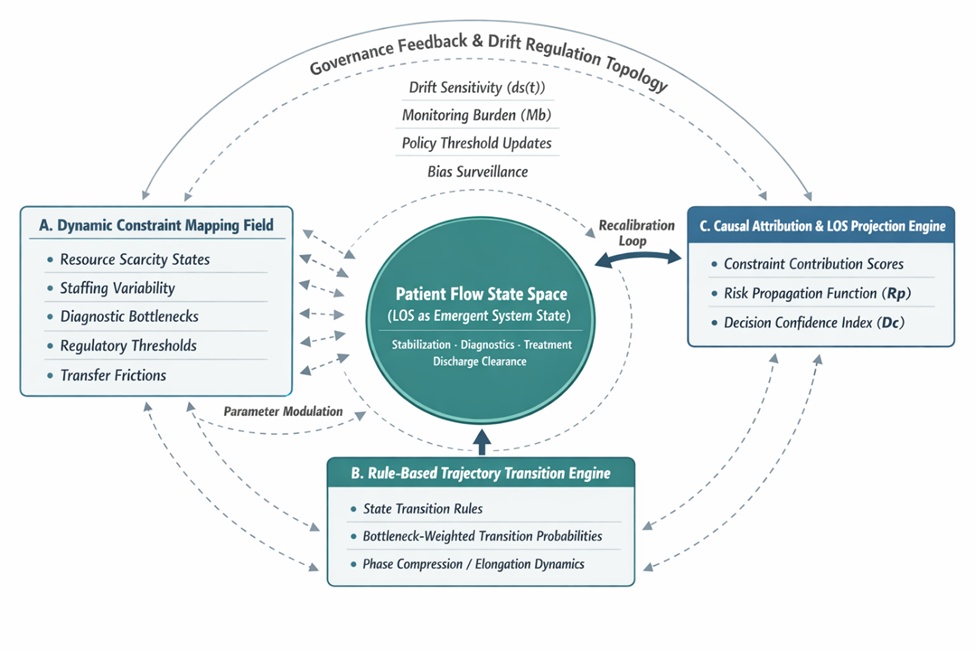
Figure 1. Constrained flow dynamics integrator (CFDI) as a recursive constraint-regulated patient flow control system
This figure conceptualizes the constrained flow dynamics integrator (CFDI) as a recursive constraint-regulated control system rather than a linear predictive pipeline. At the center lies the patient flow state space, where length-of-stay (LOS) emerges as a dynamic system state shaped by operational pressures. Module A represents a dynamic constraint field that encodes evolving operational intensities—such as staffing variability and diagnostic bottlenecks—as modulatory vectors rather than static covariates. Module B simulates semi-mechanistic state transitions across care phases, translating constraint states into rule-based trajectory elongation or compression. Module C transforms simulated trajectories into structured LOS projections accompanied by endogenous causal attribution. Surrounding the system is a governance feedback topology that continuously recalibrates constraint representations and simulation parameters in response to drift, regulatory shifts, and monitoring burdens. Recursive feedback from inference to constraint mapping establishes a closed-loop adaptive system. The architecture thus reframes LOS modeling as a governed dynamical system in which explainability, constraint modulation, and oversight are structurally embedded rather than appended.
To formalize key dynamics, we introduce interpretive formulas. First, risk propagation in constrained flows is captured as:
Second, decision confidence under constraints:
Third, monitoring burden in governance:
Table 2. Constraint taxonomy and governance modulation pathways in the CFDI control architecture
Constraint category | Structural representation | Modulation target | Governance interaction | Theoretical impact on LOS |
Resource scarcity | Severity coefficient (cᵢ) | Transition probability compression | Monitoring burden adjustment | Elongation of diagnostic/treatment phases |
Staffing variability | Workflow weight (wᵢ) | Care-phase transition delays | Drift recalibration trigger | Increased trajectory variance |
Diagnostic backlog | Operational overlap (oᵢ) | State transition bottlenecking | Threshold-based alerting | Accumulated stage congestion |
Regulatory thresholds | Constraint state boundary | Discharge clearance gating | Policy update loop | Non-linear discharge delay |
Interdepartmental transfer friction | Transition friction coefficient | Inter-phase latency | Interoperability monitoring | Cascading flow deceleration |
Data fragmentation | Constraint uncertainty index | Attribution reliability | Governance load modulation | Reduced decision confidence |
Equity sensitivity | Group-weight modifier | Risk propagation scaling | Bias surveillance feedback |
|
The constrained flow dynamics integrator (CFDI) framework, as delineated in the preceding architecture, extends its theoretical utility through an analysis of operational dynamics and projected impacts on patient flow modeling. This section scrutinizes the systemic consequences of deploying such a semi-mechanistic system in constrained healthcare landscapes, focusing on how its layers interact to modulate LOS under multifaceted pressures. By theorizing impact vectors—such as workflow efficiency gains, governance overhead reductions, and interoperability enhancements—the CFDI illuminates potential shifts in clinical operations without empirical quantification.
Central to this analysis is the framework’s capacity to project dynamics in resource-constrained scenarios, where operational bottlenecks like staffing variability or equipment limitations could theoretically be mitigated through constraint mapping. The Mechanistic Simulation Layer, for instance, enables conceptual simulations of patient trajectories, projecting how semi-mechanistic rules might redistribute flow pressures across care stages. This leads to hypothesized impacts on LOS variability, which could theoretically identify high-impact constraints, fostering proactive adjustments in decision support pipelines [1-3]. In EHR intelligence ecosystems, the CFDI’s feedback topology projects a reduction in data silos, as governance layers simulate adaptive responses to interoperability challenges, potentially streamlining patient transitions and shortening theoretical LOS durations [4-6].
Furthermore, the impact on monitoring burdens is profound, as the Governance Feedback Layer theorizes continuous oversight without escalating human intervention. By integrating drift sensitivity into its topology, the framework projects minimized governance loads, where conceptual formulas like the monitoring burden integral allow interpretive assessments of long-term system sustainability [7-9]. In clinical workflow integration models, this translates to projected dynamics where explainable outputs empower frontline decisions, theoretically alleviating operational fatigue in high-volume settings [10-12]. The semi-mechanistic nature ensures that impacts remain traceable, with risk propagation formulas highlighting how constraints cascade through flow networks, informing strategic resource allocation in analytics infrastructures [13, 14].
Projecting broader systemic consequences, the CFDI could theoretically enhance resilience in deployment environments, where AI governance systems intersect with constrained operations. For example, in multi-site healthcare networks, the framework’s layers project improved data exchange frameworks, reducing theoretical delays in LOS predictions and enabling synchronized patient flows [8, 15, 16]. This analysis also considers ethical impacts, positing that explainable mechanisms could foster trust in clinical AI architectures, mitigating potential biases amplified by operational constraints [17-19]. Ultimately, these projections underscore the CFDI’s role in reshaping healthcare dynamics, offering a lens for theoretical optimization amid persistent constraints.
The conceptualization of the constrained flow dynamics integrator (CFDI) within this manuscript represents a pivotal advancement in the theoretical discourse on explainable patient flow modeling, particularly under operational constraints. By synthesizing a semi-mechanistic framework that prioritizes interpretability over opaque algorithmic processes, the CFDI addresses longstanding gaps in healthcare analytics, where LOS predictions often succumb to the complexities of real-world constraints. This discussion elucidates the framework’s theoretical strengths, potential limitations, and broader implications for clinical AI systems, drawing on the literature synthesis to contextualize its contributions.
One of the CFDI’s primary strengths lies in its modular layer structure, which theoretically decouples constraint handling from mechanistic simulation, allowing for flexible adaptations in diverse healthcare ecosystems. Unlike traditional models that may overlook governance intricacies, the CFDI embeds feedback topologies that simulate iterative refinements, theoretically enhancing system robustness in EHR intelligence environments [1-4]. This approach aligns with recent emphases on AI governance and monitoring, where explainable frameworks mitigate risks associated with operational drift [5-7]. The interpretive formulas introduced—encompassing risk propagation, decision confidence, and monitoring burden—provide conceptual tools for dissecting flow dynamics, offering healthcare architects a means to theoretically evaluate constraint impacts without empirical data [8-10]. In decision support pipelines, this could translate to more nuanced LOS modeling, where explainability fosters clinician buy-in and reduces resistance to AI integration [11, 12].
However, theoretical limitations must be acknowledged. The semi-mechanistic design, while promoting explainability, assumes idealized interoperability in data exchange frameworks, which may not fully account for legacy system heterogeneities in constrained settings [13-15]. Governance layers, though adaptive, could theoretically impose additional computational overheads in resource-scarce environments, potentially exacerbating monitoring burdens if not carefully orchestrated [8, 16]. Furthermore, the framework’s reliance on conceptual formulas risks oversimplification of multifaceted clinical variables, such as patient comorbidities or unforeseen external constraints, highlighting the need for future theoretical extensions [17-19]. These limitations underscore the importance of iterative conceptual refinement, perhaps through hybrid integrations with emerging clinical workflow models [20, 21].
Broader implications extend to the evolution of healthcare infrastructures, where the CFDI could theoretically inform policy on AI deployment in constrained operations. By projecting impacts on patient flow efficiency, the framework advocates for governance-centric designs that prioritize ethical transparency, aligning with calls for accountable AI in medicine [22-24]. In interoperability contexts, it posits a blueprint for unified ecosystems, theoretically reducing LOS disparities across socioeconomic divides [25, 26]. Moreover, the emphasis on semi-mechanistic explainability challenges the black-box paradigm prevalent in some AI architectures, promoting a shift toward human-AI collaboration in analytics [27]. This discussion thus positions the CFDI as a catalyst for theoretical innovation, urging further exploration of constrained modeling in healthcare systems.
In conclusion, this conceptual manuscript has introduced the Constrained Flow Dynamics Integrator (CFDI), a semi-mechanistic framework engineered to advance explainable patient flow modeling under operational constraints. Through a structured exploration—from theoretical foundations and architectural design to impact projections and discursive analysis—the CFDI emerges as a robust theoretical construct for optimizing length-of-stay (LOS) in healthcare settings. By integrating unique layers for constraint mapping, mechanistic simulation, explainable inference, and governance feedback, the framework theoretically bridges gaps in clinical AI architectures, healthcare analytics infrastructures, and EHR intelligence ecosystems.
The interpretive formulas provided offer conceptual clarity on risk propagation, decision confidence, and monitoring burdens, enabling theoretical insights into resource allocation and drift sensitivity without empirical underpinnings. Projections of operational dynamics highlight the CFDI’s potential to enhance workflow integrations and interoperability, fostering resilient systems amid constraints. While limitations such as assumed ideal conditions and potential governance overheads are noted, these serve as avenues for future theoretical enhancements.
Ultimately, the CFDI contributes to the discourse on decision support pipelines and AI governance, advocating for explainable paradigms that empower healthcare stakeholders. As operational pressures in medicine intensify, this framework provides a foundational blueprint for theoretical patient flow optimization, paving the way for more transparent and efficient healthcare intelligence.
None
None
None
None
Open Access The author(s) retain copyright. This article is licensed under the Creative Commons Attribution-NonCommercial-ShareAlike 4.0 International License. It may be shared and adapted for non-commercial purposes with appropriate attribution, an indication of changes, and distribution of adaptations under the same license. Third-party material may be subject to separate terms identified in its credit line. View the license at https://creativecommons.org/licenses/by-nc-sa/4.0/.
 Clinical Intelligence Research Press