Sepsis remains a critical determinant of mortality and resource utilization in intensive care units (ICUs), necessitating proactive, intelligence-driven monitoring architectures that transcend reactive vital-sign thresholds. This conceptual manuscript introduces the sepsis-aware early warning intelligence lattice (SAEWIL), a novel theoretical framework for orchestrating multi-layered artificial intelligence within ICU monitoring ecosystems. Grounded exclusively in architectural, infrastructural, and governance principles, SAEWIL integrates clinical AI system designs, electronic health record (EHR) intelligence ecosystems, decision support pipelines, interoperability frameworks, and human–AI workflow models to enable continuous, sepsis-aware situational awareness. The framework’s unique lattice topology features five interdependent layers connected by bidirectional feedback loops that dynamically propagate risk signals while embedding real-time governance and drift-sensitivity controls. Conceptual formulas formalize risk propagation, decision confidence, and monitoring burden, offering interpretive lenses for system designers and policymakers. By synthesizing high-impact literature from 2017–2021 on AI deployment in critical care, the manuscript delineates a scalable blueprint that prioritizes ethical orchestration, seamless clinical integration, and adaptive resilience without empirical performance claims. SAEWIL thus provides a foundational reference for next-generation sepsis-aware ICU intelligence infrastructures that align technological capability with clinical safety and operational sustainability.
Intensive care units (ICUs) represent the most data-dense and temporally volatile environments in modern healthcare systems. Within these high-acuity ecosystems, sepsis remains one of the most diagnostically elusive and operationally destabilizing syndromes, characterized by nonlinear physiological deterioration, heterogeneous host responses, and rapidly compounding organ dysfunction trajectories. Conventional monitoring infrastructures—while technologically sophisticated—continue to rely heavily on rule-bound alerting paradigms that detect deterioration only after critical physiological thresholds have been breached [1-3]. This reactive posture introduces temporal blind spots during the prodromal phases of sepsis, when intervention windows remain most therapeutically actionable.
The escalating clinical and economic burden of sepsis has catalyzed a conceptual transition from retrospective detection toward anticipatory surveillance. Sepsis-aware early warning intelligence emerges from this paradigm shift as an embedded analytic cognition layer—one that does not merely monitor physiological states but continuously interprets their evolving relational dynamics. Such intelligence must operate natively within ICU monitoring fabrics, integrating high-frequency biosignal telemetry, laboratory flux patterns, therapeutic interventions, and contextual clinical annotations into a unified risk-sensing topology. The architectural challenge, therefore, extends beyond predictive modeling toward the creation of an operationally harmonized intelligence substrate capable of functioning under extreme temporal compression and cognitive load.
Traditional early warning scoring systems—including widely implemented physiological aggregation models—were architected for interpretability and bedside usability rather than predictive foresight. Their reliance on discretized thresholds, episodic sampling, and additive risk-scoring frameworks renders them intrinsically insensitive to the nonlinear, temporally entangled progression patterns that typify sepsis pathophysiology [4, 5]. These systems function as episodic evaluators rather than continuous surveillance engines, generating alerts only after clinically observable deterioration manifests.
Moreover, static rule systems lack the representational bandwidth required to assimilate unstructured clinical narratives, radiological interpretations, pharmacological trajectories, and device-generated telemetry streams. This structural limitation fragments situational awareness across data silos, delaying the orchestration of interventions and amplifying clinicians’ cognitive burden [6, 7]. In high-velocity ICU settings, where clinicians navigate overlapping diagnostic uncertainties, such informational discontinuities can materially influence patient outcomes.
Recent advances in clinical artificial intelligence have introduced system architectures capable of transcending static scoring paradigms. Machine-learning and deep-learning frameworks now enable continuous inference over multivariate physiological streams, capturing latent temporal dependencies and emergent risk signatures that elude rule-based detection [2, 8-10]. Importantly, contemporary architectures extend beyond isolated prediction engines; they function as orchestrated intelligence layers embedded within healthcare analytics infrastructures.
These AI-driven substrates support persistent risk recalibration, longitudinal patient state modeling, and adaptive alert modulation while preserving traceability through audit logs and explainability scaffolds [11]. Their infrastructural embedding allows sepsis risk signals to propagate across clinical dashboards, decision-support systems, and workflow orchestration nodes in near real time. Consequently, AI architectures are increasingly conceptualized not as adjunct diagnostic tools but as foundational sensing strata within ICU cyber-physical ecosystems.
Despite their transformative analytical capacity, AI-enabled early warning systems operate within tightly regulated ethical and institutional boundaries. Governance cannot, therefore, be appended as a post-deployment compliance layer; it must be structurally encoded within the architecture itself. Sepsis-aware intelligence frameworks must incorporate embedded monitoring nodes capable of detecting model drift, dataset shift, bias amplification, and alert performance degradation across demographic strata [12-14].
Human override pathways, audit transparency layers, and accountability routing mechanisms are equally indispensable. These governance conduits ensure that algorithmic recommendations remain contestable, reviewable, and reversible within clinical hierarchies. Without such embedded oversight infrastructures, predictive intelligence risks eroding institutional trust and regulatory viability.
The efficacy of sepsis-aware intelligence is directly proportional to the permeability of the data ecosystems in which it operates. ICU monitoring environments comprise heterogeneous device constellations, vendor-specific data schemas, and institutionally bounded electronic health record (EHR) platforms. Seamless interoperability across these domains constitutes a non-negotiable architectural prerequisite [11, 15].
Frameworks incapable of natively embedding interoperability standards—such as FHIR-enabled exchange protocols—risk generating informational archipelagos that fragment predictive insight. Federated intelligence ecosystems, by contrast, enable cross-institutional learning while preserving data sovereignty, thereby expanding model generalizability without compromising privacy integrity.
The terminal objective of sepsis-aware ICU intelligence is not automation but cognitive augmentation. Effective architectures must redistribute diagnostic workload while preserving clinician interpretive primacy. This necessitates workflow symbiosis models in which algorithmic foresight surfaces as contextualized decision support rather than prescriptive automation [16, 17].
The proposed Sepsis-Aware Early Warning Intelligence Lattice (SAEWIL) is therefore engineered as a bidirectional cognition scaffold. Within this topology, predictive signals, clinician annotations, therapeutic responses, and governance feedback loops circulate continuously—ensuring that early warning intelligence amplifies, rather than supplants, bedside expertise.
Peer-reviewed architectures emerging between 2017 and 2021 established the conceptual and infrastructural foundations for AI-mediated sepsis surveillance. Early pipelines demonstrated the feasibility of ingesting high-frequency physiological telemetry—heart rate variability, respiratory dynamics, hemodynamic indices—into machine-learning classifiers capable of surfacing preclinical sepsis risk signatures [1, 3]. Crucially, these systems prioritized interpretability, embedding feature-attribution layers and transparent risk-scoring modules to facilitate calibration of clinician trust.
Subsequent architectural evolutions expanded beyond predictive classification toward treatment policy learning. Reinforcement-learning frameworks trained on longitudinal ICU trajectories began to infer optimal intervention pathways, signaling a transition from risk detection to therapeutic orchestration [2, 8]. Systematic syntheses confirmed that temporally aware, multivariate models embedded within integrated clinical AI ecosystems consistently outperform static early warning scores across sensitivity, specificity, and lead-time metrics [4, 9].
The maturation of sepsis prediction architectures has been inextricably linked to the expansion of critical care data infrastructures. Large-scale repositories—comprising multi-institutional ICU admissions, waveform telemetry, laboratory panels, and treatment logs—have enabled the simulation and validation of real-time analytics frameworks at unprecedented scale [11].
Federated learning topologies have emerged as particularly salient infrastructural innovations. By enabling distributed model training across institutional nodes without centralized data pooling, these architectures preserve patient privacy while facilitating the propagation of cross-site intelligence. Parallel advances in cloud-native analytics stacks have further demonstrated the feasibility of deploying latency-sensitive sepsis monitoring pipelines within standards-compliant healthcare IT environments [8, 11].
Electronic health records have undergone a functional metamorphosis from archival repositories to active intelligence substrates. Deep sequence modeling applied to longitudinal EHR event streams has illustrated that early sepsis signatures can be inferred from routinely captured clinical interactions alone [6, 7]. These architectures leverage embeddings of diagnostic codes, medication orders, clinical notes, and laboratory events to construct temporally entangled patient state vectors.
FHIR-enabled streaming infrastructures further extend this intelligence by facilitating real-time interoperability between predictive engines and bedside dashboards [15]. Such pipelines enable sepsis risk alerts to be dynamically injected into clinician workflows without disrupting legacy health information system architectures.
The governance discourse surrounding clinical AI has evolved into a multidimensional architectural discipline. Contemporary responsible-AI frameworks advocate embedding fairness auditing, bias surveillance, and performance drift detection directly within model lifecycles [12-14]. Continuous monitoring layers function as epistemic sentinels, identifying when predictive validity degrades due to population shifts, therapeutic innovations, or changes in data acquisition.
Empirical examinations of bias propagation within population-health algorithms underscore the clinical stakes of governance neglect [18]. These findings reinforce the need to integrate transparency dashboards, audit trails, and escalation protocols into sepsis-aware intelligence frameworks.
Interoperability infrastructures constitute the connective tissue of lattice-style ICU intelligence systems. Fast Healthcare Interoperability Resources (FHIR) protocols have emerged as the dominant semantic exchange standard, enabling structured transmission of physiological data, clinical annotations, and predictive outputs across heterogeneous platforms [15].
Scoping analyses of FHIR-enabled systems highlight their capacity to sustain bidirectional data liquidity between monitoring devices, analytics engines, and decision-support interfaces. International health informatics standards further codify requirements for semantic normalization, device integration, and cross-vendor compatibility—ensuring that predictive intelligence remains contextually coherent across institutional boundaries.
The translational success of sepsis prediction technologies ultimately hinges on their integration within clinical workflows. Hybrid cognition models conceptualize AI outputs as augmented perception layers rather than autonomous directives [16, 17, 19, 20]. Implementation frameworks emphasize alert fatigue mitigation, interpretability scaffolds, and iterative clinician co-design processes as prerequisites for sustainable adoption.
Collectively, the literature converges on a systems-level insight: durable sepsis-aware ICU monitoring cannot emerge from predictive accuracy alone. It requires a tightly interwoven lattice of analytics, infrastructure, governance, interoperability, and workflow symbiosis—the theoretical convergence that undergirds the SAEWIL architecture advanced in this manuscript.
The central contribution of this manuscript is the Sepsis-Aware Early Warning Intelligence Lattice (SAEWIL), a uniquely articulated conceptual architecture engineered specifically for proactive, sepsis-aware ICU monitoring. SAEWIL is deliberately named and structured as a lattice rather than a linear pipeline to reflect the non-hierarchical, interdependent propagation of intelligence signals across clinical, technical, and governance dimensions.
Functional stratification and governance dependencies across SAEWIL’s five architectural layers are detailed in Table 1.
Table 1. Architectural layer functions and intelligence roles within the SAEWIL framework
SAEWIL layer | Core function | Key intelligence processes | Governance dependencies | Clinical impact domain |
Multi-modal sensory fusion | Aggregates heterogeneous ICU data streams | Signal normalization, semantic harmonization, interoperability encoding | Data provenance tracking, ingestion validation | Situational awareness foundation |
Cognitive predictive lattice | Generates dynamic sepsis risk forecasts | Ensemble inference, temporal modeling, policy learning | Bias surveillance, model drift monitoring | Preclinical deterioration detection |
Orchestration and alert synthesis | Translates predictions into clinical actions | Alert stratification, escalation routing, and visualization mapping | Alert accountability logging | Intervention timing optimization |
Embedded governance and vigilance | Regulates predictive signal propagation | Compliance auditing, override capture, and fairness monitoring | Regulatory alignment, ethical review pathways | Trust calibration & safety assurance |
Evolutionary adaptation loop | Enables system self-refinement | Outcome assimilation, parameter recalibration, and feedback learning | Longitudinal performance auditing | Continuous intelligence maturation |
The framework comprises five interdependent layers connected by a closed-loop feedback topology:
Multi-modal sensory fusion layer: Ingests and normalizes heterogeneous streams (high-frequency physiology, laboratory results, narrative notes, device telemetry) through standardized interoperability protocols.
Cognitive predictive lattice layer: Maintains parallel, mutually regularizing predictive nodes that propagate risk signals using conceptual ensemble reasoning rather than single-model dominance.
Orchestration and alert synthesis layer: Translates latent intelligence into context-aware, severity-tiered clinical notifications while embedding workflow routing logic.
Embedded governance and vigilance layer: Continuously audits for drift, bias, and compliance, applying theoretical governance weights to modulate signal propagation.
Evolutionary adaptation loop: Closes the lattice by feeding aggregated, de-identified outcomes back into upstream layers, enabling architectural self-refinement without external retraining cycles.
The feedback topology is explicitly bidirectional and multi-agent: algorithmic outputs influence clinical actions, while clinician overrides and outcome signals recalibrate lattice weights in real time. This closed-loop design theoretically minimizes decision latency while preserving human authority. The systemic signal propagation, governance modulation, and adaptive feedback dynamics of the proposed lattice architecture are schematically illustrated in Figure 1.
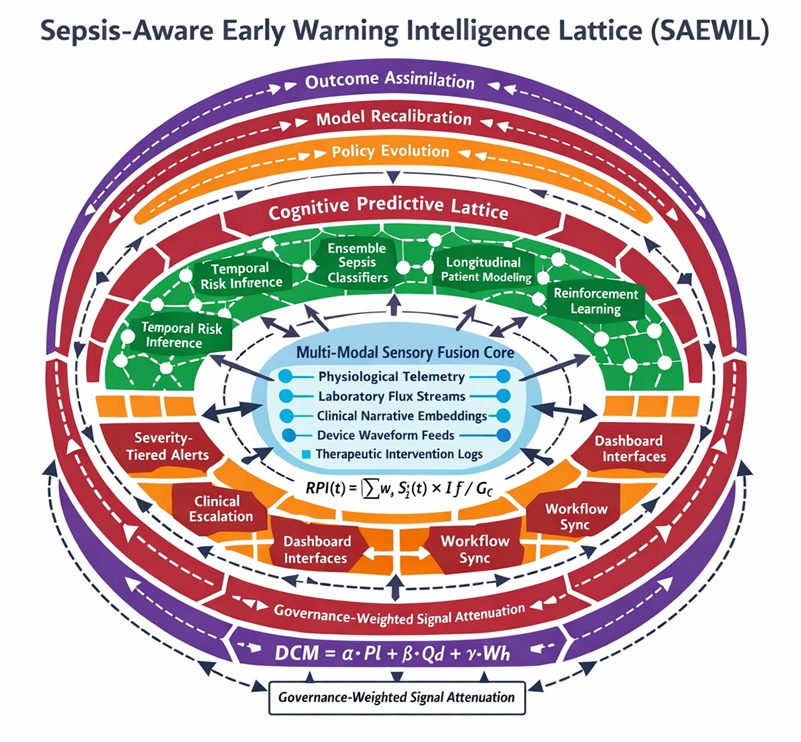
Figure 1. Sepsis-aware early warning intelligence lattice (SAEWIL): systems-level orchestration topology for ICU monitoring.
The SAEWIL framework is visualized as a five-layer radial intelligence lattice enabling continuous sepsis surveillance. Multi-modal clinical signals converge within the sensory fusion core before propagating through an ensemble predictive lattice that generates dynamic risk indices. Alert orchestration modules translate predictive signals into severity-tiered clinical notifications, while an embedded governance shell modulates signal propagation through drift auditing, bias surveillance, and compliance oversight. An outer evolutionary adaptation loop assimilates de-identified outcomes to recalibrate upstream predictive and orchestration parameters. Bidirectional feedback pathways across all layers operationalize continuous learning while preserving clinician override authority.
To formalize key dynamics, three interpretive conceptual formulas are introduced:
Risk Propagation Index (RPI):
Decision Confidence Metric (DCM):
Monitoring Burden Sensitivity (MBS):
These formulas serve purely interpretive roles, guiding architectural trade-off analysis rather than prescribing numerical thresholds. Through the SAEWIL lattice, sepsis-aware ICU monitoring transitions from fragmented alerting to orchestrated, adaptive intelligence, providing a conceptual foundation for future, deployment-ready systems.
The SAEWIL lattice, while conceptually elegant, introduces distinct operational consequences that must be anticipated during architectural maturation. Foremost among these is the redistribution of monitoring burden across ICU teams. By shifting from episodic threshold checks to continuous lattice propagation, the system theoretically reduces reactive workload spikes but elevates baseline vigilance requirements within the governance layer. Clinicians may experience a phase transition from alert-driven to oversight-driven practice, in which the primary cognitive task shifts from initiating searches for deterioration signals to interpreting modulated lattice outputs. This shift carries potential for improved anticipatory care but also risks introducing novel forms of decision fatigue if governance valves are not finely tuned to suppress low-confidence propagations.
Infrastructure sensitivities represent another critical dimension. The lattice’s reliance on bidirectional feedback presupposes robust, low-latency data pipelines across sensory, predictive, and orchestration layers. Any degradation in interoperability fidelity—whether from device heterogeneity, network partitioning, or partial EHR outages—could asymmetrically amplify upstream noise, leading to cascading governance overrides that starve downstream clinical nodes of actionable intelligence. In resource-constrained ICUs, such sensitivities may manifest as differential performance between high- and low-acuity wards, underscoring the need for tiered deployment topologies that gracefully degrade rather than fail catastrophically.
Human–AI workflow shifts constitute perhaps the most profound operational consequence. SAEWIL deliberately positions the clinician as the final governance node, receiving tiered alerts whose urgency is scaled by the decision confidence metric (DCM). This design theoretically fosters symbiosis by preserving override authority while progressively offloading routine surveillance. However, it simultaneously introduces cognitive load dependencies: clinicians must develop fluency in interpreting lattice-derived risk indices, governance audit trails, and adaptation-loop summaries. Without structured training pathways and iterative co-design, the intended augmentation could invert into mistrust or over-reliance, particularly during early post-deployment phases when adaptation feedback is still accumulating.
Governance dependencies are intrinsic rather than peripheral. The Embedded Governance and Vigilance Layer operates as a dynamic throttle on signal propagation, applying compliance scalars that reflect institutional policies, regulatory horizons, and detected distributional drift. This layer’s effectiveness hinges on persistent calibration against real-world outcome vectors, creating a dependency chain where architectural resilience scales with the maturity of institutional data-feedback loops. Weak governance dependencies—such as infrequent drift audits or siloed override logging—could, in theory, permit silent bias amplification or alert desensitization, eroding the very early warning intelligence the lattice seeks to sustain.
Collectively, these consequences highlight that successful SAEWIL deployment is less a technical installation than a socio-technical orchestration that requires aligned investments in infrastructure hardening, clinician upskilling, and governance instrumentation. When properly balanced, the lattice promises to transform ICU monitoring from reactive firefighting into proactive intelligence stewardship, but only if operational and governance dependencies are treated as first-class architectural elements from inception.
The Sepsis-Aware Early Warning Intelligence Lattice (SAEWIL) advances the conceptual frontier of ICU monitoring architectures by reconstituting previously discrete analytical, infrastructural, and governance functions into a unified lattice topology. Whereas antecedent sepsis prediction frameworks have largely been architected as linear or hierarchically staged pipelines—progressing from data ingestion to risk scoring and alert emission—SAEWIL introduces a non-sequential signal propagation model in which informational, predictive, and governance vectors circulate bidirectionally across the system substrate [1, 2, 4, 6, 8, 9, 11]. This topological reconfiguration directly addresses the fragmentation that has historically constrained the operational impact of sepsis analytics, particularly within environments characterized by heterogeneous data latency, asynchronous workflow rhythms, and rapidly evolving patient trajectories.
The lattice construct confers several theoretical resilience advantages. Non-linear propagation pathways enable predictive signals to be continuously recalibrated as new physiological, therapeutic, or contextual inputs enter the system. Rather than treating model outputs as terminal events, SAEWIL conceptualizes them as mutable intelligence states subject to recursive validation, attenuation, or amplification across interconnected nodes. Such self-refining dynamics are particularly salient in sepsis, where pathophysiological evolution is rarely monotonic and where static prediction snapshots risk rapid obsolescence [6-8].
One of SAEWIL’s most distinguishing design decisions lies in the deliberate embedding of governance as an endogenous lattice layer rather than an exogenous compliance overlay. Prior examinations of clinical AI deployment have repeatedly demonstrated that bias propagation, data drift, and performance degradation can remain undetected when oversight mechanisms operate downstream of predictive inference [12-14, 18]. SAEWIL addresses this vulnerability by directly integrating governance scalars into the risk propagation index (RPI), enabling ethical, demographic, and performance considerations to modulate signal amplification in real time.
This structural embedding transforms governance from a retrospective auditing function into an active intelligence regulator. Continuous coherence auditing across lattice nodes enables early detection of anomalous prediction clusters, subgroup performance asymmetries, and contextual misalignments between algorithmic outputs and clinical reality. In doing so, SAEWIL operationalizes contemporary calls for transparency, accountability, and algorithmic contestability within high-stakes clinical environments [12, 14].
A second architectural innovation resides in the bidirectional adaptation loop that connects predictive, workflow, and governance layers. Conventional clinical AI systems frequently rely on episodic retraining cycles to maintain performance validity—processes that are resource-intensive, operationally disruptive, and often lag behind real-world clinical evolution. SAEWIL’s lattice feedback conduits introduce a theoretical mechanism for incremental architectural recalibration without necessitating full model retraining.
By continuously ingesting clinician override patterns, intervention outcomes, and alert response latencies, the lattice can recalibrate signal weighting, escalation thresholds, and confidence modulation parameters. This adaptive elasticity may mitigate one of the most persistent translational barriers in ICU AI deployment: the erosion of predictive relevance over time due to shifting treatment protocols, patient demographics, and institutional practices [11, 19].
The introduction of interpretive formalisms—risk propagation index (RPI), decision coherence metric (DCM), and model burden sensitivity (MBS)—extends SAEWIL beyond architectural description into parametric design navigation. These constructs serve as simulation tools that enable system architects to interrogate trade-offs before deployment.
For example, Model Burden Sensitivity enables exploration of escalation-override equilibria. High alert amplification factors () may accelerate intervention timelines but risk exacerbating clinician override fatigue (). By simulating these interactions, architects can calibrate escalation dynamics that preserve vigilance without inducing alert desensitization [16, 17]. Similarly, the decision coherence metric introduces workflow harmony as a quantifiable construct, foregrounding human–AI congruence as a performance objective equal in importance to predictive accuracy [16, 17, 19, 20].
Despite its conceptual integrative strength, SAEWIL remains bounded by the limitations inherent to theoretical system design. Its projected performance advantages presuppose infrastructural conditions that are unevenly distributed across healthcare ecosystems. Seamless interoperability, low-latency device integration, standardized data ontologies, and mature governance infrastructures constitute enabling prerequisites that may not be uniformly attainable [11, 14, 15].
Furthermore, sepsis itself is a clinically fluid construct. Evolving diagnostic criteria, biomarker discovery, and therapeutic paradigms could necessitate iterative reconfiguration of the lattice. Device heterogeneity, vendor interoperability constraints, and regulatory evolution introduce additional layers of architectural contingency.
Equally salient are socio-technical uncertainties. While SAEWIL preserves clinician authority through override pathways and interpretability scaffolds, the longitudinal behavioral adaptation of care teams to lattice-mediated cognition remains underexplored. Alert trust calibration, reliance drift, and cognitive offloading dynamics warrant empirical examination through longitudinal implementation studies [16].
Several research pathways emerge from the SAEWIL conceptualization:
Prospective validation studies within live ICU telemetry environments
Federated lattice simulations across multi-institutional datasets
Governance stress-testing under demographic and epidemiological perturbations
Human factors trials examining clinician cognition under lattice-augmented monitoring
Regulatory alignment modeling to map lattice governance nodes to compliance frameworks
Collectively, these trajectories would enable translation from theoretical architecture to clinically operational intelligence infrastructure.
Sepsis continues to exert disproportionate morbidity, mortality, and resource burdens across global intensive care systems. The temporal volatility and pathophysiological heterogeneity that define the syndrome render static surveillance infrastructures increasingly insufficient for timely detection and intervention. Against this backdrop, the Sepsis-Aware Early Warning Intelligence Lattice (SAEWIL) advances a novel conceptual foundation for next-generation ICU monitoring.
By integrating multi-modal data fusion, ensemble predictive reasoning, orchestrated alert dissemination, embedded governance modulation, and adaptive evolutionary feedback into a coherent lattice topology, SAEWIL reframes sepsis surveillance as a distributed intelligence process rather than a unidirectional analytic pipeline. This architectural reframing enables continuous recalibration of risk signals in response to shifting physiological, therapeutic, and contextual inputs.
Critically, SAEWIL elevates interoperability, governance, and human–AI symbiosis from peripheral considerations to structural invariants. Such positioning directly addresses persistent translational barriers that have historically impeded clinical AI deployment—namely, data silos, opacity in oversight, workflow misalignment, and trust erosion.
The interpretive constructs embedded within the framework—RPI, DCM, and MBS—further extend its utility by equipping system architects, policymakers, and institutional leaders with tools to reason about escalation dynamics, cognitive burden distribution, and decision coherence. These parametric instruments support scenario modeling that bridges conceptual design and operational planning.
Yet the ultimate value of SAEWIL lies not solely in architectural novelty but in its capacity to reconceptualize early warning as an orchestrated cognition ecosystem. Realizing this vision will require interdisciplinary convergence spanning critical care medicine, machine learning engineering, health informatics, regulatory science, and clinical governance.
If empirically validated and thoughtfully implemented, lattice-style intelligence architectures such as SAEWIL could catalyze a paradigm shift in ICU monitoring—one in which early warning intelligence operates as an unobtrusive, continuously learning partner embedded within the rhythms of bedside care. Such a transformation holds the potential not only to accelerate sepsis detection but to redefine how complex critical illnesses are surveilled, interpreted, and governed in the era of clinical artificial intelligence.
None
None
None
None
Open Access The author(s) retain copyright. This article is licensed under the Creative Commons Attribution-NonCommercial-ShareAlike 4.0 International License. It may be shared and adapted for non-commercial purposes with appropriate attribution, an indication of changes, and distribution of adaptations under the same license. Third-party material may be subject to separate terms identified in its credit line. View the license at https://creativecommons.org/licenses/by-nc-sa/4.0/.
 Clinical Intelligence Research Press