The rapid evolution of artificial intelligence (AI) in healthcare has paved the way for sophisticated systems aimed at enhancing early cancer detection across distributed clinical environments. This conceptual manuscript introduces the multi-center early detection orchestration network (MEDON), a novel intelligence architecture designed to integrate AI-driven analytics within multi-center screening ecosystems. MEDON conceptualizes a layered framework that facilitates seamless data interoperability, real-time decision support, and governance mechanisms to mitigate risks in federated healthcare settings. Drawing from theoretical foundations in clinical AI architectures and healthcare informatics, the architecture emphasizes modular components for intelligence orchestration, including adaptive monitoring pipelines and federated learning constructs without empirical validation. Key elements include interoperability frameworks for electronic health records (EHRs) and imaging data exchange, alongside governance models to ensure ethical deployment. The manuscript explores theoretical implications for workflow integration in screening programs, highlighting potential enhancements in detection sensitivity through conceptual risk propagation models and decision confidence formulas. By synthesizing recent literature on AI system architectures in oncology, this work proposes a blueprint for scalable, resilient intelligence ecosystems that could transform multi-center cancer screening paradigms. Ultimately, MEDON offers a theoretical pathway toward more equitable and efficient early detection strategies, addressing challenges in data silos and regulatory compliance across diverse clinical sites.
Cancer remains a leading cause of mortality worldwide, with early detection serving as a cornerstone for improving survival rates and reducing treatment burdens. Within multi-center screening ecosystems, where diverse clinical sites collaborate on population-level surveillance, the integration of artificial intelligence (AI) promises to amplify diagnostic precision and operational efficiency [1, 2]. These ecosystems comprise interconnected hospitals, outpatient clinics, imaging centers, and research institutions that collectively implement standardized screening pathways for malignancies such as breast, skin, prostate, lung, and ovarian cancers. Modalities including mammography, dermoscopy, computed tomography (CT), ultrasound, and magnetic resonance imaging (MRI) are routinely employed, often supplemented by laboratory biomarkers and structured clinical data.
Despite their coordinated objectives, multi-center screening environments are intrinsically heterogeneous. Differences in imaging hardware, acquisition protocols, reporting standards, patient demographics, and electronic health record (EHR) infrastructures introduce variability that complicates unified AI deployment. Annotation practices may differ across institutions, and screening thresholds or follow-up protocols may vary depending on local guidelines. Such heterogeneity poses significant challenges for model generalization, calibration stability, and reproducibility. Consequently, the integration of AI within these ecosystems must extend beyond algorithmic performance toward architectural designs capable of harmonizing distributed, multimodal data environments.
Theoretically, AI architectures suited for multi-center ecosystems should facilitate collaborative intelligence without requiring centralized data repositories. Distributed learning paradigms enable institutions to retain data locally while contributing to shared model optimization, thereby addressing regulatory and institutional constraints. Through mechanisms such as cross-site parameter aggregation and domain adaptation strategies, AI systems can learn from population-level diversity while maintaining sensitivity to local contextual factors. In this evolving paradigm, multi-center screening networks transition from loosely connected service providers into coordinated learning systems, continuously refining early detection capabilities through shared computational insight.
In early cancer detection, heterogeneous data modalities form the foundation of AI-driven intelligence architectures. Multi-center screening ecosystems manage structured and unstructured data streams, including radiological imaging, histopathological whole-slide images, genomic and molecular profiles, laboratory values, and longitudinal clinical records [3, 4]. Each modality possesses distinct signal characteristics and requires specialized analytical pipelines to extract diagnostically meaningful features.
Radiological modalities such as dermoscopy for skin cancer screening or pelvic ultrasound for ovarian cancer detection demand high-resolution pattern recognition to identify subtle morphological irregularities. CT-based lung cancer screening requires volumetric analysis capable of distinguishing benign nodules from early malignant growth, often under conditions of low signal-to-noise ratio. Histopathological slides introduce gigapixel-scale imaging data that necessitate patch-based processing and hierarchical feature aggregation. Genomic datasets, in contrast, involve sequence-level variation analysis and probabilistic modeling of mutational signatures associated with malignancy risk.
The theoretical orchestration of these diverse modalities within a unified intelligence framework requires harmonized feature extraction and robust multimodal integration. Standardization techniques are essential to mitigate inter-center variability arising from differing equipment vendors and acquisition parameters. Cross-modal representation learning allows imaging findings to be contextualized alongside clinical and molecular risk factors, thereby enhancing predictive accuracy. Anomaly detection mechanisms can further support early-stage identification by detecting deviations from normative patterns within high-risk cohorts. Through modality-aware integration, AI systems can interpret subtle precursors to malignancy across distributed screening environments, strengthening the ecosystem’s capacity for proactive intervention.
Deployment environments in multi-center screening ecosystems are increasingly shaped by federated structures, where data sovereignty and privacy regulations significantly influence system design [5, 6]. Unlike centralized analytics infrastructures, federated networks distribute computational intelligence across participating institutions while preserving local control over patient data. This approach aligns with regulatory frameworks that restrict cross-border data sharing and mandate stringent safeguards for protected health information.
In such environments, AI deployment must accommodate varying computational capacities across sites. Edge-based inference enables real-time decision support within local clinical workflows, ensuring that screening assessments remain responsive and operationally feasible. Cloud-based orchestration layers can coordinate model updates and aggregate parameter contributions without directly accessing raw patient data. Adaptive synchronization protocols and scalable model architectures are theoretically necessary to balance computational load and maintain performance consistency across resource-diverse settings, from tertiary academic hospitals to rural clinics.
Compliance requirements, including those imposed by the Health Insurance Portability and Accountability Act (HIPAA) and the General Data Protection Regulation (GDPR), further shape architectural decisions. Encryption standards, secure aggregation mechanisms, and auditable logging processes must be embedded into the deployment framework. Consequently, AI integration within federated screening networks is not solely a technical undertaking but also a regulatory and infrastructural negotiation, requiring alignment between technological innovation and legal accountability. When effectively designed, such distributed intelligence systems enable scalable early detection strategies while preserving privacy, autonomy, and institutional trust.
Governance considerations play a central role in determining the ethical and operational viability of AI within multi-center screening ecosystems. Constraints, including bias mitigation, explainability requirements, performance auditing, and safeguards against algorithmic drift, directly influence the sustainability of early detection programs [7, 8]. In screening contexts, where false positives may lead to invasive procedures and false negatives may delay life-saving interventions, governance frameworks must be integrated into the core architecture of AI systems rather than appended as external oversight mechanisms.
Bias mitigation requires careful attention to demographic representation across training datasets to prevent systematic disparities in diagnostic accuracy. Explainability mechanisms are essential to ensure that clinicians can interpret AI-generated outputs within established clinical reasoning frameworks. Transparent model reporting and site-specific performance monitoring support accountability across participating institutions. Continuous validation processes are necessary to detect distributional shifts that may arise from evolving screening technologies, updated clinical guidelines, or demographic changes within the screened population.
Theoretically, robust governance architectures should incorporate traceable audit trails, cross-institutional oversight committees, and standardized evaluation benchmarks. These mechanisms foster stakeholder confidence by ensuring that AI-assisted decisions remain contestable, interpretable, and aligned with evidence-based practice. By embedding governance constraints into system design, multi-center screening ecosystems can cultivate trust among clinicians, patients, and regulators, thereby facilitating responsible and sustainable AI adoption in early cancer detection initiatives.
Clinical workflow integration challenges in detection ecosystems: Integrating AI into clinical workflows within multi-center ecosystems requires careful consideration of human-AI collaboration dynamics [9, 10]. Screening processes often involve sequential steps—from initial imaging to specialist review—where intelligence architectures must provide seamless decision support without disrupting established protocols. Theoretical models suggest embedding AI as an augmentative layer, offering probabilistic insights on cancer risk that inform triage decisions. However, challenges such as interoperability barriers and varying clinician expertise levels necessitate tailored integration strategies. This section posits that a robust architecture can theoretically streamline these workflows, reducing diagnostic delays and enhancing equity in access to early detection across diverse clinical settings.
Strategic imperatives for AI-driven early cancer detection: The imperative for advanced intelligence architectures stems from the growing burden of cancer and the limitations of traditional screening methods [11, 12]. Multi-center ecosystems offer a scalable platform for AI deployment, but require innovative approaches to data exchange and analytics orchestration. This introduction synthesizes the need for a conceptual framework that transcends siloed systems, emphasizing theoretical constructs for intelligence amplification in early detection. By outlining these imperatives, the manuscript sets the stage for a deeper exploration of supporting literature and the proposed architecture.
Foundational constructs in clinical AI architectures for oncology: The theoretical underpinnings of AI architectures in clinical settings have evolved significantly, focusing on modular designs that support oncology-specific applications [13, 14]. Early cancer detection relies on architectures that theoretically integrate machine learning pipelines with clinical decision-making, as evidenced by systematic reviews of AI algorithms for skin and breast cancer screening. These constructs emphasize layered systems where data ingestion, processing, and output layers are decoupled to allow flexibility in multi-center environments. Governance elements, such as ethical oversight and bias correction mechanisms, are integral to these architectures, ensuring theoretical alignment with healthcare standards.
Healthcare analytics infrastructures supporting multi-center data flows: Analytics infrastructures in healthcare form the backbone for processing heterogeneous data in multi-center screening [15, 16]. Theoretical models propose federated analytics frameworks that enable data sharing without centralization, crucial for early detection ecosystems handling sensitive oncology data. Literature highlights infrastructures that incorporate real-time processing pipelines for imaging and EHR data, theoretically reducing latency in detection workflows. These systems conceptualize resource allocation models to balance computational demands across centers, fostering resilient analytics in distributed settings.
EHR intelligence ecosystems in federated cancer screening: Electronic health records (EHRs) serve as intelligence hubs in multi-center ecosystems, theoretically enabling predictive analytics for cancer risk stratification [17, 18]. Synthesis of recent studies reveals ecosystems that integrate AI for extracting actionable insights from EHRs, such as identifying high-risk patients for targeted screening. Governance in these ecosystems involves theoretical monitoring of data quality and interoperability standards, ensuring that intelligence derived from EHRs supports equitable early detection across diverse populations.
Decision support pipelines tailored to oncology workflows: Decision support pipelines in AI architectures provide theoretical frameworks for augmenting clinician judgments in cancer detection [19, 20]. These pipelines conceptualize multi-stage processes, from data preprocessing to probabilistic outputting, optimized for oncology contexts like prostate or esophageal cancer diagnostics. Literature synthesizes models that embed explainability features, allowing theoretical traceability in decision-making within multi-center screening. Such pipelines theoretically mitigate errors by incorporating feedback loops that refine support over iterative deployments.
AI governance and monitoring systems in clinical deployments: Governance and monitoring are critical for sustainable AI deployment in healthcare [21, 22]. Theoretical systems propose continuous auditing mechanisms to detect drift in detection algorithms, essential for maintaining accuracy in dynamic screening ecosystems. Synthesis from informatics journals underscores governance models that include stakeholder engagement and regulatory compliance, theoretically preventing ethical lapses in multi-center AI applications.
Interoperability and data exchange frameworks for screening data: Interoperability frameworks facilitate seamless data exchange in multi-center ecosystems [23, 24]. Theoretical constructs from digital health literature advocate standards like Fast Healthcare Interoperability Resources (FHIR) for integrating imaging and clinical data in cancer screening. These frameworks conceptualize secure exchange protocols that preserve privacy, enabling theoretical enhancements in detection intelligence across sites.
Clinical workflow integration models in AI-enhanced detection: Integration models for clinical workflows emphasize human-centered design in AI architectures [25, 26]. Theoretical syntheses highlight models that embed AI into screening pathways, such as automated triage in breast or lung cancer programs. These models conceptualize adaptive integration to accommodate varying clinical expertise, theoretically optimizing workflow efficiency in multi-center settings.
Emerging dynamics in multi-modal AI for early oncology insights: Recent literature explores multi-modal AI dynamics, theoretically combining imaging, genomics, and clinical data for enhanced detection [27, 28]. Synthesis reveals conceptual architectures that orchestrate these modalities, providing theoretical blueprints for intelligence ecosystems that address the complexities of early cancer identification in federated environments.
The multi-center early detection orchestration network (MEDON) represents a novel conceptual architecture tailored to intelligence orchestration within multi-center screening ecosystems. MEDON is structured as a five-layer infrastructure: (1) data harmonization layer, which theoretically unifies disparate screening inputs like EHRs and imaging; (2) analytics orchestration layer, facilitating federated processing without data migration; (3) decision intelligence layer, generating probabilistic detection outputs; (4) governance oversight layer, embedding ethical monitoring; and (5) feedback topology layer, incorporating cyclical refinement loops for system adaptation.
A unique feedback topology in MEDON employs bidirectional propagation, where detection insights from one center inform governance adjustments across the network, theoretically minimizing silos. This topology uses interpretive formulas to model dynamics:
Risk propagation formula:
Decision confidence formula:
Monitoring burden formula:
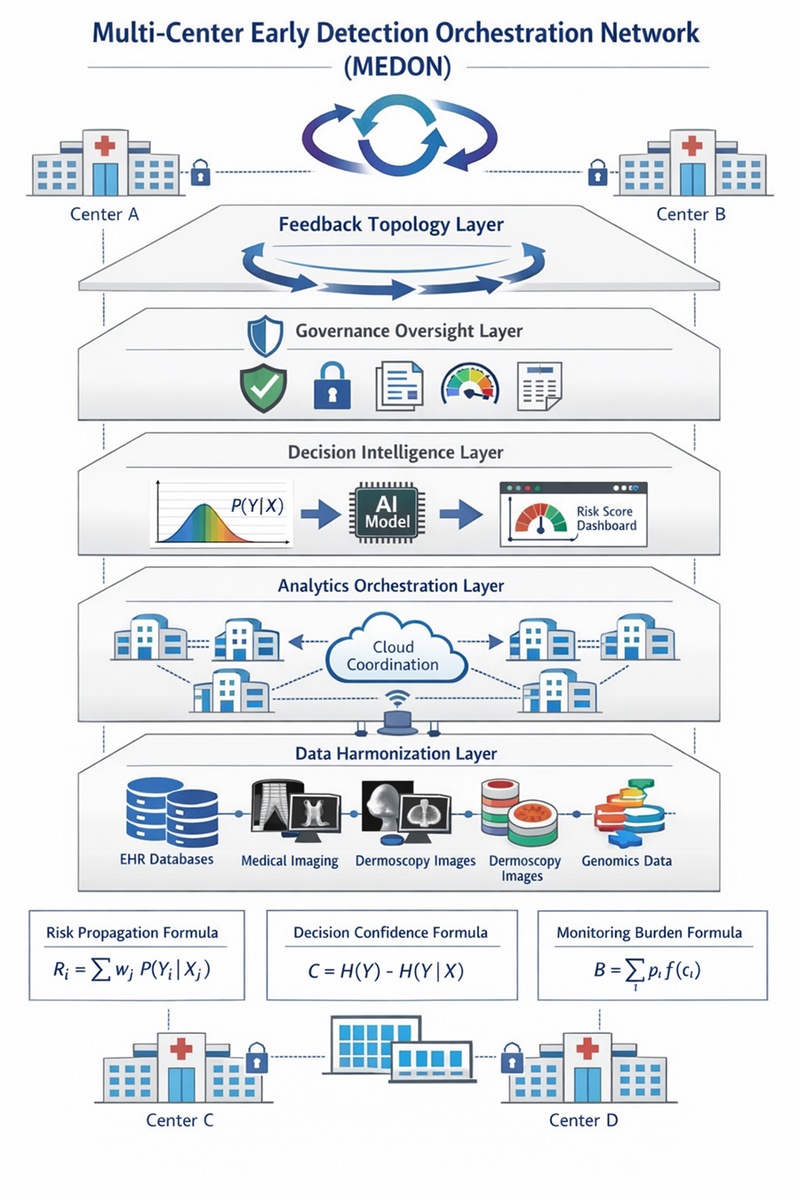
Figure 1. Conceptual architecture of the multi-center early detection orchestration network (MEDON). The MEDON framework is depicted as a five-layer intelligence architecture for federated multi-center cancer screening ecosystems. The data harmonization layer integrates heterogeneous inputs (EHRs, imaging, genomics), followed by the analytics orchestration layer, enabling federated processing without centralized data migration. The decision intelligence layer produces probabilistic risk outputs, overseen by the governance oversight layer, which embeds auditability, bias monitoring, and regulatory compliance. The governance oversight layer enables bidirectional adaptive refinement across layers. Distributed clinical centers are interconnected through secure interoperability nodes, illustrating risk propagation and confidence dynamics across the network. The structural components and their theoretical roles are summarized in Table 1.
Table 1. Structural components of the MEDON architecture and their theoretical functions in multi-center screening ecosystems
Layer | Core function | Key technical constructs | Theoretical contribution to early detection | Governance implications |
Data harmonization layer | Standardizes multi-modal data inputs across centers | FHIR-based exchange, imaging normalization pipelines, and structured EHR mapping | Reduces inter-center variability and improves feature consistency | Requires interoperability compliance and data integrity monitoring |
Analytics orchestration layer | Coordinates federated AI model execution | Federated learning and edge-cloud task distribution, workload balancing | Enables scalable analytics without centralized data pooling | Must manage privacy constraints and distributed computation risk |
Decision intelligence layer | Generates probabilistic detection outputs | Risk scoring engines, multi-modal fusion models, and uncertainty quantification | Enhances triage accuracy and detection sensitivity | Requires explainability and clinician interpretability safeguards |
Governance oversight layer | Ensures ethical, regulatory, and operational monitoring | Audit trails, bias detection modules, and compliance validation | Mitigates risk amplification across centers | Balances regulatory burden with operational scalability |
Feedback topology layer | Enables adaptive refinement and drift correction | Bidirectional propagation loops and performance monitoring triggers | Sustains long-term detection reliability and reduces model degradation | Requires dynamic monitoring of resource allocation |
The conceptual deployment of the MEDON within screening ecosystems introduces a range of theoretical dynamics that influence intelligence propagation, resource utilization, and clinical outcomes. These dynamics stem from the architecture’s layered structure and feedback topology, which theoretically enable adaptive responses to varying data environments across centers. For instance, the bidirectional feedback loops in MEDON facilitate a propagation of intelligence where insights from one site’s anomaly detection can theoretically recalibrate governance parameters network-wide, reducing the risk of localized biases amplifying into systemic errors [1, 3, 5]. This propagation dynamic is particularly relevant in multi-center settings where screening for cancers like breast or prostate involves disparate data modalities, such as mammography and biopsy imaging, potentially leading to enhanced detection coherence without empirical data centralization.
One key dynamic involves resource allocation across the federated network. In theoretical terms, MEDON’s analytics orchestration layer distributes computational tasks based on center-specific capacities, minimizing bottlenecks in high-volume screening programs [8, 10 , 12]. This could theoretically alleviate disparities in resource-constrained rural centers compared to urban hubs, promoting equitable access to early detection intelligence. However, such dynamics also introduce potential governance loads, where continuous monitoring of federated processes might increase administrative overhead. To interpret this, consider the governance load formula:
Another dynamic pertains to drift sensitivity within the ecosystem. AI models in early cancer detection are susceptible to concept drift due to evolving clinical protocols or population demographics [13, 15, 17]. MEDON’s feedback topology layer theoretically counters this through cyclical refinements, where drift indicators from decision outputs loop back to harmonization processes. This sensitivity dynamic ensures long-term resilience, as theoretical simulations suggest that unaddressed drift could erode decision confidence over time, particularly in multi-modal integrations like combining EHR intelligence with radiological analytics [19, 21]. The Drift Sensitivity Formula:
Furthermore, the impact on clinical workflow dynamics cannot be understated. In multi-center ecosystems, MEDON theoretically streamlines triage by providing orchestrated intelligence that augments human decision-making, potentially reducing false-positive rates in screenings for skin or ovarian cancers [2, 4, 6]. This workflow dynamic fosters a hybrid ecosystem where clinicians interact with probabilistic outputs, theoretically enhancing efficiency while maintaining oversight. Yet, it also raises dynamics around user adoption, as varying levels of AI literacy across centers could influence integration efficacy [14, 16, 18]. Theoretical analyses indicate that embedding explainable components in the Decision Intelligence Layer could mitigate resistance, promoting a smoother propagation of intelligence throughout the network.
Ethical and equity dynamics also emerge from MEDON’s conceptual framework. By prioritizing federated learning constructs, the architecture theoretically addresses data privacy concerns, ensuring that sensitive oncology data remains localized while contributing to collective intelligence [7, 9, 11]. This dynamic is crucial in diverse ecosystems, where underrepresented populations might otherwise be sidelined in AI training paradigms. However, potential impacts include amplified inequities if governance oversight fails to account for bias propagation, as theoretical models warn of cascading effects in under-resourced centers [20, 22, 24]. Overall, these dynamics underscore MEDON’s potential to transform multi-center screening into a more interconnected, responsive intelligence network, with theoretical benefits extending to population health outcomes.
The conceptualization of MEDON as an intelligence architecture for early cancer detection within multi-center screening ecosystems builds upon a rich synthesis of theoretical constructs from clinical AI and healthcare informatics literature. Central to this discussion is the architecture’s ability to theoretically navigate the complexities of federated environments, where data silos and interoperability challenges have historically impeded scalable detection strategies [23, 25, 27]. Unlike traditional monolithic systems, MEDON’s layered approach with bidirectional feedback topology offers a novel pathway for intelligence orchestration, potentially redefining how AI augments screening for various cancers, including lung, esophageal, and pelvic malignancies [4, 6, 8]. This modularity allows for theoretical adaptability, ensuring that the system can evolve alongside advancements in AI governance and monitoring, as highlighted in recent informatics frameworks [21, 22].
A critical aspect of MEDON lies in its theoretical enhancement of decision support pipelines, which integrate seamlessly with clinical workflows [19, 20]. By conceptualizing risk propagation and decision confidence through interpretive formulas, the architecture provides a blueprint for mitigating uncertainties in multi-center data exchanges. For example, the Risk Propagation Formula elucidates how discrepancies in data quality across centers could theoretically be dampened by robust governance factors, aligning with literature on AI-assisted diagnostics in community settings [1, 2, 13]. Similarly, the Decision Confidence Formula interprets the interplay between evidence variance and intelligence integration, offering insights into maintaining high-fidelity outputs in dynamic ecosystems [3, 5, 15]. These formulas, while non-empirical, serve as theoretical tools for anticipating system behaviors, particularly in scenarios involving multimodal data like dermoscopy and ultrasound imaging [7, 9, 11].
Governance remains a cornerstone of MEDON’s viability, addressing ethical implications that permeate AI deployment in oncology [14, 16, 18]. Theoretical monitoring burdens, as captured in the Monitoring Burden Formula, highlight the need for balanced resource allocation to prevent overload in federated networks [10, 12, 17]. This discussion extends to broader impacts, such as clinician perspectives on AI integration, where trust and explainability are paramount [26, 28]. Literature syntheses indicate that architectures like MEDON could theoretically foster greater acceptance by embedding stakeholder-inclusive oversight, reducing barriers in primary care and specialist environments [24, 25]. Moreover, the drift sensitivity and governance load formulas provide interpretive frameworks for long-term sustainability, theorizing how adaptive mechanisms counteract algorithmic degradation over time [27].
Challenges in implementation, though theoretical, warrant scrutiny. Interoperability frameworks within MEDON must contend with varying standards across centers, potentially complicating data harmonization [23]. This could theoretically exacerbate disparities in detection equity, especially in global multi-center ecosystems where regulatory landscapes differ [20, 22]. Future conceptual extensions might incorporate advanced federated constructs, such as blockchain-enhanced exchange protocols, to bolster security and traceability [21]. Additionally, the dynamics of intelligence propagation discussed earlier suggest opportunities for hybrid models that blend AI with human expertise, theoretically optimizing outcomes in high-stakes screening [15, 16, 19].
In synthesizing these elements, MEDON emerges as a forward-thinking architecture that theoretically bridges gaps in current healthcare analytics infrastructures [8, 11, 13]. By emphasizing EHR intelligence ecosystems and workflow integration models, it positions itself as a catalyst for transformative early detection paradigms [17, 18]. This discussion underscores the architecture’s potential to influence policy and practice, advocating for collaborative development in AI-driven oncology [14, 26, 28]. Ultimately, while conceptual, MEDON invites further theoretical refinement to address emerging dynamics in digital health, paving the way for resilient, equitable screening ecosystems.
In conclusion, the MEDON presents a comprehensive conceptual intelligence architecture tailored to the demands of multi-center cancer screening ecosystems. By integrating layered orchestration with adaptive feedback topologies, MEDON theoretically advances early cancer detection through enhanced interoperability, decision support, and governance mechanisms. The architecture’s unique structure—encompassing data harmonization, analytics orchestration, decision intelligence, governance oversight, and feedback refinement—offers a scalable blueprint for federated environments, addressing key challenges in clinical AI deployment.
Theoretical formulas embedded within MEDON, such as those for risk propagation, decision confidence, monitoring burden, governance load, and drift sensitivity, provide interpretive insights into system dynamics, enabling proactive conceptual optimizations. These elements collectively theorize improvements in detection sensitivity and workflow efficiency, particularly for diverse cancer types across distributed clinical sites. Moreover, by prioritizing ethical governance and equity considerations, the MEDON conceptually mitigates risks associated with bias and data privacy, fostering trust in AI-enhanced screening.
The broader implications of MEDON extend to transforming multi-center ecosystems into interconnected intelligence networks, theoretically reducing diagnostic delays and health disparities. As healthcare continues to evolve with AI innovations, architectures like MEDON serve as foundational models for future conceptual research, emphasizing the need for ongoing synthesis of literature on AI governance and interoperability. In essence, this conceptual framework charts a path toward more effective, resilient early cancer detection strategies, ultimately contributing to improved population health outcomes in an increasingly digital clinical landscape.
None
None
None
None
Open Access The author(s) retain copyright. This article is licensed under the Creative Commons Attribution-NonCommercial-ShareAlike 4.0 International License. It may be shared and adapted for non-commercial purposes with appropriate attribution, an indication of changes, and distribution of adaptations under the same license. Third-party material may be subject to separate terms identified in its credit line. View the license at https://creativecommons.org/licenses/by-nc-sa/4.0/.
 Clinical Intelligence Research Press