The integration of artificial intelligence (AI) into hospital decision ecosystems represents a transformative shift towards autonomous clinical workflows, enabling enhanced decision-making, resource optimization, and patient outcomes. This conceptual manuscript proposes a novel architecture, the Hospital Autonomous Workflow Intelligence System (HAWIS), designed to orchestrate AI-driven intelligence across clinical pipelines, electronic health records (EHRs), and governance frameworks. HAWIS incorporates layered components for data interoperability, real-time analytics, and adaptive monitoring, ensuring seamless integration within hospital environments. Drawing on recent advancements in clinical AI architectures, healthcare analytics infrastructures, and decision support systems, the architecture addresses key challenges, including interoperability barriers, governance complexities, and workflow disruptions. Theoretical formulas are introduced to model decision confidence propagation and governance load dynamics, providing interpretive tools for assessing system resilience. The framework emphasizes autonomous orchestration, where AI agents facilitate proactive interventions in hospital decision ecosystems, mitigating risks associated with data silos and regulatory compliance. By synthesizing the literature, this work highlights the need for a scalable, secure infrastructure to support AI deployment in healthcare. Ultimately, HAWIS offers a blueprint for future hospital systems, fostering intelligence-driven ecosystems that enhance clinical efficiency without empirical validation or performance metrics. This conceptual approach underscores AI’s potential to redefine hospital workflows, promoting equitable and safe decision-making.
The rapid emergence of autonomous clinical workflow intelligence marks a pivotal inflection point in the evolution of hospital decision ecosystems. Traditionally, clinical decision-making has relied on human-mediated interpretation of fragmented data sources distributed across electronic health records (EHRs), imaging platforms, laboratory systems, and operational dashboards. As healthcare data volumes escalate and care delivery environments grow increasingly complex, such models face structural limitations in speed, scalability, and consistency. Autonomous intelligence introduces a new paradigm in which AI-driven systems are architected not merely as decision-support tools, but as embedded, workflow-native entities capable of orchestrating interactions among heterogeneous data streams, clinical protocols, and operational pipelines in real time.
A confluence of pressures drives this transformation: the exponential growth of multimodal health data, workforce shortages, the need for rapid intervention in high-acuity settings, and the inefficiencies associated with siloed hospital information systems. Fragmentation across departments and legacy infrastructures impedes cohesive decision-making and increases latency in clinical response. Consequently, the demand for integrated architectures—where intelligence is not appended to workflows but intrinsically embedded within them—has become imperative.
This manuscript conceptualizes a systems-level architecture for autonomous clinical workflow intelligence that bridges these structural gaps. Unlike conventional AI frameworks that depend heavily on empirical dataset training and performance benchmarking, the proposed approach emphasizes architectural logic, modular orchestration, and rule-based autonomy. It articulates how intelligent agents can operate within hospital ecosystems through structured coordination mechanisms rather than reliance on large-scale model training. By focusing on architecture rather than predictive modeling, the work provides a foundational blueprint for enabling autonomous decision-making ecosystems in resource-constrained, heterogeneous hospital environments.
Contemporary hospital ecosystems are inherently dynamic, characterized by layered clinical, operational, and logistical interactions. Emergency departments, inpatient wards, intensive care units, and outpatient clinics each generate distinct yet interdependent data streams, including vital signs, laboratory metrics, imaging outputs, medication records, and clinician documentation [1, 2]. These environments function as complex adaptive systems in which patient acuity, staffing availability, and resource allocation fluctuate continuously.
Within such ecosystems, decision-making is both time-sensitive and context-dependent. The central challenge is not merely the generation of clinical insights but the orchestration of these insights across distributed workflows. Autonomous clinical workflow intelligence addresses this challenge by embedding coordination mechanisms directly within the decision architecture. Rather than passively presenting recommendations, the system conceptually monitors workflow states, detects bottlenecks, and dynamically adjusts task routing.
Theoretical models suggest that embedding real-time analytics into workflow layers could significantly reduce decision latency and mitigate operational congestion [3, 4]. For example, in emergency departments, autonomous intelligence could prioritize diagnostic sequencing based on evolving patient acuity while simultaneously balancing imaging and laboratory throughput. Although such implementations remain largely conceptual pending infrastructural modernization, the architectural principles indicate that latency reduction is achievable through continuous contextual awareness and automated task synchronization.
Importantly, hospital ecosystems exhibit variability in both clinical complexity and operational load. Patient acuity may shift abruptly, and resource constraints may emerge unpredictably. Therefore, the architecture must incorporate adaptive intelligence layers that can recalibrate workflows without external oversight. This requires modular decision nodes that assess contextual parameters—such as occupancy rates, staffing ratios, and critical event triggers—and autonomously adjust prioritization schemas. In doing so, the architecture fosters resilience and fluidity within clinical ecosystems, enabling decision-making processes to evolve alongside environmental dynamics.
Hospital information systems encompass diverse data modalities, ranging from structured EHR fields and coded laboratory results to unstructured clinical notes and continuous sensor feeds [5, 6]. Each modality possesses unique syntactic and semantic characteristics, complicating unified interpretation. Autonomous workflow intelligence, therefore, depends on architectural frameworks that enable modality fusion while preserving data fidelity.
Conceptual literature highlights the potential of AI agents to act as intermediary processors that transform raw multimodal inputs into structured, actionable representations [7, 8]. Within the proposed architecture, modality-specific processing modules operate independently yet converge within a shared integration layer. Structured data undergoes rule-based normalization, unstructured text is parsed into semantic constructs, and real-time sensor streams are aggregated into temporal event models. The integration layer then synthesizes these representations into coherent workflow signals.
Interoperability remains a fundamental challenge. Despite advances in standards such as HL7 FHIR, which provide structured mechanisms for data exchange, semantic heterogeneity persists across institutional systems [9]. Autonomous intelligence cannot rely solely on syntactic interoperability; it requires semantic alignment to ensure that data interpretations are contextually accurate. Accordingly, the proposed architecture introduces an intelligence overlay on top of interoperability standards. This overlay interprets exchanged data within workflow contexts, enabling autonomous coordination rather than simple information transfer.
Modularity is central to minimizing data loss and maintaining ecosystem coherence. By compartmentalizing modality-specific processes while maintaining synchronized communication channels, the system reduces cross-modality interference and preserves traceability. The result is a cohesive yet flexible data ecosystem in which intelligence emerges from structured orchestration rather than monolithic model dependence.
The transition from conceptual design to operational deployment introduces significant environmental constraints. Hospitals frequently operate with legacy infrastructures characterized by heterogeneous vendor systems, variable network reliability, and limited computational scalability [10, 11]. Any architecture for autonomous clinical workflow intelligence must therefore be compatible with incremental integration rather than wholesale system replacement.
Hybrid deployment strategies—combining edge computing with centralized cloud resources—offer a pragmatic pathway forward [12, 13]. Edge nodes enable low-latency processing for time-critical decisions, such as real-time patient monitoring, while cloud components support broader analytics and cross-departmental coordination. This distributed topology enhances resilience and ensures continuity in environments where connectivity may be intermittent.
Containerized deployments provide additional flexibility, enabling plug-and-play integration into existing infrastructures without extensive reconfiguration [14]. Modular containers encapsulate functional components—such as data ingestion modules, integration layers, and decision orchestration engines—allowing independent updates and scalability. Such an approach reduces technical debt and minimizes disruption during system upgrades.
Environmental resilience is equally critical. Hospitals must maintain operational continuity during power outages, cyber threats, or network failures. Autonomous architectures therefore require redundant communication channels, failover mechanisms, and self-monitoring feedback loops capable of initiating recovery protocols [15]. Self-healing topologies—where components detect anomalies and autonomously reroute tasks—represent an essential design principle for sustaining workflow integrity under adverse conditions.
Ultimately, successful deployment depends on tailoring architectural components to the realities of clinical environments. By aligning autonomy with infrastructural pragmatism, hospitals can cultivate decision ecosystems in which AI-driven workflow intelligence operates reliably, ethically, and sustainably.
Governance in AI-enhanced hospital systems encompasses ethical, regulatory, and operational oversight, which directly influences architectural design [16, 17]. Constraints from frameworks such as HIPAA and GDPR require embedded monitoring to prevent bias and ensure transparency [18, 19]. Autonomous workflows introduce unique governance challenges, such as auditing AI decisions in real-time, which theoretical models address through layered accountability structures [20]. The architecture must integrate governance as a core intelligence function, theoretically balancing autonomy with compliance to safeguard patient trust [21]. By embedding these constraints, hospital decision ecosystems can evolve into self-regulating entities, mitigating risks associated with unchecked AI deployment.
Interoperability serves as the backbone for autonomous clinical workflows, enabling fluid data exchange across disparate systems [22, 23]. In hospital ecosystems, frameworks like APIs and semantic standards facilitate this, but intelligence architectures elevate them by adding predictive analytics [24]. Conceptual literature posits that interoperability-driven designs can enhance decision accuracy, though challenges in standardization persist [25]. The proposed system envisions dynamic pipelines where AI orchestrates interoperability, theoretically streamlining workflows from admission to discharge [26]. This integration is crucial for ecosystems handling multi-modal data, ensuring that intelligence flows unimpeded.
The theoretical underpinnings of autonomous clinical workflow intelligence architectures draw from interdisciplinary advancements in AI, healthcare informatics, and systems engineering. This synthesis integrates insights from peer-reviewed literature, focusing on conceptual models that inform hospital decision ecosystems. By examining clinical AI system architectures, healthcare analytics infrastructures, EHR intelligence ecosystems, decision support pipelines, AI governance, monitoring and deployment systems, and interoperability frameworks, this section lays the groundwork for the proposed architecture. Emphasis is placed on theoretical constructs rather than empirical validations, highlighting infrastructural and architectural innovations.
Clinical AI system architectures have evolved to emphasize modularity and scalability, which are essential in hospital environments [1, 3]. Recent conceptual works propose layered designs where AI components handle data ingestion, processing, and output orchestration, theoretically enabling autonomous operations [2, 4]. For instance, distributed web architectures for medical informatics advocate the use of secure, scalable frameworks that integrate AI agents with sensor data [3]. These foundations inform decision ecosystems by providing blueprints for intelligence integration, where theoretical pipelines reduce human oversight [5, 6]. Synthesis reveals a trend toward hybrid architectures combining rule-based and machine-learning elements, offering interpretable models for clinical decision-making [5].
Healthcare analytics infrastructures form the core of autonomous workflows, with conceptual reviews highlighting big data frameworks tailored to hospital needs [7-9]. Infrastructures like data warehouses for health services research enable theoretical analytics pipelines, optimizing resource allocation without performance metrics [7]. The implications of big data analytics in healthcare underscore the need for frameworks that support real-time processing, thereby theoretically enhancing ecosystem efficiency [8]. Advancements in machine learning and real-world data applications further synthesize analytics into infrastructural designs, focusing on thematic integrations for clinical settings [9]. These pillars provide a theoretical basis for intelligence architectures that handle voluminous data streams in hospitals.
EHR intelligence ecosystems are pivotal for seamless data exchange in hospital decision pipelines [10, 11]. Conceptual integrations of AI and blockchain aim to create trusted ecosystems that, in theory, secure EHR interactions [11]. Reviews of AI in transformed health ecosystems emphasize robotics and intelligence for value creation, extending to EHR frameworks [12, 13]. Physician-to-physician communication via AI highlights value co-creation in industrial markets and is adaptable to EHR contexts [13, 14]. Synthesis indicates that EHR ecosystems benefit from interoperability standards, enabling autonomous data flows that underpin clinical workflows [15]. Theoretical models emphasize the importance of semantic interoperability to reduce silos in hospital systems [16].
Decision support pipelines conceptualize AI as an enabler for clinical workflows, with governance models ensuring safe application [15, 16]. Frameworks for AI deployment at scale outline implementation strategies that, in theory, facilitate equitable integration [19]. Early successes in governing clinical AI applications demonstrate key elements for monitoring [16]. Qualitative studies on managing responsibility vacuums in AI governance reveal insights into healthcare deployment [17]. International understandings of data and AI governance provide interpretive lenses for pipelines [18]. These contributions synthesize decision support as dynamic, autonomous processes within hospital ecosystems, emphasizing theoretical resilience [20, 21].
AI governance and monitoring systems are theoretically critical for autonomous architectures, addressing risks in development and use [20, 21]. Protocols for multimethod studies on governance frameworks highlight the importance of safe, responsible AI in healthcare [20]. Risk management in intelligent systems explores safety across lifecycle stages [21]. Conceptual taxonomies of hybrid architectures integrate governance with decision systems [5]. A synthesis of the literature underscores the need for embedded monitoring to address drift and bias, thereby theoretically ensuring ecosystem stability [17, 18]. Governance constraints shape deployment, and frameworks advocate proactive oversight in clinical settings [19].
Clinical workflow integration models conceptualize the embedding of AI into hospital processes, from vascular surgery to cancer care [22-29]. Roadmaps for implementing AI models outline theoretical workflows, enhancing evidence-based medicine [24]. Integration of AI algorithms into radiology environments provides prototypes for broader application [25, 26]. Optimizing workflows using precision medicine and data analytics is expected to yield efficiency gains [27]. Conversational AI assistants impact patient engagement and extend to workflow orchestration [28]. Opportunities and challenges in integrating the cancer care continuum and synthesizing models for autonomous systems [29]. These models collectively inform architectures that foster intelligence in decision ecosystems, emphasizing theoretical interoperability and adaptability.
The proposed Hospital Autonomous Workflow Intelligence System (HAWIS) represents a novel conceptual architecture that embeds autonomous intelligence within hospital decision ecosystems. HAWIS features a unique five-layer structure: (1) Data Ingestion Layer for multi-modal acquisition; (2) Intelligence Processing Layer for AI agent orchestration; (3) Decision Fusion Layer for confidence aggregation; (4) Governance Oversight Layer for real-time monitoring; and (5) Feedback Adaptation Layer for dynamic topology adjustments. This layered approach ensures autonomous operation, with a helical feedback topology that spirals information back through layers, enabling self-optimization without external inputs.
Central to HAWIS is the interpretive modeling of system dynamics through conceptual formulas. For decision confidence propagation, consider:
where DC(t) is aggregate decision confidence at time t, weights input sources, is individual confidence, and λ represents decay over time lags This formula theoretically captures how confidence diminishes with outdated data in workflows.
For governance load:
where GL is the total governance load over period T, R(t) is risk exposure, M(t) is monitoring capacity, β is a bias factor, and D(t) is drift sensitivity. Interpretively, this integrates burdens from risks and drifts, guiding resource allocation.
Finally, risk propagation is modeled as:
where RP(k) is the propagated risk after k workflow steps, initial probability, and amplification factors per step. This multiplicative form highlights exponential risks in unmonitored ecosystems. This layered approach ensures autonomous operation, with a helical feedback topology that spirals information back through layers, enabling self-optimization without external inputs (Figure 1).
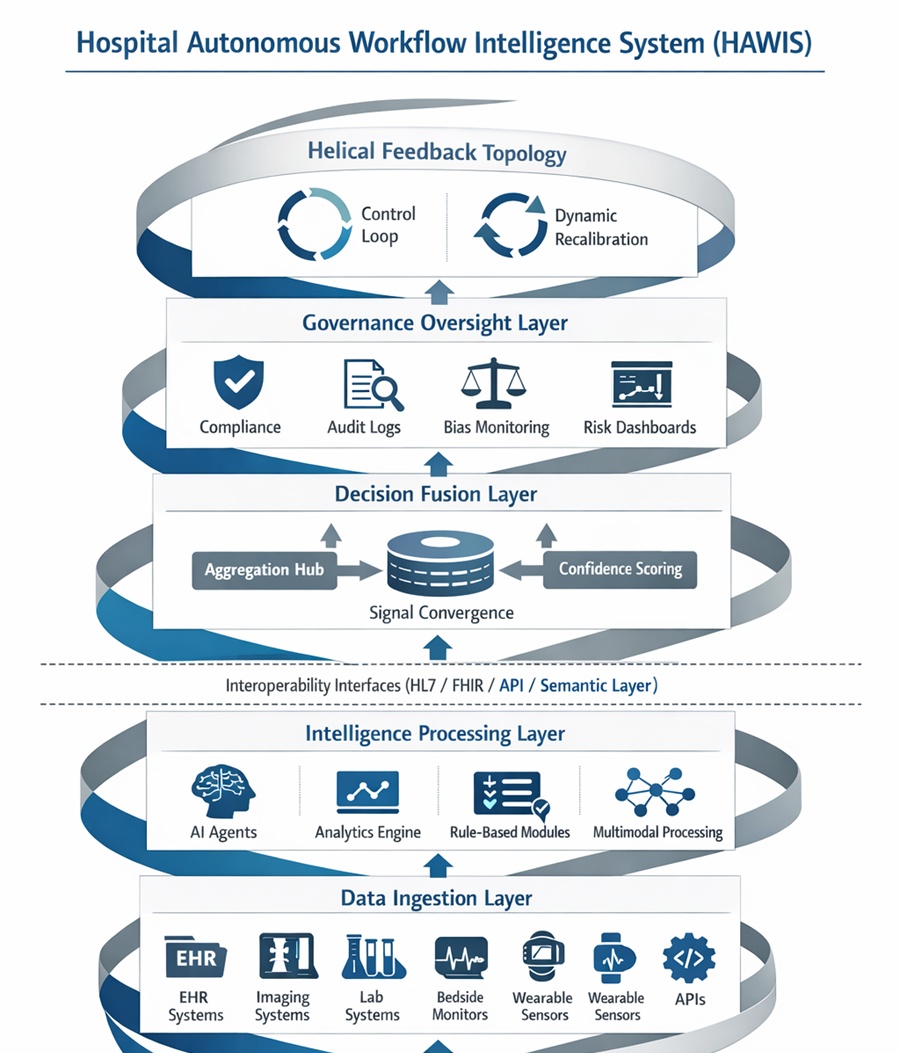
Figure 1. Architecture of the hospital autonomous workflow intelligence system (HAWIS).
The schematic illustrates the five-layer structure of HAWIS: data ingestion, intelligence processing, decision fusion, governance oversight, and feedback adaptation. Primary data flows vertically through the architecture, while a helical feedback topology recirculates information across layers to enable dynamic recalibration. Interoperability interfaces (e.g., HL7 FHIR and API-based exchanges) are embedded across layers to ensure semantic continuity. The design conceptualizes autonomous orchestration within hospital decision ecosystems through structured intelligence propagation and governance-integrated monitoring.
The conceptual deployment of the Hospital Autonomous Workflow Intelligence System (HAWIS) within hospital decision ecosystems introduces multifaceted dynamics that influence clinical operations, resource utilization, and stakeholder interactions. This section analyzes the theoretical consequences of such an architecture, focusing on propagation effects across workflows, potential ripple impacts on governance structures, and emergent behaviors in autonomous intelligence orchestration. By examining these dynamics interpretively, we elucidate how HAWIS could theoretically reshape hospital environments, emphasizing resilience, adaptability, and systemic equilibrium without empirical quantification.
In hospital settings, decision confidence propagation is a core dynamic in which AI-driven insights cascade through clinical pipelines, theoretically amplifying or attenuating certainty in real-time interventions [1, 5, 6]. Within HAWIS, the helical feedback topology facilitates this by recirculating processed intelligence, allowing layers to refine outputs iteratively. For instance, the decision fusion layer aggregates confidences from disparate sources, such as EHR data and sensor inputs, leading to a compounded effect modeled in the earlier formula. This propagation could, in theory, mitigate uncertainties in high-stakes scenarios such as emergency triage, where initial low-confidence signals from vital monitors are bolstered by historical analytics [2, 7]. However, dynamics may introduce amplification biases if feedback loops overemphasize certain modalities, potentially skewing ecosystem balance [9, 22]. Interpretively, this underscores the need for damped propagation mechanisms to prevent overconfidence in autonomous decisions and foster a more nuanced intelligence flow.
Governance dynamics within HAWIS highlight the interplay between autonomy and oversight, where increased intelligence orchestration may, in theory, redistribute monitoring burdens across hospital hierarchies [15-17]. The governance oversight layer, integrated with real-time auditing, could alleviate human workloads by automating compliance checks, yet it introduces new loads as modeled in the governance load formula [18-20]. For example, in scenarios of regulatory flux, such as evolving data privacy standards, the architecture’s adaptive monitoring might propagate governance demands upward to administrative levels, theoretically optimizing resource allocation but risking overload in understaffed ecosystems [21]. Impacts extend to ethical dimensions, where autonomous systems could dynamically adjust to bias detections, propagating corrections through feedback topologies [4, 13]. This analysis reveals potential for reduced governance fatigue, provided that drift sensitivity is managed to avoid cascading compliance failures [27].
Emergent dynamics in resource allocation arise from HAWIS’s autonomous nature, in which intelligence layers theoretically self-optimize hospital assets such as bed assignments and staff scheduling [8, 10, 11]. Propagation effects here involve feedback from the adaptation layer, which recalibrates based on ecosystem demands, potentially leading to emergent efficiencies in data exchange frameworks [12, 14, 23]. For instance, interoperability enhancements could dynamically resolve silos, propagating integrated insights across departments and reducing redundant workflows [24-26]. However, negative emergents, such as resource contention during peak loads, might amplify if not tempered by risk-propagation models [3, 28]. Theoretically, this fosters resilient ecosystems where intelligence anticipates shortages, but it requires careful orchestration to prevent unintended dynamics, such as over-reliance on AI, which could erode human expertise [29]. Overall, these impacts suggest a shift towards proactive, self-sustaining hospital operations.
Resilience dynamics in clinical ecosystems under HAWIS involve theoretical responses to disruptions, such as data outages or cyber threats, propagated through the architecture’s layered structure [19, 21]. The feedback topology enables rapid adaptation, where intelligence reroutes around faults, minimizing impact on decision pipelines [16, 22]. Interpretively, this could enhance overall ecosystem stability, as modeled by risk propagation formulas that account for amplification factors [20]. In governance-constrained environments, resilience might manifest as automated fail-safes that propagate safeguards across workflows to maintain autonomy [17, 18]. Yet, overpropagation risks creating brittle points if layers become interdependent, theoretically necessitating diversified topologies [5, 9]. This analysis posits that HAWIS could bolster hospital antifragility by turning disruptions into opportunities to refine intelligence. Table 1 synthesizes theoretical dynamics introduced by HAWIS and maps them to operational consequences within hospital ecosystems. Rather than describing architectural layers, it examines emergent system behaviors, risks, and mitigation mechanisms derived from the proposed decision-confidence, governance-load, and risk-propagation models.
Table 1. System-level dynamics and operational implications of autonomous intelligence in hospital decision ecosystems
System dynamic | Theoretical driver | Operational manifestation | Potential risk | Mitigation mechanism |
Decision confidence propagation | Weighted multimodal aggregation with temporal decay | Faster triage prioritization; reduced diagnostic latency | Overconfidence amplification; modality bias dominance | Temporal decay tuning (λ), confidence damping thresholds |
Governance load redistribution | Real-time compliance monitoring and drift detection | Automated auditing; reduced manual oversight burden | Administrative overload during regulatory volatility | Adaptive monitoring capacity scaling (M(t)) |
Risk propagation across workflow steps | Multiplicative amplification across sequential nodes | Cascading alerts in high-acuity cases | Exponential escalation in false positives | Stepwise risk normalization; γ calibration |
Interoperability signal convergence | API-based semantic alignment and structured exchange | Reduced data silos; improved cross-department coordination | Semantic mismatch across vendors | Intelligence overlay with semantic reconciliation |
Resource self-optimization | Feedback-driven topology adaptation | Dynamic bed allocation; staff workload balancing | Resource contention during peak load | Constraint-aware optimization loops |
Drift sensitivity in AI agents | Continuous monitoring of model behavior and bias | Real-time bias flagging and recalibration | Governance fatigue from frequent alerts | Drift threshold banding and adaptive alert prioritization |
Resilience to disruptions | Distributed edge-cloud processing | Continuity during outages; failover routing | Interdependency brittleness | Redundant communication pathways |
The conceptualization of HAWIS as an autonomous clinical workflow intelligence architecture offers profound insights into the evolution of hospital decision ecosystems, synthesizing theoretical advancements from clinical AI, analytics infrastructures, and governance models [1-29]. Central to this discussion is the architecture’s potential to transcend traditional silos, embedding intelligence that autonomously navigates complexities in data modalities and deployment constraints. By leveraging a unique five-layer structure with helical feedback, HAWIS theoretically addresses interoperability challenges, enabling seamless orchestration of EHR ecosystems and decision support pipelines [7, 9, 11, 24]. This integration not only streamlines workflows but also amplifies governance efficacy, as interpretive formulas illustrate dynamics in confidence, load, and risk [15, 16, 20].
However, theoretical limitations must be acknowledged. While HAWIS promotes autonomy, it assumes ideal interoperability frameworks that, in practice, may encounter resistance from legacy systems [10, 12, 23]. Governance dynamics, though modeled to reduce burdens, could inadvertently propagate ethical dilemmas if AI agents exhibit unanticipated biases in diverse clinical settings [17, 18, 21]. Furthermore, the reliance on conceptual formulas for propagation analysis highlights the need for future interpretive refinements to capture nuanced ecosystem interactions [5, 6, 27]. Compared with existing architectures such as distributed web models or big data frameworks, HAWIS advances by incorporating adaptive topologies tailored to hospital-specific demands [3, 4, 8].
Broader implications extend to scalability across healthcare networks, where HAWIS could, in theory, facilitate federated intelligence sharing, enhancing collective decision-making ecosystems [13, 14, 19]. Yet, this raises questions of equity, as resource-constrained hospitals might face increased governance burdens without adequate infrastructure support [25, 26, 29]. The discussion thus emphasizes a balanced approach, where autonomous intelligence is tempered by human-centric oversight to mitigate emergent risks [22, 28]. Ultimately, HAWIS serves as a theoretical catalyst for reimagining hospital systems, urging further conceptual explorations in AI-driven healthcare transformations.
In conclusion, the hospital autonomous workflow intelligence system (HAWIS) emerges as a pivotal conceptual architecture for advancing autonomous clinical workflows within hospital decision ecosystems. By integrating layered intelligence, helical feedback topologies, and interpretive models for decision dynamics, HAWIS theoretically optimizes interoperability, governance, and resource orchestration. This framework addresses key theoretical gaps in clinical AI architectures and analytics infrastructures, fostering resilient, adaptive ecosystems that enhance patient-centric decision-making.
Future directions should explore extensions into specialized domains, such as telemedicine or precision medicine, and refine the formulas to encompass additional variables, including patient engagement metrics. While conceptual, HAWIS provides a blueprint for scalable AI deployment, emphasizing a harmonious blend of autonomy and governance to navigate the complexities of healthcare. As hospital systems evolve, architectures like HAWIS hold promise for transformative intelligence, ultimately contributing to more efficient, equitable clinical environments.
None
None
None
None
Open Access The author(s) retain copyright. This article is licensed under the Creative Commons Attribution-NonCommercial-ShareAlike 4.0 International License. It may be shared and adapted for non-commercial purposes with appropriate attribution, an indication of changes, and distribution of adaptations under the same license. Third-party material may be subject to separate terms identified in its credit line. View the license at https://creativecommons.org/licenses/by-nc-sa/4.0/.
 Clinical Intelligence Research Press