The integration of artificial intelligence (AI) into healthcare systems has transformative potential to enhance patient outcomes, particularly in managing chronic conditions by improving medication adherence. This conceptual manuscript proposes a novel intelligence loop embedded within pharmacy-electronic health record (EHR) interoperability networks to orchestrate real-time adherence monitoring and intervention. Drawing on theoretical architectures from clinical AI systems, healthcare analytics infrastructures, and decision support pipelines, we delineate a closed-loop framework that leverages data exchange standards to facilitate seamless information flow between pharmacies and EHR platforms. The loop incorporates predictive analytics for adherence risk stratification, automated alerts for clinicians, and adaptive feedback mechanisms to refine interventions over time. Key considerations include governance protocols to ensure data privacy, ethical AI deployment, and mitigation of interoperability challenges such as semantic inconsistencies. Through a synthesis of recent literature, we explore how this intelligence loop could redistribute clinical workflows, reducing non-adherence-related complications while optimizing resource allocation in interconnected health ecosystems. Conceptual formulas model decision confidence, propagate confidence, and assess governance load sensitivities, providing interpretive tools for system design. Ultimately, this work advances theoretical discourse on AI-orchestrated adherence strategies, emphasizing infrastructural resilience and human-AI collaboration in pharmacy-EHR networks.
The convergence of pharmacy operations and electronic health records (EHRs) through interoperable digital infrastructures represents a pivotal transformation in contemporary healthcare delivery. This transformation is particularly consequential in addressing one of the most persistent and costly challenges in chronic disease management: medication non-adherence. Despite decades of clinical, behavioral, and technological interventions, adherence rates across major chronic conditions—including cardiovascular disease, diabetes, and respiratory disorders—continue to hover below 50%, contributing to avoidable morbidity, preventable hospitalizations, and escalating system-level expenditures. Within this context, the integration of artificial intelligence (AI) into pharmacy–EHR ecosystems introduces a conceptual pathway for re-architecting adherence management from episodic monitoring toward continuous, intelligence-driven oversight [1-10].
Rather than conceptualizing adherence as a static behavioral endpoint, emerging informatics paradigms frame it as a dynamic systems phenomenon shaped by multidimensional data flows. Pharmacy dispensing systems, EHR prescribing environments, clinical decision support tools, and patient engagement platforms collectively generate signals relevant to adherence. However, these signals frequently remain fragmented across institutional and technical silos. Intelligence loops embedded within interoperable pharmacy–EHR networks offer a theoretical mechanism to unify these streams, enabling real-time detection of adherence deviations and the orchestration of proactive interventions. Such loops operate not merely as analytics engines but as adaptive governance systems capable of aligning clinical oversight, patient engagement, and pharmacotherapeutic continuity.
Understanding medication adherence within interoperable ecosystems requires examining how pharmacy dispensing data intersects with clinically documented patient trajectories. Pharmacy systems capture granular records of prescription fills, refill intervals, dosage quantities, and dispensing locations. In contrast, EHR platforms document prescribing intent, therapeutic adjustments, laboratory indicators, and clinician observations. Discrepancies between these domains—such as prescriptions issued but never filled, delayed refills, or premature discontinuations—constitute early markers of non-adherence risk.
Interoperability frameworks grounded in standards such as Fast Healthcare Interoperability Resources (FHIR) enable bidirectional exchange between these systems, theoretically dissolving data silos that obscure adherence patterns [11-16]. Through semantic alignment and real-time synchronization, AI intelligence layers can detect anomalies in prescription fulfillment behaviors, flagging risk trajectories before clinical deterioration manifests. Within outpatient pharmacy environments, where dispensing behaviors are most visible, interoperability latency or fragmentation can exacerbate adherence lapses. Consequently, pharmacy nodes emerge as frontline observatories within adherence intelligence architectures [17-22].
EHR platforms serve as central intelligence hubs within adherence-monitoring ecosystems. Beyond passive repositories, contemporary EHRs aggregate multimodal datasets encompassing prescribing histories, laboratory trends, diagnostic codes, care pathways, and patient communications. AI-enabled intelligence layers embedded within these platforms can contextualize dispensing signals within broader clinical narratives, transforming isolated refill gaps into clinically interpretable adherence risk profiles.
Governance infrastructures within EHR ecosystems play a decisive role in sustaining adherence and intelligence reliability. Data provenance verification, audit logging, and interoperability validation mechanisms mitigate risks associated with incomplete or asynchronous records [23-26]. In heterogeneous deployment environments—such as community pharmacies interfacing with tertiary hospital systems—intelligence loops must accommodate variability in data fidelity, update frequency, and documentation granularity. Adaptive architectures capable of calibrating decision thresholds to data confidence levels are essential for maintaining decision support integrity [2, 3].
Pharmacy–EHR interoperability introduces substantial heterogeneity in data modalities. Structured datasets—such as prescription logs, refill timestamps, and formulary codes—coexist with unstructured artifacts, including clinician notes, discharge summaries, and patient communications. Integrating these modalities requires semantic harmonization frameworks that align ontologies, terminologies, and documentation conventions.
Conceptual models of adherence intelligence emphasize that mismatched semantic mappings can propagate inferential errors across AI loops, distorting adherence risk stratification [6]. Governance overlays further complicate modality integration. Regulatory frameworks governing protected health information impose constraints on data exchange granularity, access privileges, and storage architectures. Compliance with privacy standards—such as HIPAA and analogous international regulations—requires secure data-handling pipelines that uphold ethical accountability while maintaining analytic continuity [18].
The operationalization of adherence intelligence loops is deeply sensitive to deployment context. Rural pharmacy infrastructures, for instance, may encounter bandwidth limitations, intermittent connectivity, and workforce shortages that impede real-time interoperability. Urban academic health systems, conversely, operate within dense digital ecosystems yet face scalability and workflow complexity challenges.
Latency in data synchronization directly influences the temporal responsiveness of adherence interventions. Delayed refill visibility may postpone outreach, while asynchronous EHR updates could misrepresent therapeutic continuity. Theoretical deployment analyses, therefore, emphasize resilient interoperability architectures capable of buffering network disruptions, prioritizing critical adherence signals, and sustaining loop continuity under infrastructural variability [8].
Embedding AI-driven adherence intelligence within pharmacy–EHR ecosystems necessitates reconfiguration of clinical workflows. Traditional adherence monitoring relies heavily on retrospective review and manual pharmacist outreach. Intelligence loops shift this paradigm toward predictive surveillance, enabling clinicians to intervene before adherence deterioration escalates into therapeutic failure.
However, governance equilibrium between algorithmic autonomy and human oversight remains essential. Clinicians must retain interpretive authority over adherence alerts, particularly in socially complex or clinically ambiguous cases. Governance protocols—including explainability interfaces, audit trails, and escalation hierarchies—ensure that AI outputs remain aligned with ethical decision-making frameworks [4, 11]. When effectively integrated, such hybrid workflows may reduce cognitive burden while enhancing adherence and precision in stewardship.
Collectively, these intersecting dimensions—interoperability infrastructures, modality harmonization, deployment sensitivities, and governance integration—underscore the necessity of a unified adherence intelligence loop. By transcending traditional system silos, such architectures promise cohesive, proactive medication management ecosystems. This introduction establishes the conceptual foundation for examining the theoretical architectures, infrastructural dependencies, and governance constructs that underpin AI-enabled pharmacy–EHR adherence intelligence systems.
The theoretical scaffolding for medication adherence intelligence loops emerges from the convergence of three foundational domains: clinical AI system architectures, healthcare analytics infrastructures, and EHR-centered intelligence ecosystems. Collectively, these domains illuminate how interoperable data environments can support predictive, governance-aware adherence monitoring.
Contemporary scholarship on clinical decision support systems (CDSS) highlights the transformative role of AI in augmenting healthcare decision-making. Integrated analytics platforms have demonstrated potential to reduce medical errors, optimize therapeutic pathways, and enhance operational efficiency [1]. These architectures typically employ layered pipelines encompassing data ingestion, feature engineering, predictive modeling, and clinician interface delivery.
Within adherence contexts, similar pipelines could be adapted to monitor refill behaviors, detect discontinuation risks, and recommend pharmacist outreach. However, the literature also cautions against unintended consequences such as alert fatigue, cognitive overload, and workflow disruption—risks that are directly transferable to adherence surveillance environments [1]. Reviews of AI applications in pharmacy practice further emphasize opportunities for medication optimization analytics, reinforcing the feasibility of embedding adherence intelligence within dispensing ecosystems [4].
Healthcare analytics infrastructures provide the computational backbone for adherence intelligence loops. These infrastructures enable large-scale data aggregation, normalization, and cross-system exchange. Investigations into EHR usability reveal that interface fragmentation and documentation burdens can impede analytics integration, potentially obscuring insights into adherence [2].
The expansion of telemedicine has further reshaped the landscape of EHR interoperability. Adaptive documentation workflows and remote prescribing infrastructures demonstrate how digital ecosystems evolve under the pressures of care delivery [3]. Broader Healthcare 4.0 paradigms extend these developments, incorporating Internet of Things (IoT) devices, connected therapeutics, and cloud analytics platforms that support continuous adherence monitoring [5].
EHR intelligence ecosystems expand beyond analytics to incorporate governance, monitoring, and compliance infrastructures. Research in AI-enabled imaging informatics highlights challenges in data standardization, annotation fidelity, and interoperability—challenges that parallel those encountered in pharmacy adherence datasets [6]. Robotic homecare systems further illustrate how closed-loop AI architectures sustain continuous monitoring through adaptive feedback mechanisms [7].
Multidisciplinary eHealth surveys underscore the need for interoperable, AI-governed ecosystems that support personalized interventions [8]. Within adherence loops, such ecosystems must orchestrate secure data exchange, algorithmic transparency, and clinician accountability.
Structured data exchange frameworks underpin adherence decision pipelines. Secondary uses of EHR data in clinical trials demonstrate how standardized datasets can support longitudinal behavioral monitoring [9]. Reviews of adherence monitoring technologies—including mobile applications, ingestible sensors, and digital pill systems—provide evaluative benchmarks for AI loop integration [10].
Scoping reviews examining integrated medical devices and CDSS infrastructures reveal workflow synergies that could enhance adherence surveillance through automated escalation pathways [11].
Recent advances in pediatric informatics, cardiovascular learning systems, and digital therapeutics illustrate expanding AI capabilities in behavioral monitoring and risk prediction [12, 13, 20]. Blockchain-enabled electronic prescription frameworks introduce secure interoperability layers that enhance data trustworthiness within adherence ecosystems [14, 17].
Global digital cardiology roadmaps and FHIR-enabled machine learning infrastructures further validate interoperability as a prerequisite for scalable adherence intelligence networks [15, 16].
Efforts to democratize AI across diverse healthcare settings underscore governance imperatives for equitable adherence monitoring [18]. Cloud-based analytics environments demonstrate scalable computational infrastructures capable of sustaining adherence intelligence workloads [19].
Predictive modeling applications spanning heart failure therapeutics, non-communicable disease adherence, opioid risk detection, oncology biomarkers, and HIV stratification collectively illustrate transferable methodologies for adherence risk segmentation [21–24, 27, 28]. Parallel literature on medication error risk management reinforces AI’s preventive governance role [25], while documentation automation systems highlight opportunities to augment workflow within EHR–pharmacy intelligence loops [26].
Crucially, scholarship addressing algorithmic bias and healthcare disparities emphasizes the ethical necessity of governance overlays that ensure that intelligence systems do not amplify inequities [27].
This theoretical synthesis reveals a technologically mature yet architecturally fragmented landscape. Interoperability standards, AI analytics engines, governance frameworks, and monitoring technologies each exist as semi-independent innovations. However, their orchestration into a dedicated, closed-loop medication adherence intelligence architecture remains under-conceptualized.
Integrating these components into a unified loop—capable of continuous sensing, predictive inference, governance auditing, and intervention activation—represents a critical frontier in pharmacy–EHR interoperability science. Such systems hold theoretical potential to transform adherence management from reactive documentation toward proactive, intelligence-driven care orchestration.
The proposed orchestration topology introduces the Medication Adherence Reinforcement Intelligence Network (MARIN), a conceptual framework that embeds a closed-loop intelligence mechanism within pharmacy-EHR interoperability networks. MARIN comprises four distinct layers: (1) Data Harmonization Layer, which standardizes inputs from pharmacy dispensing logs and EHR patient profiles using interoperability protocols like FHIR; (2) Predictive Intelligence Layer, applying theoretical AI pipelines to stratify adherence risks; (3) Intervention Orchestration Layer, generating adaptive alerts and recommendations; and (4) Feedback Refinement Layer, incorporating monitoring feedback to optimize the loop iteratively.
The feedback topology is a bidirectional closed loop in which outputs from interventions feed back into the data layer for recalibration, thereby theoretically reducing drift over time. This structure ensures dynamic adaptation to patient-specific adherence patterns without empirical training (Figure 1).
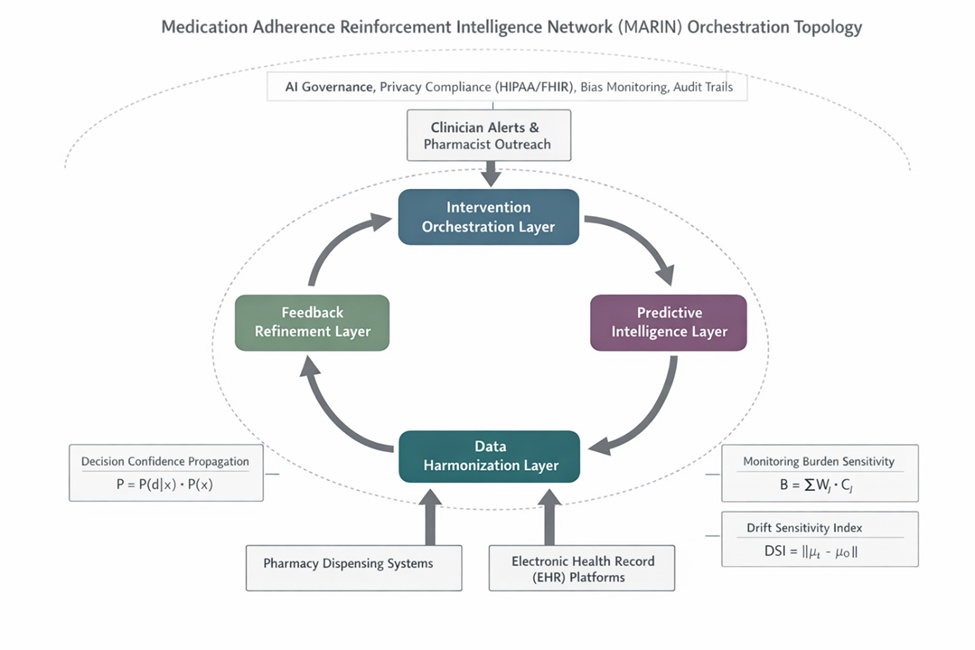
Figure 1. MARIN orchestration topology.
The schematic illustrates the closed-loop architecture embedding AI-driven adherence intelligence within pharmacy–EHR interoperability networks. Data from pharmacy dispensing systems and electronic health records are entered into the Data Harmonization Layer, where interoperability protocols standardize structured and unstructured inputs. The Predictive Intelligence Layer generates adherence risk stratification that informs the Intervention Orchestration Layer, which is responsible for clinician alerts and pharmacist outreach. The Feedback Refinement Layer recalibrates model parameters based on observed outcomes, mitigating algorithmic drift. A governance overlay encompassing privacy safeguards, audit mechanisms, and bias monitoring envelops the loop to ensure ethical and regulatory compliance. Arrows denote continuous, bidirectional information propagation sustaining adaptive adherence management.
To interpret system dynamics, consider the following conceptual formulas:
Decision confidence propagation
Monitoring burden sensitivity:
Drift sensitivity index:
These formulas provide interpretive lenses for designing resilient MARIN implementations [1, 4, 6, 10, 16, 22]. The functional decomposition of MARIN’s architectural layers is detailed in Table 1, outlining operational responsibilities and infrastructural dependencies.
Table 1. Functional architecture of MARIN layers and operational responsibilities
MARIN layer | Core function | Data inputs | Analytical processes | Outputs | Infrastructure sensitivities |
Data harmonization layer | Semantic standardization and interoperability mediation | Pharmacy refill logs, EHR prescriptions, and lab results | FHIR mapping, ontology alignment, and timestamp synchronization | Structured adherence dataset | Latency, semantic mismatch, and bandwidth variability |
Predictive intelligence layer | Adherence risk stratification | Harmonized dispensing + clinical variables | Risk modeling, anomaly detection, and confidence scoring | Adherence risk score (Ar) and Decision confidence (Cd) | Data completeness, algorithm bias, and computational load |
Intervention orchestration layer | Clinical decision activation | Risk thresholds and governance constraints | Alert generation and prioritization algorithms | Clinician alerts, pharmacist outreach prompts | Alert fatigue and workflow disruption |
Feedback refinement layer | Drift monitoring and recalibration | Observed adherence outcomes | Model recalibration and drift sensitivity calculation | Updated thresholds and adaptive parameters | Iteration latency and feedback sparsity |
The deployment of the MARIN within pharmacy-EHR interoperability networks introduces a range of infrastructural sensitivities that could profoundly influence system performance and clinical outcomes. These sensitivities arise from the interplay between data exchange frameworks, AI governance protocols, and the inherent variability of healthcare environments. Theoretically, infrastructure robustness is paramount, as intermittent connectivity in pharmacy-EHR links could amplify decision latency, potentially delaying adherence interventions and exacerbating patient risks [3, 8]. For example, in rural deployment settings with limited network bandwidth, the data harmonization layer of MARIN might experience bottlenecks, leading to incomplete adherence to risk profiles and reduced predictive accuracy [19]. This sensitivity underscores the need for redundant data pathways, drawing from cloud computing paradigms that prioritize scalability to handle fluctuating data volumes without compromising loop integrity [19]. Core system dynamics and governance-related sensitivities are synthesized in Table 2, linking conceptual formulas to operational implications.
Table 2. Conceptual system dynamics and governance sensitivities in MARIN
Conceptual model | Formula components | Theoretical interpretation | Operational risk | Mitigation strategy |
Decision confidence propagation | Confidence increases with risk clarity and interoperability quality; decreases with delay and governance load | Low trust in AI alerts | Reduce latency; optimize governance automation | |
Monitoring burden sensitivity | Monitoring demand grows with data volume and feedback iterations; it is reduced by resource allocation | Clinician overload | Edge analytics; adaptive thresholding | |
Drift sensitivity index | Accumulated prediction–observation divergence moderated by topology flexibility | Model performance decay | Continuous recalibration loop | |
Governance load sensitivity | Regulatory constraints + audit density | Increased compliance checks reduce computational efficiency | Alert delays | Tiered governance layers |
Interoperability quality gradient | Data fidelity + semantic consistency | Higher interoperability improves predictive validity | Risk misclassification | Standardized FHIR validation protocols |
Governance dependencies further heighten these sensitivities, as regulatory compliance with standards like FHIR and HIPAA imposes computational overheads that could strain resource allocation [16, 18]. Conceptual models suggest that elevated governance loads, as captured in the decision confidence propagation formula, erode confidence scores when interoperability quality dips below thresholds [1, 26]. In practice, this might manifest as heightened monitoring burdens for clinicians, with frequent AI-generated alerts requiring manual verification, potentially redistributing cognitive load and risking burnout [11, 27]. Infrastructure sensitivities also extend to semantic interoperability challenges, where mismatched data modalities between pharmacy systems and EHRs propagate errors through the loop [6, 9]. The literature on eHealth surveys highlights how such discrepancies in low-resource settings could widen health disparities, as AI loops inadvertently favor data-rich environments, leaving underserved populations with suboptimal support for adherence [18, 27].
Clinical adoption dynamics are intricately tied to these sensitivities, with human-AI workflow shifts potentially accelerating or hindering integration. Theoretical analyses indicate that adaptive feedback in MARIN could mitigate drift sensitivities by recalibrating predictions based on real-world adherence feedback, provided the infrastructure supports low-latency iterations [7, 10]. Decision latency trade-offs become evident here: prioritizing rapid alerts might increase false positives, straining pharmacy workflows, while conservative thresholds could miss critical non-adherence events [1, 25]. Expanding on this, operational consequences include resource reallocation, where AI orchestration theoretically frees pharmacists for patient counseling, but sensitivities to system downtime could revert workflows to manual processes, negating efficiency gains [4, 20]. In interconnected networks, risk propagation across nodes—such as from a compromised pharmacy database to EHR analytics—demands resilient topologies to contain failures [13, 17].
Moreover, the monitoring burden sensitivity formula illustrates how exponential increases in data volume and feedback iterations strain infrastructure limits, particularly in high-volume settings such as chronic disease clinics [5, 22]. To counter this, conceptual designs advocate for edge computing integrations, where preliminary adherence analytics occur at pharmacy endpoints, reducing central EHR loads [14, 15]. Human factors amplify sensitivities; for instance, clinician trust in AI outputs hinges on transparent governance, and any infrastructural opacity could slow adoption [2, 12]. Broader impacts encompass ethical dimensions, where biases in adherence risk stratification, as seen in disparity-focused studies, could perpetuate inequities if infrastructure fails to incorporate diverse data modalities [27, 28]. Ultimately, these sensitivities highlight the delicate balance required in MARIN deployment, where infrastructural fortification through modular designs could, in theory, enhance loop resilience, fostering sustainable adherence intelligence across varied healthcare landscapes [21, 23, 24].
The conceptualization of MARIN as an intelligence loop within pharmacy-EHR interoperability networks advances theoretical discourse on AI’s role in medication adherence. Still, it also invites scrutiny of its broader implications for healthcare systems. Central to this discussion is the potential for MARIN to transform adherence management from a fragmented, reactive process into a proactive, looped ecosystem [10, 22]. By synthesizing clinical AI architectures with data exchange frameworks, MARIN theoretically addresses gaps in current systems, such as the siloed nature of pharmacy and EHR data, which often leads to overlooked non-adherence signals [3, 9]. However, expanding on infrastructural sensitivities, we must consider how variable network reliabilities could undermine loop efficacy, particularly in resource-constrained environments [18, 19]. The literature on digital health roadmaps suggests that scalable infrastructures, such as those incorporating blockchain for secure exchanges, could mitigate these issues, ensuring data integrity across the loop [14, 15, 17].
Ethical governance emerges as a critical thread, with AI deployment systems requiring robust protocols to prevent biases in adherence predictions [27]. For instance, machine learning applications in risk stratification, while promising for personalized interventions, can amplify disparities if the training data (theoretically sourced from diverse EHRs) underrepresents marginalized groups [23, 28]. This necessitates expanded governance layers in MARIN, including continuous monitoring for drift, as modeled in our formulas, to maintain ethical alignment [1, 25]. Workflow integration models further complicate adoption; clinicians accustomed to traditional EHR interfaces might resist AI-orchestrated alerts, leading to underutilization unless human-AI synergies are carefully designed [2, 11]. Theoretical reviews of medication error management underscore the value of such integrations in reducing risks but emphasize the need for training to manage increased monitoring burdens [25].
Expanding the lens to healthcare analytics infrastructures, MARIN’s predictive layer could theoretically leverage big data to refine adherence analytics, drawing parallels with cardiovascular learning systems [13]. Yet, interoperability challenges, such as semantic inconsistencies, demand standardized frameworks to prevent error propagation [6, 16]. In eHealth contexts, multidisciplinary approaches advocate for user-centric designs that adapt to clinical workflows, potentially enhancing adoption through iterative feedback [7, 8]. The digital therapeutics literature expands on this by illustrating how AI-driven behavior nudges improve adherence in non-communicable diseases, suggesting that MARIN could extend these benefits through looped refinements [20, 21]. However, operational consequences include potential over-reliance on AI, with governance failures leading to unaddressed non-adherence [4, 26].
Decision support pipelines within MARIN highlight trade-offs in latency and accuracy; rapid interventions might boost adherence but increase alert fatigue, as noted in CDSS overviews [1]. Theoretical explorations of cloud solutions propose distributed computing to address these challenges, enabling real-time analytics without overwhelming central systems [19]. In pediatric or specialized settings, adaptability is key, with trends showing AI’s role in tailored communications [12]. Broader ecosystem impacts encompass economic dimensions: reduced non-adherence complications could lower healthcare costs, but initial infrastructure investments pose barriers [5]. Finally, envisioning future extensions, MARIN could integrate emerging technologies such as IoT to enable real-time adherence tracking, thereby fostering a more comprehensive intelligence network [5, 7]. This discussion underscores MARIN’s theoretical promise while cautioning against unmitigated sensitivities, advocating for iterative, governance-focused refinements to realize its full potential in pharmacy-EHR ecosystems [24].
In synthesizing the theoretical foundations of clinical AI systems, healthcare analytics, and interoperability frameworks, this manuscript proposes the MARIN as a pioneering intelligence loop tailored to pharmacy-EHR networks. By delineating its orchestration topology—encompassing data harmonization, predictive intelligence, intervention orchestration, and feedback refinement—MARIN offers a conceptual blueprint for addressing medication non-adherence through dynamic, adaptive mechanisms. The interpretive formulas introduced, such as those modeling decision confidence, monitoring burden, and drift sensitivity, provide analytical tools to anticipate and mitigate system vulnerabilities, emphasizing the interplay between infrastructural elements and governance imperatives.
MARIN’s deployment holds transformative potential for clinical workflows, theoretically shifting paradigms from episodic monitoring to continuous looped intelligence. This could substantially reduce the clinical and economic burdens of non-adherence, particularly in chronic care, by enabling timely interventions informed by seamless data exchanges. However, as discussed, realization demands vigilant attention to ethical governance, bias mitigation, and adoption dynamics to ensure equitable benefits across diverse healthcare settings. Challenges such as semantic interoperability and network latency, drawn from the eHealth and informatics literature, necessitate resilient designs that incorporate redundancy and edge processing.
Ultimately, MARIN advances the discourse on AI governance and deployment in healthcare, positioning intelligence loops as integral to future interoperability networks. By fostering human-AI collaboration, it theoretically optimizes resource allocation, enhances decision support, and promotes patient-centered adherence strategies. Future theoretical extensions could explore integrations with emerging modalities, such as blockchain-enhanced security or IoT-driven real-time data, to further bolster loop robustness. This work calls for continued conceptual innovation to bridge theoretical architectures with practical infrastructures, paving the way for AI-orchestrated adherence intelligence that elevates healthcare outcomes in interconnected ecosystems.
None
None
None
None
Open Access The author(s) retain copyright. This article is licensed under the Creative Commons Attribution-NonCommercial-ShareAlike 4.0 International License. It may be shared and adapted for non-commercial purposes with appropriate attribution, an indication of changes, and distribution of adaptations under the same license. Third-party material may be subject to separate terms identified in its credit line. View the license at https://creativecommons.org/licenses/by-nc-sa/4.0/.
 Clinical Intelligence Research Press