The integration of artificial intelligence (AI) into healthcare systems and analytics represents a transformative shift toward more efficient, personalized, and predictive clinical practices. However, this evolution necessitates robust governance frameworks to ensure transparency, mitigate biases, and enable continuous lifecycle monitoring. This narrative review synthesizes recent literature on AI governance in healthcare, focusing on systems-level infrastructure and clinical analytics. Drawing from peer-reviewed publications, we examine how AI tools enhance healthcare delivery through data-driven insights while addressing ethical, regulatory, and operational challenges.
Central to AI governance is transparency, which involves making algorithmic processes interpretable to clinicians and stakeholders. Studies highlight the need for explainable AI models in clinical decision-making, where opaque “black-box” systems can undermine trust and accountability. For instance, frameworks for implementing machine learning in healthcare emphasize ethical considerations, such as disclosing model limitations and decision rationales to prevent misinformed clinical actions. Bias mitigation emerges as a critical pillar, with research demonstrating how algorithmic biases in electronic health records can perpetuate health disparities, particularly among underrepresented populations. Strategies include proactive monitoring of algorithms for equity, incorporating diverse datasets during development, and post-deployment audits to detect and correct biases.
Lifecycle monitoring models ensure sustained performance and safety of AI systems over time. This encompasses ongoing evaluation, recalibration, and governance structures that adapt to evolving clinical environments. Nationwide initiatives propose AI assurance laboratories to standardize monitoring, while institutional guidelines advocate for step-by-step implementation to avoid “AI winters” caused by unaddressed failures. In analytics contexts, large AI models facilitate health informatics by processing vast datasets for predictive analytics, yet they require governance to handle challenges like data privacy and model drift.
The review structures its synthesis around healthcare systems’ end-to-end loops: from data ingestion to intelligent decision support and closed-loop interventions. It integrates cross-study analyses to propose original interpretive models for governance, emphasizing human-AI collaboration in clinical workflows. Key findings underscore the importance of multidisciplinary approaches, combining technical, ethical, and regulatory perspectives to foster responsible AI adoption. Ultimately, effective governance not only enhances patient outcomes but also builds public trust in AI-driven healthcare. This synthesis highlights gaps in current practices and advocates for integrative monitoring systems to realize AI’s full potential in equitable healthcare delivery.
The advent of artificial intelligence (AI) in healthcare has marked a paradigm shift from traditional rule-based systems to data-driven, adaptive infrastructures capable of handling complex clinical analytics. Since the late 2010s, AI technologies have permeated healthcare systems, enabling advanced analytics for disease prediction, resource allocation, and patient management [1-3]. Early applications focused on diagnostic tools, such as deep learning algorithms for image analysis in dermatology and ophthalmology, demonstrating dermatologist-level accuracy in skin cancer classification and diabetic retinopathy detection [2]. These innovations laid the groundwork for broader system integration, where AI enhances electronic health records (EHRs) and hospital information systems to support real-time decision-making.
Healthcare infrastructure has evolved to incorporate AI at multiple levels: from data acquisition through sensors and wearables to centralized analytics platforms that process multimodal data [4, 5]. Large AI models, such as those based on transformer architectures, have emerged as powerful tools for health informatics, capable of synthesizing vast datasets from genomics, imaging, and clinical notes [4]. However, this evolution introduces governance imperatives to ensure that AI systems align with clinical needs and ethical standards [6, 7]. Governance in this context refers to the structured oversight of AI’s design, deployment, and maintenance, emphasizing transparency to demystify algorithmic outputs for non-expert users [8, 9].
Transparency remains a cornerstone of AI governance, addressing the inherent opacity of many machine learning models. In healthcare, where decisions impact human lives, the inability to interpret AI recommendations can lead to hesitation among clinicians or erroneous applications [6, 10]. Literature underscores the ethical challenges of implementing machine learning, advocating for models that provide rationales alongside predictions [1, 7]. For example, in predictive analytics for patient risk stratification, transparent systems allow clinicians to trace how variables like demographics or lab results contribute to outcomes, fostering trust [9, 11].
Interpretability frameworks have been proposed to bridge this gap, including clinician checklists for assessing AI suitability [10]. These tools evaluate factors such as data quality, model robustness, and alignment with clinical workflows, ensuring that AI augments rather than replaces human judgment [8, 12]. Moreover, regulatory conformance is emphasized, with surveys highlighting the need for AI to comply with medical device standards, such as those from the FDA, to guarantee safety and efficacy [12]. Table 1 operationalizes the governance pillars of transparency, bias mitigation, and lifecycle monitoring by mapping each pillar to concrete mechanisms, accountable stakeholders, required artifacts, and auditable signals for healthcare deployment.
Table 1. governance pillar–mechanism mapping for AI-enabled healthcare systems: operational artifacts, ownership, and measurable signals.
Governance pillar | Core governance objective | Primary mechanisms in practice | Accountable owners | Required artifacts for auditability | Auditable signals and evaluation targets |
Transparency and interpretability | Make model behavior intelligible and contestable in clinical use | Interpretable output interfaces; rationale disclosure; limitation statements; traceable data provenance; reproducibility checks | Clinical safety committee; model developers; compliance and quality office | Model documentation dossier; intended-use statement; model limitations and contraindications; versioned audit trail; clinician-facing explanation template | Clinician comprehension and calibration; explanation consistency across subgroups; traceability completeness; incident explainability sufficiency for root-cause analysis [1, 6, 9, 13] |
Bias mitigation and equity | Prevent amplification of historical inequities and reduce disparate performance | Diverse dataset curation; fairness-aware training; subgroup performance validation; equity audits; post-deployment bias surveillance | Equity governance lead; data stewardship team; analytics governance board | Representativeness report; subgroup validation report; fairness risk register; bias audit log; remediation action record | Disparity in error rates across protected groups; stability under population shifts; remediation latency; equity audit coverage and cadence [11, 14-18] |
Lifecycle monitoring and assurance | Sustain safety and effectiveness under drift and changing practice contexts | Drift detection; performance surveillance dashboards; recalibration protocols; phased rollouts; cross-site assurance processes | MLOps and monitoring team; institutional review body; external assurance partners | Monitoring plan; drift thresholds and escalation policy; recalibration protocol; incident reporting pathway; periodic revalidation report | Drift detection sensitivity and specificity; time-to-detection and time-to-mitigation; workflow disruption burden; post-update safety revalidation pass rate [4, 19-22] |
Accountability and liability alignment | Clarify responsibility and reduce governance ambiguity at failure points | Role assignment across pipeline; governance gates; clinical override pathways; documentation of handoffs and decisions | Legal and risk management; clinical leadership; governance steering committee | Responsibility matrix; override and escalation log; change-control records; decision trace documentation | Clarity of responsibility at incidents; completeness of override documentation; reduction in ambiguous failure attribution [13] |
Privacy and data protection integration | Balance data utility with confidentiality and regulatory constraints | Access control; privacy-preserving analytics; minimization and purpose limitation; consent governance | Data protection officer; institutional governance board; information security | Data governance charter; access logs; consent and purpose documentation; privacy impact assessment | Compliance adherence under evolving analytics demands; traceability of data use; adequacy of minimization for clinical objectives [4, 7] |
Bias mitigation is integral to AI governance, as unchecked biases can exacerbate health disparities. Research reveals how AI algorithms trained on skewed EHR data may discriminate against racial or socioeconomic groups, leading to inequitable resource allocation [16-18]. For instance, a widely used algorithm for health management was found to under-allocate care to Black patients due to biased proxies like healthcare costs [16]. Mitigation strategies involve diversifying training datasets, employing fairness-aware algorithms, and conducting regular audits [11, 14].
Equity-focused governance extends to conversational AI and chatbots, where inclusive design roadmaps aim to reduce disparities in access to health information [23]. Studies advocate for proactive monitoring to ensure health equity, integrating bias checks into the AI lifecycle [14, 15]. This includes addressing inequalities amplified during events like the COVID-19 pandemic, where AI tools risked widening gaps in care delivery [15].
Lifecycle monitoring models provide a systematic approach to sustaining AI performance post-deployment. These models involve continuous surveillance for model drift, where changes in data distribution can degrade accuracy over time [19, 21]. Institutional case studies illustrate comprehensive guidelines for responsible AI use, including monitoring protocols that involve multidisciplinary teams [19, 20]. Nationwide networks of AI assurance laboratories are proposed to standardize evaluations, ensuring interoperability and scalability across healthcare systems [20].
Regulatory perspectives emphasize step-by-step governance to prevent implementation failures, such as those leading to “AI winters” [21]. Consensus statements outline critical questions for transparency, replicability, and ethics in AI research, guiding lifecycle management [8]. Liability considerations further underscore the need for robust monitoring, as healthcare providers may face accountability for AI-induced errors [13].
Table 2 presents a lifecycle monitoring model that specifies phase-specific triggers, governance actions, and decision thresholds required to detect drift, preserve safety, and support continuous accountability after deployment.
Table 2. Lifecycle monitoring model for healthcare AI: triggers, governance actions, and decision thresholds across deployment phases.
Lifecycle phase | Dominant risk mode | Trigger signals in real settings | Required governance action | Decision threshold logic for escalation | Accountability assignment and documentation |
Pre-deployment validation | Hidden bias; poor generalizability; weak interpretability | Subgroup performance gaps; unstable calibration; low clinician interpretability; dataset mismatch to intended use | Freeze model and revise training and validation scope; require explainability readiness; document limitations | Escalate when subgroup disparities exceed preset tolerance or when interpretability is insufficient for intended clinical decision impact [1, 6, 9, 16, 17] | Governance gate sign-off; validation report; fairness register; intended-use statement [8, 12] |
Controlled rollout | Workflow disruption; miscalibration under local context | Increased alert fatigue; override spikes; clinician-reported confusion; site-specific performance drop | Implement staged deployment with a human oversight gate; update interfaces; retrain on local distribution if warranted | Escalate when override rates rise persistently or when workflow burden exceeds acceptable operational limits [10, 22] | Rollout log; override log; training record; site readiness checklist [10] |
Routine operation | Model drift; emergent inequities; silent failure | Drift metrics; distribution shifts; change in coding practices; shifting patient mix; periodic equity audit deviations | Activate monitoring dashboard; run periodic revalidation; conduct equity audits; initiate recalibration protocol | Escalate when drift persists beyond the monitoring window or when equity audits reveal new disparate impact patterns [4, 14, 19, 21, 23] | Monitoring plan; drift reports; audit results; recalibration approval record [19, 20] |
Incident response | Safety event; harmful recommendation; accountability ambiguity | Adverse outcome reports; near-miss clusters; misalignment with clinical guidelines; escalation via safety reporting | Pause or constrain model; root-cause analysis; communicate limitations; remediate and revalidate | Escalate immediately for safety-critical incidents or repeated near-misses within a defined time horizon [13] | Incident dossier; root-cause analysis report; corrective action record; governance committee minutes [13, 19] |
Post-update reassurance | Regression after update; documentation drift | Performance regression; altered explanation behavior; subgroup regression; documentation mismatch | Formal revalidation; update audit trail; clinician re-training if interface changed | Escalate when post-update metrics regress beyond baseline tolerance or when explanation stability degrades [8, 10, 20] | Change-control record; versioned model card; revalidation report; updated limitations statement [8, 20] |
This review positions itself as an integrative synthesis of AI governance in healthcare systems and analytics. Unlike prior reviews that focus narrowly on ethical challenges or specific applications, this narrative emphasizes a holistic lifecycle perspective: from data ingestion to governance feedback loops. The synthesis logic organizes literature into thematic clusters—transparency mechanisms, bias mitigation strategies, and monitoring architectures—while cross-analyzing studies for emergent patterns in clinical integration. By framing AI as an embedded component of healthcare infrastructure, the review highlights interpretive models for closed-loop systems, providing actionable insights for policymakers and clinicians.
The landscape of AI in healthcare systems is fundamentally anchored in data analytics, where vast repositories of clinical, genomic, and imaging data fuel intelligent systems [1, 4, 5]. AI analytics transform raw data into actionable insights, enabling predictive modeling for disease outbreaks, patient trajectories, and resource optimization [3, 4]. For instance, machine learning applications in EHRs facilitate pattern recognition that surpasses human capabilities in scale and speed, supporting population health management [1, 18].
However, the quality and diversity of data underpin system reliability, with studies warning against biases inherent in historical datasets [16-18]. Governance begins at this foundational layer, requiring protocols for data curation to ensure representativeness and privacy compliance [7, 8]. Analytics platforms increasingly incorporate federated learning to handle distributed data without centralization, enhancing scalability in multi-institutional settings [4].
Clinical analytics workflows leverage AI for tasks ranging from diagnostic support to prognostic assessments. Deep learning models excel in medical imaging, achieving high accuracy in breast cancer screening and radiographic interpretations [24, 25]. These workflows integrate AI into hospital systems, where analytics engines process real-time data streams from monitoring devices to alert clinicians of anomalies [3, 9].
Synthesis across studies reveals a shift toward hybrid systems, combining rule-based and learning-based approaches for robust analytics [1, 12]. Governance frameworks advocate for transparency in these workflows, mandating audit trails that document data transformations and model inferences [6, 19]. Bias mitigation is embedded through techniques like adversarial training, which adjusts models to minimize discriminatory outputs [11].
Healthcare infrastructure for AI deployment emphasizes interoperability and security, with cloud-based platforms enabling seamless integration across care settings [20, 21]. Nationwide initiatives propose assurance laboratories to validate AI tools before widespread use, ensuring they meet clinical standards [20]. Deployment strategies include phased rollouts, as outlined in step-by-step guides that incorporate stakeholder feedback to refine systems [21, 22].
Analytics in deployed systems focus on performance monitoring, using metrics tailored to healthcare outcomes rather than generic accuracy [8, 10]. Literature synthesizes barriers to deployment, such as regulatory hurdles and clinician resistance, recommending mixed-method strategies for overcoming them [22]. Governance models here prioritize lifecycle adaptability, allowing systems to evolve with new evidence [19].
Transparency in AI systems is operationalized through explainable interfaces that reveal decision pathways, crucial for clinical acceptance [6, 9, 10]. Accountability frameworks assign roles for oversight, with institutional committees developing guidelines for ethical AI use [7, 19]. Cross-study analysis shows that transparency reduces litigation risks by clarifying liability in AI-assisted decisions [13].
In analytics contexts, transparency extends to data provenance, ensuring traceability from source to insight [8]. Perspective pieces argue for regulatory conformance, integrating governance into system design to align with evolving policies [12].
Systemic bias mitigation involves proactive interventions at multiple stages: data selection, model training, and output validation [13, 14, 16]. Studies dissect biases in population management algorithms, advocating for equity audits that quantify disparities [16, 17]. Strategies include debiasing techniques and inclusive design, particularly for underserved groups [11, 15, 23].
Synthesis highlights the role of conversational AI in mitigating access biases, with roadmaps for equitable chatbot implementation [23]. Governance integrates these strategies into infrastructure, mandating periodic reviews to maintain fairness [14].
Monitoring architectures form the backbone of sustained AI efficacy, featuring feedback mechanisms for recalibration [19-21]. These include dashboards for real-time performance tracking and protocols for intervention when deviations occur [10, 14]. National-scale models propose collaborative networks for shared monitoring resources [20].
Analytics-driven monitoring uses AI itself to detect anomalies, creating meta-level governance [4]. Literature emphasizes ethical monitoring, ensuring that surveillance respects patient autonomy [7, 8].
Intelligent clinical decision support systems (CDSS) represent the convergence of AI analytics and healthcare infrastructure, providing real-time recommendations to enhance clinician judgment [1, 5, 9]. These architectures typically comprise modular components: data ingestion layers that aggregate EHRs, imaging, and sensor inputs; inference engines powered by machine learning models; and output interfaces that deliver interpretable insights [3, 4]. Governance is embedded within these architectures, ensuring decisions align with ethical standards and clinical protocols [6, 7].
Closed-loop systems extend CDSS by incorporating feedback mechanisms, where AI outputs influence interventions, and subsequent outcomes inform model updates [9, 21]. For example, in intensive care settings, AI monitors vital signs to suggest adjustments in treatment, closing the loop through continuous data recirculation [21]. Synthesis of literature reveals original structuring: decision architectures as dynamic networks, where nodes represent human-AI interaction points, edges denote data flows, and governance overlays enforce transparency [8, 10, 12].
Collaboration dynamics in intelligent systems emphasize augmentation, where AI handles high-volume analytics while humans provide contextual oversight [1, 3, 9]. Frameworks for assessing AI suitability include checklists that evaluate collaboration feasibility, focusing on scenarios where AI reduces cognitive load without introducing risks [10]. Bias mitigation in these loops involves human-in-the-loop validations, where clinicians flag potential inequities in recommendations [11, 14, 17].
Lifecycle monitoring enhances collaboration by enabling adaptive loops, where models learn from human corrections to improve future decisions [19, 20]. Studies advocate for regulatory-compliant architectures that formalize these interactions, ensuring accountability [12, 13].
Closed-loop healthcare systems operationalize feedback through iterative cycles: prediction, intervention, outcome assessment, and recalibration [4, 21]. In analytics terms, this involves predictive models forecasting risks, followed by targeted interventions like medication adjustments, with outcomes feeding back to refine predictions [1, 14]. Governance models monitor these cycles for drift, employing automated alerts for human review [19, 20].
Original interpretive structuring synthesizes cycles as governance-augmented loops, integrating transparency at each stage to trace biases or errors [6, 8]. For instance, in population health analytics, closed loops mitigate disparities by continuously auditing intervention equity [15, 16].
To synthesize human-AI decision fusion in closed-loop systems, consider the following interpretive formula:
where D represents the fused clinical decision, H denotes human input (clinical expertise and context), A signifies AI output (analytics-driven prediction), and G embodies governance constraints (transparency rules, bias checks, and monitoring thresholds). This formula illustrates a non-linear integration, where governance modulates the weighting of H and A to ensure ethical alignment, without specifying empirical parameters. Figure 1 synthesizes an end-to-end AI governance loop in healthcare that links transparency mechanisms, bias mitigation controls, and lifecycle monitoring checkpoints across data ingestion, model development, clinical decision support, intervention execution, and continuous recalibration.
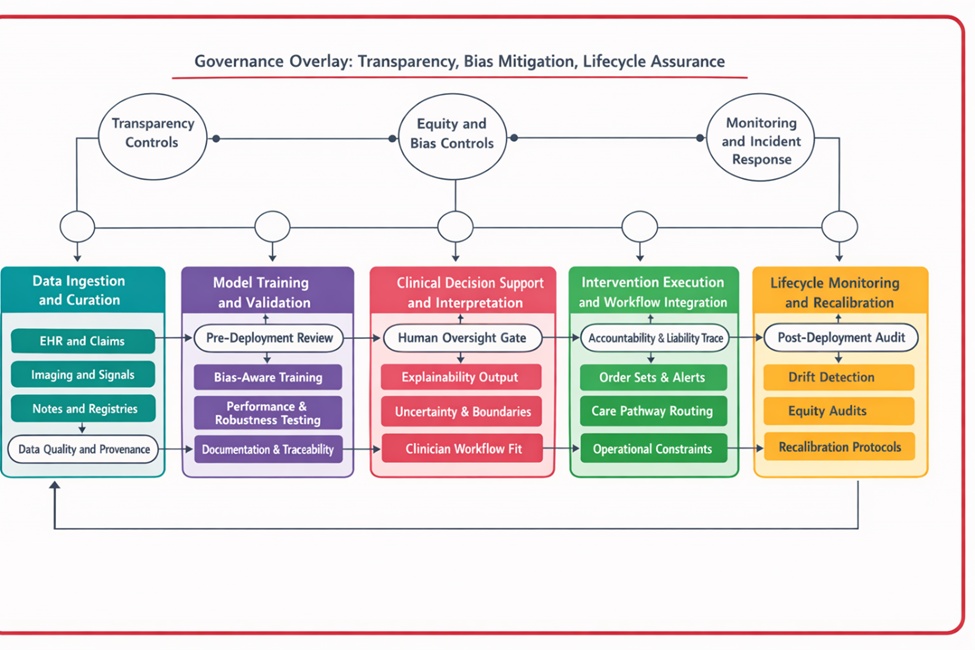
Figure 1. Systems-level AI governance loop for healthcare analytics. A closed-loop architecture illustrates how transparency and interpretability controls, bias and equity safeguards, and lifecycle monitoring protocols can be embedded across the AI pipeline, from data ingestion and curation through model training and validation, clinical decision support, intervention execution, and post-deployment drift detection with recalibration pathways that sustain safety and accountability over time.
The integration of artificial intelligence (AI) into healthcare systems and analytics has progressed significantly, yet governance remains the pivotal factor determining whether these technologies deliver equitable, reliable, and sustainable benefits. This narrative review synthesizes evidence, revealing that effective governance hinges on three interconnected pillars: transparency, bias mitigation, and lifecycle monitoring. These elements are not isolated but form a cohesive framework that supports end-to-end healthcare processes—from data ingestion to clinical intervention and feedback.
Transparency facilitates trust by enabling clinicians to understand and interrogate AI outputs [6, 9]. Without it, adoption stalls, as opaque models hinder informed decision-making and accountability [8, 10]. Literature consistently links transparency to ethical implementation, where explainable interfaces and audit trails allow stakeholders to trace algorithmic reasoning [7, 13]. In analytics-heavy environments, transparency extends to data provenance and model assumptions, ensuring that insights derived from EHRs or imaging are verifiable [1, 18].
Bias mitigation addresses systemic inequities embedded in training data or algorithmic design [11, 16, 17]. Cross-study analysis shows that biases often arise from non-representative datasets, leading to disparate outcomes in risk prediction or resource allocation [16, 18]. Proactive strategies, including fairness-aware training and equity audits, are essential [14, 15]. Governance must institutionalize these practices, as post-deployment monitoring alone is insufficient without upstream interventions [11, 23].
Lifecycle monitoring ensures AI systems remain performant amid evolving clinical realities [19-21]. Model drift, triggered by shifts in patient demographics or data practices, poses ongoing risks [4, 21]. Assurance mechanisms, such as continuous validation and recalibration protocols, are critical for sustained safety [9, 20]. Institutional and national frameworks advocate for multidisciplinary oversight to detect degradation early [8, 19].
Original interpretive synthesis positions governance as an overarching layer in closed-loop systems. The conceptual formula
Challenges persist in operationalizing these pillars. Implementation barriers include resource constraints in diverse healthcare settings, regulatory fragmentation, and clinician resistance due to perceived threats to autonomy [21, 22]. Despite progress in frameworks, gaps in pediatric applications and underrepresented populations highlight uneven governance maturity. The review’s emphasis on integrative monitoring addresses these by advocating scalable, feedback-driven architectures.
Despite substantial technological advancement and growing institutional investment, durable and scalable governance of AI in healthcare systems remains constrained by interlocking technical, ethical, infrastructural, and regulatory barriers. These challenges operate across the full sociotechnical stack of AI-enabled healthcare—from algorithm design and data provenance to clinical workflow integration and transnational regulatory harmonization—revealing governance not as a peripheral compliance layer but as a central systems architecture problem.
A persistent and foundational obstacle to trustworthy AI governance is the opacity of high-performing computational models. Many contemporary AI systems, particularly deep neural networks, ensemble models, and generative architectures, operate through complex multi-layered representations that are not readily interpretable by clinicians or oversight bodies [1, 6, 9]. In high-stakes clinical environments, such as critical care triage, oncology risk stratification, and perioperative decision support, limited transparency impedes clinicians’ ability to interrogate the reasoning pathways underlying model outputs. This opacity undermines epistemic trust and reduces clinicians’ willingness to rely on algorithmic recommendations when consequences are irreversible or life-altering.
Opacity also complicates accountability structures. When adverse outcomes occur, tracing causality becomes difficult: errors may stem from biased training data, model miscalibration, integration failures, or misinterpretation by clinicians [13]. The absence of clear reasoning pathways, therefore, destabilizes legal and institutional liability allocation. Governance frameworks must then operate in environments where responsibility is diffused across data curators, algorithm developers, healthcare institutions, and frontline clinicians.
Efforts to improve explainability have introduced post-hoc interpretability techniques such as saliency mapping, feature attribution, and surrogate modeling. However, enhancing interpretability often entails performance trade-offs, particularly when simpler or inherently interpretable models replace high-capacity architectures [8, 12]. This tension generates a governance dilemma between predictive optimization and decision transparency. In some contexts, marginal gains in performance may not justify diminished interpretability, particularly where explainability is ethically or legally mandated.
Regulatory approaches to transparency remain fragmented. Although oversight agencies increasingly require documentation such as algorithmic impact assessments and audit trails, standards vary across jurisdictions [12, 20]. The lack of uniform interpretability benchmarks complicates multinational deployment and results in inconsistent governance expectations. Consequently, transparency remains both a technical limitation and a regulatory coordination challenge.
Algorithmic bias continues to represent one of the most consequential governance risks in AI-enabled healthcare. Models trained on historical datasets inevitably encode structural inequities embedded in healthcare delivery, including disparities in diagnosis, treatment access, and documentation practices [16-18]. When scaled through automated decision systems, these inequities risk amplification rather than mitigation.
Bias mitigation is computationally complex and resource-intensive. Addressing disparities requires access to demographically diverse datasets, fairness-aware optimization strategies, subgroup performance auditing, and sustained post-deployment surveillance [11, 14, 15]. Institutions lacking robust data infrastructure or analytic capacity may struggle to implement such safeguards, producing governance inequities across healthcare systems. This asymmetry creates a scenario in which well-resourced institutions achieve higher algorithmic fairness standards while under-resourced settings remain vulnerable to biased outputs.
Bias is also dynamic. Population shifts, epidemiological transitions, and changes in care pathways introduce distributional drift that can generate emergent disparities even in previously validated systems [14, 23]. Without longitudinal equity audits, post-deployment inequities may remain undetected. Routine fairness monitoring has not yet been universally institutionalized, leaving governance reactive rather than preventative.
Vulnerable populations experience disproportionate exposure to algorithmic misclassification. Racial minorities, rural communities, rare-disease cohorts, and pediatric patients are frequently underrepresented in training datasets, resulting in reduced predictive reliability [16, 17]. Pediatric governance is particularly complex due to developmental variability, consent structures, and limited high-quality labeled data. These inequities highlight the necessity of embedding fairness as a continuous governance function rather than a one-time validation step.
AI governance extends beyond deployment to continuous lifecycle oversight. Yet operationalizing real-time monitoring systems presents substantial technical and organizational challenges. Detecting subtle statistical drift, recalibrating models without interrupting care delivery, and maintaining performance sustainability require integrated surveillance infrastructures [4, 19, 21]. These infrastructures must analyze incoming data streams, compare outputs against evolving baselines, and trigger recalibration protocols when performance degradation is detected.
The resource demands of such monitoring are considerable. Continuous auditing requires computational capacity, interdisciplinary oversight teams, and interoperable analytics dashboards [20, 22]. Smaller institutions often lack these capabilities, creating disparities in governance robustness. As a result, lifecycle monitoring may become unevenly implemented across healthcare ecosystems.
Interoperability barriers further complicate oversight. Monitoring systems must integrate with electronic health records, imaging repositories, and clinical decision platforms. Fragmented standards and incompatible architectures hinder seamless integration, reducing the feasibility of unified monitoring frameworks [8, 10]. In addition, liability concerns may discourage transparent reporting of performance deterioration or near-miss events [13]. Without protected channels for governance disclosure, institutions may hesitate to surface issues that could expose them to litigation.
AI governance requires multidisciplinary coordination across clinical, technical, ethical, and regulatory domains. However, healthcare institutions often operate in siloed structures that inhibit cross-disciplinary collaboration [7, 8, 19]. Governance frameworks must reconcile divergent epistemologies, priorities, and professional norms among stakeholders.
Regulatory adaptation struggles to keep pace with rapid technological evolution. The emergence of generative, adaptive, and agentic AI systems challenges regulatory paradigms originally designed for static medical devices [12, 21]. This temporal misalignment produces compliance ambiguity and potential oversight gaps.
Privacy considerations introduce further complexity. Advanced analytics demand granular and longitudinal datasets, yet privacy regulations impose constraints on data sharing and secondary use [4, 7]. Balancing analytic utility with confidentiality protection requires nuanced governance mechanisms capable of supporting both innovation and ethical safeguards.
Human factors compound these structural barriers. Clinician training deficits limit interpretive fluency in AI outputs, and poorly integrated systems increase cognitive burden rather than reducing it [10, 22]. Governance mechanisms must therefore address not only algorithmic risk but also workflow ergonomics and professional capacity building.
Collectively, these challenges demonstrate that AI governance in healthcare is a dynamic systems problem requiring adaptive, scalable, and context-sensitive oversight architectures.
Addressing the persistent governance gaps identified above requires coordinated research agendas that integrate technical innovation, policy development, and implementation science. Progress toward trustworthy AI in healthcare depends on advancing both algorithmic capabilities and institutional oversight infrastructures.
First, future research must focus on developing standardized and scalable transparency frameworks embedded within clinical workflows [6, 8, 10]. Hybrid modeling paradigms that balance interpretability with high predictive performance warrant rigorous evaluation. Clinician-validated explanation interfaces, uncertainty visualization tools, and provenance-tracing mechanisms should be tested in real-world settings to ensure that interpretability enhances decision quality rather than introducing cognitive overload.
Second, bias mitigation research must evolve from reactive correction to proactive design. Intersectional fairness methodologies capable of detecting compound disparities across demographic variables require further development [12, 14, 15, 17]. Longitudinal equity monitoring frameworks should be integrated into lifecycle governance architectures, enabling early detection of emergent disparities. Federated and privacy-preserving data collaboration models may facilitate diverse training datasets while respecting regulatory constraints.
Third, lifecycle monitoring systems require architectural refinement through automated, AI-assisted drift detection and recalibration protocols [4, 19-21]. Multi-site validation studies should evaluate governance performance under real-world variability, establishing benchmarks for sustainability, recalibration thresholds, and escalation procedures. Such trials would generate empirical evidence for regulatory standardization.
Fourth, population-specific governance models must be explored, particularly for pediatric and underrepresented cohorts [23]. Research should address consent frameworks, developmental modeling variability, and inclusive stakeholder engagement. Comparative analyses of national regulatory approaches could inform harmonized international standards for vulnerable populations.
Fifth, the dynamics of human–AI collaboration in closed-loop systems merit systematic investigation [1, 9, 10]. Empirical research should quantify how governance mechanisms influence decision concordance, override behavior, clinician workload, and outcome reliability. Longitudinal studies examining liability allocation and regulatory adaptation will further clarify institutional accountability structures.
Finally, implementation-focused research is essential to ensure equitable governance adoption across diverse healthcare contexts [21, 22]. Mixed-methods studies examining infrastructure constraints, workforce capacity, and cost-utility trade-offs in resource-limited settings will be critical for translating governance principles into practice. Governance innovation risks reinforcing global inequities rather than alleviating them without attention to implementation scalability.
AI holds immense promise for transforming healthcare systems and analytics, enabling predictive, personalized, and efficient care. However, realizing this potential requires governance frameworks that prioritize transparency, bias mitigation, and lifecycle monitoring. This narrative review synthesizes key literature to highlight how these pillars support end-to-end clinical intelligence loops, fostering human-AI synergy while safeguarding equity and safety.
Effective governance is not optional but foundational, embedding ethical oversight into infrastructure to build clinician and patient trust. By addressing persistent challenges through proactive strategies and targeted research, healthcare can navigate regulatory complexities and technological evolution responsibly.
Ultimately, governance ensures AI augments rather than undermines care quality, promoting equitable outcomes across diverse populations. As adoption accelerates, sustained multidisciplinary commitment to these principles will determine AI’s lasting impact on health systems.
None
None
None
None
Open Access The author(s) retain copyright. This article is licensed under the Creative Commons Attribution-NonCommercial-ShareAlike 4.0 International License. It may be shared and adapted for non-commercial purposes with appropriate attribution, an indication of changes, and distribution of adaptations under the same license. Third-party material may be subject to separate terms identified in its credit line. View the license at https://creativecommons.org/licenses/by-nc-sa/4.0/.
 Clinical Intelligence Research Press