In the high-stakes domain of intensive care units (ICUs), where patient conditions evolve rapidly through continuous streams of physiological signals, there is a pressing need for advanced intelligence frameworks that can interpret temporal patterns without relying on empirical data processing. This conceptual manuscript proposes the temporal signal adaptive resonance topology (TSART), a novel architectural design for orchestrating signal intelligence in continuous ICU monitoring environments. TSART integrates layered modules for signal temporality capture, adaptive resonance mapping, and feedback-driven orchestration, emphasizing theoretical interoperability with electronic health records (EHRs) and decision support pipelines. By synthesizing recent literature on clinical AI architectures and healthcare analytics infrastructures, we outline how TSART addresses governance challenges, such as drift sensitivity and resource allocation, through interpretive formulas modeling decision latency and monitoring burden. The framework fosters seamless clinical workflow integration, mitigating human-AI interaction frictions in real-time environments. Without empirical validations, this work highlights theoretical implications for enhancing ICU vigilance, including reduced cognitive overload for clinicians and optimized signal governance. Ultimately, TSART represents a blueprint for future intelligence ecosystems that prioritize temporal fidelity and systemic resilience in critical care settings.
Intensive care units (ICUs) represent one of the most data-intensive and physiologically volatile environments in modern healthcare systems. Within these high-acuity settings, patient survival frequently depends on the uninterrupted interpretation of continuously evolving physiological signals, including heart rate variability, blood pressure waveforms, oxygen saturation trajectories, and respiratory oscillations. These signals are inherently temporal in nature, unfolding across millisecond-to-multi-day horizons. Consequently, intelligence systems deployed in ICUs must be capable of discerning patterns over time without disrupting clinical workflows or introducing interpretive latency.
Conventional monitoring infrastructures remain predominantly threshold-based, detecting acute deviations but often failing to capture longitudinal deterioration trajectories embedded within signal chronologies. As predictive paradigms increasingly shape critical care analytics, there is a growing architectural imperative to design intelligence frameworks that embed temporality as a first-order principle rather than a secondary analytical dimension. The proposed temporal signal intelligence framework (TSIF) addresses this gap by conceptualizing a structure in which adaptive resonance is embedded within continuous monitoring ecosystems. Through theoretically synchronized signal ingestion, temporal modeling, and governance oversight, TSIF enables anomalies to be contextually mapped to proactive alerts rather than reactive threshold breaches.
This introduction outlines the foundational imperatives driving temporal-centric intelligence architectures, drawing from healthcare analytics infrastructures and clinical decision support precedents to underscore the necessity of chronologically coherent designs.
In ICU environments, physiological signals exhibit dynamic temporality characterized by layered oscillations and evolving entropy. Short-term waveform fluctuations may foreshadow long-term organ deterioration, while cumulative micro-variations can signal impending instability. Traditional monitoring approaches frequently flatten these chronologies into discrete observation windows, creating theoretical blind spots in continuous intelligence capture.
Temporal fidelity—defined as the preservation of time-indexed signal integrity across acquisition, storage, and analysis—poses unique constraints for ICU intelligence systems. Architects must account for signal entropy across extended horizons and integrate interpretive continuity to prevent fragmentation in monitoring ecosystems [1, 2]. Without such temporal preservation, predictive systems risk isolating events from their chronological contexts, thereby undermining deterioration modeling in high-acuity settings.
Furthermore, temporal intelligence architectures must synchronize with EHR ecosystems to ensure that waveform data aligns with laboratory trends, medication timelines, and intervention records. This synchronization is essential for cohesive data exchange and longitudinal interpretive validity. Absent such integration, mortality or deterioration predictions may suffer from contextual incompleteness, exacerbating uncertainty in continuous environments [1, 2].
Signal intelligence in ICUs extends beyond static waveform analytics toward adaptive, multimodal integration. Continuous monitoring modalities—including ventilator telemetry, infusion dynamics, hemodynamic tracings, and oxygenation metrics—generate interdependent data streams that must be orchestrated within interoperable pipelines.
Embedding AI within such environments amplifies governance demands. Intelligence must be integrated across modalities without empirical interference in clinical workflows, ensuring traceability and interpretive accountability [3, 4]. Continuous environments heighten the risk of inference opacity; therefore, architectures must incorporate layered orchestration mechanisms that align real-time analytics with oversight safeguards.
Multimodal temporal fusion becomes central in this context. By theoretically synchronizing respiratory rhythms with cardiovascular oscillations and perfusion markers, intelligence systems can enhance vigilance across deterioration spectra. Anchored to governance constraints, this modality convergence avoids analytic silos and fosters a cohesive intelligence mesh aligned with clinical adoption dynamics [3, 4].
Deploying temporal intelligence frameworks in ICU settings entails navigating infrastructural constraints, including heterogeneous hardware capabilities, vendor-segmented device networks, and bandwidth limitations. These environmental variables influence latency thresholds and computational feasibility.
Temporal signals demand architectures that mitigate processing delays while preserving interpretive depth. Continuous monitoring systems must theoretically operate within stringent latency envelopes to ensure that alerts correspond with real-time physiological states [5, 6]. Failure to manage latency may introduce decision delays that compromise clinical responsiveness.
Additionally, deployment frameworks must address signal drift and device recalibration variability. Adaptive feedback loops are therefore essential to recalibrate interpretive baselines dynamically, maintaining reliability across fluctuating infrastructural conditions. Governance mechanisms overseeing drift detection and feedback calibration further ensure sustained monitoring fidelity in resource-constrained environments [5, 6].
Governance forms the structural backbone of ICU temporal intelligence systems. Continuous AI-driven monitoring operates within ethically sensitive domains, where interpretive inaccuracies can influence life-critical interventions. Frameworks must therefore embed safeguards against bias propagation within longitudinal signal streams [7, 8].
Temporal intelligence introduces distinct governance challenges. Continuous learning pipelines may amplify interpretive drift if oversight checkpoints are absent. To mitigate such risks, architectures must incorporate validation layers, audit trails, and policy envelopes that supervise intelligence evolution in real time [7, 8]. These safeguards ensure that temporal analytics remain aligned with ethical and operational mandates.
Interoperability standards also play a decisive governance role. Seamless data exchange between monitoring systems and decision support infrastructures preserves signal temporality while maintaining clinical accountability. Without such harmonization, fragmentation in oversight may erode trust in AI-assisted monitoring.
The integration of temporal signal intelligence inevitably reshapes ICU workflows. Continuous environments redistribute cognitive burdens, shifting pattern recognition responsibilities from clinicians to automated orchestration layers. This redistribution demands theoretical models that balance autonomy with structured oversight [9, 10].
Temporal intelligence systems must enhance decision confidence without exacerbating alert fatigue or disrupting established care pathways. Frameworks should integrate seamlessly within existing pipelines, preserving clinician agency while augmenting vigilance [9, 10]. Transparent explainability mechanisms and confidence indices can further support clinician–AI synergy, minimizing workflow friction.
When effectively orchestrated, temporal intelligence frameworks transform ICU monitoring from reactive surveillance to anticipatory care ecosystems—aligning predictive modeling with operational stability and governance accountability.
The evolution of artificial intelligence (AI) in healthcare has increasingly focused on conceptual architectures tailored to clinical exigencies, particularly in intensive care units (ICUs), where temporal signals dominate monitoring paradigms. This section synthesizes peer-reviewed literature from 2017 to 2023, emphasizing clinical AI system architectures, healthcare analytics infrastructures, EHR intelligence ecosystems, decision support pipelines, AI governance and deployment systems, interoperability frameworks, and clinical workflow integration models. By grouping contributions thematically, we lay the groundwork for a novel temporal signal intelligence framework, highlighting theoretical gaps and architectural innovations without empirical claims.
Clinical AI architectures for ICU monitoring have advanced toward modular designs that prioritize temporal processing. For example, pervasive sensing integrated with deep learning concepts forms the basis for autonomous patient monitoring, theoretically enabling real-time signal interpretation in dynamic environments [1]. Similarly, explainable models for predicting acute illnesses from EHRs underscore the need for temporal-aware architectures that maintain interpretability across continuous data streams [2]. These works illustrate how layered architectures can theoretically handle signal temporality, though they often lack explicit governance for long-term deployment in ICU settings.
Healthcare analytics infrastructures further extend this by emphasizing continual monitoring and updating of AI algorithms. Quality improvement frameworks advocate for ongoing surveillance of clinical AI, proposing theoretical mechanisms to detect performance drifts in temporal signals [3]. Multimodal integration frameworks combine imaging and non-imaging data, offering conceptual blueprints for fusing temporal modalities in critical care [4]. Such infrastructures highlight the importance of adaptive topologies that can theoretically resonate with evolving signal patterns, yet they underexplore feedback mechanisms specific to continuous ICU environments.
EHR intelligence ecosystems play a pivotal role in anchoring temporal signals to broader clinical intelligence. Models for predicting clinical deterioration using interpretable machine learning emphasize the orchestration of temporal data within EHR pipelines [5]. Transformer-based approaches for survival prediction integrate temporal and multimodal data, conceptually enhancing prognostic accuracy in ICUs [6]. Reinforcement learning frameworks for hypotension management demonstrate theoretical interpretability in pre-deployment modeling, aligning with EHR-driven decision support [7]. These ecosystems reveal opportunities for intelligence frameworks that theoretically embed temporal resonance, but interoperability challenges persist in fragmented clinical networks.
Decision support pipelines in ICUs increasingly incorporate temporal intelligence for aggregated predictions. Real-time models for hospital admissions leverage machine learning to handle heterogeneous time series, theoretically improving resource allocation without variable curation [8, 9]. Algorithms for respiratory failure prediction in critically ill patients exemplify how temporal signals can inform invasive interventions [10]. Sepsis prediction models that acknowledge uncertainty further refine decision pipelines by theoretically calibrating alerts in continuous monitoring [11]. Literature on AI for cardiovascular ICU monitoring synthesizes decision support, advocating systematic reviews of interpretable models [12]. These pipelines underscore the need for frameworks that theoretically optimize temporal decision latency, integrating governance to mitigate false positives.
AI governance, monitoring, and deployment systems are critical for sustaining temporal signal intelligence. Implementation frameworks for end-to-end clinical AI derive structured approaches like SALIENT, emphasizing governance in deployment lifecycles [13]. Optimization of clinical decision support using AI-generated suggestions highlights theoretical enhancements to governance [14]. Technical frameworks for deploying real-time machine learning models into EHRs address governance in operational embedding [15]. Reframing natural language processing tasks as clinical needs further informs governance in decision support [16]. These systems collectively advocate for theoretical governance layers that handle drift sensitivity in continuous ICU signals.
Interoperability and data exchange frameworks facilitate the seamless flow of temporal signals across ICU environments. Converting ICU datasets to FHIR standards enables interoperable formats for temporal data sharing [17]. Scoping reviews of FHIR-based tools support clinical research interoperability, theoretically extending to monitoring architectures [18]. Clinical data sharing improves quality measurement, with theoretical implications for temporal signal governance [19]. AI approaches to prior authorization demonstrate interoperability in decision workflows [20]. Surveys of organizational setups for predictive models reveal deployment challenges in interoperable systems [21]. Patient matching frameworks ensure consistent data exchange, vital for temporal integrity [22]. Cross-institution data sharing architectures like iTHRIV Commons provide theoretical models for federated temporal analytics [23].
Clinical workflow integration models round out the synthesis, focusing on how temporal intelligence reshapes ICU operations. Analyses of FDA-authorized devices for critical care decision support highlight workflow implications [24]. Tools like APPRAISE-AI evaluate AI studies for decision support, informing theoretical integration [25]. Studies on AI impact in diagnosis via vignettes assess workflow shifts [26]. Development of decision support for resource utilization optimizes elective operations, with parallels to ICU monitoring [27]. Systematic reviews of machine learning trials in healthcare emphasize workflow randomization [28]. Hospital-based computerized systems test clinician recommendations, theoretically enhancing temporal decision flows [29]. Validation of prediction models using natural language processing integrates workflows with temporal EHR data [30]. Automated EEG interpretation using AI refines neurological monitoring workflows [31]. Prospective evaluations of mortality prediction models at admission inform ICU workflow orchestration [32].
This synthesis reveals a convergence toward temporal-centric architectures, yet gaps remain in unified frameworks that theoretically orchestrate signal intelligence with adaptive feedback. Existing works provide building blocks for governance and interoperability, setting the stage for innovative topologies in continuous ICU monitoring.
The core of this manuscript is the Temporal Signal Adaptive Resonance Topology (TSART), a conceptual framework designed to orchestrate intelligence across continuous ICU monitoring environments. TSART comprises four unique layers: (1) Temporal Capture Layer, which theoretically ingests and segments signal streams; (2) Resonance Mapping Layer, adapting patterns through interpretive matching; (3) Orchestration Integration Layer, fusing with EHR and decision pipelines; and (4) Feedback Governance Layer, enabling cyclic adjustments for drift sensitivity. Unlike linear architectures, TSART employs a helical feedback topology, where resonance outputs loop back to refine temporal capture, theoretically minimizing decision latency.
To formalize key dynamics, consider the following interpretive formulas:
Decision Confidence (DC) =
Monitoring Burden
Risk Propagation
The layered topology and helical feedback orchestration of TSART are illustrated in Figure 1.
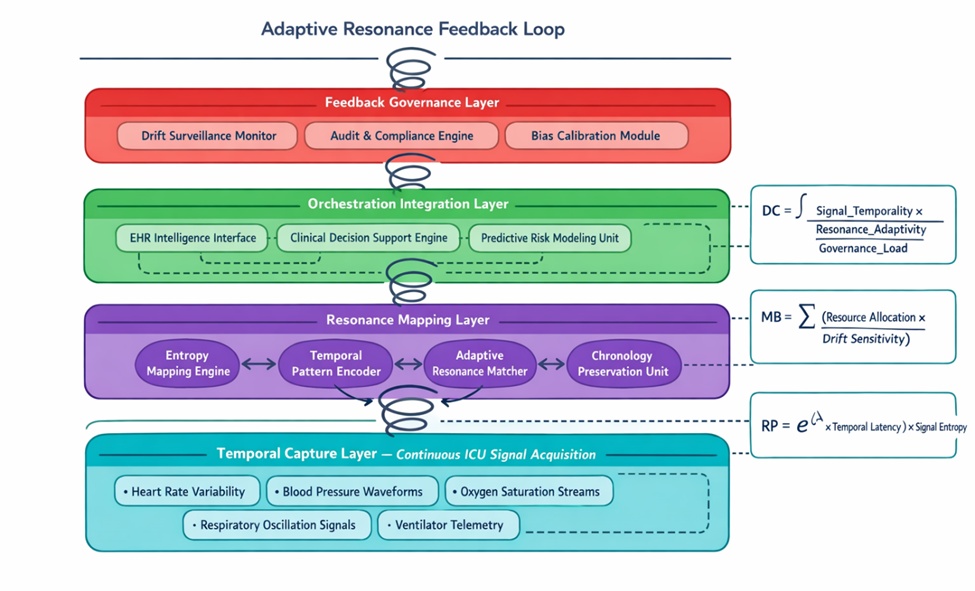
Figure 1. Temporal signal adaptive resonance topology (TSART) for continuous ICU monitoring environments. The architecture depicts four integrated strata: the temporal capture layer for continuous physiological signal ingestion; the resonance mapping layer for adaptive temporal pattern encoding; the orchestration integration layer interfacing with EHR and decision support ecosystems; and the Feedback Governance Layer supervising drift, bias, and operational compliance. A helical feedback topology cyclically recalibrates resonance outputs to capture systems upstream, preserving temporal fidelity. Side panels denote interpretive formulations for decision confidence, monitoring burden, and risk propagation.
The functional stratification and governance dependencies of TSART are detailed in Table 1.
Table 1. Layered functional architecture of the TSART framework
TSART layer | Core functions | Intelligence role | Governance dependencies | Clinical impact |
Temporal capture layer | Continuous signal ingestion, waveform buffering, chronology indexing | Preserves temporal fidelity of ICU signals | Device calibration governance, data integrity validation | Enables longitudinal deterioration detection |
Resonance mapping layer | Entropy modeling, pattern encoding, adaptive matching | Identifies resonance patterns across time horizons | Drift monitoring, model recalibration policies | Enhances early anomaly detection |
Orchestration integration layer | Multimodal fusion, EHR synchronization, decision routing | Contextualizes signals within clinical ecosystems | Interoperability compliance, data exchange standards | Improves decision confidence & alert precision |
Feedback governance layer | Audit loops, bias surveillance, compliance enforcement | Supervises intelligence evolution | Ethical AI governance, oversight protocols | Maintains clinical accountability |
The deployment of the temporal signal adaptive resonance topology (TSART) in continuous ICU monitoring environments introduces a spectrum of governance dependencies and operational sensitivities that merit theoretical exploration. These elements encompass how the framework’s helical feedback topology influences risk propagation, decision confidence, and resource allocation, while interacting with clinical workflows and infrastructure constraints. By dissecting these dynamics through interpretive lenses, we can anticipate theoretical shifts in ICU intelligence ecosystems without empirical assertions.
Governance dependencies in TSART arise primarily from the need to synchronize the Feedback Governance Layer with external regulatory and ethical frameworks. For instance, the layer’s cyclic adjustments must theoretically align with AI governance protocols that monitor for temporal drift, such as those outlined in quality improvement architectures for continual algorithm updating [3]. This dependency manifests in heightened sensitivities to interoperability standards, where mismatches could theoretically amplify governance load, as captured in the formula for Monitoring Burden (MB). In resource-constrained ICUs, where signals from multiple modalities converge, governance must theoretically mitigate biases in resonance mapping, drawing from interpretable models that predict deterioration [5, 6]. Operational sensitivities here include the potential for over-reliance on automated orchestration, which could redistribute human oversight but introduce vulnerabilities if feedback loops fail to adapt to signal entropy spikes. Key governance dependencies and operational sensitivities associated with TSART deployment are synthesized in Table 2.
Table 2. Governance dependencies and operational sensitivities in TSART deployment
Domain | Governance dependency | Operational sensitivity | Theoretical risk if unmitigated | TSART mitigation mechanism |
Signal drift | Continuous recalibration policies | Sensor degradation and waveform distortion | False alerts and missed deterioration | Helical feedback recalibration |
Interoperability | EHR integration standards | Data latency and exchange fragmentation | Context loss in predictions | Orchestration fusion layer |
Infrastructure | Compute and bandwidth provisioning | Processing latency | Delayed interventions | Distributed resonance processing |
Human–AI workflow | Oversight alignment frameworks | Cognitive overload and alert fatigue | Adoption resistance | Confidence-scored alerting |
Bias governance | Demographic calibration protocols | Training data imbalance | Inequitable predictions | Governance audit loops |
Resource allocation | Monitoring load distribution | Hardware strain | System performance degradation | Monitoring burden modeling |
Operational consequences extend to clinical adoption dynamics, where TSART’s temporal capture theoretically reduces decision latency but alters workflow rhythms. In continuous environments, clinicians interfacing with the orchestration integration layer might experience cognitive load redistribution, as theoretical formulas for decision confidence (DC) suggest improved alert fidelity over time [1, 2]. However, sensitivities to infrastructure, such as bandwidth for EHR data exchange, could propagate risks exponentially, per the risk propagation (RP) model. Literature on deployment systems reinforces this, indicating that real-time model integration into EHRs demands careful governance to avoid operational disruptions [14, 15]. For example, in multimodal ICU scenarios, TSART’s resonance mapping could theoretically enhance survival predictions by fusing temporal data. Yet, operational sensitivities to data silos might undermine this, necessitating robust interoperability frameworks [4, 17, 18].
Human-AI workflow shifts represent another critical sensitivity, where TSART’s helical topology fosters symbiotic interactions but depends on governance for ethical calibration. Theoretical analyses of decision support pipelines show that temporal intelligence can optimize resource utilization, yet it introduces trade-offs in clinician autonomy [24, 26, 27]. In high-stakes ICUs, where signals like EEG or vital signs require continuous vigilance, TSART could theoretically alleviate monitoring burden through adaptive resonance. Still, operational dependencies on training and interface design might exacerbate adoption barriers [31, 32]. Governance must theoretically address these by incorporating feedback from clinical trials of AI interventions, ensuring that sensitivities to false negatives do not compromise patient safety [28, 29].
Infrastructure sensitivities further complicate TSART’s operational landscape, particularly in federated networks where temporal signals span institutions. The framework’s reliance on seamless data exchange heightens dependencies on architectures like FHIR-based tools, theoretically enabling cross-institution sharing but sensitive to latency in governance enforcement [19, 23]. In cardiovascular or sepsis monitoring, for instance, operational consequences include optimized alert calibration, as seen in uncertainty-aware models [11, 12], yet infrastructure bottlenecks could inflate RP values. Theoretical resource allocation formulas highlight how MB scales with signal complexity, urging governance that balances computational demands with clinical efficacy [20, 21].
Decision latency trade-offs encapsulate these sensitivities, where TSART’s integrative layers theoretically minimize delays in continuous monitoring but depend on governance for resilience. Pipelines for dynamic survival prediction illustrate this, showing how temporal handling without curation can enhance responsiveness [8-10]. However, operational sensitivities to environmental noise in ICUs—such as device interoperability—might offset gains, requiring theoretical safeguards in framework design [16, 22]. Ultimately, these dependencies and sensitivities position TSART as a catalyst for resilient ICU ecosystems, theoretically fostering environments where temporal signal intelligence drives proactive care while navigating inherent complexities.
The conceptualization of the temporal signal adaptive resonance topology (TSART) advances the discourse on temporal signal intelligence by structurally addressing persistent blind spots within existing clinical AI architectures and governance models. Contemporary ICU intelligence systems remain largely threshold-driven or episodically analytical, emphasizing acute detection rather than longitudinal resonance mapping. TSART repositions temporality as an architectural axis rather than an analytic afterthought. Central to this repositioning is the framework’s embedding of adaptive resonance within continuous ICU environments, theoretically extending beyond static monitoring toward dynamic, feedback-enriched orchestration.
Synthesizing literature on pervasive sensing and autonomous signal interpretation, TSART aligns with paradigms advocating continuous machine-mediated vigilance [1], yet differentiates itself by integrating a helical topology that operationalizes cyclic reinforcement rather than linear inference cascades. This topology directly addresses temporal fidelity challenges identified in explainable AI models [2], where signal chronology fragmentation undermines interpretive continuity. By embedding resonance loops within signal processing layers, TSART preserves chronological coherence while enabling interpretive recalibration across evolving physiological trajectories.
The layered structure of TSART further mitigates operational sensitivities through modular decomposition. Signal ingestion, adaptive inference, governance oversight, and feedback recalibration operate as semi-autonomous strata, reducing systemic fragility. In contrast to monolithic AI deployments, this stratification enables isolation of drift phenomena without collapsing the entire monitoring architecture. Such modularity becomes especially relevant in ICU ecosystems characterized by fluctuating patient acuity and infrastructural heterogeneity.
A principal strength of TSART lies in its interoperability orientation. The framework is theoretically harmonized with EHR ecosystems and decision support pipelines [13-15], ensuring that laboratory trends, pharmacologic timelines, and procedural events contextually enrich temporal signal intelligence. This contextual alignment mitigates the risk of waveform isolation—a common failure mode in standalone monitoring systems. Unlike linear architectures prone to cumulative drift, the helical feedback topology introduces cyclic governance reinforcement, theoretically attenuating risk propagation as modeled in RP formulations. This cyclical reinforcement resonates with quality improvement frameworks emphasizing continuous surveillance and recalibration [3].
Moreover, TSART supports multimodal temporal fusion, synchronizing ventilatory oscillations, hemodynamic variability, and perfusion kinetics within unified interpretive matrices [4, 6]. Such integration aligns with aggregated prediction models in ICU analytics [7, 8], theoretically enhancing decision confidence through DC-based interpretive scoring. By transforming disparate streams into coherent physiological narratives, the framework may streamline ICU workflows and reduce cognitive fragmentation among clinicians.
However, these strengths are tempered by infrastructural sensitivities. TSART presupposes stable interoperability scaffolds and computational resilience. In resource-constrained environments, governance load may escalate disproportionately [19-21], potentially offsetting theoretical gains in efficiency. The helical architecture, while robust conceptually, introduces cyclical validation overhead that may strain bandwidth and hardware capacities if not strategically optimized. Thus, scalability remains contingent on infrastructural maturity.
Limitations inherent to TSART’s conceptual orientation warrant critical examination. The reliance on interpretive formulas—such as those modeling decision confidence, monitoring burden, and risk propagation—provides structural clarity but abstracts away empirical variabilities, including signal noise heterogeneity and patient-specific physiological idiosyncrasies. Literature on sepsis and respiratory prediction modeling underscores the necessity of uncertainty calibration in high-acuity environments [10, 11]. While TSART acknowledges probabilistic instability, its theoretical architecture cannot fully anticipate real-world perturbations without deployment validation [12, 24].
Human–AI interaction dynamics further complicate translational applicability. Vignette-based analyses suggest that algorithmic augmentation may variably influence diagnostic reasoning [25, 26], raising concerns regarding cognitive offloading and interpretive overreliance. TSART’s resonance loops aim to preserve clinician oversight; nevertheless, implementation may introduce cognitive dissonance if explainability layers are insufficiently transparent. This tension underscores the importance of embedding interpretive dashboards and traceable inference pathways within the helical topology.
Governance dependencies present additional limitations. Interoperability infrastructures such as FHIR-based ecosystems assume standardized environments [17, 18], yet ICU deployments often span heterogeneous vendor systems with uneven compliance maturity. TSART’s governance envelope presumes policy harmonization and audit readiness; absent such conditions, theoretical safeguards may remain aspirational rather than operational.
Future conceptual extensions could deepen the framework’s adaptability. Incorporating probabilistic resonance modeling—potentially inspired by quantum-like representations of uncertainty—may enhance handling of stochastic temporal signals, analogous to advances observed in automated EEG interpretation domains [31]. Governance scalability could be strengthened through integration with predictive organizational infrastructures [21-23], allowing dynamic allocation of oversight resources in response to monitoring load fluctuations.
An intriguing theoretical avenue involves engagement-threshold optimization for alert dissemination. Borrowing from min_faves-like filtering analogies in digital ecosystems, adaptive alert prioritization mechanisms could theoretically calibrate clinician attention bandwidth without saturating cognitive capacity [27-29]. Such refinements may reduce alert fatigue while preserving vigilance sensitivity.
Additionally, simulated governance environments—absent empirical patient data—could provide validation scaffolds for stress-testing TSART’s feedback loops. These simulations might address interpretive gaps observed in natural language processing pipelines for clinical decision support [16, 30], reinforcing temporal coherence across multimodal intelligence systems.
Collectively, TSART contributes to the evolving architecture of AI in critical care by foregrounding temporality as a structural imperative. Rather than positioning predictive analytics as standalone modules, the framework integrates signal resonance, governance oversight, and workflow adaptation into a unified topology. By navigating operational sensitivities, governance constraints, and cognitive redistribution dynamics, TSART outlines a resilient pathway toward clinician-centric, temporally aware ICU intelligence ecosystems.
This manuscript has introduced the Temporal Signal Adaptive Resonance Topology (TSART) as a conceptual architecture for orchestrating intelligence within continuous ICU monitoring environments. By embedding adaptive resonance within a layered and helical topology, TSART reframes temporal signal processing as an iterative, governance-integrated process rather than a linear analytic function. Its structural design integrates signal ingestion, contextual enrichment through EHR ecosystems, decision support alignment, and cyclic oversight reinforcement to address persistent temporal fidelity challenges in high-acuity care.
Through interpretive constructs modeling decision confidence, monitoring burden, and risk propagation, TSART provides a theoretical lens for examining operational sensitivities in ICU intelligence systems. These constructs illuminate how latency, drift, governance load, and multimodal fusion dynamics interact within continuous environments. Although conceptual in scope, the framework synthesizes contemporary advances in clinical AI architectures and interoperability infrastructures into a cohesive topology that prioritizes adaptive resonance and infrastructural resilience.
By centering temporality as an organizing principle, TSART advances the paradigm of anticipatory critical care. Its architecture promotes environments in which continuous monitoring enhances vigilance while preserving clinician agency, mitigating cognitive overload through structured feedback loops and oversight scaffolds. Future explorations should refine these theoretical constructs through simulated deployment modeling and expanded governance analyses, ensuring that temporal intelligence systems remain responsive to evolving clinical, infrastructural, and ethical landscapes.
None
None
None
None
Open Access The author(s) retain copyright. This article is licensed under the Creative Commons Attribution-NonCommercial-ShareAlike 4.0 International License. It may be shared and adapted for non-commercial purposes with appropriate attribution, an indication of changes, and distribution of adaptations under the same license. Third-party material may be subject to separate terms identified in its credit line. View the license at https://creativecommons.org/licenses/by-nc-sa/4.0/.
 Clinical Intelligence Research Press