The integration of healthcare analytics across regional boundaries remains a critical challenge in modern population health management, where disparate data ecosystems hinder comprehensive intelligence generation. This conceptual manuscript proposes the population health intelligence mesh (PHIM), a novel architectural framework designed to facilitate seamless cross-regional analytics integration through a mesh-based topology that emphasizes interoperability, governance, and real-time decision support. Drawing from theoretical foundations in clinical AI architectures and healthcare informatics, PHIM conceptualizes a layered structure comprising data ingestion nodes, federated analytics hubs, and adaptive governance overlays to mitigate silos in electronic health record (EHR) systems and enable population-level insights. Key components include decentralized intelligence propagation mechanisms and feedback loops for dynamic system adaptation, ensuring resilience in diverse healthcare environments. Theoretical formulas are introduced to interpret risk propagation across regions, decision confidence aggregation, and governance load distribution, highlighting potential operational efficiencies without empirical validation. The framework addresses interoperability frameworks by synthesizing recent literature on AI governance and workflow integration, offering a blueprint for theoretical advancements in population health analytics. While focusing on conceptual viability, PHIM underscores the need for ethical monitoring and human-AI collaboration in cross-regional deployments, paving the way for future infrastructural innovations in healthcare systems.
The advent of artificial intelligence (AI) in healthcare has ushered in transformative possibilities for population health management. Yet, the fragmentation of data across regional boundaries poses persistent barriers to holistic analytics integration. In this context, the concept of a population health intelligence mesh (PHIM) emerges as a pivotal architectural paradigm, aiming to weave disparate healthcare systems into a cohesive intelligence fabric. This introduction delineates the foundational imperatives for such a mesh, emphasizing its role in bridging clinical silos and fostering cross-regional synergies without relying on empirical datasets or performance benchmarks.
In diverse clinical environments, ranging from urban tertiary hospitals to rural primary care networks, the need for integrated population health intelligence is paramount. Traditional healthcare analytics often falter in cross-regional scenarios where patient data traverses jurisdictional lines, leading to incomplete population profiles. The Population Health Intelligence Mesh addresses this by theorizing a decentralized structure that adapts to varying clinical densities, enabling theoretical flows of aggregated insights from emergency departments to community health centers. This mesh topology theoretically enhances situational awareness in population-level interventions, such as epidemic tracking or chronic disease monitoring, by conceptualizing fluid data exchanges that respect regional autonomy while promoting collective intelligence.
Healthcare data modalities—encompassing structured EHR entries, unstructured clinical notes, and imaging archives—demand sophisticated integration mechanisms to support population health analytics. The mesh framework posits a modality-agnostic layer that theoretically harmonizes these diverse inputs across regions, mitigating inconsistencies arising from heterogeneous data standards. For instance, in cross-regional setups, genomic data from one area might intersect with behavioral health records from another, requiring a mesh that facilitates semantic alignment without data centralization. This approach draws on interoperability principles to envision a system where data modalities contribute to a unified intelligence mesh, enhancing theoretical comprehensiveness in population risk stratification and resource planning.
Deployment environments in healthcare vary significantly, from cloud-based regional hubs to on-premise legacy systems, influencing the feasibility of intelligence meshes. The Population Health Intelligence Mesh conceptualizes adaptive deployment strategies that accommodate these variances, such as hybrid federated models that theoretically balance computational loads across borders. In resource-constrained regions, the mesh could prioritize lightweight analytics nodes, while affluent areas leverage advanced AI orchestration. This environmental sensitivity ensures that cross-regional integration remains viable, fostering a theoretical ecosystem where deployment heterogeneities become strengths rather than impediments to population health intelligence.
Governance emerges as a cornerstone in cross-regional healthcare analytics, where regulatory divergences—such as data privacy laws like GDPR in Europe versus HIPAA in the US—complicate intelligence sharing. The mesh framework incorporates governance constraints as intrinsic architectural elements, theorizing embedded compliance layers that dynamically enforce policies during analytics integration. This prevents theoretical breaches in population data flows, ensuring ethical stewardship. By embedding governance into the mesh, the system conceptualizes a proactive stance against fragmentation, where constraints catalyze rather than hinder cross-regional collaboration in health intelligence.
Clinical workflows, often rigid and practitioner-centric, must evolve to accommodate mesh-based intelligence integration. In cross-regional contexts, workflows span multidisciplinary teams, necessitating a mesh that theoretically streamlines decision pipelines from data capture to actionable insights. Challenges include latency in intelligence dissemination and cognitive overload on clinicians, which the Population Health Intelligence Mesh addresses through conceptualized orchestration layers. These layers envision seamless workflow embeddings, where population analytics inform real-time decisions without disrupting established protocols, ultimately theorizing enhanced efficiency in cross-regional healthcare delivery.
The theoretical underpinnings of population health intelligence meshes draw from advancements in clinical AI architectures, healthcare analytics infrastructures, and interoperability frameworks, synthesizing insights from recent peer-reviewed literature to inform cross-regional integration. This section consolidates key conceptual strands, highlighting how disparate systems can theoretically converge into a cohesive mesh without empirical experimentation.
Clinical AI architectures have evolved from siloed models to more integrated paradigms, particularly in population health scenarios where regional data aggregation is essential. Early frameworks emphasized modular designs for decision support [1, 2], but recent conceptualizations advocate for mesh-like topologies that facilitate distributed intelligence. For instance, roadmaps for responsible machine learning in healthcare underscore the need for architectures that prioritize ethical integration across clinical settings [2]. In population health, these architectures theoretically extend to handle large-scale data flows, enabling cross-regional analytics by conceptualizing layered structures that adapt to varying AI maturity levels [3]. This evolution reflects a shift toward resilient systems capable of theoretical propagation of insights, mitigating the isolation inherent in traditional clinical AI deployments.
Analytics infrastructures in healthcare have increasingly focused on bridging regional divides, with theoretical models proposing federated approaches to maintain data sovereignty while enabling collective intelligence [4, 5]. Literature on real-world integrations, such as deep learning for clinical alerts, highlights infrastructural needs for seamless data pipelines [4]. In cross-regional contexts, these infrastructures must theoretically incorporate scalability mechanisms to handle population-level volumes, drawing on EHR intelligence ecosystems that emphasize interoperability [5, 6]. Conceptual discussions in ophthalmology and epilepsy diagnostics illustrate how analytics infrastructures can theoretically unify disparate data sources, informing the mesh’s design for population health [5, 6]. Such syntheses suggest that infrastructures should prioritize theoretical resilience against data heterogeneity, fostering analytics that transcend regional boundaries.
Electronic health record (EHR) ecosystems form the backbone of population intelligence, with theoretical frameworks advocating for ecosystems that support dynamic intelligence generation across regions [7, 8]. Governance in these ecosystems is critical, as evidenced by reports on EHR future directions that conceptualize enhanced interoperability for population analytics [8]. Literature synthesizes how AI governance can theoretically mitigate risks in EHR integrations, ensuring that intelligence meshes respect data privacy while enabling cross-regional flows [9, 10]. In breast cancer screening and retinopathy detection, conceptual AI systems demonstrate how EHR ecosystems can theoretically underpin population-level decision support, informing mesh topologies that aggregate EHR insights without centralization [9, 10].
Decision support pipelines have been theoretically refined to incorporate AI orchestration in population health, with models emphasizing adaptive pipelines for clinical workflows [11, 12]. Conceptual guidance on AI for healthcare data stresses the importance of interpretable pipelines that theoretically enhance decision confidence in cross-regional settings [3, 12]. Literature on schizophrenia diagnostics and racial bias recognition illustrates how pipelines can theoretically address underdiagnosis in diverse populations, informing mesh designs that propagate decisions across regions [12, 13]. These pipelines must theoretically balance automation with human oversight, synthesizing governance models that prevent bias amplification in population analytics [14, 15].
AI governance frameworks are indispensable for monitoring cross-regional deployments, with theoretical models proposing oversight mechanisms to ensure ethical analytics integration [15, 16]. Conceptual challenges in delivering clinical impact highlight governance dependencies that theoretically safeguard population health meshes [17]. Literature synthesizes ethical considerations, such as bias mitigation and fairness in multi-level systems, to inform monitoring topologies [17, 18]. Deployment systems, as discussed in global health AI applications, theoretically require adaptive governance to handle resource variabilities across regions [14, 19]. This synthesis underscores the need for meshes with embedded monitoring layers, theoretically distributing governance loads to maintain system integrity.
Interoperability frameworks constitute the structural backbone of cross-regional population health analytics, serving as the enabling substrate upon which intelligence meshes can function coherently. In theoretical models of distributed healthcare systems, standards-based exchanges are consistently identified as essential mechanisms for harmonizing heterogeneous data environments and unifying population-level datasets across institutional and geographic boundaries [20, 21]. Within the context of a PHIM, interoperability is not confined to syntactic compatibility but extends to semantic alignment, governance harmonization, and dynamic model portability.
Conceptual governance frameworks for AI applications emphasize interoperable infrastructures that theoretically facilitate secure, traceable, and policy-compliant data flows, thereby preventing the re-emergence of silos in healthcare intelligence [21]. Rather than relying solely on centralized repositories, these frameworks promote federated query architectures, standardized ontologies, and machine-readable policy enforcement layers that enable nodes within a mesh to exchange intelligence without compromising sovereignty or privacy. In this sense, interoperability functions simultaneously as a technical protocol and a governance instrument—ensuring that cross-regional collaboration adheres to ethical, regulatory, and clinical safety standards.
Literature synthesizing bias and clinical safety considerations further underscores interoperability’s role in addressing ethical challenges in population contexts [22, 23]. Standardized data schemas and harmonized terminologies reduce misclassification risks, mitigate dataset imbalance artifacts, and enhance comparability across demographic groups. In cross-regional deployments, this becomes particularly salient, as variations in documentation practices and diagnostic coding may otherwise exacerbate disparities. By embedding bias-detection and fairness auditing mechanisms within interoperable exchange layers, population meshes can theoretically operationalize equity-aware analytics at scale.
In both aesthetic surgery applications and broader healthcare AI overviews, interoperability frameworks illustrate modality-agnostic integrations that inform mesh designs capable of handling diverse data types, including imaging, genomics, structured clinical data, and real-time sensor streams [23, 24]. These theoretical integrations highlight the necessity of exchange protocols that are flexible enough to accommodate emerging modalities while remaining stable enough to ensure longitudinal continuity. Such adaptability is particularly relevant in population health contexts where surveillance systems, hospital networks, and community-based interventions must converge within a unified analytical environment.
Lessons synthesized from telemedicine deployments during public health crises further demonstrate how interoperable infrastructures contribute to resilience [25]. Rapid scaling of remote consultations, distributed diagnostics, and shared registries during crisis conditions revealed the importance of standardized exchange layers in maintaining continuity of care. Applied to population meshes, these insights suggest that interoperability frameworks not only enable routine intelligence flows but also provide surge capacity during epidemiological shocks. Consequently, resilient data ecosystems emerge when interoperability is treated as a dynamic, continuously governed process rather than a static technical specification.
Within the PHIM paradigm, interoperability therefore operates at multiple levels: technical (data formatting and exchange), semantic (terminology alignment), procedural (workflow compatibility), and regulatory (cross-jurisdictional compliance). Integrating these dimensions within a mesh architecture enables sustained, secure, and equitable intelligence exchange across regions. As population health challenges become increasingly transnational, interoperability frameworks will remain indispensable for ensuring that distributed analytics translate into coherent and actionable intelligence.
Clinical workflow integration represents a critical interface between technical architectures and frontline implementation. Theoretical models of AI integration in population health settings suggest that intelligence meshes must be designed not only for computational efficiency but also for cognitive and organizational compatibility [26, 27]. Workflow models that incorporate AI decision support aim to redistribute cognitive loads, augment diagnostic reasoning, and facilitate timely intervention across distributed healthcare networks.
Syntheses on human–AI dynamics emphasize that cross-regional integration introduces layered complexity: clinicians must interpret algorithmic outputs generated from federated systems that incorporate data beyond their immediate institutional context [26, 27]. This expanded analytic horizon has the potential to enhance situational awareness but may also introduce interpretive ambiguity. Therefore, workflow integration models within population meshes must incorporate transparency interfaces, contextual metadata, and feedback loops that clarify the provenance and confidence of algorithmic recommendations.
Conceptual evaluations of dataset shifts and underdiagnosis biases further inform adaptive workflow design [26, 27]. In population health, shifts in demographic composition, disease prevalence, or screening practices across regions can affect model performance. Workflow models that incorporate dynamic recalibration checkpoints, continuous performance monitoring, and clinician override capabilities theoretically enhance adaptability and maintain clinical trust. Embedding such safeguards within PHIM ensures that distributed analytics remain responsive to evolving epidemiological realities.
Literature addressing algorithmic disparities in population management reinforces the need for integration models explicitly designed to mitigate bias [28, 29]. Without careful embedding, AI tools risk reinforcing structural inequities in access, diagnosis, or treatment allocation. Workflow integration must therefore incorporate bias surveillance dashboards, disaggregated outcome reporting, and inclusive user training strategies. In doing so, population meshes can operationalize fairness not only at the data exchange level but also at the point of clinical decision-making.
Domain-specific examples, including retinal disease screening and mammography diagnostics, demonstrate theoretical embeddings of AI decision support within routine clinical pathways [30, 31]. These models illustrate how algorithmic triage systems, second-reader frameworks, and automated risk stratification can be integrated into existing diagnostic workflows without displacing clinician authority. When extrapolated to cross-regional population meshes, such architectures suggest scalable templates for embedding AI support across distributed networks while maintaining interpretive oversight and accountability.
Finally, bias mitigation strategies in machine learning provide theoretical lenses for optimizing workflow integration across diverse regional contexts [32]. Techniques such as reweighting, fairness constraints, and subgroup performance auditing can be translated into workflow checkpoints that monitor real-time equity metrics. By coupling these technical strategies with clinician-facing interpretability tools, PHIM can ensure that intelligence integration remains both scientifically rigorous and socially responsible.
Collectively, clinical workflow integration models underscore that the success of population intelligence meshes depends not solely on architectural sophistication but on socio-technical harmonization. Effective integration requires iterative co-design, adaptive training frameworks, and continuous evaluation mechanisms that align algorithmic intelligence with human expertise. Within this expanded framework, PHIM advances a vision of distributed population health analytics that is not only interoperable and resilient but also ethically grounded and operationally sustainable.
The Architectural Topology of the Population Health Intelligence Mesh (PHIM) delineates a novel framework for cross-regional healthcare analytics integration, conceptualizing a decentralized mesh of interconnected nodes that facilitate intelligence propagation. PHIM comprises four unique layers: the Ingestion Periphery Layer for regional data intake, the Federated Analytics Core for aggregated processing, the Intelligence Dissemination Fabric for cross-boundary flows, and the Adaptive Governance Overlay for dynamic oversight. This layered structure incorporates a bidirectional feedback topology, where governance signals loop back to ingestion nodes to refine data quality, ensuring theoretical resilience against regional variances.
Figure 1 shows the architectural topology of the population health intelligence mesh (PHIM)
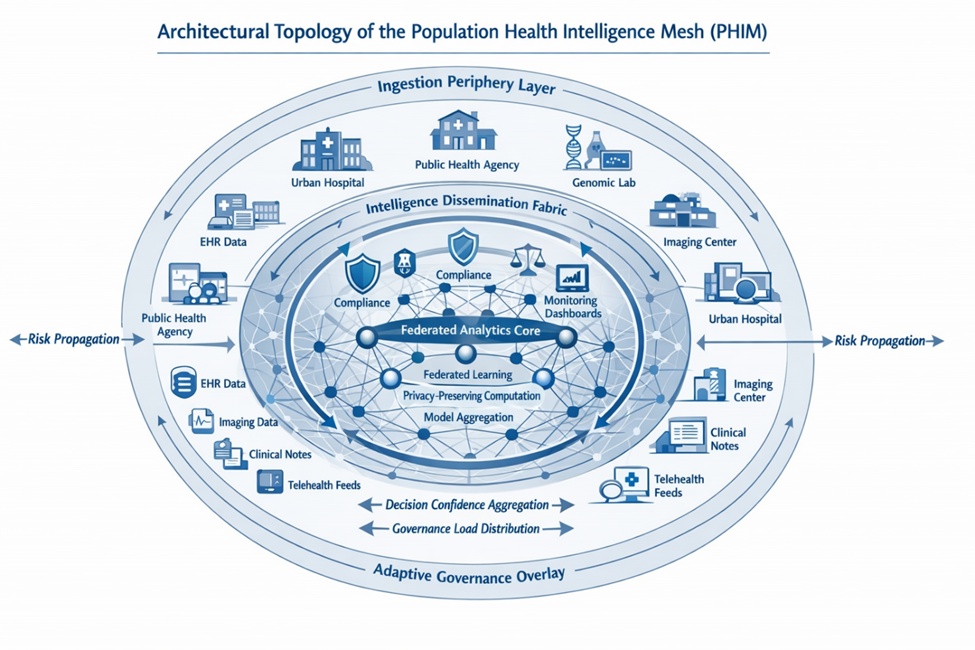
Figure 1. Architectural topology of the population health intelligence mesh (PHIM).
The PHIM framework comprises four integrated layers: (1) the ingestion periphery layer, representing distributed regional healthcare data nodes; (2) the federated analytics core, enabling decentralized model training and cross-regional intelligence synthesis; (3) the intelligence dissemination fabric, supporting bidirectional propagation of insights; and (4) the adaptive governance overlay, providing dynamic regulatory enforcement, fairness auditing, and system monitoring. Bidirectional feedback loops enable governance-informed refinement of data ingestion and analytics processes, supporting resilience, equity, and distributed decision confidence aggregation across heterogeneous healthcare environments.
To interpret system dynamics, consider the following conceptual formulas:
Risk propagation index (RPI):
Decision confidence aggregation (DCA):
Governance load distribution (GLD):
The structural components and their theoretical operational roles within PHIM are summarized in Table 1.
Table 1. Core structural components and theoretical functions of the population health intelligence mesh (PHIM).
PHIM layer | Primary function | Operational mechanisms | Theoretical contribution to cross-regional analytics |
Ingestion of the periphery layer | Multimodal data intake from regional nodes | EHR feeds, imaging archives, genomics, telehealth, public health registries; semantic harmonization | Reduces fragmentation; enables modality-agnostic integration across heterogeneous regions |
Federated analytics core | Distributed intelligence computation | Federated learning, secure aggregation, privacy-preserving computation, decentralized model training | Maintains data sovereignty while enabling cross-regional predictive modeling |
Intelligence dissemination fabric | Propagation of population insights | Bidirectional intelligence flows, stakeholder dashboards, and regional decision routing | Enhances situational awareness and coordinated decision-making across borders |
Adaptive governance overlay | Ethical, regulatory, and performance oversight | Fairness auditing, compliance verification, drift monitoring, policy enforcement loops | Distributes governance load; mitigates bias propagation and regulatory misalignment |
Feedback topology (cross-layer) | Continuous system refinement | Governance-informed ingestion recalibration, adaptive load balancing | Enhances resilience and prevents single-point failure in distributed healthcare ecosystems |
Table 1 summarizes the four architectural layers and cross-layer feedback topology within PHIM, highlighting their respective operational mechanisms and theoretical contributions to resilient, equitable, and interoperable cross-regional healthcare analytics integration.
The operational dynamics of the PHIM reveal multifaceted impacts on cross-regional healthcare analytics, theorizing shifts in system behaviors, resource utilizations, and stakeholder interactions. This analysis explores the consequences of mesh deployment through lenses of infrastructure sensitivities, human-AI workflow redistributions, and decision latency trade-offs, providing a conceptual evaluation of how PHIM might influence population health ecosystems without empirical assessments.
PHIM’s mesh topology introduces sensitivities to infrastructural variabilities, where cross-regional data flows theoretically amplify dependencies on network stability and computational equity. In heterogeneous environments, such as those blending high-bandwidth urban grids with limited rural connectivity, the federated analytics core could experience theoretical bottlenecks, potentially exacerbating disparities in population intelligence access [4, 13]. Conceptual models suggest that these sensitivities necessitate adaptive resource allocation, where governance overlays dynamically reroute analytics loads to mitigate overloads in under-resourced regions [20, 21]. This impact underscores a trade-off: enhanced interoperability may heighten vulnerability to infrastructural failures, yet it theoretically fosters resilience through redundant mesh pathways, aligning with literature on scalable healthcare infrastructures [7, 8].
The integration of PHIM theoretically redistributes cognitive and operational loads in clinical workflows, shifting from siloed human decision-making to collaborative human-AI paradigms across regions. Clinicians in cross-regional networks might encounter reduced manual data synthesis burdens, as the intelligence dissemination fabric automates population trend aggregation, allowing focus on interpretive tasks [11, 27]. However, this shift could introduce adoption dynamics where resistance arises from perceived loss of autonomy, informed by ethical discussions on AI in workflows [15, 16]. Theoretical formulas extend this analysis: for instance, the cognitive load redistribution
Cross-regional analytics integration via PHIM involves inherent trade-offs in decision latency, where the mesh’s decentralized nature theoretically balances speed against comprehensiveness. In time-sensitive population health scenarios, such as outbreak response, the feedback topology might delay decisions due to governance checks, yet it enhances accuracy through aggregated regional inputs [2, 3]. Literature on decision support pipelines suggests that these trade-offs can be mitigated by prioritizing low-latency edges in the mesh, theoretically optimizing for scenarios with high decision urgency [5, 12]. This dynamic impacts overall system efficacy, where latency reductions in one region could propagate efficiencies network-wide, aligning with conceptual governance models that emphasize adaptive monitoring [22, 32].
The conceptualization of the PHIM advances theoretical discourse on cross-regional healthcare analytics by directly confronting the entrenched fragmentation that characterizes contemporary population health ecosystems. Despite substantial investments in digital health infrastructure, health information exchange remains uneven, institutionally siloed, and frequently constrained by incompatible data standards and governance regimes. PHIM responds to these structural discontinuities by proposing a distributed intelligence topology capable of orchestrating heterogeneous systems into a coherent analytical continuum. In doing so, the framework extends beyond conventional interoperability models and reframes cross-regional analytics as an adaptive, intelligence-driven mesh rather than a centralized repository paradigm.
Expanding on its architectural topology, PHIM’s layered design—encompassing ingestion, federation, dissemination, and governance—offers a theoretically robust blueprint for integrating disparate AI-driven ecosystems, drawing synergies from clinical architectures and interoperability frameworks [1-3, 9-11]. The ingestion layer conceptualizes multimodal data acquisition across clinical, administrative, environmental, and community domains, embedding semantic harmonization at the point of entry to reduce downstream normalization burdens. The federation layer operationalizes distributed analytics through privacy-preserving computation, enabling collaborative model training and inference without necessitating raw data centralization. Dissemination mechanisms ensure that synthesized intelligence is delivered contextually—tailored to policymakers, clinicians, and public health actors—while preserving traceability and auditability. Finally, the governance layer overlays dynamic compliance monitoring, algorithmic auditing, and ethical safeguards across the mesh.
Importantly, PHIM does not merely theorize seamless intelligence flows; it anticipates operational dynamics that may shape real-world deployment. Infrastructure sensitivities—including bandwidth asymmetries, variable computational capacity, and data sparsity—are not treated as peripheral constraints but as central design considerations. By embedding federated architectures and adaptive load-balancing mechanisms, the mesh theoretically equalizes analytic participation in underserved or resource-constrained regions. Such design responsiveness directly addresses biases associated with data centralization and algorithmic exclusion, as highlighted in recent literature [13, 27, 28]. In this respect, PHIM contributes to a growing body of scholarship advocating equity-aware AI architectures in public health.
Further expansion reveals PHIM’s potential to redefine governance paradigms in cross-regional analytics. Traditional centralized data infrastructures concentrate regulatory authority, oversight mechanisms, and computational control within singular institutional nodes. While administratively straightforward, such configurations are vulnerable to single-point failures, policy bottlenecks, and jurisdictional misalignment. PHIM proposes instead a decentralized feedback topology in which adaptive overlays proactively manage ethical and regulatory challenges in cross-regional deployments [15, 21, 22]. These overlays may incorporate automated compliance verification, fairness diagnostics, and model-drift surveillance—functions synthesized conceptually from AI monitoring systems [17, 20]. By distributing governance functions across interconnected nodes, PHIM theoretically enhances resilience, redundancy, and contextual regulatory responsiveness.
However, decentralization also introduces socio-technical complexity. Human–AI interaction patterns are likely to shift as analytic intelligence becomes continuously generated and redistributed across institutional boundaries. Workflow transformations may amplify cognitive redistributions, with clinicians and public health practitioners negotiating evolving boundaries between algorithmic recommendations and human judgment. Without structured adaptation strategies, such shifts risk increasing cognitive load, diminishing interpretability, or fostering automation bias. Consequently, theoretical training frameworks and participatory co-design approaches are necessary to mitigate adoption barriers and ensure responsible integration [16, 18, 19]. Embedding explainability interfaces, feedback loops, and competency development programs within the mesh architecture may further align technical innovation with workforce preparedness.
Decision latency represents another conceded trade-off within distributed architectures. Federated consensus-building and multi-node validation processes may introduce temporal delays relative to centralized computation. Yet, such latency can be reconceptualized not solely as a limitation but as an opportunity for enhanced confidence aggregation and probabilistic robustness. By incorporating ensemble-based confidence scoring and distributed validation checkpoints, PHIM could leverage latency as a mechanism for improved reliability and interpretive transparency. This aligns with theoretical formulations that interpret system behaviors through probabilistic aggregation models, even in the absence of empirical instantiation [12, 26]. Thus, performance trade-offs may be reframed as design variables within a broader resilience-oriented architecture.
Broadening the discussion, PHIM’s implications extend to global health equity. Cross-regional meshes offer a theoretical mechanism to bridge data divides in resource-poor settings by enabling collaborative intelligence without requiring infrastructural parity. Syntheses on AI implementation in diverse environments suggest that contextual adaptation and distributed governance are critical to equitable digital transformation [14, 25]. PHIM’s federated topology may allow low-resource regions to participate in global analytic ecosystems while maintaining sovereignty over local data assets. Nevertheless, the possibility of risk propagation across interconnected nodes remains a substantive concern. Conceptual risk indices indicate that algorithmic bias, model drift, or governance lapses in one node could propagate through federated linkages if not adequately monitored [23, 29, 32]. Vigilant ethical oversight, real-time monitoring, and cross-jurisdictional accountability mechanisms are therefore indispensable to prevent amplification of disparities.
Future conceptual iterations of PHIM may incorporate advanced computational modalities, including generative AI for synthetic population data, multimodal foundation models, and adaptive simulation environments. Synthetic data generation, when governed responsibly, could enhance predictive analytics, enable stress-testing of public health scenarios, and mitigate privacy constraints in cross-regional collaboration [6, 24, 30]. However, such expansions must remain aligned with governance sensitivities, ensuring transparency, bias mitigation, and regulatory coherence. Embedding model registries, algorithmic impact assessments, and federated audit trails within the mesh architecture would be essential for sustaining ethical integrity as analytic complexity increases.
Ultimately, PHIM positions itself as a foundational theoretical framework rather than a finalized operational blueprint. Its principal contribution lies in reconceptualizing population health intelligence as a distributed, adaptive mesh that integrates architecture, governance, workflow, and equity considerations into a unified paradigm. By synthesizing technological, regulatory, and human-centered dimensions, PHIM invites iterative refinement, empirical validation, and cross-disciplinary dialogue to translate conceptual promise into scalable implementation.
In summary, the PHIM conceptualizes a transformative approach to cross-regional healthcare analytics integration, synthesizing architectural innovation with governance and workflow considerations to advance population health intelligence. Through its layered topology—ingestion, federation, dissemination, and governance—the framework offers a coherent blueprint for overcoming regional silos and enabling distributed intelligence coordination. By explicitly addressing infrastructural variability, ethical oversight, and human–AI interaction dynamics, PHIM theorizes systems capable of enhancing decision support, resilience, and resource equity while mitigating biases identified in prior scholarship.
Although trade-offs in decision latency and adoption complexity are acknowledged, the framework’s adaptive and decentralized mechanisms suggest pathways toward resilient, confidence-aggregated analytics aligned with evolving AI landscapes. Its emphasis on distributed governance and proactive oversight further reinforces alignment with regulatory and ethical imperatives in cross-regional deployments. Future conceptual explorations should prioritize scalability, empirical validation, and inclusive design, ensuring that PHIM remains responsive to diverse healthcare ecosystems and global equity objectives. By advancing a mesh-based paradigm for population health intelligence, PHIM contributes a theoretically grounded foundation upon which integrated, ethical, and equitable health analytics infrastructures may be constructed.
None
None
None
None
Open Access The author(s) retain copyright. This article is licensed under the Creative Commons Attribution-NonCommercial-ShareAlike 4.0 International License. It may be shared and adapted for non-commercial purposes with appropriate attribution, an indication of changes, and distribution of adaptations under the same license. Third-party material may be subject to separate terms identified in its credit line. View the license at https://creativecommons.org/licenses/by-nc-sa/4.0/.
 Clinical Intelligence Research Press