Rare pediatric tumors like sarcomas, neuroblastoma, medulloblastoma, and retinoblastoma pose a challenge for developing deep learning models due to the limited availability of histopathology images, which are distributed across multiple institutions. This scarcity is compounded by privacy concerns, as whole-slide images often contain sensitive clinical and genomic data, and generative adversarial networks (GANs) risk memorizing and leaking training samples. To address this, a differentially private GAN framework is proposed for synthesizing high-resolution histopathology patches of rare pediatric cancers. The framework incorporates a generator for image synthesis, a discriminator for realism assessment, per-sample gradient clipping, Gaussian noise injection, and a privacy accountant, ensuring provable privacy guarantees during the training process. The synthetic images generated can aid in data augmentation, model pre-training, and benchmarking without exposing identifiable pathology data, offering a privacy-preserving solution for dataset augmentation while emphasizing the importance of clinical validation.
Rare pediatric cancers impose a disproportionate diagnostic and computational burden because each disease subtype may appear infrequently within a single hospital, yet accurate histopathological classification requires exposure to diverse morphologic patterns. Deep learning has shown promise for extracting diagnostic and molecular information from histopathology images, including tumor classification and mutation-associated morphology in adult cancers [1, 2]. Pediatric tumor applications are beginning to demonstrate similar potential, particularly in neuroblastoma and sarcoma histopathology, but the available datasets remain much smaller and less diverse than those used in common adult malignancies [3-6]. This creates a structural mismatch between the data requirements of high-capacity models and the limited availability of rare pediatric tumor whole-slide images.
Direct data sharing is not a sufficient remedy because pediatric pathology data are governed by heightened privacy expectations, institutional review constraints, and cross-border regulatory limits. Whole-slide images may contain tissue patterns associated with diagnosis, treatment history, or rare disease identity, making them difficult to treat as low-risk research images. Reviews of medical synthetic data emphasize that utility must be balanced against privacy, especially when released data could be reused outside the original governance environment [7-9]. In this context, synthetic histopathology is attractive only if its release mechanism is explicitly privacy-preserving rather than merely visually realistic.
Conventional GANs can synthesize plausible histopathology images, but realism alone does not guarantee safety. Generative models may memorize rare examples, especially when training data are small, high-dimensional, and morphologically distinctive, making rare pediatric tumor images particularly vulnerable to unintended disclosure. Membership inference attacks have shown that adversaries may determine whether a particular record contributed to model training, and later work extended this concern to generative models and synthetic health data [10-13]. Therefore, a synthetic pathology framework for rare pediatric cancer must address privacy leakage as a first-order design constraint, not as a post hoc audit.
This article develops a conceptual framework for a differentially private GAN that generates synthetic histopathology patches of rare pediatric tumors while providing a formal privacy guarantee. The framework draws on digital pathology GAN research, high-resolution histopathology synthesis, and medical data privacy methods to define an architecture suitable for scarce pediatric cancer slides [14-21]. It does not report experiments, fabricated performance gains, or simulated results; instead, it specifies the design logic, privacy mechanism, evaluation strategy, and clinical boundaries of a privacy-preserving generative system. The roadmap proceeds from histopathology and generative modeling background to architecture, differential privacy integration, privacy auditing, downstream utility, and rare pediatric tumor adaptation.
Rare pediatric cancers are histologically heterogeneous, with sarcomas, neuroblastoma, medulloblastoma, retinoblastoma, Wilms tumor, and embryonal tumors each presenting distinct nuclear morphology, mitotic activity, stromal organization, and tissue architecture. Neuroblastoma histopathology, for example, has been approached using deep learning methods that encode morphologic features for classification, while sarcoma-focused studies highlight the need for multicenter integration because no single site captures sufficient subtype diversity [3-6]. These tumors are usually represented as whole-slide images after hematoxylin and eosin staining, from which diagnostically meaningful regions must be sampled at magnifications that preserve cellular and stromal detail. A privacy-preserving synthetic framework must therefore respect both subtype-specific morphology and the patch-level sampling structure through which whole-slide images are made computationally tractable.
Generative models in digital pathology have been used for image augmentation, stain transformation, high-resolution synthesis, segmentation support, and layout-conditioned tissue generation. GAN-based approaches have produced diagnostic-quality pathology images, selective synthetic augmentation, stitched histology regions, and high-resolution histopathology outputs, but reviews note recurring risks such as mode collapse, texture imitation without diagnostic preservation, and artifacts introduced by patch tiling [15, 16, 18-21]. More recent synthesis approaches explore bespoke cellular layouts, frequency-spatial hybrid generation, and ultra-resolution histopathology synthesis, indicating that visual fidelity is improving but remains technically constrained by tissue scale and morphology [22-24]. For rare pediatric tumors, these methods require privacy-aware redesign because small datasets increase the probability that a visually convincing output may be too close to an identifiable training image.
Privacy risks in generative pathology arise because the model learns from real patient images while producing outputs that may be released beyond the original clinical institution. Membership inference attacks assess whether a target image was included in training, while model inversion, attribute inference, and leakage from gradients or generated samples may reveal sensitive information about rare cases [10-13]. These risks are amplified in pediatric oncology because rare tumor subtypes may be represented by very few slides, making memorization more likely and harder to detect through visual inspection alone. Consequently, a safe generative framework must combine architectural choices with formal privacy mechanisms and adversarial auditing.
Differential privacy provides a mathematical definition of limited disclosure by bounding how much the output distribution of a mechanism can change when one training record is added or removed. In deep learning, the standard mechanism clips per-sample gradients to bound sensitivity and then adds calibrated Gaussian noise before parameter updates, with a privacy accountant tracking the accumulated privacy loss across training iterations [25-28]. The parameters ε and δ define the strength of the privacy guarantee, while Rényi or moments-based accounting enables more precise tracking over many optimization steps. The central trade-off is that stronger privacy generally increases noise, which may degrade convergence, image fidelity, and downstream diagnostic utility.
The proposed framework begins with rare pediatric tumor whole-slide images that are curated into a small real patch dataset, then trains a GAN under differential privacy using gradient clipping and Gaussian noise injection. The generator produces synthetic histopathology patches, while the discriminator or critic provides realism feedback during training but is never treated as a clinical validator. After training, generated patches pass through a privacy audit and a pathology-oriented fidelity review before being used for downstream classifier development or benchmarking. This architecture integrates the synthetic augmentation logic of histopathology GANs with the privacy-accounted training logic used in differentially private medical image learning [14, 18, 25-27].
Figure 1 presents the proposed differentially private GAN architecture for transforming scarce rare pediatric tumor WSI patches into privacy-governed synthetic histopathology images for downstream deep learning development.
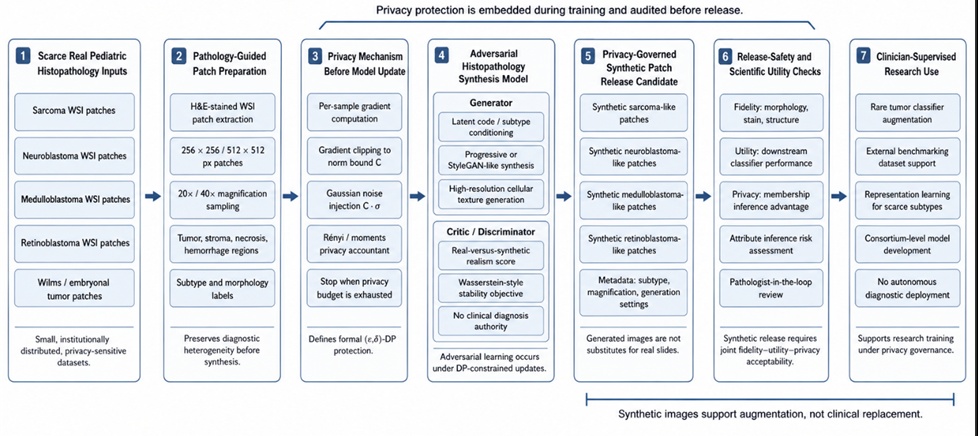
Figure 1. Differentially Private GAN Framework for Synthetic Rare Pediatric Tumor Histopathology Generation
The framework assumes that a small but curated rare pediatric tumor dataset is available, such as tens to hundreds of diagnostically reviewed WSI-derived patches per tumor subtype rather than thousands of independent whole-slide images. It also assumes that the privacy mechanism is implemented at the training level rather than approximated through visual de-identification, because anonymization alone cannot remove all inference risk from high-dimensional medical images [7-9, 29]. Computational cost is expected to be higher than conventional GAN training because per-sample gradients, noise calibration, and privacy accounting increase optimization complexity. These assumptions position the framework as a governed research infrastructure for consortial pediatric pathology rather than a plug-and-play image augmentation method.
The first design principle is provable privacy: synthetic outputs should inherit protection from a differentially private training mechanism rather than relying only on the absence of visible identifiers. The second principle is utility preservation, meaning that synthetic images should retain diagnostically relevant morphology such as nuclear density, mitotic pattern, stromal organization, and subtype-associated architecture rather than merely reproducing plausible texture [19, 21-23]. The third principle is adversarial conservatism, because privacy must be evaluated against strong membership inference and synthetic health data attack scenarios rather than benign visual review alone [10-13]. The final principle is clinical non-substitution: synthetic patches can support model training and benchmarking, but they cannot replace real pediatric pathology review or prospective validation.
Table 1 consolidates the privacy, fidelity, utility, and governance design choices that determine whether DP-GAN-generated pediatric tumor histopathology patches can be responsibly used for downstream model development.
Table 1. Privacy–Utility–Fidelity Design Matrix for DP-GAN-Based Synthetic Rare Pediatric Tumor Histopathology
Design Dimension | Framework Role | Core Mechanism | Risk Controlled | Expected Trade-Off | Required Governance Check |
Scarce pediatric tumor input curation | Defines the real data boundary from which the model learns | Subtype-stratified WSI patch extraction from sarcoma, neuroblastoma, medulloblastoma, retinoblastoma, Wilms tumor, and embryonal tumor slides | Overrepresentation of dominant morphologies and underrepresentation of rare patterns | Greater stratification improves representativeness but increases annotation burden | Pathologist-confirmed subtype and morphology labels |
Patch-level synthesis | Makes WSI-scale learning computationally feasible | 256 × 256 or 512 × 512 high-magnification H&E patch generation | Loss of tissue context and spatial continuity | Smaller patches improve training feasibility but may miss slide-level architecture | Documentation of magnification, tissue region, and sampling strategy |
Generator design | Produces synthetic histopathology images | Progressive or StyleGAN-like architecture with subtype-aware conditioning | Texture-only replication without diagnostic feature preservation | Higher-capacity synthesis improves realism but increases memorization risk | Visual inspection plus morphology-specific fidelity assessment |
Critic or discriminator | Provides adversarial realism feedback | Wasserstein-style critic or stabilized discriminator | Unstable training, mode collapse, unrealistic tissue patterns | Stronger critics improve realism but may amplify overfitting to rare cases | DP-constrained updates whenever real data are used |
Per-sample gradient clipping | Bounds each image’s influence on training | Clip each real-image gradient to norm C before aggregation | Excessive influence of a rare or identifiable pediatric patch | Strong clipping improves privacy but may reduce convergence quality | Predefined clipping rule recorded before training |
Gaussian noise injection | Obscures individual data contributions | Add calibrated Gaussian noise proportional to C · σ | Memorization and training-set membership leakage | Higher noise improves privacy but may blur nuclear and stromal details | Noise multiplier justified by release sensitivity |
Privacy accounting | Tracks cumulative privacy loss | Rényi or moments accountant over training steps | Uncontrolled privacy budget exhaustion | Earlier stopping protects privacy but may reduce image fidelity | Final ε and δ reported with release documentation |
Membership inference audit | Tests practical leakage resistance | Compare attack advantage for DP-GAN versus non-private GAN | Adversarial discovery of whether a patient image was used in training | Stronger privacy should reduce attack success but may reduce utility | Release permitted only if attack advantage remains acceptable |
Downstream classifier evaluation | Tests whether synthetic images add scientific value | Real-only versus real plus DP-synthetic versus real plus non-DP synthetic comparison | Synthetic artifacts falsely improving apparent performance | Utility gain must be demonstrated on held-out real slides | Evaluation restricted to real pediatric pathology test sets |
Clinical boundary setting | Prevents misuse of synthetic pathology images | Explicit restriction to research augmentation and benchmarking | Misinterpretation as diagnostic-grade clinical evidence | Conservative framing limits immediate deployment but improves safety | Pathologist-in-the-loop validation and governance review |
Patch-based synthesis is necessary because pediatric tumor whole-slide images are extremely large, heterogeneous, and computationally expensive to synthesize at full resolution. The framework extracts diagnostically annotated patches, such as 256 × 256 or 512 × 512 pixels, at 20× or 40× magnification while preserving representative regions of tumor, necrosis, stroma, hemorrhage, and normal-adjacent tissue. Prior histopathology GAN studies show that patch-level synthesis can support classification, augmentation, and high-resolution image generation, but they also demonstrate that tissue continuity and sampling bias remain important concerns [18-21, 30]. For rare pediatric tumors, patch selection should therefore be stratified by subtype and morphology so that the generator does not overrepresent common visual patterns while ignoring diagnostically rare features.
The generator should use a progressive or StyleGAN-like design capable of producing high-resolution cellular texture while controlling artifacts introduced by upsampling. Histopathology synthesis research has shown that diagnostic-quality outputs require more than global realism; generated patches must preserve meaningful nuclear contours, chromatin distribution, stromal relationships, and tumor-specific morphology [19, 22-24]. Adaptive or instance normalization may help stabilize stain and texture variation, but excessive normalization could suppress subtype-specific histological cues. Because pediatric tumor datasets are small, the generator must be explicitly constrained by differential privacy and evaluated for memorization rather than optimized only for visual fidelity.
The discriminator or critic estimates whether a patch resembles the real pediatric tumor distribution, but its role in this framework is limited to training feedback rather than diagnostic judgment. Wasserstein-style critics are conceptually attractive because they can provide smoother optimization signals and may be more stable under noisy updates than standard adversarial losses, particularly when training data are scarce and privacy noise is present. Existing histopathology GAN studies demonstrate that discriminator design influences synthetic image realism, segmentation compatibility, and downstream augmentation utility [18, 20, 21, 30]. In the proposed DP-GAN, the critic must be trained through the same privacy-aware update mechanism when it directly accesses real images, ensuring that privacy protection is embedded in adversarial learning rather than added only to the released generator.
Per-sample gradient clipping is the first privacy mechanism because it limits how much any single real histopathology patch can influence a model update. For each minibatch, the gradient contribution from every real image is computed separately and clipped to a fixed norm bound C before aggregation, thereby controlling sensitivity even when a rare pediatric tumor patch has unusually distinctive morphology. Differentially private medical image learning studies emphasize that this step is essential for making subsequent noise calibration meaningful, because Gaussian noise cannot provide a valid privacy guarantee when individual gradients are unbounded [25-28]. In the proposed framework, clipping should be applied to all adversarial updates that depend on real pediatric pathology patches, including critic or discriminator updates and any generator updates whose gradients are mediated through real-image comparisons.
After clipping, Gaussian noise scaled to the clipping bound and a noise multiplier σ is added to the aggregated gradient before the optimizer updates model parameters. This noise weakens the influence of any individual pediatric tumor patch on the learned generator distribution, reducing the likelihood that a released synthetic image reveals whether a specific patient slide was included in training. The privacy-utility literature on synthetic medical data shows that stronger noise can improve protection but may reduce fidelity and downstream usefulness, making calibration a core design decision rather than a technical afterthought [7, 9, 29, 31]. For rare pediatric histopathology, the selected σ should be justified by the intended release setting, the sensitivity of the disease subtype, and the expected adversary’s ability to compare generated patches with candidate patient images.
A privacy accountant tracks the accumulated ε for a chosen δ across all training steps, batch sampling events, and optimization epochs. Rényi differential privacy or moments-based accounting is appropriate because adversarial training requires repeated access to small real datasets, and privacy loss grows with continued optimization [25-28]. Training should stop when the predefined privacy budget is exhausted, even if visual fidelity could improve with additional epochs, because the framework prioritizes formal release safety over unconstrained image realism. Once training is complete, the released generator and its synthetic outputs are treated as products of the differentially private mechanism, subject to subsequent privacy audit through membership inference and synthetic health data risk assessment [10-13].
The formal privacy claim of the framework is that the trained generator is the output of a differentially private learning mechanism, so any synthetic image sampled from it is protected by the same bounded disclosure guarantee. Under (ε,δ)-differential privacy, the presence or absence of a single pediatric tumor patch in the training set should not substantially change the probability distribution of released generator outputs, which is why the guarantee is stronger than conventional anonymization or visual de-identification [25-28]. This is especially important for rare pediatric cancers because individual slides may contain unusual morphologic signatures that could otherwise be memorized by a high-capacity generator. The guarantee does not mean that synthetic images are clinically perfect or risk-free; rather, it defines a mathematically bounded relationship between the training dataset and the released synthetic distribution.
Although the framework is conceptual, it requires any future implementation to evaluate membership inference resistance as a privacy audit rather than relying only on the formal accountant. Membership inference attacks against machine learning and generative models demonstrate that adversaries may distinguish training samples from non-training samples when models overfit or memorize rare examples [10-12]. In synthetic health data, this risk is clinically meaningful because a successful attacker could infer that a child’s rare tumor slide contributed to a dataset, even if the released image is not an exact copy [13]. Therefore, the framework defines attack resilience as a combined requirement: the DP accountant must report the final privacy budget, and empirical attacks should show reduced membership advantage relative to a non-private GAN trained on the same source distribution.
The intended utility pathway is to augment a small real pediatric histopathology dataset with DP-generated synthetic patches, then train a downstream classifier for subtype recognition, triage support, or feature representation learning. Prior work on selective synthetic augmentation and histopathology GAN synthesis suggests that generated images can improve training diversity when synthetic samples are morphologically plausible and diagnostically aligned with the target task [18-21]. In this framework, synthetic patches should not be mixed indiscriminately with real images; instead, they should be labeled by tumor subtype, magnification, tissue compartment, and generation settings so that downstream models do not learn artifacts as disease signals. The downstream classifier may use convolutional or transformer-based architectures, but its final evaluation must occur on held-out real pediatric pathology slides rather than on synthetic validation data.
Utility under differential privacy is governed by a trade-off between privacy strength and synthetic image fidelity. Smaller ε values generally imply stronger privacy but require more noise during training, which may reduce nuclear sharpness, mitotic visibility, stromal continuity, and the subtype-specific texture needed for classifier learning [25-28]. Synthetic data utility studies show that high apparent fidelity does not automatically translate into useful downstream performance, and that privacy-preserving generation must be evaluated along privacy, fidelity, and task utility dimensions simultaneously [7-9, 29, 31]. For rare pediatric tumor augmentation, the acceptable privacy budget should be selected according to clinical sensitivity and release scope, with the goal of improving real-data-only model training without permitting unsafe memorization of scarce cases.
Table 2 specifies an evaluation logic that separates visual plausibility, diagnostic feature preservation, privacy protection, membership inference resistance, and downstream classifier utility.
Table 2. Evaluation Logic for Synthetic Rare Pediatric Tumor Histopathology Generated under Differential Privacy
Evaluation Domain | Primary Question | Recommended Comparison | Main Metrics | Failure Signal | Interpretation for the Framework |
Visual fidelity | Do synthetic patches resemble plausible pediatric tumor histopathology? | Real patches versus DP-synthetic patches | Pathologist review, stain consistency, nuclear morphology, stromal organization | Unrealistic nuclei, blurred mitoses, inconsistent staining, impossible tissue boundaries | Synthetic images should not advance to utility testing if morphology is visibly misleading |
Distributional fidelity | Does the synthetic distribution cover the real patch distribution? | Real patch embeddings versus synthetic patch embeddings | FID adapted to pathology embeddings, precision, recall, subtype coverage | Low recall for rare morphologies or high precision with narrow diversity | High visual realism is insufficient if the generator collapses to common tissue patterns |
Diagnostic feature preservation | Are tumor-relevant structures retained? | Tumor-region synthetic patches versus subtype-matched real patches | Nuclear density, mitotic count proxy, necrosis representation, stromal architecture | Synthetic patches preserve texture but lose diagnostically meaningful structure | Utility depends on preservation of disease-relevant morphology, not only image naturalness |
Privacy guarantee | Does the training mechanism provide bounded disclosure? | DP-GAN training configuration versus predefined privacy budget | Final ε, δ, clipping norm C, noise multiplier σ, number of steps | Privacy budget exceeded or accountant not reported | No synthetic release should occur without a documented formal privacy guarantee |
Membership inference resistance | Can an adversary infer training-set participation? | DP-GAN versus non-private GAN under matched attack setting | Attack accuracy, true positive rate, false positive rate, attack advantage | Attack advantage remains high for rare subtypes or outlier patches | DP should reduce membership leakage relative to non-private synthesis |
Attribute inference risk | Could generated images reveal sensitive tumor-associated features? | Generated patches with known subtype or molecular labels versus adversarial attribute prediction | Attribute prediction accuracy, confidence thresholding, rare-feature leakage | Sensitive subtype or molecular attributes inferred above acceptable risk | Privacy evaluation should include clinically meaningful attributes, not only image identity |
Downstream augmentation value | Do synthetic images improve classifier training? | Real-only versus real plus DP-synthetic versus real plus non-DP synthetic | AUROC, F1 score, balanced accuracy, calibration, subtype sensitivity | Gains appear only with non-DP images or disappear on real test slides | DP-synthetic augmentation is useful only if benefit persists on held-out real pediatric slides |
Bias and subtype equity | Are rare subtypes adequately represented? | Performance across tumor categories and morphology strata | Per-subtype sensitivity, confusion matrix, minority-class recall | Synthetic augmentation improves common classes but harms rare subtype recognition | A useful generator must not intensify the scarcity problem it is intended to solve |
Pathologist validation | Are synthetic images acceptable for research training use? | Blinded review of real and synthetic patches | Diagnostic plausibility, artifact detection, confidence rating, rejection rate | Pathologists identify systematic artifacts or misleading morphology | Expert review is required before using synthetic patches in model development |
Release governance | Is the synthetic dataset safe and appropriately bounded? | Proposed release package versus privacy and use restrictions | Documentation completeness, intended-use statement, audit report, access controls | Missing privacy report, unclear use boundaries, unrestricted diagnostic use | Synthetic pathology release should be treated as governed research infrastructure |
Fidelity evaluation should combine generic image realism metrics with pathology-specific morphology assessment. Measures such as Fréchet Inception Distance, precision, and recall can estimate whether synthetic patches approximate the real image distribution, but digital pathology requires additional checks for nuclear morphology, mitotic figure preservation, stromal structure, necrosis patterns, and stain variability [14-17]. High-resolution histopathology synthesis studies also indicate that tiling artifacts, unrealistic cellular boundaries, and texture-only replication can remain hidden when only global image metrics are used [21-24]. Therefore, the framework treats fidelity as a layered construct: visual similarity is necessary, but diagnostic feature preservation and pathologist review are required before synthetic patches are considered useful for model development.
Downstream utility should be measured by training classifiers under controlled data regimes and testing them only on held-out real pediatric histopathology images. The core comparison is between a real-only baseline, a real plus DP-synthetic training set, and a real plus non-private synthetic training set, with metrics such as AUROC, F1 score, balanced accuracy, calibration, and subtype-level sensitivity [3, 5, 6, 18, 30]. This comparison separates the value of synthetic augmentation from the cost of privacy noise, while also identifying whether non-private gains depend on unsafe memorization. Because adult cancer histopathology models have shown strong performance in mutation prediction and classification tasks, evaluation in pediatric tumors must be stricter rather than assumed transferable from common adult datasets [1, 2].
Privacy evaluation should include both formal and empirical metrics, because a privacy accountant alone may not capture practical attack behavior under realistic adversarial assumptions. Membership inference attack accuracy, true positive rate, false positive rate, and attack advantage should be reported for DP-GAN and non-private GAN variants, with special attention to rare morphologic subtypes that may be easiest to memorize [10-13]. Attribute inference should also be considered if generated images could reveal sensitive tumor features associated with molecular subtype, treatment response, or rare diagnostic category. A synthetic release should be considered acceptable only when fidelity and utility are adequate and privacy attacks remain constrained within the intended risk tolerance.
Extreme scarcity can be addressed by pre-training a generative model on broader histopathology data and then differentially private fine-tuning on scarce pediatric tumor patches. This strategy may improve convergence and image quality because the model learns general tissue texture, staining variation, and cellular organization before accessing the sensitive rare pediatric dataset [15, 19, 21, 24]. However, pre-training must be carefully governed: adult or generic pathology images may help the generator learn histological priors, but they cannot substitute for pediatric tumor morphology. The DP fine-tuning phase is therefore the privacy-critical stage, because it is the point at which the model learns from rare pediatric sarcoma, neuroblastoma, medulloblastoma, retinoblastoma, or other scarce tumor patches.
Domain shift is a central limitation because pediatric tumors often show embryonal, small round blue cell, sarcomatous, or developmental morphologies that differ from adult epithelial cancers commonly used in digital pathology benchmarks. Studies of neuroblastoma and pediatric sarcoma show that pediatric histology requires attention to tumor-specific morphology and multicenter variation rather than simple transfer from adult cancer image models [3-6, 32]. Attention-based conditioning, subtype-aware latent codes, and style-transfer mechanisms may help adapt adult-pretrained generative priors to pediatric morphology, but these mechanisms must remain within the DP training boundary when they learn from sensitive pediatric images. The framework therefore treats pediatric domain adaptation as a constrained transfer problem: useful prior knowledge may be imported, but rare child-specific tissue information must be learned under formal privacy protection.
Differential privacy introduces noise that may degrade fine-grained histological details, including mitotic figures, apoptotic bodies, nuclear atypia, chromatin texture, and subtle stromal invasion patterns. High-resolution WSI synthesis also remains technically difficult because full slides contain multiscale structure, tissue folds, scanner variation, and spatial dependencies that patch-based GANs cannot fully reproduce [20, 21, 23, 24, 29]. DP training may further increase instability, computational cost, and non-convergence risk, particularly when pediatric tumor datasets contain very few examples per subtype [25, 26, 28]. As a result, the proposed framework should be interpreted as a privacy-preserving augmentation architecture, not as a claim that synthetic slides can fully replicate rare pediatric tumor pathology.
Synthetic histopathology images may fail to represent the complete biological and diagnostic variation of real pediatric tumors, especially when rare subtypes, treatment effects, or unusual morphologic presentations are absent from the source dataset. Pathologist-in-the-loop validation is essential because computational fidelity metrics may miss clinically meaningful artifacts or misleading patterns that could bias downstream classifiers [15-17, 31]. Clinical deployment remains distant, since synthetic images should support research augmentation and benchmarking rather than autonomous diagnosis or replacement of expert review. Regulatory frameworks for synthetic pathology data are also immature, so governance must define release scope, audit requirements, documentation standards, and restrictions on clinical use.
The proposed framework defines a privacy-preserving generative pathway for rare pediatric tumor histopathology. It combines GAN-based WSI patch synthesis with per-sample gradient clipping, Gaussian noise injection, and privacy budget accounting to create synthetic images under an explicit differential privacy guarantee. The framework is intended for conceptual design, dataset augmentation planning, and governance-oriented AI development rather than for reporting experimental performance.
Its central advantage is that privacy protection is embedded in the training mechanism rather than added as an afterthought. This design can reduce memorization risk, constrain membership inference attacks, and allow synthetic patches to support classifier training when real pediatric tumor datasets are too small for robust deep learning. At the same time, utility must be judged by real-slide evaluation, pathologist review, and privacy auditing rather than visual realism alone.
Future implementation should occur within pediatric rare-cancer curation consortia that can combine archival slides, expert annotation, privacy governance, and prospective validation. Consortia such as international neuroblastoma and pediatric oncology research networks could provide the multicenter structure needed to test whether DP-generated synthetic histopathology improves model development without exposing individual patients. The long-term goal is not to replace real pathology data, but to make rare pediatric cancer AI research more scalable, privacy-preserving, and clinically accountable.
None
None
None
None
Open Access The author(s) retain copyright. This article is licensed under the Creative Commons Attribution-NonCommercial-ShareAlike 4.0 International License. It may be shared and adapted for non-commercial purposes with appropriate attribution, an indication of changes, and distribution of adaptations under the same license. Third-party material may be subject to separate terms identified in its credit line. View the license at https://creativecommons.org/licenses/by-nc-sa/4.0/.
 Clinical Intelligence Research Press