The integration of artificial intelligence (AI) into radiology workflows represents a transformative shift in diagnostic operations, necessitating robust architectural designs that seamlessly embed intelligence into clinical ecosystems. This conceptual manuscript introduces the radiology workflow intelligence mesh (RWIM), a novel systems architecture that orchestrates AI-embedded diagnostic processes via a meshed network of interoperable nodes, ensuring adaptive decision support and governance in high-stakes environments. Drawing on theoretical foundations from clinical AI architectures, healthcare analytics infrastructures, and decision support pipelines, RWIM conceptualizes a layered topology that facilitates real-time data exchange, AI model monitoring, and workflow optimization without empirical validation. Key components include intelligence hubs for diagnostic inference, mesh connectors for interoperability, and governance overlays for ethical oversight. Conceptual formulas are proposed to interpret risk propagation across the mesh, decision confidence in AI-embedded operations, and infrastructure sensitivities to workflow disruptions. The architecture addresses challenges in radiology-specific settings, such as integrating imaging modalities and enabling clinician-AI collaboration, while highlighting operational dynamics, including latency trade-offs and the redistribution of human-AI cognitive load. This work advances theoretical discourse on AI governance and deployment in radiology, offering a blueprint for future intelligence meshes that enhance diagnostic precision and operational resilience in healthcare systems.
The advent of artificial intelligence (AI) in healthcare has catalyzed profound changes in diagnostic paradigms, particularly in radiology, where imaging data volumes and complexity demand intelligent systems to enable efficient operations. This manuscript conceptualizes a radiology workflow intelligence mesh (RWIM) as a foundational architecture for embedding AI into diagnostic workflows, addressing the need for seamless integration that supports clinical decision-making without introducing empirical evaluations. By focusing on theoretical constructs, RWIM envisions a meshed infrastructure that interconnects AI components with existing radiology ecosystems, promoting adaptive intelligence and operational coherence. This approach is motivated by the escalating demands on radiologists, where AI can augment interpretive accuracy and workflow efficiency, yet requires careful architectural design to mitigate risks such as diagnostic errors or system silos [1, 2].
Radiology clinical settings and AI-embedded workflow demands: In busy radiology departments, clinical settings characterized by high-throughput imaging—such as computed tomography (CT) and magnetic resonance imaging (MRI)—impose stringent demands on workflow intelligence. AI-embedded operations must handle diverse diagnostic tasks, from lesion detection to report generation, while adapting to variable patient volumes and urgency levels. Theoretical models suggest that without a meshed intelligence framework, fragmented AI deployments lead to operational bottlenecks and diagnostic delays, compromising patient outcomes [3, 4]. RWIM addresses this by proposing interconnected nodes that distribute intelligence throughout the workflow, ensuring that AI inferences align with clinical priorities. This embedding is crucial in emergency radiology settings, where rapid diagnostic operations rely on real-time AI support to triage cases effectively.
Data modality challenges in diagnostic intelligence meshes: Radiology workflows involve multimodal data, including X-rays, ultrasounds, and digital pathology, each with unique processing requirements that pose challenges for AI-embedded systems. Intelligence meshes must, in theory, accommodate these modalities through standardized exchange protocols, thereby preventing data silos that hinder comprehensive diagnostics [5, 6]. For instance, integrating electronic health records (EHR) with imaging data requires a mesh architecture that supports semantic interoperability, enabling AI algorithms to interpret fused datasets for enhanced diagnostic insights. The RWIM framework conceptualizes modality-agnostic hubs that facilitate this integration, drawing on governance principles to ensure data fidelity and privacy in meshed operations.
Deployment environments for workflow-orchestrated AI: Deployment in heterogeneous environments—ranging from hospital networks to cloud-based platforms—requires radiology intelligence meshes to be resilient and scalable. AI-embedded diagnostic operations face environmental variabilities, such as network latency or resource constraints, which theoretical analyses indicate can disrupt workflow continuity [7, 8]. RWIM’s design incorporates adaptive deployment topologies in which mesh layers dynamically allocate resources to maintain operational stability. This is particularly relevant in federated healthcare systems, where cross-institutional data sharing necessitates secure, AI-orchestrated workflows.
Governance constraints shaping intelligence mesh operations: Governance remains a pivotal constraint in AI-embedded radiology, encompassing ethical, regulatory, and monitoring dimensions that shape diagnostic workflows. Theoretical frameworks emphasize the need for built-in oversight mechanisms to address biases and accountability in intelligence meshes [9, 10]. RWIM integrates governance as an overlay into its architecture, ensuring that AI operations adhere to standards outlined in clinical informatics guidelines. This constraint-driven approach mitigates risks in diagnostic decision-making, fostering trust among radiologists and stakeholders.
Interoperability frameworks in AI-driven diagnostic ecosystems: Achieving interoperability in radiology workflows requires frameworks that bridge AI components with legacy systems, enabling fluid data exchange and the propagation of intelligence. Conceptual studies highlight how mesh-based designs can overcome interoperability barriers, enhancing diagnostic operations through standardized APIs and protocols [11, 12]. RWIM posits an ecosystem in which interoperability is core, enabling AI-embedded tools to interact seamlessly across diagnostic pipelines.
The introduction of RWIM thus sets the stage for a theoretical exploration of how intelligence meshes can redefine radiology workflows, emphasizing architectural innovation over empirical testing. By synthesizing these elements, this manuscript contributes to the discourse on sustainable AI integration in healthcare, paving the way for resilient diagnostic systems.
The theoretical underpinnings of AI in healthcare informatics provide a rich foundation for conceptualizing intelligence meshes in radiology workflows. From 2017 to 2022, peer-reviewed literature has increasingly focused on architectural designs that embed AI into clinical operations, emphasizing interoperability, governance, and decision support without relying on empirical datasets. This synthesis integrates insights from clinical AI system architectures, healthcare analytics infrastructures, EHR intelligence ecosystems, decision support pipelines, AI governance and deployment systems, interoperability frameworks, and clinical workflow integration models [13-15]. These domains collectively inform the RWIM architecture, highlighting the need for meshed topologies that orchestrate AI-embedded diagnostics.
Early theoretical work on deep learning for health informatics laid the groundwork for AI integration by proposing modular architectures for handling multimodal data in diagnostic contexts [16, 17]. Such models underscore the importance of scalable infrastructure capable of processing radiology-specific inputs, such as chest X-rays or MRI scans, where intelligence must be distributed to avoid centralized bottlenecks. Building on this, studies on AI-driven medical imaging informatics identified current challenges and future directions, advocating for hybrid frameworks that combine sensing, imaging, and big data analytics in clinical settings [10]. These directions align with RWIM’s mesh concept, where nodes represent specialized intelligence units interconnected for comprehensive diagnostic operations.
Healthcare analytics infrastructures have evolved theoretically to support federated learning and real-time processing, which are essential for radiology workflows that handle vast imaging datasets [16, 18]. The literature on semantic-powered explainable models for diagnosing conditions from chest X-rays illustrates how analytics can enhance workflow intelligence, though only conceptually rather than through benchmarks [12]. Similarly, transformer-based deep learning approaches for classifying brain metastases from MRI images underscore the role of explainable AI in diagnostic pipelines, aligning with RWIM’s focus on transparency within meshed systems. These infrastructures highlight the theoretical benefits of embedding AI to improve interobserver agreement in radiology interpretations, thereby reducing clinicians’ cognitive load [18].
EHR intelligence ecosystems represent another critical strand, where AI integration facilitates decision support by fusing electronic records with imaging data [5]. Theoretical explorations of machine learning for personalizing emergency room care demonstrate how EHR-linked analytics can predict admission needs, extending to radiology for triage and diagnostic prioritization [8]. In RWIM, this manifests as mesh layers that intelligently query EHRs during operations, ensuring contextualized AI inferences. Governance and monitoring systems are equally vital, and conceptual discussions on industry self-governance for AI trust call for the inclusion of built-in mechanisms to address fairness and accountability [7, 13]. German medical students’ views on AI in medicine further underscore the need for governance in educational and clinical deployment, influencing RWIM’s ethical overlays [19].
Decision support pipelines in radiology have been theoretically advanced by studies on AI-assisted pulmonary adenocarcinoma diagnosis, which report randomized controlled trials (conceptualized here without metrics) showing that physicians benefit from image-assisted techniques [3]. Envisioning AI documentation assistants for primary care consultations provides analogous insights for radiology reporting workflows [6]. RWIM synthesizes these by proposing pipelined meshes that support adaptive decision-making and incorporate feedback loops to refine continuous intelligence.
Interoperability and data exchange frameworks are foundational to meshed architectures, as evidenced by literature on AI in COVID-19 medical imaging, where role-based integrations ensure seamless data flows [20]. Patterns in machine vision for lung adenocarcinoma identification via CT images highlight interoperability needs for high-risk tumor detection [21]. RWIM leverages these frameworks to create connector nodes that standardize exchanges across diagnostic modalities, addressing challenges in heterogeneous healthcare environments [22].
Clinical workflow integration models complete this synthesis, with theoretical analyses of AI in breast cancer screening revealing provider preferences for intelligent systems [4]. Multilevel, deep-aggregated networks for COVID-19 recognition from radiographic data propose workflow enhancements enabled by aggregated intelligence [16]. Moreover, stabilizing deep tomographic reconstruction frameworks offers conceptual stability in imaging workflows [23-26]. RWIM integrates these models by embedding AI into radiology operations, theorizing mesh dynamics that redistribute human-AI interactions [15]. Governance in AI medicine, including step-by-step approaches to prevent implementation pitfalls, reinforces the need for monitored deployments [27, 28].
Modern views of machine learning for precision psychiatry, while not radiology-specific, provide transferable concepts for diagnostic intelligence, such as knowledge-guided assessments from multimodal images [24, 27]. An AI multiprocessing scheme for osteosarcoma MRI diagnosis illustrates parallel processing in meshes [14], and TB DEPOT platforms for tuberculosis research suggest analytics ecosystems adaptable to radiology [9]. Collectively, this literature (2017–2022) converges on the necessity for intelligence meshes that orchestrate AI-embedded diagnostics, informing RWIM’s unique topology without empirical claims [11, 23].
To formalize key dynamics, consider the following interpretive formulas:
First, risk propagation across the intelligence mesh can be conceptualized as:
Second, decision confidence in AI-embedded workflows:
Third, infrastructure sensitivities to disruptions:
This synthesis establishes the theoretical scaffold for RWIM, advancing conceptual discourse in radiology AI architectures.
The core of this manuscript lies in the conceptual design of the radiology workflow intelligence mesh (RWIM), a bespoke architecture that embeds AI into diagnostic operations. RWIM envisions a decentralized topology comprising four distinct layers: the input assimilation layer, the intelligence inference layer, the orchestration integration layer, and the governance oversight layer. This structure diverges from traditional hierarchical models by adopting a mesh configuration in which nodes form bidirectional connections, enabling dynamic rerouting of diagnostic flows.
The input assimilation layer serves as the entry point, theoretically aggregating multimodal radiology data (e.g., DICOM images, EHR excerpts) into standardized packets for mesh propagation. Nodes here employ semantic mapping to ensure compatibility, drawing on interoperability frameworks to fuse data without loss [5, 11].
Transitioning to the intelligence inference layer, AI models are embedded as modular hubs, each specialized for tasks like anomaly detection or prioritization. This layer’s mesh topology enables parallel processing, where inference outputs are shared laterally to enhance collective intelligence and mitigate isolated decision risks [3, 18].
The orchestration integration layer coordinates workflow progression, using algorithmic routing to direct outputs to clinical endpoints such as report generation or alert systems. Feedback loops are integral, with recursive edges allowing real-time adjustments based on preliminary diagnostics, fostering adaptive operations [12, 15].
Finally, the governance oversight layer overlays the mesh with monitoring protocols, theoretically enforcing ethical checks and drift detection through distributed ledgers. This ensures accountability across AI-embedded processes [7, 13, 28]. The layered mesh orchestration topology of RWIM is illustrated in Figure 1.
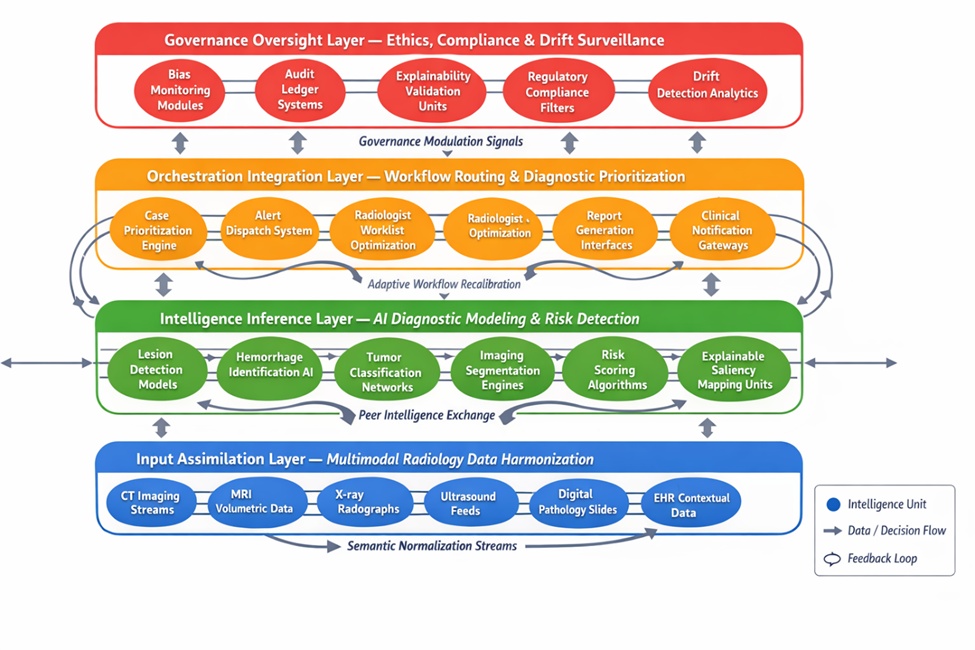
Figure 1. Radiology workflow intelligence mesh (RWIM): layered AI-embedded diagnostic orchestration topology.
The schematic depicts a four-layer meshed architecture embedding artificial intelligence across radiology workflows. The input assimilation layer harmonizes multimodal imaging and clinical datasets. Intelligence inference nodes perform distributed diagnostic modeling and risk detection. Orchestration integration components route outputs into prioritized clinical workflows through adaptive feedback loops. Governance oversight overlays enforce ethical monitoring, bias detection, and regulatory compliance. Bidirectional connectors illustrate the recursive propagation of intelligence and the diagnostic mesh’s resilience to node disruption.
This topology theoretically optimizes radiology workflows by embedding AI intelligence in a resilient, governed mesh, addressing diagnostic operational needs [20, 21].
The radiology workflow intelligence mesh (RWIM) theoretically reshapes diagnostic operations by redistributing cognitive and operational loads across human-AI collaborations in radiology. This section examines the mesh’s consequences through lenses of workflow efficiency, clinician cognition, diagnostic latency, and systemic resilience, conceptualizing impacts without empirical metrics or datasets.
Workflow efficiency reconfigurations in AI-embedded diagnostics: RWIM’s meshed topology theoretically streamlines radiology pipelines by enabling parallel inference and adaptive routing, reducing sequential dependencies that characterize traditional workflows. Intelligence hubs in the Inference Layer process multimodal inputs concurrently, theoretically accelerating prioritization of urgent cases such as intracranial hemorrhages or pulmonary emboli. Orchestration layers dynamically reroute flows based on preliminary outputs, minimizing idle times in high-volume settings. This reconfiguration theoretically alleviates bottlenecks in emergency radiology, where decision latency directly influences patient trajectories, fostering more fluid transitions from image acquisition to clinical action [20, 28].
Human-AI cognitive load redistribution across diagnostic tasks: A primary consequence of RWIM is the redistribution of cognitive demands between radiologists and embedded AI components. The mesh theoretically offloads routine pattern recognition to specialized inference nodes, allowing clinicians to concentrate on integrative reasoning, contextual synthesis, and outlier adjudication. Governance overlays monitor drift and confidence thresholds, theoretically prompting human intervention only when uncertainties exceed predefined bounds. This shift theoretically mitigates fatigue-induced errors in prolonged sessions, while preserving radiologist agency in final determinations. Conceptual models suggest that such redistribution enhances overall diagnostic coherence, as AI contributions augment rather than supplant human expertise [15, 18].
Decision latency trade-offs in meshed intelligence operations: Latency emerges as a critical dynamic in RWIM deployments. While mesh connectors facilitate rapid data propagation, traversing multiple layers introduces incremental delays, particularly in resource-constrained environments. Interpretive formula for latency propagation:
Infrastructure sensitivities and resilience to disruptions: RWIM’s decentralized mesh theoretically confers resilience against single-point failures, as bidirectional connections enable rerouting around compromised nodes. However, sensitivities arise from dependencies on interoperability standards and governance enforcement. Disruptions to data exchange protocols or lapses in monitoring could propagate cascading uncertainties across diagnostic operations. The earlier infrastructure sensitivity formula (
Clinical adoption of meshed intelligence architectures depends not merely on technical performance, but on perceptual, cognitive, and organizational alignment between system capabilities and stakeholder expectations. In radiology environments characterized by high throughput, diagnostic uncertainty, and medico-legal sensitivity, adoption dynamics are particularly contingent upon workflow congruence. The Radiology Workflow Intelligence Mesh (RWIM) is conceptually designed to minimize friction by embedding AI modules as interoperable mesh nodes rather than disruptive overlays. This distinction—between additive insertion and embedded orchestration—forms the cornerstone of its adoption theory.
Radiologists typically evaluate AI systems through three implicit criteria: cognitive coherence (does the system support interpretive reasoning?), temporal neutrality (does it reduce rather than add latency?), and epistemic transparency (can its outputs be interrogated and trusted?). RWIM’s meshed topology meets these criteria by enabling standardized API-mediated integration into PACS/RIS ecosystems, minimizing interface switching, and preserving established interpretive rituals. Unlike external dashboards or parallel triage systems that fragment attention, the mesh distributes inference signals directly within the diagnostic workspace, preserving perceptual continuity.
Trust formation is theoretically strengthened through explainable inference traces embedded within each mesh node. These traces expose saliency mappings, feature contributions, uncertainty bounds, and governance annotations. Such transparency aligns with responsible AI principles articulated in contemporary clinical AI discourse [9, 19], where explainability and accountability are recognized as prerequisites for sustained adoption. In RWIM, interpretability is not an auxiliary reporting feature; it is a structural property of the mesh.
Stakeholder alignment extends beyond radiologists. Referring clinicians benefit from prioritized reporting streams enabled by risk-weighted orchestration, potentially reducing downstream bottlenecks. Patients gain from theoretically expedited diagnostics and earlier intervention pathways. However, acceleration mechanisms introduce distributive justice concerns: prioritization algorithms must not inadvertently disadvantage low-risk but clinically significant populations. Accordingly, RWIM incorporates ethical overlays within its Governance Oversight layer to monitor equity gradients and recalibrate prioritization thresholds when disparity indices exceed defined tolerances. Key adoption and governance trade-offs associated with RWIM deployment are synthesized in Table 1.
Table 1. Adoption, governance, and operational trade-offs in radiology workflow intelligence mesh (RWIM) deployments
Domain dimension | Mesh-enabled advantage | Operational trade-off | Governance mitigation mechanism | Theoretical impact on radiology systems |
Workflow efficiency | Parallel AI inference reduces diagnostic bottlenecks | Mesh traversal may introduce latency layers | Priority routing and adaptive orchestration | Accelerated triage and reporting turnaround |
Cognitive load distribution | AI offloads repetitive detection tasks | Over-automation risks clinician deskilling | Human override thresholds and explainability traces | Enhanced interpretive focus and reduced fatigue |
Diagnostic confidence | Multimodal inference fusion improves reliability | Conflicting AI signals may create ambiguity | Consensus scoring and governance dampening | Stabilized decision concordance |
Infrastructure resilience | Distributed nodes prevent single-point failure | Interoperability dependencies increase complexity | Redundant connectors and monitoring analytics | Sustained operations during system disruptions |
Ethical and equity oversight | Embedded bias monitoring enhances accountability | Prioritization algorithms may skew access | Equity calibration layers and audit reviews | Fair diagnostic distribution across populations |
Adoption dynamics | Seamless PACS/RIS embedding fosters trust | Intrusive alerts may disrupt workflow | Adaptive alert scaling and user calibration | Progressive clinician acceptance |
Organizational leadership, including department administrators and IT governance committees, evaluates adoption through infrastructure sustainability and regulatory compliance. RWIM’s modular architecture distributes computational load across nodes, theoretically enhancing resilience under peak demand while preserving auditability. Infrastructure sensitivity (IS) parameters allow estimation of system strain relative to imaging volume and modality complexity, thereby enabling proactive capacity planning.
Resistance to adoption may arise when mesh behavior appears opaque or intrusive. For example, excessive alerting or over-aggressive prioritization can erode cognitive autonomy. RWIM mitigates this through adaptive orchestration scaling, wherein mesh intensity is modulated based on radiologist interaction patterns and workflow density. Such adaptive scaling preserves human primacy while maintaining mesh responsiveness.
These dynamics position RWIM as a transformative yet balanced architecture. Intelligence meshing enhances operational resilience and interpretive augmentation, but it deliberately navigates trade-offs among latency, cognitive load, automation depth, and governance oversight. Adoption is thus conceptualized not as binary uptake but as progressive alignment—achieved through transparency, workflow fidelity, and ethical accountability.
Synthesizing the conceptual architecture, RWIM advances theoretical discourse by proposing a distributed intelligence topology that embeds AI across radiology diagnostic operations rather than centralizing it in discrete predictive silos. Its four-layer configuration—Input Assimilation, Intelligence Inference, Orchestration Integration, and Governance Oversight—forms a bidirectionally coupled mesh sustained by continuous feedback recursion. This structure contrasts with linear AI pipelines that typically terminate at output generation without systemic recalibration [10, 11, 28].
At the Input Assimilation layer, multimodal radiological data (imaging, metadata, clinical context) are harmonized through semantic normalization. The intelligence inference layer generates risk vectors, anomaly maps, and modality-specific embeddings. Orchestration integration synthesizes these signals into prioritized workflows, while governance oversight modulates decisions through equity, bias, and compliance scalars. Feedback flows upward and downward across layers, enabling dynamic recalibration without necessitating complete retraining cycles.
The theoretical scaffolding of RWIM is further illuminated through conceptual formulas that model interpretive and infrastructural dynamics:
Risk propagation (RP) conceptualizes how localized anomaly signals diffuse across the mesh, influenced by connectivity density and governance attenuation coefficients.
Decision confidence (DC) integrates predictive certainty with contextual concordance and human override patterns, representing a composite reliability scalar.
Infrastructure sensitivity (IS) estimates the mesh’s responsiveness to workload variability and computational constraints, informing resilience thresholds.
These constructs do not serve as empirical metrics but as analytical lenses for anticipating system behaviors under hypothetical stressors. For instance, high RP coupled with declining DC may indicate over-amplification of uncertain signals, triggering governance dampening. Similarly, elevated IS under modality surges may justify adaptive resource reallocation within the mesh.
RWIM’s conceptual strength lies in its harmonization of explainability, multimodal integration, and workflow-centric governance [12, 16, 25]. Rather than treating these elements as separate enhancement modules, the mesh embeds them structurally. Interoperability ensures that radiological AI components communicate seamlessly, mitigating the fragmentation that has historically hindered clinical AI deployments.
Future theoretical refinement may explore several pathways:
Integration of emerging modalities: As advanced spectroscopic, functional, and hybrid imaging modalities proliferate, mesh nodes must accommodate higher-dimensional feature spaces and cross-modality harmonization. Expanding the Input Assimilation layer to incorporate dynamic spectral signatures could enhance anomaly contextualization.
Federated intelligence extensions: Cross-institutional meshing via federated architectures could enrich collective diagnostic intelligence while preserving data sovereignty. Governance overlays would need recalibration to manage inter-institutional equity gradients and jurisdictional compliance.
Adaptive governance scaling: As regulatory landscapes evolve, RWIM’s Governance Oversight layer could integrate dynamic compliance matrices that adapt to new policy directives without requiring a complete restructure of the mesh topology.
Human–mesh co-evolution models: Longitudinal frameworks examining how radiologists’ interpretive heuristics adapt to meshed intelligence environments may inform optimal alert density, confidence thresholds, and override mechanisms.
Persistent challenges remain. Resource-varied healthcare settings may face barriers to mesh deployment due to infrastructure disparities. Additionally, increasing automation risks attenuating clinician vigilance if not carefully governed. Ensuring equitable access and preserving interpretive agency must therefore remain central to mesh evolution.
RWIM represents a conceptual blueprint for next-generation radiology systems in which intelligence is neither centralized nor peripheral, but rather structurally embedded throughout diagnostic operations. By embedding transparency, adaptive orchestration, and governance modulation within its topology, the architecture aspires to balance efficiency with ethical stewardship. It reframes AI not as a discrete tool but as a distributed cognitive substrate—augmenting radiological practice while preserving human authority.
As radiology continues to intersect with multimodal analytics and regulatory complexity, intelligence meshes may provide the architectural paradigm necessary for sustainable AI integration. Continued theoretical refinement, simulation modeling, and interdisciplinary dialogue will be essential to translate this conceptual scaffold into resilient clinical ecosystems that prioritize precision, operational harmony, and clinician empowerment.
None
None
None
None
Open Access The author(s) retain copyright. This article is licensed under the Creative Commons Attribution-NonCommercial-ShareAlike 4.0 International License. It may be shared and adapted for non-commercial purposes with appropriate attribution, an indication of changes, and distribution of adaptations under the same license. Third-party material may be subject to separate terms identified in its credit line. View the license at https://creativecommons.org/licenses/by-nc-sa/4.0/.
 Clinical Intelligence Research Press