Pressure ulcers are a persistent issue in bedridden patients, especially in intensive care, rehabilitation, and long-term care, leading to pain, infection, and extended hospital stays. Current risk assessments rely on intermittent scoring and clinical judgment, failing to account for continuous changes in body posture, tissue loading, and mechanical tolerance. This conceptual framework proposes a physics-informed graph neural network to predict pressure ulcer risk by integrating data from body position sensors, local tissue loading, and skin perfusion measurements into a dynamic, personalized model. The model represents the body as a graph, with nodes representing pressure-prone areas and edges indicating anatomical and mechanical connections. Tissue stress, perfusion data, and posture features are processed through network layers constrained by soft-tissue mechanics. By encoding the relationship between external forces, internal tissue deformation, ischemia, and damage, the framework allows risk propagation across adjacent anatomical regions. This approach offers a path for continuous, personalized pressure ulcer risk monitoring, laying the foundation for clinical validation and sensor integration.
Pressure ulcers are clinically significant adverse events in bedridden patients because prolonged loading over bony prominences can produce local tissue ischemia, soft-tissue deformation, pain, infection, and delayed recovery. Current prevention practices rely on repositioning, pressure-redistributing surfaces, and structured risk assessment, yet these strategies remain intermittent and may not capture rapid changes in posture or tissue tolerance. Clinical reviews emphasize that pressure ulcer development reflects a complex interaction among pressure, shear, tissue viability, and patient-specific vulnerability, rather than a single static risk factor [1, 2]. Machine-learning approaches have improved risk stratification from electronic health records, but they often remain disconnected from continuous biomechanical sensing and regional tissue loading [3-5].
Continuous body position sensing and skin monitoring technologies create an opportunity to move from episodic assessment to real-time risk modelling. Pressure-sensitive mattresses, smart mats, wearable sensors, and posture recognition systems can estimate contact distribution, body orientation, and repositioning behaviour over time [6-9]. Complementary reviews of loaded skin tissues and intelligent pressure ulcer prevention systems suggest that sensor streams could be used to quantify tissue exposure, mechanical loading, and physiological vulnerability more directly than bedside risk scales [10, 11]. However, a predictive framework must still connect these heterogeneous measurements to tissue deformation, perfusion compromise, and evolving anatomical risk.
This article proposes a conceptual framework for a physics-informed graph neural network that integrates body position sensor data, skin perfusion measurements, and soft-tissue mechanics to estimate personalised pressure ulcer risk. The framework uses graph structure to represent anatomical regions such as the sacrum, heels, trochanters, scapulae, and occiput, while physics-informed learning constrains predictions using principles derived from tissue stress, strain, and equilibrium. Physics-informed neural networks provide a foundation for embedding governing equations and physical residuals into machine-learning objectives, while graph-based models offer a natural structure for propagating physiological risk across connected body regions [12-15]. The following sections define the pathophysiological basis, sensing inputs, conceptual architecture, and mechanics-informed risk formulation.
Pressure ulcer pathophysiology involves sustained mechanical loading, impaired capillary perfusion, deformation-induced cellular injury, lymphatic obstruction, and reperfusion-related inflammatory damage after load relief. Interface pressure and shear stress are especially important because they concentrate internal strains near bony prominences, while microclimate and tissue tolerance alter the threshold at which external loading becomes harmful [1, 2]. Systematic evidence links pressure and shear to reduced tissue viability, showing that ulcer risk cannot be understood solely from external pressure magnitude without considering duration, tissue properties, and physiological response [1]. Computational and clinical studies of tissue deformation further support the need to represent internal stress distributions, not only surface contact pressure, when assessing pressure injury risk [16-18].
Body position sensor technologies include pressure-sensitive mattresses, conductive sheets, capacitive or resistive mats, wearable accelerometers, and embedded systems that infer posture from contact pressure and movement signatures. Recent work has demonstrated posture recognition from miniature smart mats, pressure-sensitive conductive sheets, sparse sensor arrays, and deep learning models for in-bed posture classification [7-9, 19]. Studies using wearable sensors and electronic alert systems show how continuous monitoring can cue repositioning and identify prolonged loading before visible tissue injury occurs [20-22]. These technologies provide the positional and temporal information needed for a graph-based model in which each anatomical region receives a time-varying estimate of contact pressure, posture state, and loading duration.
Skin perfusion measurements provide physiological information about whether mechanically loaded tissue is maintaining adequate oxygen delivery and microvascular flow. Reviews of technologies for loaded skin tissues highlight the potential value of monitoring tissue health, oxygenation, and perfusion alongside external loading measurements [11]. In a pressure ulcer prediction framework, perfusion-derived signals can serve as dynamic indicators of tissue viability, complementing posture and pressure features that describe mechanical exposure. Although the Part 1 reference set emphasizes sensor-based monitoring and tissue viability rather than a single perfusion modality, the conceptual role of laser Doppler flowmetry, transcutaneous oxygen tension, and near-infrared spectroscopy is to provide real-time evidence of ischemia or recovery during and after loading [10, 11].
Physics-informed neural networks incorporate physical laws into learning by penalizing violations of governing equations, boundary conditions, or conservation principles during model training. The foundational PINN formulation showed how neural networks can solve forward and inverse problems governed by nonlinear partial differential equations, while geometry-adaptive extensions demonstrate how physics-guided learning can be applied to irregular computational domains [12, 13]. Physics-informed graph neural networks extend this principle by combining graph message passing with physical constraints, enabling predictions over connected spatial regions or physiological structures rather than independent observations [23-25]. In pressure ulcer modelling, this logic supports a neural architecture that learns from sensor data while remaining constrained by soft-tissue stress balance, strain compatibility, and physiologically plausible damage progression.
The proposed architecture begins with continuous body position data and skin perfusion inputs, converts them into anatomical node features, applies a physics-informed graph neural network, and outputs a regional risk score for pressure ulcer development. The body surface is represented as a graph in which pressure-prone anatomical landmarks serve as nodes, while edges encode anatomical proximity and load-sharing relationships. This graph design is motivated by clinical graph learning in electronic health records and physiological risk prediction, where relationships among variables can improve prediction beyond isolated feature vectors [14, 15, 26]. In the proposed framework, graph learning is combined with tissue mechanics so that predicted risk reflects both measured sensor states and physically plausible stress propagation [12, 23, 25].
Figure 1 presents the proposed physics-informed graph neural network architecture, showing how continuous body position sensing, skin perfusion measurements, anatomical graph construction, soft-tissue mechanics constraints, and clinician-supervised decision support are integrated into a staged regional pressure ulcer risk prediction framework.
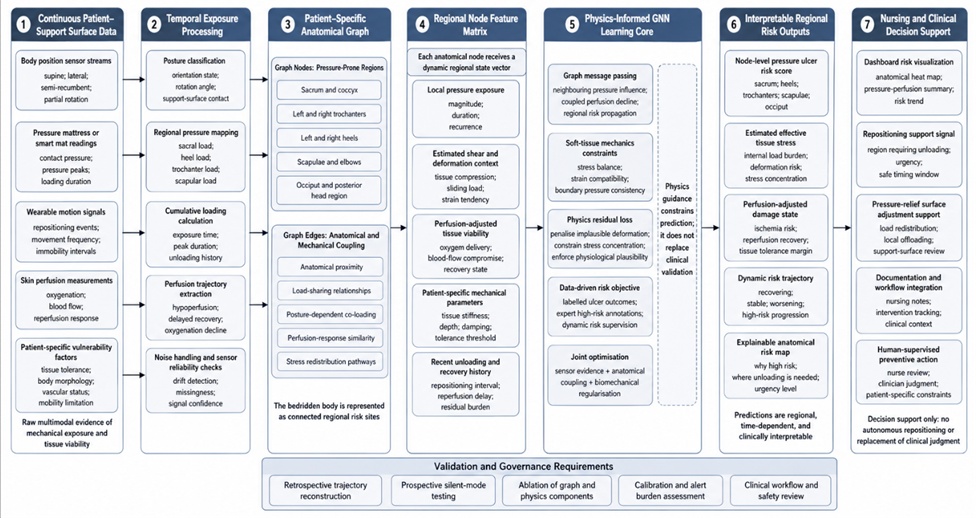
Figure 1. Physics-Informed Graph Neural Network Architecture for Regional Pressure Ulcer Risk Prediction in Bedridden Patients
The framework assumes that the bedridden body can be discretised into clinically meaningful anatomical nodes, including the sacrum, coccyx, left and right trochanters, heels, scapulae, and occiput. Each node is associated with local pressure exposure, posture-dependent contact status, perfusion state, cumulative loading duration, and approximate tissue mechanical parameters. The assumption of regional discretisation is consistent with pressure monitoring systems that estimate pressure maps and posture states from mattress arrays or smart surfaces [6-8, 27]. The model also assumes that anatomical regions are mechanically coupled, meaning that changes in body orientation or local unloading can redistribute stress and perfusion risk across neighbouring regions [16, 17].
The framework follows five design principles: physics guidance, personalisation, continuity, non-invasiveness, and clinical interpretability. Physics guidance constrains predictions using tissue stress and strain relationships, while personalisation allows node-level thresholds to vary according to perfusion response, body morphology, and tissue tolerance. Continuous and non-invasive monitoring are supported by pressure mattresses, wearable sensing systems, and posture recognition methods that can operate without disrupting routine care [10, 20-22]. Interpretability is pursued through anatomical risk maps and stress visualisation, reflecting the need for explainable pressure injury prediction rather than opaque risk scores alone [3, 5].
Table 1 clarifies how the proposed framework translates pressure ulcer pathophysiology into measurable sensor signals, anatomical graph structures, physics-informed constraints, and interpretable model outputs.
Table 1. Conceptual Mapping between Clinical Pressure Ulcer Mechanisms, Sensor-Derived Signals, and Physics-Informed Graph Model Constructs
Clinical pressure ulcer mechanism | Observable or inferable sensor signal | Anatomical graph representation | Physics-informed construct | Model interpretation value |
Prolonged compression over bony prominences | Sustained high contact pressure from mattress or smart mat arrays | Node-level loading feature for sacrum, heels, trochanters, scapulae, elbows, or occiput | Boundary pressure condition applied to regional soft tissue | Distinguishes transient pressure peaks from sustained harmful loading |
Shear-related tissue deformation | Posture transition, partial rotation, sliding, or asymmetric pressure distribution | Edge-modulated interaction between neighbouring loaded regions | Strain compatibility and deformation plausibility constraint | Helps explain why posture change may redistribute rather than eliminate risk |
Capillary occlusion and ischemia | Reduced local perfusion, oxygenation decline, or delayed reperfusion | Node-level perfusion viability feature | Perfusion-adjusted damage threshold | Allows identical pressure exposure to carry different risk across patients or regions |
Cumulative loading burden | Duration above pressure threshold, immobility interval, recent unloading history | Temporal node-state memory | Time-dependent damage accumulation | Supports dynamic risk trajectories rather than single static risk scores |
Load redistribution between adjacent regions | Change in pressure pattern after repositioning or support-surface adjustment | Weighted anatomical and mechanical edges | Stress balance across coupled nodes | Represents risk propagation across neighbouring anatomical regions |
Patient-specific tissue tolerance | Body morphology, vascular impairment, malnutrition, age-related vulnerability, mobility limitation | Patient-specific node parameters | Regional stiffness, damping, tissue depth, and tolerance threshold | Enables personalised risk estimation rather than population-average scoring |
Recovery after unloading | Perfusion rebound, reduction in pressure, restoration of movement | Updated node recovery state | Reperfusion and residual damage representation | Differentiates recovering tissue from tissue with persistent vulnerability |
Regional ulcer emergence | Documented pressure injury location and timing | Node-level outcome label or expert high-risk annotation | Joint data-driven and physics-residual loss | Aligns model training with clinically meaningful regional injury endpoints |
Position data processing begins by converting pressure mattress arrays or smart mat readings into contact pressure distributions over time. These distributions are used to identify posture states such as supine, lateral, semi-recumbent, or partially rotated positions, while local peaks indicate regions exposed to concentrated loading. Deep learning and transfer learning approaches for sleep or in-bed posture recognition show that pressure maps can be transformed into posture classifications and spatial loading features suitable for downstream modelling [7-9, 19]. Within the proposed framework, these features become graph node attributes that summarize current pressure, accumulated exposure, recent repositioning, and deviation from safe loading intervals.
Perfusion measurements are conceptually incorporated as node-level indicators of local tissue oxygenation, blood flow, and recovery after unloading. Transcutaneous oxygen tension may be represented as a surrogate of tissue oxygen availability, while relative perfusion change over time can indicate whether a region is compensating or entering a hypoperfused state. The rationale for integrating perfusion with loading is supported by tissue viability research showing that external pressure and shear must be interpreted in relation to the biological response of loaded skin and subcutaneous tissue [1, 11]. In the framework, perfusion trajectories adjust the damage threshold at each node, allowing the same pressure exposure to generate different risk estimates in patients with different tissue tolerance.
The continuum mechanics component represents skin, adipose tissue, muscle, and underlying bone as a simplified layered soft-tissue system exposed to external boundary pressure from the support surface. A hyperelastic or viscoelastic formulation can approximate nonlinear deformation under sustained loading, with parameters representing regional stiffness, damping, and tissue depth. Finite element and personalised modelling studies of pressure ulcer risk show that internal stress and strain can differ substantially from surface pressure and that real-time prevention may require patient-specific mechanical approximation [16, 17]. The proposed model therefore treats surface pressure as an observable boundary condition and estimates internal stress, strain, and deformation fields that are more directly related to tissue damage [2, 18].
The physics loss formulation penalizes neural predictions that violate equilibrium, produce unrealistic stress concentrations, or generate incompatible strain fields across neighbouring anatomical regions. Conceptually, the total learning objective combines data-driven risk prediction with residual terms derived from mechanical balance, boundary pressure consistency, and plausible soft-tissue deformation. Physics-informed learning provides the methodological basis for embedding such residuals into the objective function, while graph-based physics models show how constraints can be imposed across spatially connected structures [12, 13, 23, 24]. In the pressure ulcer framework, this loss does not claim experimental performance but defines how future models could align sensor-driven prediction with the mechanics of tissue loading and injury progression [15, 25].
Graph construction begins by defining anatomical nodes that correspond to pressure-prone regions of the bedridden body, including the sacrum, coccyx, left and right trochanters, heels, scapulae, elbows, and occiput. Each node stores local pressure exposure, posture state, loading duration, recent unloading history, and perfusion-derived tissue viability indicators. This representation is consistent with graph learning approaches in healthcare, where clinically meaningful entities are modelled as connected nodes rather than isolated variables [14, 15, 26]. In the proposed framework, node features also incorporate patient-specific mechanical assumptions so that local risk reflects both measured sensor state and estimated tissue tolerance [16, 17, 28].
Edges represent anatomical proximity, mechanical coupling, and load redistribution between neighbouring body regions during posture changes. For example, the sacrum, coccyx, and trochanters may be strongly coupled during supine or lateral positioning, while the heels and lower legs may share load under partial elevation. Edge weights can therefore encode anatomical distance, co-loading frequency, posture-dependent contact transitions, and similarity in perfusion response. This edge logic follows the broader rationale of graph neural networks for clinical risk prediction, in which relational structure allows information from one physiological region or clinical variable to influence another [14, 15, 28].
The physics-informed graph neural network updates each anatomical node by combining its own sensor state with messages from adjacent nodes. These messages may include pressure redistribution, neighbouring perfusion decline, cumulative tissue loading, and inferred mechanical strain propagation. The physics constraint acts as a regularisation term so that message passing does not merely learn statistical associations but remains aligned with equilibrium, stress continuity, and plausible deformation behaviour [12, 23, 24]. This is particularly important for pressure ulcer prediction because external pressure at one region may alter internal stress and perfusion risk in adjacent regions through tissue deformation and load sharing [1, 16, 17].
The conceptual loss function combines a data-driven pressure ulcer risk objective with a physics residual that penalizes mechanically implausible predictions. The data component would learn from labelled clinical outcomes or expert-annotated high-risk periods, while the physics component would encode boundary pressure consistency, strain compatibility, and stress balance across connected anatomical regions. This formulation follows the principle that physical knowledge can be embedded directly into neural learning rather than applied only after prediction [12, 13]. For graph-structured body regions, physics-informed graph models provide a suitable abstraction because they permit node-level learning while preserving spatial coupling through edges [23-25].
The output layer is designed to generate clinically interpretable intermediate quantities rather than only a binary risk label. These quantities may include estimated effective stress, cumulative loading burden, local tissue damage score, perfusion-adjusted tolerance, and regional recovery state after repositioning. Prior work on wearable sensing, electronic alerts, and dynamic pressure injury prediction supports the need for outputs that are interpretable enough to guide preventive action in real time [3, 5, 21, 22]. The framework therefore treats model outputs as decision-support signals that can explain why a region is considered high risk, not merely whether an ulcer is predicted.
Each anatomical node receives a dynamic risk score based on accumulated mechanical exposure, estimated internal stress, perfusion decline, and recovery after unloading. Conceptually, risk increases when pressure and shear exposure persist above a damage threshold, especially when perfusion measurements suggest hypoperfusion or delayed reperfusion. This formulation reflects the evidence that pressure ulcer risk depends on both mechanical loading and biological tissue viability, rather than on interface pressure alone [1, 2, 11]. Machine-learning studies of pressure injury risk prediction demonstrate the feasibility of dynamic risk modelling, but the proposed framework adds regional sensing and physics constraints to support personalised node-level interpretation [3-5, 29].
The framework estimates a dynamic risk trajectory by repeatedly updating node states as posture, pressure distribution, and perfusion signals change. Rather than producing a single admission-level score, the model would track whether a specific anatomical region is moving toward recovery, stable tolerance, or progressive damage. This time-dependent logic is consistent with continuous monitoring systems that capture posture changes, pressure peaks, repositioning events, and sensor-based alerts during routine care [6, 10, 20-22]. The model could therefore support repositioning recommendations by identifying which region requires unloading and how recent perfusion response changes the urgency of intervention [11, 18].
Clinical integration would require a real-time dashboard that displays the body as an anatomical risk map, with each region linked to current pressure exposure, perfusion status, and estimated tissue stress. The dashboard should emphasize explainable indicators such as prolonged loading, reduced perfusion recovery, and mechanically coupled risk spreading from adjacent regions. This design is supported by pressure injury prediction work emphasizing explainability and by sensor-based prevention studies showing that actionable alerts can cue repositioning in critical care settings [5, 21, 22]. A graph-based presentation is also aligned with mixed-variable graphical modelling approaches, which make relationships among risk factors more transparent than isolated score outputs [28].
The framework should be embedded into nursing workflow as a decision-support tool rather than as an autonomous replacement for clinical judgment. Alerts could be linked to repositioning documentation, pressure-relief surface adjustments, and records of patient tolerance, while the system could learn from whether recommended actions were completed and whether tissue risk subsequently improved. Existing studies of electronic health record prediction, dynamic pressure injury risk, and machine-learning-based risk modelling indicate that clinical usefulness depends on integration with routine documentation and staff decision processes [3-5]. The proposed system therefore prioritizes workflow compatibility, explainable alerts, and feedback loops that support adherence without increasing unnecessary alarm burden.
Table 2 outlines an evaluation matrix for determining whether anatomical graph structure, physics-informed constraints, perfusion integration, and patient-specific modelling provide added value beyond conventional pressure ulcer risk prediction approaches.
Table 2. Evaluation Matrix for Testing the Added Value of Anatomical Graph Structure and Physics-Informed Learning
Evaluation dimension | Full proposed model: physics-informed GNN | Comparator model | What the comparison tests | Preferred evidence of added value |
Regional discrimination | Predicts node-level risk across pressure-prone anatomical regions | Admission-level or patient-level risk model | Whether regional graph modelling improves localisation of risk | Higher regional sensitivity and specificity for future ulcer sites |
Temporal warning quality | Updates risk as posture, loading, and perfusion change over time | Static bedside risk scale or baseline EHR model | Whether continuous sensing improves early warning | Earlier identification of high-risk intervals without excessive false alerts |
Contribution of graph structure | Uses anatomical and mechanical edges between body regions | Non-graph neural network using the same sensor features | Whether relational coupling adds predictive or explanatory value | Improved calibration and localisation when load redistribution affects adjacent regions |
Contribution of physics constraints | Penalises mechanically implausible stress, strain, and boundary-pressure predictions | GNN without physics residuals | Whether biomechanical regularisation improves plausibility and generalisation | Fewer implausible risk spikes and better performance under posture shifts |
Contribution of perfusion signals | Adjusts node-level tolerance using tissue viability trajectories | Pressure-only or posture-only model | Whether physiological response improves risk stratification beyond mechanical exposure | Better distinction between tolerated loading and ischemic vulnerability |
Personalisation capacity | Incorporates patient-specific mechanical and physiological tolerance parameters | Population-average model | Whether individual vulnerability improves clinical relevance | Improved calibration across high-risk subgroups such as immobile, vascular-impaired, or critically ill patients |
Interpretability | Outputs regional stress, cumulative burden, perfusion-adjusted tolerance, and recovery state | Black-box binary classifier | Whether outputs can support clinical reasoning | Nurses and clinicians can identify why, where, and when risk is increasing |
Workflow safety | Produces clinician-reviewed decision-support signals | Autonomous alerting or unvalidated active deployment | Whether the model can be introduced cautiously | Safe silent-mode performance before active bedside use |
Robustness to sensor limitations | Handles missingness, drift, and noisy perfusion signals | Model trained only on complete idealised sensor streams | Whether the framework remains usable in routine care | Stable predictions despite partial sensor failure or sparse perfusion monitoring |
Clinical implementation readiness | Links risk maps to repositioning documentation and prevention workflow | Standalone predictive score outside workflow | Whether predictions can support actionable care | Reduced alert burden, clear escalation logic, and compatibility with nursing documentation |
Retrospective validation would use historical patient data containing body position records, pressure sensor streams, perfusion measurements where available, nursing documentation, and clinically confirmed pressure ulcer outcomes. The aim would be to test whether the framework can reconstruct plausible node-level risk trajectories before observed tissue injury, while comparing its predictions with established clinical risk documentation. Evaluation metrics such as discrimination, calibration, sensitivity, and specificity may be used conceptually, but this article does not report experimental values or claim empirical performance. Prior machine-learning studies in pressure injury prediction provide methodological precedent for retrospective cohort validation, while the proposed framework extends this logic toward regional and mechanically informed risk estimation [3, 4, 29].
Prospective silent-mode evaluation would deploy the framework in a clinical unit without showing alerts to staff, allowing predicted high-risk periods to be compared with subsequent nursing observations and documented pressure injury events. This design would help determine whether the model produces clinically plausible warnings without altering care behaviour during the observation period. Sensor-based monitoring and wearable cueing studies suggest that real-time systems must be assessed not only for prediction but also for timing, interpretability, and integration into bedside practice [20-22]. Silent-mode deployment would therefore provide a cautious transition between retrospective modelling and active clinical decision support.
Ablation experiments would conceptually compare the full physics-informed graph neural network with reduced variants, including a graph neural network without physics constraints, a pressure-only model, a perfusion-only model, and a non-graph risk model. The purpose would be to examine whether anatomical graph structure and mechanical regularisation contribute meaningful explanatory value beyond sensor features alone. Graph learning research in healthcare shows that relational structure can improve representation of complex clinical dependencies, while physics-informed methods provide a basis for constraining predictions to physically plausible states [12, 14, 15, 23]. These comparisons would not establish clinical superiority without empirical validation, but they would clarify which components of the conceptual framework warrant future implementation.
The proposed framework depends on simplified tissue mechanics and may not fully capture anisotropy, muscle relaxation, nonlinear viscoelasticity, local temperature, moisture, or patient-specific anatomical variation. Pressure sensors may drift, accelerometer-based posture inference may misclassify partial rotations, and perfusion signals may be sparse or noisy in routine clinical settings. Existing tissue modelling studies show the value of mechanical approximation, but they also indicate that internal stress and tissue damage are difficult to infer precisely from external boundary measurements alone [16-18]. Consequently, the framework should be interpreted as a structured conceptual model for future validation rather than a complete digital twin of tissue injury.
Clinical limitations include variation in tissue tolerance among older adults, malnourished patients, individuals with spinal cord injury, sedated intensive care patients, and patients with vascular impairment. Repositioning recommendations may also be constrained by respiratory support, pain, surgical wounds, haemodynamic instability, or patient preference. Pressure injury pathophysiology and clinical prevention literature emphasize that risk is multifactorial, so no sensor model should replace comprehensive clinical assessment [19, 24]. Adoption will therefore depend on nursing acceptance, alert reliability, integration with documentation systems, and evidence that the framework supports rather than complicates preventive care [3, 5, 21].
This conceptual framework proposes a physics-informed graph neural network for pressure ulcer risk prediction in bedridden patients using body position sensor data and skin perfusion measurements. The framework represents pressure-prone anatomical regions as graph nodes, links them through mechanical and anatomical relationships, and estimates regional risk as posture and perfusion change over time.
The central advantage of the framework is its integration of data-driven learning with biomechanical reasoning. By combining continuous sensing, anatomical graph structure, and physics-guided stress estimation, the model could support personalised and interpretable risk maps rather than relying only on intermittent bedside scoring.
Future work should implement the framework on clinically collected sensor datasets from pressure mattresses, wearable repositioning systems, and skin perfusion monitors. Prospective validation will be necessary to determine whether such a model can improve prevention workflows, support timely repositioning, and reduce pressure ulcer burden in real clinical settings.
None
None
None
None
Open Access The author(s) retain copyright. This article is licensed under the Creative Commons Attribution-NonCommercial-ShareAlike 4.0 International License. It may be shared and adapted for non-commercial purposes with appropriate attribution, an indication of changes, and distribution of adaptations under the same license. Third-party material may be subject to separate terms identified in its credit line. View the license at https://creativecommons.org/licenses/by-nc-sa/4.0/.
 Clinical Intelligence Research Press