Elevated intracranial pressure (ICP) is a critical condition in traumatic brain injury, stroke, intracerebral hemorrhage, and hydrocephalus, often associated with poor outcomes when exceeding 20–25 mmHg. While invasive monitoring is accurate, it carries risks and is not always feasible, motivating the use of non-invasive approaches based on transcranial Doppler (TCD) ultrasound and arterial blood pressure (ABP) waveforms for continuous neurocritical care monitoring. However, existing non-invasive methods and purely data-driven machine learning models often lack physiological grounding, leading to reduced reliability and potential violations of cerebral hemodynamic principles, especially across diverse ICU settings with variable signal quality. To address these limitations, a physics-informed neural network (PINN) framework is proposed that integrates TCD and ABP signals while embedding cerebral hemodynamic equations into the learning process. The model uses separate encoders for TCD and ABP features, followed by a physics-constrained module and a loss function combining data accuracy with physical law consistency, such as mass conservation and pressure–flow relationships. This structure enables physiologically consistent ICP estimation, reduces data requirements, and improves generalization in clinical environments where labeled data are limited. Overall, the PINN-based approach enables more reliable, non-invasive, and continuous ICP monitoring by combining machine learning with physiological modeling. It offers a safer alternative when invasive monitoring is not possible and supports improved clinical decision-making in neurocritical care, though challenges remain in modeling complex autoregulation and ensuring high-quality waveform inputs.
Intracranial pressure (ICP) monitoring plays a pivotal role in the management of patients with traumatic brain injury, ischemic stroke, intracerebral hemorrhage, and hydrocephalus. Elevated ICP levels above 20-25 mmHg are strongly associated with adverse neurological outcomes and increased mortality rates in these conditions [1]. Timely detection and intervention are essential to prevent secondary brain injury and optimize cerebral perfusion. Continuous monitoring enables clinicians to tailor therapeutic strategies effectively in intensive care settings [2].
In clinical practice, invasive methods such as the external ventricular drain and intraparenchymal sensors serve as the gold standard for ICP measurement due to their high accuracy and ability to facilitate therapeutic cerebrospinal fluid drainage in cases of hydrocephalus or refractory intracranial hypertension. However, these techniques carry substantial risks including infection rates of 5 to 10 percent, hemorrhage, and malfunction, particularly in patients with coagulopathy or those requiring prolonged monitoring [3]. Indications for invasive ICP monitoring are typically reserved for severe cases where the benefits outweigh the potential complications in neurocritical care units. Alternative strategies are therefore sought to broaden access to reliable ICP assessment without these drawbacks [4].
Non-invasive alternatives including transcranial Doppler ultrasound for cerebral blood flow velocity assessment, continuous arterial blood pressure monitoring, and optic nerve sheath diameter measurements have been explored to address the limitations of invasive approaches. Despite their safety and accessibility, these methods often exhibit limited accuracy and poor generalizability across patient populations due to variability in waveform signals [5]. Pure machine learning techniques applied to these signals frequently fail to account for the underlying cerebrovascular physiology and autoregulation mechanisms [6]. Consequently, there remains a pressing need for more sophisticated models that integrate physical principles [7].
Table 1 clarifies why the proposed physics-informed framework occupies a distinct methodological position between direct invasive monitoring and purely empirical waveform-based prediction.
Table 1. Conceptual comparison of invasive, conventional non-invasive, pure machine learning, and physics-informed approaches to intracranial pressure estimation.
Approach category | Primary input modalities | Physiological grounding | Invasiveness | Expected interpretability | Robustness to sparse labels | Vulnerability to signal-quality variation | Main clinical advantage | Main limitation |
Invasive ICP monitoring | External ventricular drain or intraparenchymal sensor | Direct measurement rather than modeled physiology | High | High at measurement level but limited mechanistic abstraction | Not dependent on labeled datasets | Less affected by waveform inferential uncertainty | Gold-standard accuracy and direct therapeutic guidance | Infection, hemorrhage, malfunction, and limited eligibility |
Conventional non-invasive surrogate methods | TCD, ABP, optic nerve sheath diameter, derived indices | Partial and indirect physiological association | Low | Moderate when based on known surrogate indices | Not primarily label-driven | High, because surrogate relationships vary across patients and settings | Safer and more accessible than invasive monitoring | Limited accuracy and weak generalizability |
Pure machine learning models | TCD and/or ABP waveforms with outcome labels | Weak or absent explicit physical constraints | Low | Low to moderate depending on architecture | Poor to moderate, because performance depends strongly on labeled training pairs | High, because noise and population shifts can induce non-physical predictions | Flexible nonlinear mapping from signals to ICP | May violate conservation laws and cerebrovascular dynamics |
Physics-informed neural network framework | TCD waveform + ABP waveform + governing cerebral hemodynamic equations | Strong, because physical laws are embedded in optimization | Low | High, through explicit linkage to pressure-flow and autoregulatory principles | Stronger than pure ML under limited labels | Moderate, because physics loss regularizes noisy waveform learning | Continuous, non-invasive, physiologically plausible ICP estimation | Depends on simplified physical assumptions and adequate waveform quality |
Hybrid semi-supervised PINN deployment scenario | TCD + ABP with selective invasive ICP labels in a subset | Strong | Low for routine deployment; intermittent invasive reference during development | High | High, because data loss can be activated only where labels exist | Moderate | Enables translation in ICUs where invasive labels are incomplete | Requires careful calibration of loss weighting and validation across centers |
The thesis of this conceptual framework is the development of a physics-informed neural network that incorporates cerebral hemodynamics principles, specifically the pressure-flow relationship and autoregulation dynamics, to enable accurate estimation of ICP from TCD and ABP waveforms [8]. This approach provides a roadmap for non-invasive, continuous ICP monitoring by embedding governing physical equations into the neural network architecture [9]. The framework outlines the integration of waveform processing, physical model constraints, and neural network components to achieve physiologically consistent predictions. Such a strategy promises to enhance the reliability of non-invasive techniques in real-time clinical decision-making [10].
According to the Monroe-Kellie doctrine, the skull forms a rigid container with a fixed volume consisting of brain parenchyma, cerebrospinal fluid, and cerebral blood volume, necessitating compensatory mechanisms to prevent ICP elevation [11]. Disruptions in this balance, such as edema or hemorrhage, lead to exponential rises in ICP once compensatory reserves are exhausted. The ICP waveform typically exhibits three distinct peaks labeled P1, P2, and P3, reflecting arterial pulsations, brain compliance, and venous outflow respectively. These morphological features provide valuable insights into intracranial dynamics during continuous monitoring [12].
Cerebral perfusion pressure is calculated as the difference between mean arterial pressure and ICP, serving as a key indicator of adequate brain blood supply. Cerebral autoregulation mechanisms actively maintain relatively constant cerebral blood flow despite fluctuations in perfusion pressure within a physiological range [13]. Impairment of autoregulation, common in traumatic brain injury and stroke, results in pressure-passive flow and heightened vulnerability to secondary insults. Understanding these relationships is fundamental to interpreting TCD and ABP signals for non-invasive ICP estimation [14].
The external ventricular drain is widely regarded as the gold standard for invasive intracranial pressure monitoring owing to its dual capability for accurate measurement and therapeutic cerebrospinal fluid drainage in cases of hydrocephalus or refractory intracranial hypertension [15]. Parenchymal catheter devices offer an alternative with lower infection risk but lack the drainage function and may drift over time. These invasive techniques are indicated primarily in severe traumatic brain injury, subarachnoid hemorrhage, and other conditions with high risk of intracranial hypertension. Clinical guidelines recommend their use when non-invasive methods are insufficient for guiding management [16].
Despite their utility, invasive ICP monitoring is associated with notable complications including infection rates ranging from 5 to 10 percent, intracranial hemorrhage, and catheter malfunction. Patient-specific factors such as coagulopathy or immunosuppression further elevate these risks, often contraindicating invasive approaches [4]. Long-term implantation can lead to additional issues like cerebrospinal fluid leakage or obstruction, complicating patient care in the intensive care unit. Therefore, the development of reliable non-invasive alternatives is a priority in neurocritical care [2].
Transcranial Doppler ultrasound enables non-invasive assessment of blood flow velocity in major cerebral arteries such as the middle cerebral artery by measuring Doppler shift in reflected ultrasound waves [11]. The derived parameters including systolic, diastolic, and mean velocities provide insights into cerebral hemodynamics. The pulsatility index, calculated as the difference between systolic and diastolic velocities divided by mean velocity, has been correlated with ICP levels in various studies. Waveform morphology analysis further reveals patterns indicative of altered intracranial compliance [16].
Strong correlations have been observed between TCD-derived pulsatility index and invasive ICP measurements, although variability exists depending on patient condition and autoregulation status. TCD waveform analysis allows for real-time evaluation of cerebral blood flow dynamics when combined with ABP signals [1]. This modality is particularly valuable in intensive care settings for monitoring traumatic brain injury and stroke patients without invasive probes. Limitations include operator dependency and signal quality issues in patients with poor acoustic windows [17].
Raissi et al. introduced physics-informed neural networks as a deep learning framework that embeds governing physical laws in the form of partial differential equations directly into the loss function [8]. This architecture enables the solution of forward and inverse problems with sparse data by minimizing residuals of the physical equations through automatic differentiation. Unlike traditional neural networks, PINNs incorporate boundary and initial conditions as soft constraints within the optimization process. Applications in fluid dynamics have demonstrated their efficacy in modeling complex hemodynamic flows with limited labeled data [9].
The dual components of data loss and physics loss in PINNs allow for hybrid supervised and unsupervised learning, enhancing generalization in physiological modeling. In cerebral hemodynamics, PINNs have been applied to predict blood flow patterns using medical imaging data [10]. The framework enforces physical consistency, making predictions more reliable than black-box machine learning models. Recent advancements have extended PINNs to time-dependent problems relevant to waveform analysis [4].
The high-level architecture of the proposed framework begins with the simultaneous acquisition of transcranial Doppler ultrasound waveforms and arterial blood pressure signals as primary inputs [5]. These raw waveforms undergo feature extraction via specialized neural network encoders to capture temporal and morphological characteristics. The extracted features are subsequently input into the physics-informed neural network core, where physical constraints are enforced through the loss function [8]. The output consists of continuous ICP estimates along with associated hemodynamic variables [18].
This integrated approach enables real-time, continuous estimation of ICP without the need for invasive sensors. By combining data-driven learning with physics-based regularization, the model produces outputs that are both accurate and physiologically interpretable [9]. The architecture is designed for seamless deployment in intensive care unit monitoring systems. Future extensions could include additional physiological signals for enhanced robustness [19].
Figure 1 illustrates the hierarchical physics-informed architecture through which transcranial Doppler and arterial blood pressure waveforms are transformed into physiologically constrained non-invasive intracranial pressure estimates.
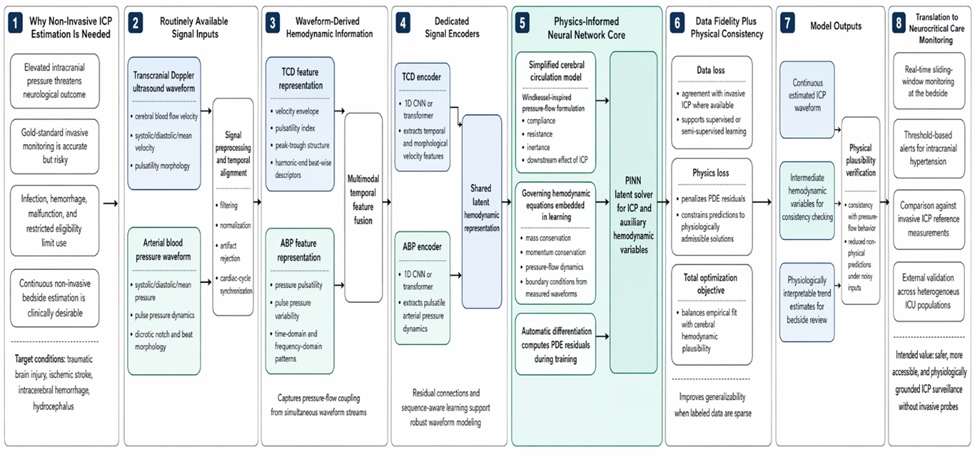
Figure 1. Hierarchical physics-informed architecture for non-invasive intracranial pressure estimation from transcranial Doppler and arterial blood pressure waveforms.
The framework relies on a simplified cerebral circulation model that approximates the intracranial vascular network using lumped parameter approaches to facilitate computational efficiency [20]. In acute clinical settings, autoregulation effects are assumed to be negligible or impaired, allowing direct linkage between ABP, TCD velocities, and ICP [13]. Input waveforms are presumed to exhibit reasonable signal-to-noise ratios following standard preprocessing. These assumptions streamline the integration of physical equations into the neural network [14].
Under these conditions, the model focuses on pressure-flow relationships without extensive patient-specific calibration. The core assumption of time-aligned TCD and ABP signals ensures accurate computation of residuals. Such simplifications are justified for initial conceptual development while acknowledging the need for refinement in heterogeneous populations. Validation protocols will later assess the impact of violating these assumptions [21].
The design principles emphasize a physics-grounded approach that embeds fundamental hemodynamic equations to guarantee physiologically consistent ICP estimates [10]. Non-invasiveness is achieved by relying exclusively on TCD and ABP signals routinely collected in neurocritical care [16]. Continuous estimation is facilitated through sliding window processing of waveforms for beat-to-beat or trend monitoring. Minimal calibration requirements enhance practicality for bedside application [22].
These principles collectively aim to overcome the shortcomings of existing non-invasive methods by prioritizing interpretability and reliability. The framework is modular to allow future incorporation of additional data modalities. Emphasis on minimal calibration reduces operational burden on clinical staff. Overall, the principles align with the goals of digital health technologies in critical care [22].
A simplified Windkessel model captures the essential pressure-flow relationship in the cerebral circulation by representing arterial compliance, resistance, and inertance [20]. In this model, arterial blood pressure serves as the input driving cerebral blood flow velocity measured by TCD, while ICP modulates the effective downstream pressure. The relationship between these variables is governed by the interaction of pulsatile components and mean pressures. Such models provide the foundation for linking observable waveforms to unmeasured ICP [23].
Extensions to one-dimensional arterial network models further refine the representation of wave propagation and reflections in cerebral vessels. The pressure gradient between ABP and ICP directly influences flow velocity according to Navier-Stokes approximations. Parameterization with patient-specific vessel properties enhances model fidelity. This physical foundation is critical for informing the neural network architecture [18].
Conservation of mass and momentum principles underpin the governing equations that relate pressure gradients to blood flow velocity in the cerebral vasculature [10]. These partial differential equations describe the dynamic interplay between arterial blood pressure, intracranial pressure, and transcranial Doppler-derived velocities. Key parameters such as vessel compliance, peripheral resistance, and characteristic impedance are incorporated to characterize the system. Automatic differentiation within the PINN framework computes the residuals of these equations efficiently [8].
The differential equations are discretized in time to align with the sampled waveform data from TCD and ABP. Boundary conditions derived from measured signals enforce physical realism in the predictions. Inclusion of these equations ensures that estimated ICP values satisfy fundamental fluid dynamics constraints. This rigorous physical embedding distinguishes the framework from conventional machine learning approaches [9].
Waveform encoders employ one-dimensional convolutional neural networks or transformer architectures to process the TCD velocity envelope and extract temporal features [7]. These encoders capture key morphological aspects such as systolic peaks and diastolic troughs in the Doppler signal. Parallel encoders for ABP waveforms similarly identify pressure dynamics including pulse pressure variations. The extracted latent representations are fused prior to physics-informed processing [6].
Temporal feature extraction enables the model to account for beat-to-beat variations and longer-term trends in cerebral hemodynamics. Architectural choices such as residual connections enhance training stability for long waveform sequences. Preprocessing steps including normalization and alignment ensure compatibility between TCD and ABP inputs. This modular design facilitates scalability to multi-channel monitoring data [21].
The physics integration layer receives fused features and outputs both the estimated ICP waveform and auxiliary hemodynamic variables such as cerebral blood flow resistance [8]. This multi-output structure allows for simultaneous prediction and validation against physical constraints. Intermediate variables serve as proxies for verifying consistency with the underlying cerebral circulation model. The layer is fully differentiable to support end-to-end training [9].
Physical consistency checks are performed by evaluating the residuals of governing equations at each time step. Deviations trigger penalties in the loss function to guide the network toward plausible solutions. This integration ensures that ICP estimates are not only data-driven but also adhere to physiological principles. The architecture promotes robustness in the presence of noisy clinical waveforms [10].
The data loss component quantifies the agreement between the predicted intracranial pressure waveform and any available invasive ICP measurements during supervised training phases [6]. Mean squared error serves as the primary metric to align the network output with ground-truth values obtained from paired TCD and ABP recordings in neurocritical care datasets [21]. This term ensures that the model remains anchored to clinical observations whenever such data exist [16]. The supervised loss is selectively activated to balance empirical fidelity with the physics-driven constraints of the overall objective function.
When invasive ICP data are absent, the data loss term can be downweighted or omitted entirely, allowing the framework to operate in a semi-supervised regime suitable for routine ICU monitoring [4]. This flexibility broadens the applicability of the conceptual model across patients who do not qualify for invasive probes [7]. Integration of the data loss with other loss terms promotes stable convergence during optimization [14]. Consequently, the framework maintains predictive accuracy even under partial supervision typical of real-world clinical workflows.
The physics loss term evaluates the residual of the governing partial differential equations through automatic differentiation applied to the network outputs [8]. This component penalizes any deviation from the conservation of mass and momentum within the simplified cerebral circulation model [10]. By embedding the PDE residuals directly into the total loss, the architecture enforces physiologically plausible ICP estimates irrespective of data availability [20]. Residual computation occurs at each discretized time step aligned with the input waveforms.
Boundary conditions extracted from measured ABP and TCD signals further tighten the physics constraints, reducing the solution space to physically admissible regions [9]. This loss formulation draws upon established applications of PINNs in hemodynamic modeling to enhance generalization [18]. The physics penalty discourages non-physical predictions that might arise from noisy clinical signals [13]. Overall, the physics loss component ensures that the framework produces outputs consistent with fundamental fluid dynamics principles in cerebral hemodynamics [19].
Transcranial Doppler waveform processing extracts key hemodynamic descriptors including systolic velocity, diastolic velocity, mean velocity, and the pulsatility index from the middle cerebral artery envelope [5]. These features capture the morphological characteristics of the velocity time series that reflect intracranial compliance and resistance [16]. Additional shape-based metrics derived from peak detection and harmonic analysis provide supplementary information on waveform dynamics [1]. Preprocessing steps such as filtering and normalization standardize the input prior to encoder ingestion.
Temporal segmentation into cardiac cycles enables beat-wise feature computation, supporting alignment with simultaneously acquired ABP data [17]. The extracted TCD features serve as direct inputs to the waveform encoders within the PINN architecture [24]. This processing pipeline preserves the physiological information necessary for accurate pressure-flow inference [14]. Consequently, robust feature representation forms the foundation for subsequent physics-informed estimation of ICP.
Arterial blood pressure waveform processing identifies systolic pressure, diastolic pressure, mean pressure, the dicrotic notch location, and pulse pressure variability from continuous invasive or non-invasive recordings [2]. These parameters quantify the pulsatile driving force acting on the cerebral vasculature [15]. Time-domain alignment between ABP and TCD signals is achieved through cross-correlation to synchronize cardiac cycles [23]. Frequency-domain analysis further reveals respiratory and autoregulatory influences embedded in the pressure trace.
The processed ABP features are fused with TCD-derived descriptors before entering the physics integration layer [25]. This dual-stream processing ensures that both upstream pressure and downstream velocity information are jointly considered [20]. Feature normalization and artifact rejection enhance signal quality for reliable PINN input [26]. Such comprehensive waveform handling enables the framework to capture the full spectrum of pressure-flow interactions relevant to non-invasive ICP estimation.
Continuous ICP estimation is realized through sliding-window processing of the aligned TCD and ABP waveforms, producing beat-to-beat or short-term trend outputs [5]. The PINN architecture updates predictions in real time as new waveform segments become available from bedside monitors [7]. This approach supports ongoing surveillance of intracranial dynamics without interruption in neurocritical care settings [21]. Trend monitoring aggregates sequential estimates to detect gradual rises in ICP that may precede clinical deterioration.
The framework operates on a rolling basis to maintain temporal continuity across extended monitoring periods [27]. Intermediate hemodynamic variables generated alongside ICP further aid in validating estimate stability [18]. Continuous operation aligns with the clinical need for uninterrupted assessment in patients with traumatic brain injury or stroke [2]. Consequently, the model facilitates proactive management by delivering physiologically grounded ICP values at the point of care.
Clinical alert generation is triggered when the estimated ICP exceeds established thresholds such as 20 mmHg sustained for predefined durations [22]. Integration with existing bedside monitoring platforms allows seamless overlay of PINN-derived ICP trends onto standard displays [15]. Alert logic incorporates both absolute value crossings and rate-of-change criteria to minimize false positives while preserving sensitivity [16]. Notifications can be configured to prompt immediate clinical review or therapeutic intervention.
The alert subsystem leverages the continuous nature of the PINN output to enable early detection of intracranial hypertension episodes [28]. Threshold parameters are derived from established neurocritical care guidelines and can be adapted institutionally [1]. This functionality enhances the translational value of the conceptual framework by bridging estimation with actionable decision support [17]. Ultimately, the alert mechanism positions the framework as a practical adjunct in intensive care unit workflows.
The evaluation strategy would employ standard regression metrics such as root mean square error and mean absolute error to quantify agreement between PINN-estimated ICP and reference invasive measurements where available [6]. Correlation coefficients would assess linear association across physiological ranges, while Bland-Altman analysis would characterize bias and limits of agreement [14]. Area under the alert curve would serve as a clinically oriented metric for evaluating threshold-based detection performance [2]. These metrics collectively provide a multifaceted view of framework reliability in conceptual validation studies.
Additional qualitative assessments would examine the physical consistency of predicted waveforms against governing equations [10]. Sensitivity analyses would explore robustness to variations in input signal quality and model hyperparameters [19]. The chosen metrics emphasize both numerical fidelity and physiological plausibility in line with PINN design principles [8]. Such an evaluation approach ensures comprehensive characterization without presupposing experimental deployment.
Validation protocols would involve partitioning datasets from patients undergoing concurrent invasive ICP monitoring into training and held-out testing cohorts [23]. External validation across multiple clinical centers would further test generalizability under varying waveform acquisition conditions [22]. Cross-validation strategies would mitigate overfitting while preserving temporal integrity of the physiological time series [13]. These protocols align with best practices for developing machine learning applications in neurocritical care.
Prospective simulation on public repositories containing paired TCD, ABP, and invasive ICP recordings would enable standardized benchmarking [29]. Iterative refinement based on validation outcomes would guide incremental improvements to the physical model and network architecture [20]. The protocols prioritize patient-level independence to reflect real-world deployment scenarios [21]. Consequently, the evaluation framework supports systematic advancement of the conceptual PINN model toward clinical readiness.
The proposed physics-informed neural network framework synthesizes transcranial Doppler ultrasound waveforms and arterial blood pressure signals to achieve non-invasive estimation of intracranial pressure. By embedding cerebral hemodynamic governing equations directly into the learning process, the architecture delivers physiologically consistent predictions suitable for continuous neurocritical care monitoring. The modular design encompassing waveform encoders, physics integration, and hybrid loss functions establishes a coherent conceptual pathway from raw signals to actionable ICP estimates. This integration represents a principled advancement over purely empirical approaches in healthcare artificial intelligence.
Key advantages of the framework include its ability to generate physically plausible outputs even with sparse labeled data, its strictly non-invasive data requirements, and its capacity for real-time continuous operation at the bedside. These attributes collectively address longstanding limitations of existing TCD- and ABP-based methods while enhancing interpretability for clinicians. The physics-informed regularization further promotes robustness across heterogeneous patient populations encountered in traumatic brain injury, stroke, and hydrocephalus management. Such strengths position the conceptual model as a scalable solution for safer intracranial pressure surveillance.
Nevertheless, the framework retains inherent limitations including reliance on a simplified representation of cerebral autoregulation dynamics, dependence on operator-acquired TCD signals of sufficient quality, and the necessity for extensive multi-center validation prior to clinical adoption. Refinement of the underlying physical model and expansion of training corpora will be required to address these challenges. Future iterations may also incorporate additional physiological signals to mitigate residual uncertainties. Acknowledgment of these constraints ensures a balanced perspective on the current conceptual stage.
Implementation on publicly available datasets containing paired TCD, ABP, and invasive ICP recordings is encouraged to facilitate community-driven refinement and benchmarking of the framework. Collaborative efforts across neurocritical care and artificial intelligence research communities will accelerate translation from conceptual design to practical deployment. Ultimately, this physics-informed approach holds promise for transforming non-invasive intracranial pressure assessment into a reliable, accessible standard of care. Continued development along these lines will contribute meaningfully to improved outcomes in critical neurological conditions.
None
None
None
None
Open Access The author(s) retain copyright. This article is licensed under the Creative Commons Attribution-NonCommercial-ShareAlike 4.0 International License. It may be shared and adapted for non-commercial purposes with appropriate attribution, an indication of changes, and distribution of adaptations under the same license. Third-party material may be subject to separate terms identified in its credit line. View the license at https://creativecommons.org/licenses/by-nc-sa/4.0/.
 Clinical Intelligence Research Press