Rare diseases collectively affect over 300 million people globally, yet individual conditions are often missed due to low clinician familiarity and non-specific presenting symptoms that mimic common disorders. Supervised machine learning requires large numbers of labeled examples for training, but rare diseases have too few diagnosed cases to develop condition-specific predictive models using traditional approaches. We propose a multimodal foundation model pretrained on 10 million de-identified electronic health records (EHRs) combining clinical notes and laboratory values for zero-shot rare disease diagnosis without requiring labeled training examples. The framework comprises four components: a clinical note encoder based on a large language model, a laboratory value encoder using a time-series transformer, a multimodal fusion module with cross-attention, and a zero-shot classifier that compares patient embeddings to disease descriptions. Pretraining on large-scale EHR data enables the model to learn general medical knowledge and disease patterns, allowing diagnosis of rare conditions by recognizing manifestations even when no labeled examples of that specific disease were used for training.
More than 7,000 rare diseases have been identified, affecting approximately 300 million individuals worldwide, with a median diagnosis time of five to seven years from symptom onset. This diagnostic odyssey creates missed opportunities for early intervention, disease-modifying therapies, and genetic counseling, while imposing substantial economic and psychological burdens on patients and families [1, 2]. The problem is compounded by the fact that most rare diseases lack pathognomonic features, presenting instead with common symptoms such as fatigue, developmental delay, or laboratory abnormalities that clinicians encounter daily in non-rare conditions [3, 4].
Electronic health records contain rich longitudinal data including clinical notes documenting symptom evolution, physical examination findings, and clinician reasoning, as well as laboratory values that may reveal characteristic biomarker patterns. However, the subtle manifestations of rare diseases are easily overlooked even when documented in the record, as clinicians may not recognize atypical combinations of common findings as indicative of a rare diagnosis [5, 6]. Traditional natural language processing and machine learning approaches have achieved success for common diseases but require large labeled datasets that simply do not exist for rare conditions, fundamentally limiting their applicability in this domain [7, 8].
Table 1 clarifies why a zero-shot multimodal foundation model is conceptually better aligned with rare disease diagnosis than conventional supervised diagnostic modeling approaches.
Table 1. Conceptual distinction between conventional supervised diagnosis models and multimodal zero-shot foundation models for rare disease detection.
Analytical dimension | Conventional supervised diagnostic models | Proposed multimodal zero-shot foundation model | Conceptual implication for rare disease diagnosis |
Training dependence | Requires labeled examples for each target disease | Learns general patient representations during large-scale pretraining and uses semantic disease matching at inference | Makes prediction feasible even when disease-specific labels are unavailable |
Suitability for rare diseases | Weak, because most rare diseases have too few confirmed cases for model development | Stronger in principle, because inference can be performed from disease descriptions without condition-specific training sets | Directly addresses the data scarcity problem underlying the rare disease diagnostic gap |
Knowledge source | Disease-specific labeled datasets | Broad clinical knowledge extracted from notes, labs, and textual disease descriptions | Shifts the model from narrow classification toward transferable medical reasoning |
Input structure | Often unimodal or narrowly engineered features | Integrates narrative notes and longitudinal laboratory values in one patient representation | Better captures subtle phenotypic constellations distributed across modalities |
Adaptation to new diseases | Requires retraining or fine-tuning when new conditions are added | Can encode a new disease description immediately and compare it with patient embeddings | Enables immediate screening for newly characterized syndromes |
Representation of phenotype complexity | Frequently limited to predefined features or local task labels | Learns latent multimodal phenotype structure from large-scale EHR data | Better aligned with heterogeneous and weakly structured rare disease presentation |
Scalability across disease space | Limited by the need to curate labels and models disease-by-disease | One pretrained architecture can score thousands of diseases | Supports broad diagnostic search rather than isolated condition detection |
Explainability pathway | Often tied to local feature importance only | Can expose matched note phrases, relevant laboratory trajectories, and disease-description alignment | More compatible with clinician review of why a disease was prioritized |
Failure mode profile | Underperformance when labels are sparse or class imbalance is severe | Risk of semantic overgeneralization, miscalibration, and false positives in unseen conditions | The gain in coverage must be balanced against stronger safety controls |
Evaluation logic | Standard accuracy and AUROC on seen disease classes | Ranking-based, calibration-aware, disease-holdout, and external validation-centered evaluation | Requires a different validation philosophy to support claims of zero-shot utility |
Clinical role | Often framed as prediction within established diagnostic categories | Best framed as hypothesis generation and diagnostic prioritization | Positions the model as decision support rather than replacement of specialist judgment |
Deployment requirement | Labeled data pipeline and disease-specific maintenance | Large-scale pretraining infrastructure, trusted knowledge sources, and confirmatory workflow integration | Implementation shifts from annotation burden to infrastructure and governance burden |
Foundation models pretrained on massive unlabeled or weakly labeled healthcare data offer a paradigm shift, as they learn generalizable representations of patient states that can be adapted to new tasks without task-specific training examples. Recent advances in large language models for biomedical text and multimodal learning from structured EHR data have demonstrated that pretrained representations can encode clinically meaningful information that transfers across diseases and institutions [9, 10]. The zero-shot capability of these models—making predictions for classes never seen during training—is particularly promising for rare diseases where labeled examples are scarce or nonexistent [11, 12].
This article presents a conceptual framework for a multimodal foundation model pretrained on 10 million de-identified EHRs, combining clinical notes and laboratory values, to enable zero-shot diagnosis of rare diseases. We describe the architectural components, pretraining strategy, zero-shot inference mechanism, evaluation protocols, and limitations of this approach, providing a roadmap for implementation on large-scale EHR systems and prospective clinical validation [13-15].
The diagnostic odyssey for rare diseases typically involves multiple specialist referrals, repeated testing, and often years of uncertainty before a correct diagnosis is established, with delays contributing to disease progression and irreversible complications. Primary care clinicians, who serve as the first point of contact for most patients, face particular challenges because they encounter individual rare diseases so infrequently that maintaining diagnostic awareness for thousands of conditions is practically impossible [16, 17]. The economic costs of delayed diagnosis include unnecessary procedures, hospitalizations, and treatments, while the personal costs include prolonged suffering, loss of employment, and reduced quality of life for patients and caregivers alike [18, 19].
Clinical notes within EHRs contain narrative descriptions of symptoms, temporal evolution of findings, clinician impressions, and responses to treatments—all rich sources of information that may contain subtle clues to rare disease diagnoses when considered collectively. Laboratory values provide objective quantitative measurements including complete blood counts, serum chemistries, enzyme levels, and specialized biomarkers that often reveal characteristic abnormalities in rare metabolic, hematologic, and genetic disorders [20, 21]. Structured data elements such as diagnoses, procedures, medications, and vital signs complement free-text notes and laboratory results, creating a multidimensional patient representation that can capture the complex phenotypes of rare diseases [22, 23].
Several domain-specific language models have been developed for biomedical and clinical text, including BioBERT trained on PubMed abstracts and full-text articles, Clinical BERT trained on clinical notes, and larger models such as GatorTron and Clinical Camel that scale to billions of parameters using extensive EHR data from multiple institutions. These models have demonstrated strong performance on tasks including named entity recognition, relation extraction, and clinical concept normalization, but most are unimodal and require fine-tuning on labeled data for each new disease or task [24, 25]. For rare diseases, the fundamental limitation remains that even the best foundation models cannot be fine-tuned effectively without sufficient labeled examples of the target condition [26, 27].
Zero-shot learning enables models to make predictions for classes not encountered during training by leveraging auxiliary information such as textual descriptions, class attributes, or semantic embeddings that relate unseen classes to seen ones. In the medical domain, natural language inference and prompt-based classification have been applied to answer clinical questions from text, with benchmarks such as MedQA and PubMedQA evaluating model performance on medical knowledge reasoning without task-specific training [28, 29]. For rare disease diagnosis, the zero-shot paradigm is particularly attractive because disease descriptions from sources such as OMIM, Orphanet, and medical textbooks can serve as the semantic bridge between general medical knowledge learned during pretraining and specific rare conditions never seen in the training data.
The proposed framework accepts two primary inputs from a patient's EHR—clinical notes and laboratory values—processes each through modality-specific encoders, fuses the resulting representations using cross-attention, and finally compares the patient embedding to encoded disease descriptions to produce a zero-shot disease prediction. The architecture is designed to operate without any labeled examples of target rare diseases, requiring only that the model has been pretrained on a large corpus of general EHR data covering a broad range of medical conditions and patient populations [16]. At inference time, the clinician or health system specifies a disease of interest, the model encodes the textual disease description from a knowledge source, computes similarity between the patient embedding and disease embedding, and outputs a probability that the patient has that condition [17].
The framework rests on several core assumptions: first, that 10 million de-identified EHRs provide sufficient breadth and depth of medical knowledge to enable generalization to rare diseases not explicitly represented in the training data. Second, that the pretraining data includes at least a small number of examples of most rare diseases, even if not labeled as such, such that the model has encountered their phenotypic patterns even without explicit diagnosis labels [18, 19]. Third, that clinical notes and laboratory values together capture the majority of discriminative information needed to distinguish rare diseases from common conditions and from each other, acknowledging that imaging, genomics, and other modalities may be required for definitive diagnosis in some cases [20].
Five design principles guide the framework development: multimodality (integrating both unstructured text and structured time-series data), scalability (handling millions of patients and thousands of potential diseases), privacy preservation (de-identification of all training data and secure inference), zero-shot capability (no labeled examples required for target diseases), and explainability (providing clinicians with the specific notes, lab values, and disease description elements driving predictions). These principles reflect both technical requirements for a production-ready system and clinical requirements for trust, safety, and usability in healthcare settings where diagnostic errors carry serious consequences [21-23].
Figure 1 illustrates the end-to-end conceptual architecture linking longitudinal EHR inputs, modality-specific representation learning, multimodal fusion, semantic disease matching, and safety-governed zero-shot rare disease prediction.
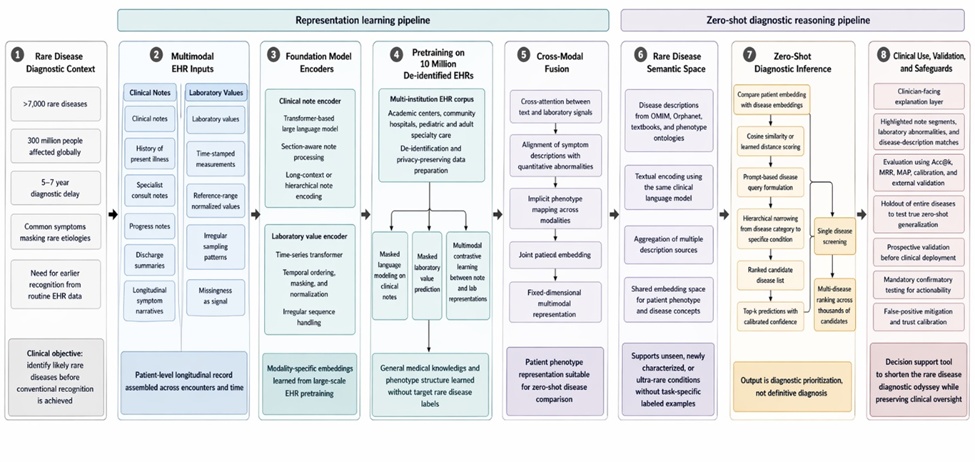
Figure 1. Conceptual architecture of a multimodal foundation model for zero-shot rare disease diagnosis from electronic health records.
The clinical note encoder employs a transformer-based large language model architecture similar to Clinical Camel or GatorTron, initialized from publicly available biomedical language model weights and further pretrained on the target EHR corpus. To handle the long documents typical of longitudinal patient records, the encoder supports context windows of 32,000 tokens or more through sparse attention mechanisms or hierarchical processing that first encodes sections independently before aggregating across the full note history [24, 25]. The encoder incorporates section segmentation to distinguish between history of present illness, past medical history, physical examination, assessment and plan, and other note sections, as each provides different types of diagnostic information that should be weighted differently for rare disease detection [26].
The laboratory value encoder uses a time-series transformer that processes sequences of laboratory measurements with associated timestamps, handling the irregular sampling frequency and variable missing data patterns inherent in real-world EHR data. Each laboratory test is represented by its LOINC code or local identifier, normalized value (converted to common units and adjusted for age- and sex-specific reference ranges when available), and timestamp relative to the index date [19, 20]. Missing data are handled through a masking mechanism that treats absent measurements as informative (e.g., a missing test may indicate the clinician did not suspect a condition) rather than simply imputing mean values, following approaches validated in prior multimodal EHR prediction work [21].
Multimodal fusion is achieved through cross-attention between the note-derived embedding and lab-derived embedding, allowing the model to align textual descriptions of symptoms with laboratory abnormalities that may be their quantitative correlates. The cross-attention mechanism computes attention weights that identify which laboratory values are most relevant to which textual concepts, effectively performing implicit phenotype mapping across modalities without explicit annotation [22, 23]. The fused representation passes through a final projection layer to produce a joint patient embedding of fixed dimensionality (e.g., 768 or 1024 dimensions) that can be compared efficiently to disease description embeddings using cosine similarity or learned distance metrics [24].
The pretraining corpus comprises 10 million de-identified EHRs from multiple healthcare institutions including academic medical centers, community hospitals, pediatric hospitals, and adult specialty clinics to ensure broad demographic and disease representation. All personally identifiable information including names, dates, geographic locations, and medical record numbers are removed using automated de-identification systems with manual validation to ensure patient privacy is protected [25, 26]. The corpus includes all clinical notes (admission notes, progress notes, discharge summaries, consult notes) and laboratory values for each patient, with temporal coverage spanning up to ten years of longitudinal data where available [27].
Three complementary pretraining objectives are optimized jointly: masked language modeling on clinical notes (randomly masking 15% of tokens and training the model to predict them from context), masked laboratory value prediction (randomly masking a subset of laboratory measurements and predicting their values from remaining labs and notes), and multimodal contrastive loss that maximizes agreement between note and lab embeddings from the same patient while minimizing agreement between different patients. The contrastive objective is particularly important for zero-shot rare disease diagnosis, as it forces the model to learn a joint embedding space where textual disease descriptions and patient phenotypes can be directly compared even when the specific disease was not seen during pretraining [28, 29].
For a given patient and a candidate rare disease, the zero-shot classifier computes the probability that the patient has the disease by encoding a natural language prompt of the form "Does this patient have [disease name]?" and comparing the prompt embedding to the patient's joint multimodal embedding using cosine similarity with temperature scaling. The prompt can be enriched with additional context such as "Based on the clinical notes and laboratory values, does this patient have [disease name]?" or can include a brief description of the disease's typical presentation to provide更强的 guidance to the model [12, 14]. The model does not require any training examples of the disease; it relies entirely on the semantic alignment learned during pretraining between patient phenotypes (from notes and labs) and medical concepts (from disease descriptions and prompts) [15].
Disease descriptions are encoded using the same clinical note transformer encoder, ensuring that both patient representations and disease representations exist in a shared semantic space where similarity reflects diagnostic consistency. Descriptions are sourced from authoritative knowledge bases including OMIM (Online Mendelian Inheritance in Man), Orphanet, medical textbooks, and structured disease ontologies such as the Human Phenotype Ontology, which provides standardized phenotypic terms that can be mapped to elements in clinical notes [27, 28]. For diseases with multiple description sources, the framework can aggregate embeddings via averaging or attention-based weighting to capture a comprehensive representation of the disease's clinical spectrum, including typical presentations, atypical variants, and diagnostic criteria [29].
The zero-shot capability is particularly valuable for newly identified rare diseases or recently characterized genetic syndromes, as the framework can generate predictions immediately upon encoding the disease description without waiting for labeled cases to accumulate for supervised training. When a novel rare disease is first described in the literature, clinical teams can input its characteristic features from the publication into the framework and retrospectively query their EHR system to identify potentially undiagnosed patients who match the description [18, 19]. This enables rapid, scalable screening across large patient populations, potentially identifying missed cases years or decades before they would otherwise be recognized through traditional clinical pathways [20].
Distinguishing between phenotypically similar rare diseases presents a particular challenge, as many conditions share overlapping features such as developmental delay, seizure disorders, or specific laboratory abnormalities that are not pathognomonic. The framework addresses this through fine-grained zero-shot classification using hierarchical disease ontologies, first predicting the general disease category (e.g., "mitochondrial disorder") and then computing similarity to specific diseases within that category to identify the most likely diagnosis [16, 21]. For diseases with high phenotypic overlap, the framework can output a ranked list of possibilities with confidence scores, guiding targeted confirmatory testing (e.g., genetic sequencing, enzyme assays, or imaging) rather than providing a single deterministic prediction that might be incorrect [22].
Evaluation of zero-shot rare disease diagnosis requires metrics that capture ranking performance rather than simple accuracy, as the model will typically output multiple candidate diseases from which clinicians must select the correct one. Primary metrics include accuracy at k (Acc@k) for k=1, 5, and 10, measuring whether the correct disease appears among the top k predictions; mean reciprocal rank (MRR), which penalizes correct predictions that are ranked lower; and mean average precision (MAP), which considers the entire ranked list [23, 24]. Where labeled data for rare diseases are available for evaluation purposes (e.g., from specialty clinics or genetic testing registries), supervised baselines trained on common diseases can be compared to the zero-shot model to quantify the performance gap and identify conditions where zero-shot is sufficient versus where fine-tuning would be necessary [25].
Zero-shot probabilities are often miscalibrated, meaning that a predicted probability of 0.8 may not correspond to a true positive rate of 80%, which poses challenges for clinical decision-making where confidence thresholds determine whether to order confirmatory testing or dismiss a prediction. Temperature scaling—a post-hoc calibration method that learns a single temperature parameter on a validation set to rescale logits—can substantially improve calibration without changing the ranking of predictions [26, 27]. For clinical actionability, the framework should output calibrated probabilities with confidence intervals, along with explicit guidance that confirmatory testing is required before making treatment decisions, as even well-calibrated zero-shot predictions have higher error rates than supervised models trained on abundant data [28].
Validation must ensure that evaluation reflects real-world deployment by holding out entire rare diseases from the pretraining data, ensuring that no examples of the target disease—even unlabeled ones—were seen during model training. Cross-disease validation evaluates the framework on a set of rare diseases completely absent from pretraining, measuring zero-shot generalization to truly novel conditions; temporal validation uses data from earlier time periods for pretraining and later periods for evaluation to assess performance drift over time [16, 29]. Additionally, external validation on EHR data from institutions not contributing to pretraining is essential to demonstrate transportability, as note-taking styles, laboratory reference ranges, and patient populations vary substantially across healthcare systems [17].
Annotation bias in pretraining data represents a fundamental limitation, as clinical notes reflect the diagnostic reasoning and documentation practices of the clinicians who wrote them, including potential anchoring bias, confirmation bias, and under-documentation of findings considered non-contributory. Rare diseases remain underrepresented even in large EHR corpora of 10 million patients, meaning the model may have encountered very few examples of the rarest conditions during pretraining, limiting its ability to learn discriminative patterns for those specific diseases [18, 19]. Computational cost is substantial, with transformer-based models of the scale proposed requiring hundreds of GPU-days for pretraining and significant memory for inference, potentially limiting deployment at resource-constrained institutions or for real-time clinical decision support [20].
Zero-shot predictions require prospective validation before clinical use, as current evidence demonstrates that foundation models can produce confidently incorrect predictions, particularly for rare diseases where training data are sparse and disease descriptions may not capture the full phenotypic heterogeneity. False positives could cause significant harm by triggering unnecessary diagnostic procedures, specialist referrals, patient anxiety, or potentially harmful treatments if predictions are overinterpreted by clinicians unfamiliar with the limitations of zero-shot AI [21, 22]. The framework cannot replace clinical expertise, as the final diagnosis of rare diseases typically requires confirmatory testing (genetic, enzymatic, or histopathologic) that considers the patient's entire clinical context, family history, and physical examination findings that may not be fully captured in structured EHR data [23, 24].
Table 2 consolidates the translational logic of the framework by linking each technical module to its expected diagnostic contribution, major risk profile, and required validation or governance response.
Table 2. Translational framework linking technical modules, diagnostic value, evaluation requirements, and safety safeguards in zero-shot rare disease prediction.
Framework domain | Specific design element in the proposed model | Diagnostic value added | Principal risk or limitation | Evaluation or governance requirement |
Clinical text modeling | Section-aware transformer encoding of longitudinal clinical notes | Captures symptom evolution, clinician reasoning, and contextual nuance not available in structured fields | Documentation bias, incomplete notes, and institution-specific writing styles may distort phenotype capture | External validation across institutions and ablation testing of section contributions |
Laboratory trajectory modeling | Time-series transformer for irregular laboratory sequences with masking | Detects subtle quantitative biomarker patterns and temporal abnormalities | Missingness may reflect workflow rather than biology; normalization errors may introduce bias | Robustness testing across reference ranges, sampling frequencies, and missingness regimes |
Multimodal fusion | Cross-attention alignment between note and lab embeddings | Links narrative symptoms to measurable abnormalities, strengthening phenotype coherence | Spurious cross-modal associations may appear clinically plausible but be incorrect | Attention auditing, clinician review of exemplar matches, and modality ablation analysis |
Pretraining corpus scale | 10 million de-identified EHRs from diverse institutions | Expands medical knowledge breadth and increases transfer potential to unseen diseases | Rarest conditions may still remain weakly represented; corpus composition may encode systemic bias | Dataset characterization, subgroup analysis, and documentation of institutional composition |
Privacy protection | De-identification and secure handling of large EHR corpora | Enables large-scale model development within healthcare governance constraints | Residual privacy leakage and variable de-identification quality remain concerns | Formal privacy review, de-identification validation, and institutional oversight |
Shared embedding space | Common semantic space for patient phenotypes and disease descriptions | Makes zero-shot comparison between patients and unseen diseases possible | Semantic proximity may not equal true diagnostic specificity | Disease-holdout validation and comparison against clinically adjacent disorders |
Disease knowledge encoding | Use of OMIM, Orphanet, textbooks, and phenotype ontologies | Provides an external semantic bridge for diseases lacking labeled EHR cohorts | Source descriptions may be incomplete, inconsistent, or overly canonical relative to real-world heterogeneity | Source harmonization, ontology mapping review, and sensitivity analysis across description sources |
Prompt-based zero-shot scoring | Natural-language disease queries and similarity-based scoring | Enables flexible screening of one disease or many without retraining | Prompt wording and disease description phrasing can influence scores | Prompt sensitivity testing and standardized inference templates |
Hierarchical disease ranking | Category-first then disease-specific ranking among similar conditions | Improves discrimination where phenotypic overlap is high | Closely related syndromes may still be poorly separated | Evaluation within disease families and top-k ranking analysis |
Probability calibration | Temperature scaling and calibrated confidence outputs | Improves thresholding for confirmatory testing and clinical triage | Miscalibration can still create overconfidence in rare settings | Calibration curves, decision-threshold analysis, and prospective recalibration monitoring |
Explainability layer | Surfacing matched notes, lab abnormalities, and disease-description elements | Supports clinician trust and permits contestability of predictions | Explanations may appear persuasive without being causally valid | Human factors testing and specialist review of explanation usefulness |
Clinical workflow integration | Ranked suggestions followed by confirmatory testing rather than autonomous diagnosis | Reduces diagnostic search burden while preserving specialist oversight | Overreliance could trigger unnecessary referrals or investigations | Explicit clinical-use policy, decision support framing, and mandatory confirmation protocols |
Prospective deployment | Real-world implementation across health systems | Tests whether the model truly shortens the diagnostic odyssey | Performance drift, workflow disruption, and uneven transportability may emerge post-deployment | Temporal validation, silent-mode trials, and prospective multicenter studies |
This article has presented a conceptual framework for a multimodal foundation model pretrained on 10 million de-identified electronic health records combining clinical notes and laboratory values to enable zero-shot diagnosis of rare diseases. The framework leverages recent advances in large language models for biomedical text, time-series transformers for laboratory data, and multimodal fusion to learn joint patient representations that can be compared directly to textual disease descriptions without requiring labeled training examples for target conditions.
The key advantages of this approach include eliminating the need for labeled rare disease datasets that are practically impossible to assemble, leveraging the vast quantities of existing EHR data already collected in healthcare systems, and scaling to thousands of rare diseases with a single pretrained model. For novel or newly characterized rare diseases, the framework can generate predictions immediately upon encoding the disease description from the literature, enabling retrospective screening of large patient populations to identify potentially undiagnosed cases.
Several limitations must be addressed before clinical deployment, including the need for rigorous prospective validation of zero-shot predictions, mitigation of false positives through calibrated confidence thresholds and mandatory confirmatory testing, and demonstration of clinical utility in real-world settings where documentation practices vary widely. Computational costs and infrastructure requirements for pretraining and deploying models at scale also present implementation challenges, particularly for resource-limited healthcare systems.
We call for implementation of this framework on large-scale EHR systems across diverse healthcare institutions, followed by prospective evaluation in clinical settings where zero-shot predictions can be compared to traditional diagnostic pathways. Collaborative efforts between AI researchers, clinical geneticists, rare disease advocacy groups, and health systems will be essential to translate this conceptual framework into a practical tool that reduces the diagnostic odyssey for the millions of patients living with undiagnosed rare diseases worldwide.
None
None
None
None
Open Access The author(s) retain copyright. This article is licensed under the Creative Commons Attribution-NonCommercial-ShareAlike 4.0 International License. It may be shared and adapted for non-commercial purposes with appropriate attribution, an indication of changes, and distribution of adaptations under the same license. Third-party material may be subject to separate terms identified in its credit line. View the license at https://creativecommons.org/licenses/by-nc-sa/4.0/.
 Clinical Intelligence Research Press