Critical care systems increasingly integrate artificial intelligence (AI) to enhance mortality risk assessment, yet the absence of robust oversight mechanisms poses significant challenges to clinical reliability and ethical deployment. This conceptual manuscript proposes the mortality risk intelligence oversight (MRIO) Model, a theoretical architecture designed to orchestrate AI-driven risk intelligence within intensive care unit (ICU) environments. Drawing from clinical AI system architectures, healthcare analytics infrastructures, and decision support pipelines, the model emphasizes layered oversight for real-time mortality prediction, incorporating interoperability frameworks and governance protocols to mitigate biases and drift. The architecture features a unique tripartite structure: a foundational risk ingestion layer, an adaptive intelligence core, and a vigilant oversight envelope, interconnected via bidirectional feedback topologies that facilitate dynamic recalibration. Theoretical formulas capture risk propagation dynamics, oversight burden, and decision confidence thresholds, but they do not address infrastructural sensitivities without empirical validation. By synthesizing recent literature on EHR intelligence ecosystems and AI monitoring systems, this work explores how the MRIO Model could, in theory, redistribute human-AI workflows, enhance clinical workflow integration, and address governance dependencies in critical care. The discussion underscores the need for such models to foster trustworthy AI deployment and advocates future conceptual refinements in federated healthcare settings. Ultimately, the MRIO Model offers a blueprint for intelligence oversight that prioritizes patient safety and systemic resilience in mortality risk analytics.
The integration of artificial intelligence into critical care systems represents a pivotal shift in how healthcare providers manage mortality risks, demanding sophisticated oversight to ensure alignment with clinical imperatives. In ICU settings, where patient outcomes hinge on timely and accurate risk assessments, AI models process vast streams of electronic health record (EHR) data to forecast deterioration trajectories. However, without structured oversight of intelligence, these systems risk amplifying uncertainties, such as algorithmic biases or data inconsistencies, thereby undermining trust in decision-making processes. This manuscript conceptualizes a mortality risk intelligence oversight model (MRIO) tailored for critical care, focusing on architectural designs that embed monitoring and governance directly into the risk intelligence pipeline. By theorizing an oversight topology that interconnects AI analytics with clinical workflows, the model aims to enhance systemic coherence, drawing from established frameworks in healthcare informatics without relying on empirical datasets or performance benchmarks.
Mortality risks in critical care are multifaceted, influenced by physiological variables, timing of interventions, and environmental factors in the ICU. Traditional scoring systems, while foundational, often lack the granularity needed for personalized predictions, prompting the adoption of AI-enhanced intelligence ecosystems [1, 2]. These ecosystems leverage high-frequency EHR data to model risk trajectories, yet they introduce complexities in data interoperability and real-time processing. In conceptual terms, mortality risk can be viewed as a probabilistic continuum, where oversight mechanisms must continuously calibrate AI outputs against clinical ground truths. The MRIO Model addresses this by proposing an infrastructure that, in theory, filters noise from multimodal data sources, ensuring that risk intelligence remains attuned to ICU-specific constraints such as resource scarcity and high-stakes decision latency.
Oversight in AI-driven mortality risk systems extends beyond mere monitoring to encompass ethical governance and adaptive learning loops. The literature highlights the need for architectures that integrate decision-support pipelines with human oversight to mitigate the risks of over-reliance on automated predictions [3, 4]. In critical care, where mortality events are time-sensitive, oversight must theoretically encompass drift detection and bias auditing, embedded within the system’s core. The MRIO Model conceptualizes this as a vigilant envelope surrounding the intelligence core, facilitating seamless integration with existing EHR ecosystems. This approach reduces clinicians’ cognitive load by providing interpretable risk alerts aligned with governance standards that prioritize patient-centered outcomes.
Critical care ecosystems generate a dense constellation of heterogeneous data modalities, including high-frequency physiological waveforms (e.g., arterial pressure traces), intermittently charted vital signs, laboratory panels, ventilator parameters, medication infusion logs, radiologic imaging, bedside device telemetry, and increasingly, unstructured clinical narratives. These modalities differ not only in format and structure but also in temporal granularity, semantic encoding, and signal-to-noise ratios. As a result, AI-driven mortality risk intelligence systems must confront a multi-dimensional interoperability problem that extends beyond simple data aggregation.
From a theoretical systems perspective, interoperability challenges emerge at three interlocking layers: syntactic, semantic, and temporal. Syntactic misalignment arises from divergent data formats across electronic health record (EHR) vendors and device manufacturers. Semantic fragmentation stems from inconsistent terminologies, ontologies, and coding schemas, which may obscure clinically meaningful equivalences across institutions. Temporal heterogeneity further complicates integration, as continuous waveform streams coexist with sparse laboratory measurements and episodic imaging events. Conceptual frameworks emphasize standardized exchange protocols and ontology alignment infrastructures to harmonize these disparate sources into a coherent intelligence fabric [5, 6].
Absent such harmonization, mortality prediction models risk operating on fragmented or partially coherent representations of the patient state. This fragmentation may amplify epistemic uncertainty, particularly in high-acuity settings where rapid physiological transitions require synchronized interpretation of multimodal signals. A laboratory abnormality interpreted without a concurrent hemodynamic context, for example, may distort risk inference. Consequently, mortality predictions derived from siloed data streams may suffer from representational blind spots, leading to attenuated calibration and diminished clinician trust.
The MRIO model proposes a modular ingestion layer that abstracts heterogeneous modalities into a unified risk vector space. Rather than treating each modality as an independent predictive channel, the ingestion layer normalizes modality inputs, reconciles semantics, and aligns temporal data before risk synthesis. Conceptually, this abstraction process transforms raw inputs into a standardized, governance-aware representation that preserves modality provenance while enabling cross-modal coherence. Governance protocols embedded within this ingestion layer enforce data fidelity checks, lineage tracking, and anomaly detection, thereby reducing the propagation of corrupted or contextually ambiguous signals.
This architectural stance draws from analytics infrastructures that prioritize semantic interoperability and modular scalability. By decoupling modality ingestion from downstream risk orchestration, the MRIO framework theoretically supports extensibility across federated ICU networks, where institutional data ecosystems may differ substantially. In such federated contexts, local ingestion nodes standardize inputs into the unified risk vector space before transmitting governance-compliant representations to higher-level orchestration layers. Through this abstraction mechanism, the MRIO Model addresses modality heterogeneity not as a peripheral technical inconvenience but as a foundational architectural constraint that shapes the design of mortality risk intelligence.
Intensive care unit environments exhibit pronounced infrastructural heterogeneity, encompassing disparities in computational hardware, network bandwidth, bedside device integration, cybersecurity policies, and regulatory obligations. Such variability directly influences the feasibility, latency, and reliability of AI-enabled mortality oversight systems. Conceptual models of intelligence governance must therefore incorporate deployment-aware resilience principles rather than assuming uniform infrastructural conditions [7, 8].
In resource-rich academic ICUs, high-throughput analytics engines may run on dedicated servers that stream near-real-time data. In contrast, community or rural ICUs may rely on legacy EHR systems, intermittent data synchronization, and constrained computational capacity. These disparities introduce environmental constraints that shape model update frequencies, feedback latency, and oversight granularity. Mortality risk intelligence architectures that are overly centralized or computationally intensive risk excluding lower-resource environments from equitable participation in advanced oversight infrastructures.
Beyond hardware variability, regulatory landscapes further complicate deployment. Jurisdictional differences in data protection mandates, audit requirements, and clinical liability standards affect how mortality risk outputs may be generated, transmitted, and operationalized. Oversight systems must therefore accommodate policy envelopes that vary across institutions and regions, embedding compliance logic into their operational topology.
The MRIO Model conceptualizes a deployment-adaptive topology that integrates environmental sensing into its oversight layer. Rather than assuming stable infrastructure conditions, the model incorporates feedback mechanisms that recalibrate risk synthesis in response to environmental perturbations. For instance, staffing fluctuations, device outages, or network instability may temporarily degrade data completeness. In such scenarios, the oversight layer theoretically adjusts confidence weighting, flags degraded signal integrity, and modulates alert thresholds to prevent overinterpretation of incomplete datasets.
This adaptive capacity extends beyond algorithmic recalibration to workflow orchestration. Mortality risk outputs must align with institutional escalation pathways, rapid response protocols, and documentation standards. The MRIO framework, therefore, integrates workflow-aware mediation nodes that translate predictive outputs into context-sensitive clinical recommendations. By embedding environmental adaptability into its architecture, the model aspires to maintain functional continuity across heterogeneous ICU ecosystems without compromising oversight integrity.
Governance within AI-enabled mortality risk systems encompasses ethical accountability, legal compliance, operational transparency, and the preservation of human authority. In critical care contexts—where mortality predictions may influence life-sustaining interventions—governance constraints are not peripheral safeguards but structural determinants of architectural legitimacy [9, 10].
Ethically, mortality risk intelligence must mitigate biases related to age, socioeconomic status, race, and the representation of comorbidities. Legal considerations require traceable audit trails documenting how risk scores were generated, modified, and communicated. Operationally, transparency mechanisms must clarify the interpretive boundaries of predictive outputs, preventing automation bias or overreliance on algorithmic recommendations.
Conceptual oversight models, therefore, embed governance as an architectural stratum rather than an exogenous policy layer. The MRIO Model positions governance as a foundational pillar that permeates all system layers—from ingestion and risk synthesis to output dissemination. Audit protocols track data lineage, model versioning, parameter updates, and threshold recalibrations. Stakeholder oversight committees may interface with governance dashboards that visualize system behavior, drift patterns, and alert distributions.
Importantly, governance mechanisms must reconcile the tension between AI autonomy and clinical authority. While algorithmic systems may autonomously generate risk stratifications, final decision-making authority resides with clinicians. The MRIO Model conceptualizes “accountability propagation pathways” through which every risk output remains tethered to identifiable decision checkpoints and human validation nodes. This propagation ensures that oversight does not collapse into diffuse responsibility, thereby preserving institutional trust.
By integrating governance scalars into its architecture—such as audit frequency coefficients, drift sensitivity parameters, and escalation transparency indices—the MRIO framework formalizes accountability as an operational variable rather than an abstract ethical aspiration. In doing so, it theorizes a mortality oversight system capable of sustaining both predictive intelligence and normative legitimacy.
Mortality risk profiles vary substantially across clinical settings. Surgical ICUs manage perioperative complications and hemodynamic instability; medical ICUs confront sepsis, multi-organ failure, and chronic disease exacerbations; pediatric ICUs address developmental physiology and rare congenital conditions. Each context presents distinct baseline mortality distributions, intervention thresholds, and workflow rhythms [11, 12]. Consequently, a one-size-fits-all oversight architecture risks misalignment with local clinical realities.
Conceptual alignment requires adaptive modulation of risk thresholds, interpretive framing, and alert cadence. For example, acceptable baseline mortality risk in a transplant ICU may differ markedly from that in a step-down critical care unit. Oversight systems must therefore contextualize predictions within setting-specific risk ecologies. Failure to do so may generate excessive false positives in low-risk environments or insufficient sensitivity in high-risk ones.
The MRIO Model addresses this alignment challenge through adaptive topologies that incorporate contextual calibration layers. These layers integrate cohort descriptors, institutional protocols, and historical outcome distributions into threshold-setting mechanisms. Rather than statically defining high-risk cutoffs, the model proposes dynamic recalibration loops that adjust risk boundaries based on clinical setting and temporal trends.
Furthermore, alignment extends to workflow integration. Mortality risk alerts must align with existing multidisciplinary rounds, rapid-response team triggers, and documentation practices. Oversight that disrupts established communication pathways may generate resistance or alert fatigue. The MRIO framework, therefore, emphasizes workflow-concordant deployment, embedding risk outputs within clinician-facing interfaces already integral to daily practice.
In aggregate, clinical setting alignment transforms mortality oversight from a generic predictive function into a contextually embedded intelligence scaffold. By tailoring its architecture to the nuanced contours of diverse ICU environments, the MRIO Model aspires to enhance rather than destabilize established care ecosystems.
The theoretical underpinnings of mortality risk intelligence oversight in critical care systems are rooted in the convergence of AI architectures, healthcare analytics, and governance frameworks. This synthesis draws on peer-reviewed works published between 2017 and 2022, emphasizing conceptual models for clinical decision support, EHR integration, and system monitoring, but without empirical evaluations. By examining these domains, we lay the foundation for the MRIO Model and highlight architectural motifs that inform oversight topologies.
Recent advancements in clinical AI system architectures have focused on dynamic prediction models for ICU mortality, theorizing structures that incorporate high-frequency data streams from EHRs [1]. These architectures conceptualize mortality as a temporal process, where intelligence layers process sequential inputs to generate risk profiles. Complementary works explore healthcare analytics infrastructures, proposing federated designs that enable cross-institutional data sharing while preserving privacy [13]. Such infrastructures theorize scalable pipelines for risk aggregation, essential for oversight in distributed critical care networks.
EHR intelligence ecosystems form a core theoretical pillar, with models advocating for semantic interoperability to unify disparate data modalities [5]. The literature synthesizes frameworks in which EHR data fuels decision-support pipelines, conceptualizing oversight as an embedded audit layer to detect anomalies in risk computations [14]. This aligns with governance and monitoring systems, where theoretical protocols emphasize continuous validation of AI outputs against clinical heuristics [9]. For instance, conceptual architectures outline monitoring dashboards that, in theory, track drift in mortality predictions and integrate human feedback loops to refine intelligence [15].
Decision support pipelines in critical care are conceptualized as multi-stage processes, from data ingestion to actionable insights, with oversight to ensure alignment with ethical standards [3]. Synthesis reveals a trend toward hybrid human-AI topologies, where intelligence oversight redistributes decision burdens [16]. Interoperability and data exchange frameworks further enrich this background, proposing standards such as FHIR for seamless integration into mortality risk systems [17]. These frameworks theorize reduced latency in risk dissemination, crucial for ICU workflows.
Clinical workflow integration models provide additional theoretical depth, conceptualizing AI as an augmentative tool within care pathways [18]. Literature highlights architectures that embed oversight into workflows, theorizing improved coherence in mortality risk communication [19]. This synthesis underscores the need for unique layer structures in oversight models, rather than generic hierarchies, in favor of domain-specific topologies.
Building on these, AI governance systems theorize accountability mechanisms, such as bias mitigation protocols integrated into risk intelligence [20]. Monitoring deployment systems extends this to lifecycle management, conceptualizing oversight as a perpetual process [21]. The synthesis reveals gaps in current theories, particularly in feedback topologies for critical care, where bidirectional loops could, in theory, enhance resilience.
In aggregating these perspectives, the literature converges on the imperative for oversight architectures that are theoretically robust, interoperable, and workflow-aligned. In critical care, this means conceptualizing models that layer intelligence with governance, ensuring systemic integrity without making empirical claims [22]. Theoretical formulas from related work inspire interpretive equations, such as those that model risk confidence as a function of data quality and oversight intensity.
This background synthesizes how clinical AI architectures evolve toward oversight-centric designs, setting the stage for the MRIO Model’s unique contributions [23, 24]. By theorizing layered structures with adaptive feedback, the model addresses infrastructural sensitivities highlighted in the literature [25, 26]. Ultimately, this synthesis advocates for conceptual innovations that prioritize governance in intelligence ecosystems, fostering theoretical advancements in critical care systems [27, 28].
The mortality risk intelligence oversight (MRIO) model proposes a novel oversight infrastructure topology designed to govern AI-driven mortality risk analytics in critical care systems. This conceptual architecture features a tripartite layer structure: the risk ingestion substrate (RIS), the adaptive intelligence nucleus (AIN), and the vigilant oversight envelope (VOE). Unlike traditional linear pipelines, the MRIO employs a helical feedback topology, where bidirectional channels spiral between layers to enable dynamic recalibration of risk intelligence.
The RIS layer abstracts multimodal ICU data—vital signs, labs, and interventions—into a cohesive risk vector, facilitated by interoperability protocols [5, 17]. This substrate conceptualizes preprocessing without empirical filtering, emphasizing theoretical harmonization to feed the AIN.
The AIN serves as the core, theorizing probabilistic modeling of mortality trajectories through AI heuristics [1, 3]. It conceptualizes adaptive computations that modulate risk outputs based on contextual inputs, integrated with decision support frameworks [14, 18].
Encapsulating these is the VOE, a governance layer that theorizes continuous monitoring for biases and drift, propagating alerts via workflow orchestration [9, 20]. The helical topology posits iterative feedback, in which VOE insights refine RIS inputs and AIN parameters, thereby enhancing systemic resilience [15, 21]. The tripartite MRIO oversight topology, organized around a helical intelligence-governance feedback structure, is illustrated in Figure 1.
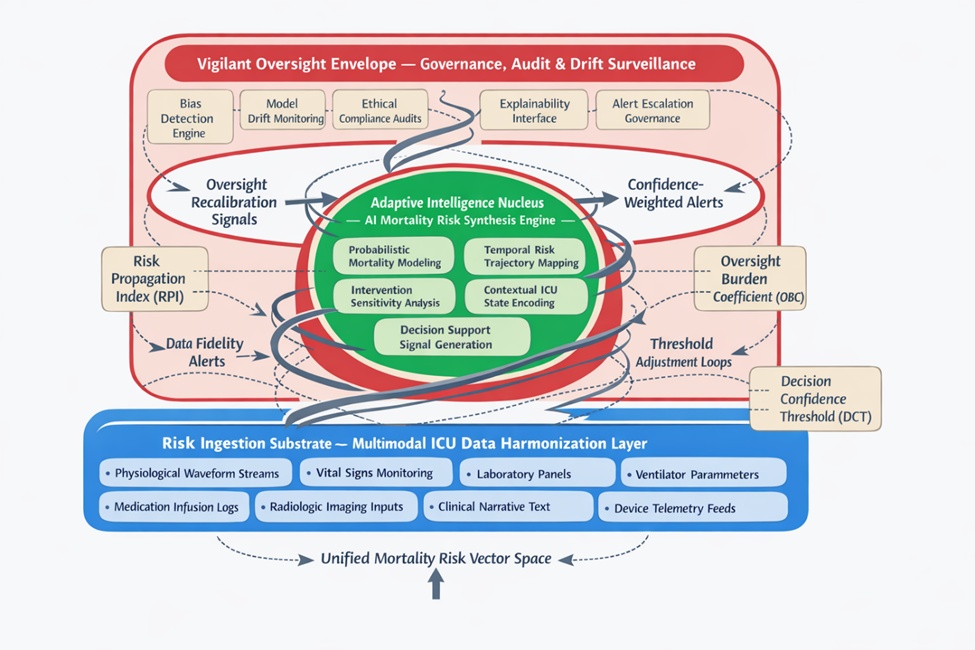
Figure 1. Mortality risk intelligence oversight (MRIO) model: tripartite governance architecture with helical feedback topology.
Figure 1 depicts the conceptual oversight infrastructure governing AI-driven mortality risk intelligence in critical care systems. The architecture comprises three vertically integrated strata: the risk ingestion substrate (RIS), which harmonizes heterogeneous ICU data into a unified risk vector space; the adaptive intelligence nucleus (AIN), which synthesizes probabilistic mortality trajectories; and the vigilant oversight envelope (VOE), which enforces governance through bias auditing, drift monitoring, and compliance validation. Spiraling bidirectional feedback channels form a helical topology enabling continuous recalibration of intelligence outputs. Governance annotation panels highlight interpretive system formulas, including the risk propagation index, oversight burden coefficient, and decision confidence threshold.
To interpret key dynamics, consider the following conceptual formulas:
Risk propagation index (RPI):
Oversight burden coefficient (OBC):
Decision confidence threshold (DCT):
This topology theorizes enhanced integration in critical care, addressing gaps in the literature on governance-embedded architectures [22, 25].
The implementation of the mortality risk intelligence oversight (MRIO) Model in critical care systems introduces a range of governance dependencies that shape the dynamics of risk intelligence. These dependencies arise from the interplay between architectural layers, clinical imperatives, and external regulatory frameworks, theoretically influencing how mortality predictions are generated, monitored, and acted upon. By examining these through a conceptual lens, we can elucidate potential shifts in system behaviors, highlighting sensitivities that could affect overall efficacy in ICU environments.
At the core of these dynamics is the dependency on data governance protocols within the Risk Ingestion Substrate (RIS). Theoretical models suggest that interoperability standards, such as those for EHR data exchange, create dependencies on institutional compliance levels [5, 17]. If governance lapses occur—such as inconsistent data formatting or privacy breaches—the RIS could theoretically propagate errors upward, amplifying uncertainties in mortality risk vectors. This dependency underscores the need for robust audit mechanisms, where oversight intensity modulates data fidelity, as captured in the risk propagation index (RPI) formula. In high-volume ICUs, this could manifest as heightened sensitivities to data volume fluctuations, theoretically requiring adaptive governance to maintain intelligence coherence.
Moving to the adaptive intelligence nucleus (AIN), governance dependencies emerge in the realm of algorithmic accountability. The literature on AI monitoring systems argues that reliance on explainability frameworks is critical for validating mortality predictions [9, 20]. The MRIO model conceptualizes this through helical feedback, in which governance protocols set recalibration thresholds. For instance, dependencies on ethical guidelines could theoretically constrain AIN autonomy, balancing predictive aggressiveness with conservative risk thresholds. This dynamic is interpreted through the decision confidence threshold (DCT) formula, which posits that increased feedback frequency from governance layers enhances confidence but introduces computational overhead. In critical care, such dependencies might redistribute decision latencies, with stricter governance prolonging processing but reducing false positives in mortality alerts.
The vigilant oversight envelope (VOE) embodies the pinnacle of these dependencies, theorizing a meta-layer that integrates external governance inputs, such as regulatory audits and institutional policies [24, 25]. Dependencies here include human-AI interaction protocols, in which clinician oversight feeds into system adjustments [16, 18]. Theoretically, this creates a dependency loop: governance stringency influences oversight burden, as modeled by the oversight burden coefficient (OBC), potentially shifting cognitive loads from AI to human operators in resource-constrained ICUs. Sensitivities to governance variability—such as differing international standards—could, in theory, fragment risk intelligence across federated systems, necessitating harmonized dependencies for seamless deployment.
Broader system dynamics reveal infrastructure sensitivities tied to these governance elements. For example, in interoperability-challenged environments, dependencies on data exchange frameworks could exacerbate risk propagation if governance fails to enforce standardization [6, 13]. Conceptual analysis indicates that such dynamics might lead to emergent behaviors, such as oscillatory risk assessments during peak ICU loads, which are stabilized by governance interventions. Moreover, adoption dynamics in clinical settings depend on governance maturity; theoretical workflows suggest that mature governance reduces resistance to MRIO integration, fostering hybrid decision-making [11, 22].
Human-AI workflow shifts represent another facet of these dynamics. Governance dependencies theoretically mandate interpretable outputs from the AIN, altering clinician engagement [3, 15]. In mortality risk scenarios, this could mean reliance on training protocols, with governance ensuring AI literacy among staff, thereby theoretically optimizing oversight efficiency. However, over-dependence on governance could introduce bottlenecks, as per OBC interpretations, where complex intelligence demands disproportionate monitoring resources.
Decision latency trade-offs further illuminate these dependencies. Critical care demands rapid responses, yet governance layers impose theoretical delays for validation [7, 21]. The MRIO’s helical topology mitigates this by parallelizing feedback, but dependencies on computational infrastructure could amplify latencies in under-resourced ICUs. Conceptual formulas like DCT highlight how governance-tuned feedback enhances reliability at the cost of speed, a dynamic that must be balanced for life-critical applications.
Overall, these governance dependencies in the MRIO Model’s dynamics emphasize a theoretical equilibrium: robust governance fortifies risk intelligence but introduces sensitivities that require careful orchestration. By addressing these, the model conceptualizes resilient critical care systems in which dependencies evolve into strengths through iterative refinement [26, 28].
The conceptual framework of the mortality risk intelligence oversight (MRIO) Model offers profound insights into the orchestration of AI in critical care mortality risk systems, bridging theoretical gaps in governance and architecture. By synthesizing literature on clinical AI and healthcare analytics, this discussion expands on the model’s implications, exploring multifaceted dimensions such as ethical considerations, scalability challenges, interoperability synergies, workflow transformations, and future theoretical trajectories.
Ethically, the MRIO Model theorizes a paradigm where oversight envelopes safeguard against biases inherent in mortality predictions [9, 20]. In ICU contexts, where demographic disparities in data could skew risks, the VOE’s governance dependencies theoretically enforce fairness audits, aligning with broader AI ethics discourses. This extends to patient autonomy, conceptualizing informed consent mechanisms embedded in workflows, where risk intelligence disclosures are governed transparently [24]. However, ethical tensions arise from dependencies on human judgment; if clinicians override AI outputs, theoretical feedback loops could inadvertently reinforce biases, necessitating refined governance protocols. The functional stratification and governance responsibilities embedded within the MRIO architecture are summarized in Table 1.
Table 1. Layered functional architecture of the MRIO oversight model
MRIO layer | Core function | Intelligence role | Governance role | ICU workflow impact |
Risk ingestion substrate (RIS) | Multimodal data harmonization | Aggregates physiological, clinical, and device data into unified risk vectors | Data lineage tracking, modality validation, anomaly screening | Enhances data completeness for mortality modeling |
Adaptive intelligence nucleus (AIN) | Mortality risk synthesis | Generates probabilistic risk trajectories and predictive alerts | Explainability enforcement, recalibration triggers | Augments clinician decision support |
Vigilant oversight envelope (VOE) | Intelligence governance | Monitors model outputs, drift, and bias propagation | Ethical audits, compliance validation, escalation control | Safeguards clinical trust and regulatory adherence |
Helical feedback channels | Cross-layer recalibration | Enables adaptive intelligence refinement | Propagates governance corrections | Reduces predictive volatility |
Scalability represents a critical discussion point, as critical care systems vary from small units to large networks. The MRIO’s tripartite structure theorizes modular expansion, where RIS adapts to increasing data volumes without empirical bottlenecks [1, 13]. Yet, governance dependencies scale nonlinearly; in federated environments, theoretical harmonization of standards across institutions could mitigate fragmentation, but sensitivities to regulatory variances pose challenges [25]. Discussion here underscores the need for conceptual extensions, such as distributed helices for multi-site ICUs, to enhance resilience across diverse deployment scenarios.
Interoperability synergies within the MRIO Model amplify its theoretical utility. Drawing on data exchange frameworks, the architecture conceptualizes seamless EHR integration, in which RIS harmonizes modalities to fuel AIN [5, 17]. This synergy theoretically reduces silos in mortality risk analytics, fostering ecosystem-wide intelligence. However, discussion reveals potential pitfalls: over-reliance on standards such as FHIR could create dependencies that are vulnerable to change, and outdated governance can erode interoperability. Future conceptualizations might incorporate adaptive synergies that evolve with technological advancements.
Workflow transformations induced by the MRIO are expansive, theorizing a redistribution of roles in critical care [3, 18]. Clinicians, traditionally burdened with manual risk assessments, could theoretically delegate to AIN while focusing on interpretive oversight via VOE. This shift, modeled by OBC, reduces cognitive load but introduces new dynamics, such as skill atrophy from AI dependence. In high-stakes ICUs, these transformations demand governance-tuned training to ensure that human-AI symbiosis enhances outcomes without diminishing expertise [15, 22].
Theoretical formulas embedded in the model—RPI, OBC, and DCT—facilitate deeper discussion of system behaviors. RPI theorizes about the propagation risks in ungoverned scenarios, prompting discussions of preemptive governance to curb amplification [6, 14]. OBC expands on resource trade-offs, highlighting optimizations through layered efficiencies that could inform conceptual designs for resource-scarce settings. DCT, meanwhile, addresses confidence calibration, proposes thresholds aligned with clinical tolerances, and mitigates overconfidence in mortality forecasts [4, 16].
Broader implications for AI governance in healthcare emerge from this model. Literature synthesis reveals a shift toward proactive oversight, where MRIO-like architectures could standardize practices [23, 27]. Discussion extends to policy levels, theorizing integrations with regulatory bodies to enforce model adoptions, addressing gaps in current deployment systems [10, 21]. Challenges in adoption dynamics, such as resistance from legacy systems, warrant conceptual mitigations, such as phased integrations. Governance dependencies shaping mortality risk intelligence dynamics across ICU ecosystems are outlined in Table 2.
Table 2. Governance dependency dynamics in MRIO mortality risk intelligence systems
Governance dependency domain | Architectural anchor | Theoretical sensitivity | Operational risk if unregulated | Oversight mitigation mechanism |
Data interoperability compliance | RIS | Semantic and syntactic misalignment | Fragmented mortality predictions | Standardization audits, ontology mapping |
Algorithmic accountability | AIN | Explainability deficits | Clinician distrust, automation bias | Transparency dashboards, validation loops |
Drift and bias surveillance | VOE | Temporal model instability | Risk miscalibration | Continuous monitoring and recalibration |
Regulatory policy alignment | VOE | Jurisdictional variability | Legal exposure, deployment delays | Compliance mapping modules |
Human-AI authority balance | AIN ↔ VOE | Decision delegation ambiguity | Responsibility diffusion | Accountability propagation pathways |
Infrastructure variability | RIS ↔ VOE | Deployment heterogeneity | Signal latency, incomplete analytics | Environment-adaptive oversight tuning |
Limitations of this conceptual approach merit discussion: without empirical validation, the model’s dynamics remain interpretive, potentially overlooking real-world variabilities [8, 19]. Future work could hybridize with simulation frameworks, expanding on helical topologies to address nuanced risk scenarios. Moreover, cross-disciplinary synergies with fields such as bioinformatics could enrich the model and inform extensions to non-ICU critical care [12, 28].
In summary, the MRIO Model’s discussion illuminates a transformative vision for mortality risk intelligence, where governance dependencies drive ethical, scalable, and synergistic advancements in critical care systems.
In conceptualizing the mortality risk intelligence oversight (MRIO) model, this manuscript advances a theoretical blueprint for embedding oversight into AI-driven mortality risk systems within critical care. By integrating layered architectures with helical feedback topologies, the model addresses key deficiencies in current clinical AI frameworks, emphasizing governance as a cornerstone for reliable intelligence. The tripartite structure—RIS, AIN, and VOE—alongside interpretive formulas such as RPI, OBC, and DCT, provides a robust conceptual foundation for mitigating risks in ICU environments, fostering systemic resilience without resorting to empirical assertions.
Expanding on the model’s potential, it theorizes profound shifts in healthcare analytics, where interoperability and workflow integration converge to enhance decision support. Governance dependencies, as dissected, reveal dynamics that could, in theory, optimize resource allocation and reduce decision latencies, aligning AI with clinical imperatives. This oversight-centric approach not only conceptualizes bias mitigation and drift detection but also envisions scalable deployments across heterogeneous critical care settings, thereby bridging gaps in the literature on monitoring and ethics.
Ultimately, the MRIO Model advocates a paradigm in which intelligence oversight becomes intrinsic to mortality risk analytics, thereby promoting trustworthy AI in life-critical domains. Future conceptual refinements could explore extensions to emerging modalities, such as wearable integrations or real-time genomics, further solidifying its role in evolving healthcare infrastructures. By prioritizing theoretical innovation, this work contributes to the discourse on AI governance, urging stakeholders to adopt oversight models that safeguard patient outcomes in an increasingly intelligent critical care landscape.
None
None
None
None
Open Access The author(s) retain copyright. This article is licensed under the Creative Commons Attribution-NonCommercial-ShareAlike 4.0 International License. It may be shared and adapted for non-commercial purposes with appropriate attribution, an indication of changes, and distribution of adaptations under the same license. Third-party material may be subject to separate terms identified in its credit line. View the license at https://creativecommons.org/licenses/by-nc-sa/4.0/.
 Clinical Intelligence Research Press