The rapid evolution of artificial intelligence (AI) in healthcare necessitates robust frameworks to manage cross-institutional analytics while preserving data privacy and governance integrity. This conceptual systems research article proposes the federated analytics governance lattice (FAGL), a novel architecture that orchestrates intelligence across distributed healthcare institutions. FAGL integrates federated learning principles with governance mechanisms to facilitate secure, collaborative analytics without centralized data aggregation. The framework delineates layers for data sovereignty enforcement, intelligence orchestration, and compliance monitoring, incorporating feedback topologies for adaptive governance. Theoretical analysis explores risk-propagation models, decision-confidence formulations, and governance-load estimations to underscore the system’s theoretical underpinnings. By synthesizing literature on clinical AI architectures, interoperability frameworks, and decision-support pipelines, this work highlights how FAGL addresses challenges in EHR intelligence ecosystems and in workflow integration. The architecture emphasizes theoretical constructs to mitigate biases, ensure ethical AI deployment, and optimize cross-institutional synergies. Ultimately, FAGL offers a blueprint for scalable, privacy-preserving healthcare analytics that fosters innovation in multi-site clinical environments. This study contributes to the discourse on AI governance by providing a unique lattice-based topology that balances autonomy with collective intelligence, paving the way for future theoretical explorations in federated healthcare systems.
Cross-institutional healthcare analytics face profound systemic barriers rooted in structural fragmentation, regulatory asymmetry, and infrastructural incompatibility. In contemporary care ecosystems, electronic health records (EHRs) are distributed across hospitals, outpatient clinics, specialty centers, insurance repositories, and research institutions—each governed by distinct data architectures, access controls, and compliance protocols. The resulting landscape is not a unified intelligence grid but a constellation of semi-isolated data enclaves. Achieving cohesive analytics within such an environment requires navigating privacy regimes such as HIPAA in the United States and GDPR in the European Union, both of which impose stringent constraints on the transfer of identifiable data, cross-border processing, and the secondary use of clinical information [1, 2].
These regulatory safeguards, while ethically indispensable, introduce latency and segmentation into analytical pipelines. Institutions are often unable to participate in shared predictive modeling initiatives because pooling raw datasets risks legal exposure, consent violations, or data sovereignty conflicts. Consequently, real-time analytics infrastructures—particularly those supporting early risk detection, population health surveillance, or adverse event forecasting—operate on institutionally bounded datasets. This boundedness attenuates statistical power, reduces cohort diversity, and limits the generalizability of predictive insights.
Federated analytical approaches emerge as a theoretical antidote to these constraints. By enabling the exchange of model parameters, gradients, or encrypted weight updates rather than raw patient data, federated paradigms preserve institutional autonomy while enabling collective intelligence formation [3, 4]. In this configuration, each institution trains localized models on in-situ datasets, contributing only abstracted learning signals to a shared optimization process. The architecture thus constructs a distributed intelligence layer capable of synthesizing insights without breaching data protection statutes.
However, the promise of federated intelligence is tempered by governance discontinuities. In the absence of harmonized oversight frameworks, participating institutions often operate under divergent data ontologies, preprocessing pipelines, and validation thresholds. These inconsistencies propagate analytical discordance: identical clinical variables may be coded differently, sampled at different times, or filtered through heterogeneous quality-control protocols. The result is suboptimal model convergence and degraded decision-support fidelity in downstream clinical workflows.
This section, therefore, delineates how regulatory fragmentation, infrastructural silos, and governance asymmetries jointly undermine the realization of unified, cross-institutional intelligence. It underscores the necessity for a federated governance scaffold capable of standardizing analytical conduct while preserving institutional sovereignty. Table 1 summarizes the dominant structural barriers that suppress unified cross-institutional intelligence and maps each barrier to the corresponding FAGL design countermeasure.
Table 1. Structural barriers to cross-institutional healthcare intelligence and FAGL design countermeasures
Barrier class | Manifestation in cross-institutional settings | System-level consequence | FAGL countermeasure layer | Conceptual governance mechanism (interpretive) |
Regulatory asymmetry | HIPAA/GDPR constraints prevent unrestricted transfer and secondary use of identifiable data | Analytics fragmentation; delayed collaboration; reduced cohort diversity | Data sovereignty enforcement | Policy envelopes + access-rule arbitration to prevent illicit exchange |
Data heterogeneity | Inconsistent EHR schemas, coding systems, units, and documentation styles | Semantic impedance; distorted feature spaces; unstable aggregation | Intelligence Orchestration + Interoperability mediation | Ontology alignment checkpoints; harmonization gates before update acceptance |
Governance discontinuity | Divergent validation thresholds and audit norms across sites | Bias and error diffusion across nodes; weak accountability | Governance Modulation | Edge-level audit nodes; fairness parity monitoring; update quarantine rules |
Workflow misalignment | Analytics outputs conflict with local protocols or EHR decision surfaces | Clinician friction; bottlenecks; adoption resistance | Workflow embedding interface | Human-oversight checkpoints; provenance tags for interpretive confidence |
Modality variance | Imaging/genomics/notes handled differently across institutions | Unequal learning contribution; inconsistent risk signals | Modality-agnostic federation stratum | Modality adapters; standardized representation interfaces |
Deployment constraints | Hybrid cloud/on-prem and latency/resource disparities | Asynchronous updates; unequal participation; instability | Orchestration kernel + load balancing | Connectivity-aware scheduling; governance load throttling (GLE-guided) |
Theoretical constructs from recent literature further illuminate these barriers through the lens of interoperability fractures and data heterogeneity. Variances in EHR system architectures—ranging from vendor-specific database schemas to bespoke institutional extensions—create semantic inconsistencies that impede aggregate analytics [5, 6]. Even when datasets appear structurally aligned, latent discrepancies persist in coding ontologies (e.g., ICD vs. SNOMED mappings), laboratory measurement units, imaging annotation conventions, and narrative documentation styles.
Such heterogeneity produces what may be termed semantic impedance within federated systems. Analytical models attempting cross-site synthesis encounter discordant feature spaces, leading to distorted risk signals or attenuated predictive sensitivity. For example, a comorbidity indicator normalized in one institution may remain free-text encoded in another, rendering automated aggregation unreliable without intensive harmonization layers.
Governance deficiencies amplify these vulnerabilities. Without standardized validation oversight, federated networks risk propagating localized biases across institutional nodes. A model trained on demographically skewed data in one site may disseminate biased gradients into the shared learning environment, contaminating system-wide intelligence outputs. Error propagation thus becomes network-amplified rather than locally contained.
Conceptualizing these barriers as network vulnerabilities—where each institution represents a semi-permeable intelligence node—reveals the necessity for lattice-like governance architectures capable of securely interlinking analytics operations. Within such a topology, interoperability is not merely technical but epistemic: governance protocols must regulate how knowledge is generated, validated, and transmitted across nodes. This perspective aligns with emerging calls for privacy-by-design infrastructures, where encryption, differential privacy, and secure multiparty computation are embedded directly into analytical workflows rather than appended retroactively [7, 8].
Through this lens, interoperability becomes an intelligence enabler only when governed by harmonized ontologies, standardized validation regimes, and cryptographically secure exchange channels.
The evolution of federated paradigms marks a transformative shift from isolated institutional analytics toward collaborative intelligence ecosystems. Initially derived from distributed computing frameworks, federated learning operationalizes decentralized model training through iterative parameter aggregation. Institutions compute localized model updates, which are then synthesized through centralized or peer-to-peer coordination layers without exposing underlying datasets [9, 10].
This paradigm reconfigures cross-institutional analytics from data centralization to intelligence decentralization. Predictive capacity emerges not from pooled records but from pooled learning trajectories. Such architectures are particularly consequential in domains where data sensitivity is acute yet analytical value scales with diversity—radiology imaging repositories, oncology registries, and chronic disease surveillance networks exemplify this dynamic. Multi-site learning theoretically enhances model robustness by incorporating demographic, geographic, and procedural variability absent in single-institution datasets.
Governance frameworks have co-evolved alongside these technological shifts. Monitoring layers now track gradient anomalies, model drift, and convergence disparities across participating institutions [11, 12]. These supervisory modules function as epistemic stabilizers, ensuring that federated intelligence remains clinically reliable and ethically aligned. Drift detection algorithms, for instance, can flag when one institution’s updates diverge significantly from network baselines, prompting recalibration or exclusion.
The literature synthesizes this progression through ecosystemic models that emphasize scalability and anti-monopolistic data dynamics [13, 14]. Federated systems mitigate the concentration of informational power within dominant health networks while enabling smaller institutions to contribute to and benefit from collective intelligence. Conceptual architectures further envision virtual data lakes instantiated through federated query orchestration—allowing cross-institutional insights to be generated dynamically without physical data consolidation.
Yet this evolution introduces governance complexities. Asynchronous model updates, inconsistent computational capacities, and conflicting institutional policies can destabilize federated coordination processes. Regulatory heterogeneity—where jurisdictions impose distinct AI validation or audit requirements—further complicates ecosystem cohesion [15, 16]. Thus, technological maturation and regulatory adaptation must co-evolve to sustain the viability of federated intelligence.
Governance imperatives sit at the core of cross-institutional healthcare analytics orchestration, mediating the tension between collaborative innovation and clinical accountability. Federated intelligence systems must embed auditability, transparency, and bias surveillance directly into their operational strata. This includes cryptographically verifiable audit trails documenting model training cycles, parameter exchanges, and validation checkpoints across institutions [17, 18].
Bias mitigation constitutes a parallel imperative. Governance layers must continuously evaluate demographic performance parity, outcome calibration, and subgroup sensitivity to prevent inequitable risk stratification. In federated contexts, such oversight is inherently complex: bias introduced at one institutional node may diffuse system-wide unless intercepted through supervisory governance filters.
Within decision-support pipelines, governance also governs the translation of analytics into clinical action. Intelligence outputs must augment—not override—clinician judgment. Human-AI oversight checkpoints, therefore, function as interpretive buffers, ensuring that federated predictions are contextualized within localized care realities before operational deployment.
Theoretically, governance operates as a meta-layer modulating intelligence flows across the institutional lattice. It calibrates trust, validates epistemic integrity, and prevents cascading analytical failures within interconnected networks [19, 20]. Without such modulation, federated systems risk becoming high-velocity conduits for error propagation rather than instruments of collective insight.
Analytical frameworks increasingly propose adaptive governance mechanisms capable of real-time recalibration. Monitoring agents dynamically adjust validation thresholds, compliance audits, and update acceptance criteria in response to evolving data landscapes. Conceptual governance load formulas have been introduced to quantify the infrastructural overhead imposed by regulatory compliance within federated ecosystems [21, 22]. These formulations enable system architects to balance analytical throughput with ethical safeguards, optimizing both innovation velocity and institutional trust.
By embedding adaptive governance imperatives into federated infrastructures, cross-institutional healthcare analytics can, in theory, achieve resilient, privacy-preserving intelligence orchestration—unlocking the full predictive potential of distributed clinical knowledge while maintaining rigorous accountability.
Ungoverned analytics in cross-institutional settings disrupt clinical workflows by introducing uncertainties in decision pipelines. Without governance, federated intelligence may yield inconsistent recommendations, complicating integrations into EHR systems and potentially delaying patient care [23, 24]. Theoretical disruptions include workflow bottlenecks caused by unharmonized data exchanges, leading to analytics that fail to align with institutional protocols. Addressing this requires frameworks that model workflow embeddings, ensuring seamless intelligence insertion [25, 26].
Data modalities in healthcare—ranging from structured EHR entries to unstructured imaging—pose unique challenges in federated intelligence. Cross-institutional variances in modality handling can fragment analytics, necessitating governance to standardize interpretations without data centralization [27, 28]. Theoretical solutions involve modality-agnostic layers in frameworks, promoting unified intelligence despite diversity.
Deployment environments, often hybrid cloud-on-premise setups, constrain federated analytics governance. Theoretical constraints include latency in cross-institutional communications and resource disparities, which governance frameworks must mitigate through optimized topologies [29, 30].
The theoretical foundations of federated intelligence governance in healthcare analytics draw from interdisciplinary advancements in AI architectures, data interoperability, and clinical decision systems. This synthesis integrates conceptual models from peer-reviewed literature, focusing on infrastructural designs that enable cross-institutional collaboration without empirical validation. Key themes include privacy-preserving mechanisms, system topologies, and governance dynamics, providing a bedrock for novel frameworks like the one proposed herein.
Federated learning emerges as a cornerstone paradigm, theoretically allowing distributed model updates across institutions while maintaining data locality. Conceptual architectures emphasize edge intelligence, where local computations contribute to global models via parameter aggregation, thereby mitigating the risk of data breaches [1, 31]. This aligns with healthcare-specific infrastructures that prioritize EHR sovereignty, enabling analytics on sensitive patient data without translocation [3, 10]. The literature highlights theoretical benefits, such as reduced transmission overhead and enhanced scalability, through models of network topologies that simulate institutional interactions [12, 15]. However, these paradigms reveal governance gaps, particularly in monitoring model integrity across heterogeneous environments [11, 18].
Interoperability frameworks form another pillar, theoretically bridging disparate EHR systems to facilitate seamless data exchange proxies. Conceptual pipelines propose standardized ontologies for semantic alignment, ensuring that cross-institutional analytics yield coherent intelligence [5, 14]. For instance, theoretical models of data harmonization address modality divergences, from genomic sequences to imaging datasets, by advocating virtual federation layers [21, 29]. These frameworks underscore the role of APIs and middleware in orchestrating intelligence flows, with governance embedded to enforce compliance protocols [6, 16]. Synthesis reveals a consensus on hybrid architectures that blend blockchain-inspired ledgers for auditability with AI-driven orchestration, theoretically enhancing trust in multi-site ecosystems [28, 30].
Clinical AI system architectures provide theoretical blueprints for embedding intelligence into decision support pipelines. The literature conceptualizes modular designs in which analytics modules interface with workflows, theoretically optimizing response times and accuracy [7, 13]. Governance is framed as a supervisory layer that monitors for drifts in model behavior across institutions [9, 22]. Conceptual topologies include feedback loops for iterative refinements, ensuring that intelligence evolves with clinical needs [4, 24]. These architectures highlight challenges in cross-institutional settings, such as asynchronous data updates that lead to theoretical inconsistencies, which are addressed through governance protocols that model convergence dynamics [2, 17].
Healthcare analytics infrastructures theoretically extend these concepts to large-scale ecosystems, incorporating resource allocation models for distributed computing. Synthesis points to cloud-federated hybrids that balance computational loads, with governance ensuring equitable participation [8, 19]. Theoretical formulas for resource optimization, such as those estimating bandwidth requirements for parameter exchanges, underscore infrastructural efficiencies [20, 25]. The literature also explores ethical dimensions, conceptualizing frameworks that integrate bias-detection mechanisms to safeguard the fairness of analytics [23, 26].
EHR intelligence ecosystems theoretically amplify these infrastructures by focusing on data lifecycle management. Conceptual models advocate for ecosystem-wide governance to track data provenance, preventing propagation of errors in federated analytics [27, 32]. Synthesis reveals innovative topologies, such as neural graph-based structures for semi-supervised tasks, thereby theoretically enhancing knowledge sharing across institutions [31]. Governance here involves monitoring burdens, with formulas quantifying oversight costs in decentralized setups [15, 21].
Decision support pipelines, in theory, integrate these elements into clinical practice, modeling human-AI interactions to enable augmented intelligence. The literature proposes orchestration topologies that embed governance to modulate decision confidence, ensuring reliability across cross-institutional contexts [13, 22]. Conceptual challenges include workflow disruptions caused by misaligned analytics, which are mitigated through adaptive pipelines that, in theory, redistribute cognitive load [6, 24].
AI governance, monitoring, and deployment systems provide the overarching theoretical lens, emphasizing compliance and ethical oversight. Frameworks conceptualize monitoring as continuous loops that detect anomalies in federated intelligence [11, 18]. Deployment models advocate phased integration, with governance frameworks assessing readiness across institutions [4, 9]. Synthesis highlights the need for unique topologies that avoid central points of failure, promoting resilient analytics [2, 17].
Overall, this literature synthesis coalesces theoretical insights into a cohesive narrative, revealing opportunities for innovative governance frameworks. By drawing on these conceptual pillars, the proposed architecture advances the field through a lattice-based design that uniquely addresses cross-institutional dynamics.
The federated analytics governance lattice (FAGL) is a novel conceptual architecture that orchestrates intelligence across healthcare institutions while enforcing robust governance. This topology structures the system into interconnected layers, each addressing specific facets of federated analytics, from data sovereignty to adaptive monitoring. Unlike traditional hierarchical models, FAGL employs a lattice structure in which nodes (institutions) interconnect via bidirectional edges, facilitating dynamic intelligence flows and governance feedback.
At the base layer, Data Sovereignty Enforcement ensures institutional control over local EHRs, theoretically preventing unauthorized access through cryptographic proxies [1, 12]. This layer interfaces with Intelligence Orchestration, where federated algorithms aggregate insights via parameter sharing, modeled as theoretical convergence functions [3, 15]. Governance Modulation overlays these, incorporating compliance automata to audit exchanges and mitigate risks [11, 18].
The topology includes a unique feedback mechanism: Adaptive Resonance Loops, which, in theory, recirculate governance signals to adjust analytics parameters in response to detected drifts. This loop structure enhances resilience, with conceptual formulas guiding its dynamics. Figure 1 illustrates the Federated Analytics Governance Lattice (FAGL) as a non-hierarchical topology in which institutional nodes exchange privacy-preserving model updates. At the same time, governance modulation and adaptive resonance loops regulate drift, bias, and compliance across the network.
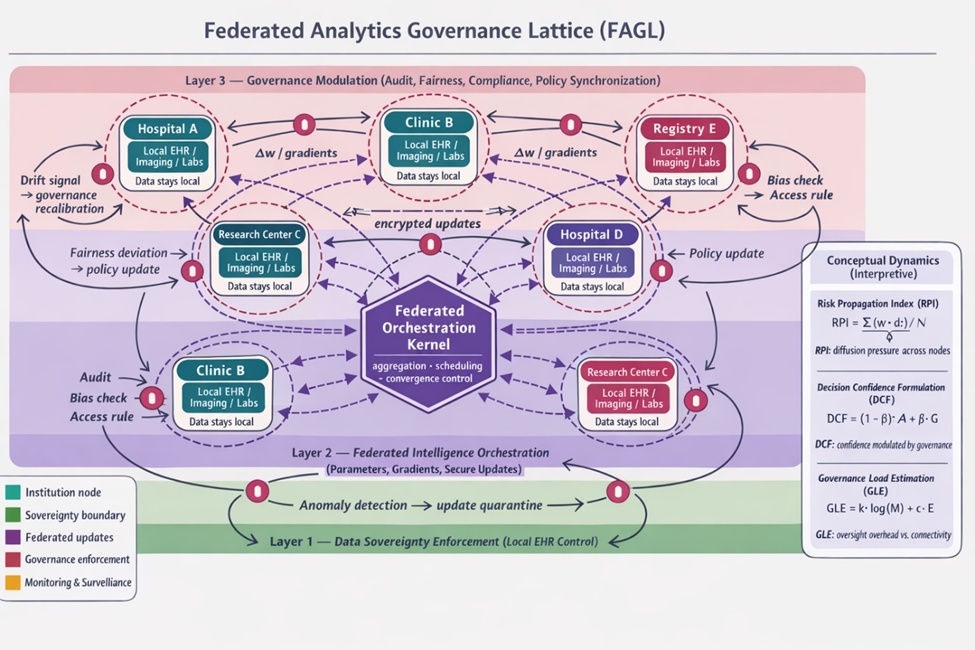
Figure 1. Federated analytics governance lattice (FAGL) for cross-institutional healthcare analytics.
The schematic depicts a lattice-based federation of institutional nodes in which data sovereignty is preserved locally, while parameter/gradient exchanges enable collaborative intelligence formation without centralized data pooling. A central orchestration kernel coordinates convergence and scheduling, whereas governance modulation checkpoints enforce auditability, fairness surveillance, and policy synchronization across edges. Adaptive resonance loops recirculate drift and anomaly signals to recalibrate governance intensity and update acceptance criteria, conceptually stabilizing distributed analytics under heterogeneous institutional constraints. The right-side panel summarizes interpretive formulations for risk propagation (RPI), decision confidence (DCF), and governance load (GLE). Table 2 specifies FAGL’s functional layers as a governance-oriented system, clarifying each module’s outputs, monitoring signals, and failure modes if deployed without structured oversight.
Table 2. FAGL layer functions, outputs, and failure modes: a governance-oriented systems specification
FAGL Layer/module | Primary function | Governed input/output | Key monitoring signal | Failure mode if ungoverned | Mitigation lever (FAGL control) |
Data sovereignty enforcement | Enforce locality of EHR data; authorize computation without export | Input: local EHR/imaging/labs; Output: permitted local training updates | Access violations; consent mismatch; provenance gaps | Data leakage; noncompliance; irreversible privacy breach | Policy envelope rules; cryptographic proxies; auditable access logs |
Federated intelligence orchestration | Coordinate parameter exchange and convergence without raw data pooling | Input: Δw/gradients; Output: aggregated model state | Divergence rate; contribution imbalance; update anomalies | Model collapse; unstable learning; site dominance effects | Scheduling arbitration; weighted aggregation; anomaly quarantine |
Governance modulation layer | Apply auditability, fairness, and compliance checks to update flows | Input: updates + metadata; Output: accepted/rejected updates + governance score (G) | Fairness deviation; audit gaps; policy conflicts | Bias propagation; silent misconduct; weak accountability | Edge checkpoints; fairness parity rules; audit trail verification |
Adaptive resonance loops | Recalibrate governance intensity based on drift/anomaly signals | Input: drift + bias + stability metrics; Output: updated governance thresholds | Drift sensitivity (dᵢ); instability spikes; repeated violations | Drift entrenchment; delayed detection; systemic error diffusion | Threshold adaptation; rollback triggers; dynamic monitoring frequency (M) |
Clinical workflow embedding | Insert governed intelligence into EHR decision surfaces | Input: DCF outputs + provenance; Output: interpretable decision support | Override rates; alert fatigue proxy; clinician trust markers | Workflow disruption; resistance; unsafe automation reliance | Human-in-the-loop gates; interpretability tags; confidence modulation (β) |
Governance load balancer | Control overhead across lattice edges and nodes | Input: edge count (E), monitoring frequency (M); Output: governance load allocation | GLE escalation; bandwidth stress; node saturation | Oversight saturation; inequitable burden; participation drop | Load throttling; adaptive sampling; connectivity-aware policy scheduling |
To formalize key dynamics, consider the following conceptual formulas:
Risk propagation index
Decision confidence formulation
Governance load estimation
This infrastructure topology theoretically positions FAGL as a scalable blueprint for healthcare analytics, embedding uniqueness through its lattice and loop elements.
The deployment of the federated analytics governance lattice (FAGL) engenders multi-scalar impacts across cross-institutional healthcare ecosystems, reshaping intelligence circulation, governance coupling, and operational resilience. Rather than functioning as a static compliance scaffold, FAGL introduces a dynamic governance topology in which analytical authority, validation oversight, and ethical modulation are continuously redistributed across institutional nodes. This section interrogates these systemic consequences through two interlocking analytical lenses: governance dependency propagation and clinical adoption reconfiguration. Both are examined through conceptual systems modeling without recourse to empirical performance assertions.
At the infrastructural level, FAGL transforms healthcare analytics from a hub-and-spoke exchange model into a distributed lattice of governed intelligence pathways. Each participating institution operates as both a knowledge generator and a governance sentinel, simultaneously contributing to and regulating federated analytical flows. The resulting system exhibits properties of adaptive regulatory coevolution, in which institutional policies and analytical outputs recursively shape one another.
Governance dependencies within FAGL manifest as interdependent regulatory moduli embedded across institutional nodes. These modules include compliance verification engines, bias surveillance layers, audit logging systems, and validation arbitration protocols. Their interdependence produces what may be conceptualized as governance propagation chains—oversight pathways through which policy adaptations in one institution disseminate across the lattice [2, 11].
From a systems dynamics perspective, such dependencies recalibrate lattice stability. When an institution modifies its compliance parameters—such as tightening data-anonymization thresholds or recalibrating fairness metrics—these adjustments propagate through the federated coordination layers. Downstream nodes must synchronize validation schemas to maintain analytical interoperability. This synchronization demand increases governance coupling density, theoretically enhancing ethical cohesion while simultaneously elevating coordination complexity.
Within EHR analytics ecosystems, this phenomenon produces ripple effects in intelligence validation. For instance, if one hospital implements stricter adverse-event classification ontologies, federated risk models must recalibrate feature weightings to maintain predictive consistency across the network. Such ripple propagation theoretically strengthens collective robustness by preventing governance blind spots, yet it introduces sensitivity to regulatory heterogeneity [14, 21].
Conceptual modeling suggests that governance dependencies function analogously to load-bearing beams within an architectural lattice. Strong interdependencies increase structural integrity but reduce modular independence. This introduces a trade-off continuum between institutional autonomy and federated coherence. High dependency densities promote ethical alignment, bias harmonization, and audit transparency, yet they may constrain localized innovation or slow analytical iteration cycles [18, 22].
Importantly, governance propagation is not purely restrictive; it also serves as a bias-dampening conduit. Shared fairness protocols enable bias-detection signals originating in one node to inform mitigation strategies across other nodes. Thus, governance dependencies theoretically operate as ethical signal amplifiers within the federated intelligence mesh.
Beyond infrastructural impacts, FAGL exerts transformative effects on clinical adoption trajectories and workflow cognition. Traditional AI deployment models often place a burden on clinicians, requiring them to independently assess model validity, contextual relevance, and compliance with governance requirements. FAGL redistributes this burden by embedding governance-verified analytics directly into care-delivery interfaces.
Adoption models posit that such lattice-embedded orchestration reduces cognitive load at the point of care. Governed intelligence outputs arrive pre-validated through federated oversight channels, enabling clinicians to focus on interpretive application rather than epistemic verification [6, 13]. In multi-institutional care settings—such as referral networks or shared specialty programs—this reduces analytical friction and accelerates decision throughput.
However, adoption dynamics extend beyond efficiency gains. Trust calibration emerges as a critical mediator. Clinicians have historically shown resistance to opaque AI systems, particularly those lacking explainability or regulatory transparency. FAGL addresses this through embedded governance visibility: audit trails, fairness annotations, and validation provenance layers accompany analytical outputs. Transparency thus becomes an adoption catalyst, counteracting skepticism associated with ungoverned predictive infrastructures [17, 24].
Workflow redistribution also manifests in decision authority gradients. While clinicians retain ultimate interpretive sovereignty, federated intelligence assumes greater responsibility for signal aggregation, cross-site benchmarking, and anomaly detection. This creates a hybrid cognition model in which human expertise and lattice intelligence co-produce clinical judgments.
Resource allocation dynamics further evolve under FAGL. Conceptual efficiency formulas suggest that federated governance reduces the duplication of analytics development across institutions. Rather than independently constructing risk models, institutions leverage shared intelligence infrastructures, reallocating computational and financial resources toward localized care optimization [19, 25].
Collectively, governance dependencies and adoption shifts position FAGL as a systemic optimizer within healthcare analytics networks. Its lattice topology enables adaptive balancing between regulatory rigor and analytical agility. Feedback loops continuously recalibrate governance intensity in response to institutional performance signals, ensuring neither oversight saturation nor compliance erosion.
This adaptive equilibrium underscores FAGL’s theoretical capacity to harmonize privacy preservation, intelligence scalability, and operational resilience within cross-institutional healthcare ecosystems.
The federated analytics governance lattice (FAGL) advances theoretical discourse on cross-institutional healthcare analytics by fusing federated computation principles with embedded governance infrastructures. This synthesis addresses longstanding deployment barriers—including privacy constraints, interoperability fractures, and validation opacity—through a distributed lattice topology that orchestrates intelligence without centralized data consolidation [1, 3, 12].
Within this architecture, sovereignty enforcement functions as a foundational design principle. Institutional data never exists beyond its jurisdictional boundary; instead, governance-mediated parameter exchanges enable collaborative model evolution. This preserves regulatory compliance while enabling scalable analytics. Modulation layers further ensure that institutional policies remain synchronized, preventing governance drift across the network [5, 11, 15].
A defining innovation within FAGL lies in its adaptive resonance loops—feedback circuits that monitor analytical convergence, bias dispersion, and performance drift across nodes. These loops introduce self-stabilizing properties into federated ecosystems, theoretically mitigating the degradation phenomena that often afflict distributed AI deployments [9, 18, 21].
In contrast, FAGL diverges from hierarchical federated architectures that rely on centralized parameter-aggregation authorities. Such hierarchies introduce single-point governance vulnerabilities and power asymmetries. In contrast, the lattice topology promotes equitable node interactions, distributing validation authority horizontally rather than vertically [2, 4, 10].
This structural distinction carries measurable implications within EHR intelligence ecosystems. Conceptual constructs, such as the risk propagation index, illustrate how governed lattices attenuate error diffusion compared to unregulated federated networks. Analytical distortions originating in one institution encounter governance barriers before being disseminated system-wide [14, 20, 31].
Governance load modeling further illuminates operational trade-offs. While lattice oversight introduces compliance overhead, distributed validation reduces the need for redundant institutional audits, theoretically optimizing governance expenditure across multi-site collaborations [22, 25, 26].
Despite its conceptual robustness, FAGL’s theoretical scope assumes relatively uniform institutional computational capacity and governance maturity. In resource-disparate environments, smaller institutions may struggle to sustain continuous participation in federated validation cycles, potentially reinforcing infrastructural inequities [7, 16, 28].
Future architectural extensions could incorporate quantum-inspired resilience modeling, leveraging probabilistic entanglement analogies to simulate governance synchronization under uncertainty. Blockchain augmentation represents another trajectory, enabling immutable audit trails and decentralized compliance verification across federated nodes [8, 23, 30].
Ethically, FAGL aligns with equity imperatives by embedding continuous bias surveillance within intelligence aggregation pathways. Monitored federated learning reduces demographic blind spots and promotes distributive analytical fairness [13, 19, 27].
In conclusion, the federated analytics governance lattice (FAGL) emerges as a pivotal conceptual scaffold for governing cross-institutional healthcare analytics. By harmonizing privacy preservation, interoperability orchestration, and distributed intelligence synthesis, the framework addresses structural deficiencies that have historically constrained the deployment of collaborative clinical AI.
Its lattice topology—reinforced by adaptive governance feedbacks—enables institutions to participate in collective analytics without relinquishing data sovereignty. System impact dynamics, including governance dependency propagation and clinical adoption recalibration, underscore FAGL’s capacity to transform operational and epistemic landscapes within healthcare networks.
Conceptual formulations spanning risk propagation, confidence weighting, and governance load offer interpretive instruments for navigating federated complexity. While infrastructural heterogeneity and resource asymmetries remain implementation challenges, FAGL provides a theoretically resilient blueprint for future cross-institutional intelligence ecosystems.
Ultimately, this work contributes to the expanding canon of AI governance scholarship, advocating federated architectures that elevate collective clinical intelligence while preserving ethical accountability and institutional trust.
None
None
None
None
Open Access The author(s) retain copyright. This article is licensed under the Creative Commons Attribution-NonCommercial-ShareAlike 4.0 International License. It may be shared and adapted for non-commercial purposes with appropriate attribution, an indication of changes, and distribution of adaptations under the same license. Third-party material may be subject to separate terms identified in its credit line. View the license at https://creativecommons.org/licenses/by-nc-sa/4.0/.
 Clinical Intelligence Research Press