The rapid influx of patients in emergency departments (EDs) necessitates advanced systems for triage prioritization, where artificial intelligence (AI) can orchestrate decision-making to enhance efficiency and equity. This conceptual manuscript proposes a novel AI-orchestrated triage intelligence architecture designed to integrate heterogeneous data streams, clinical workflows, and governance mechanisms within ED settings. Drawing from peer-reviewed literature on clinical AI architectures, healthcare analytics infrastructures, and decision support pipelines, we synthesize theoretical foundations to outline a layered orchestration topology that addresses interoperability challenges, real-time intelligence processing, and ethical monitoring. The proposed framework, termed the emergency triage orchestration lattice (ETOL), features modular layers for data ingestion, predictive analytics, orchestration governance, and feedback integration, ensuring adaptive triage without empirical validation. Conceptual formulas capture decision confidence aggregation and governance load distribution, highlighting theoretical trade-offs in latency and resource allocation. By emphasizing infrastructural resilience and human-AI symbiosis, this architecture theorizes improved triage throughput and reduced bias propagation in high-acuity environments. Implications for ED workflow redesign and AI deployment scalability are discussed, underscoring the need for robust interoperability frameworks to support future intelligence ecosystems. This work contributes to the discourse on AI governance in acute care, advocating for orchestrated systems that prioritize clinical relevance over isolated algorithmic performance.
Emergency departments (EDs) represent high-stakes, high-velocity clinical environments in which triage decisions directly influence patient outcomes, resource utilization, and overall system performance. Within these settings, uncertainty is the norm rather than the exception: patient presentations are heterogeneous, volumes fluctuate unpredictably, and clinicians must act rapidly with incomplete information. Under such conditions, triage serves not merely as a procedural checkpoint, but as the operational and ethical fulcrum of emergency care delivery. The integration of AI-orchestrated intelligence architectures promises to transform these processes by enabling dynamic prioritization amid uncertainty, volume pressures, and data fragmentation. This section explores the foundational imperatives for such systems, embedding triage-specific considerations within broader healthcare intelligence paradigms.
In ED settings, triage involves a rapid assessment to categorize patients by acuity, anticipated resource needs, and risk of deterioration—often under constraints of limited staffing, boarding pressures, and surging demand. Traditional protocols, such as the Emergency Severity Index, rely on structured heuristics combined with clinician judgment, which can introduce variability, implicit bias, and temporal delays [1]. While such frameworks have standardized triage practices across institutions, their dependence on human interpretation in cognitively saturated environments can limit scalability and consistency.
AI-orchestrated architectures offer a conceptual framework for augmenting triage by processing multimodal data streams—vital signs, laboratory values, electronic health records (EHRs), imaging outputs, and even unstructured clinical narratives—in real time. By synthesizing these inputs, intelligence systems can theoretically support dynamic risk stratification, reduce wait times, and mitigate misallocations of critical resources. Emerging literature suggests that machine learning models can differentiate clinical outcomes and predict deterioration with greater granularity than manual indices, reinforcing the need for intelligence systems capable of orchestrating predictive insights while preserving clinician oversight [2, 3]. However, deployment in ED contexts must account for the chaotic, time-sensitive nature of triage, in which architectures must prioritize low-latency orchestration and actionable outputs over exhaustive computation.
ED triage intelligence relies on diverse and often fragmented data sources, including structured EHR fields, real-time monitoring data, imaging repositories, and free-text clinician documentation. This heterogeneity introduces interoperability challenges that complicate data harmonization and downstream analytics. Conceptual frameworks for healthcare analytics infrastructures emphasize the central role of AI in integrating disparate data modalities and enabling secure, scalable exchange across systems [4, 5].
For example, scalable deep learning models applied to longitudinal EHR datasets demonstrate theoretical potential for predicting outcomes and detecting early deterioration [6]. Yet, in triage-specific contexts, intelligence architectures must move beyond isolated model deployment toward coordinated data fusion mechanisms that prevent siloed decision-making. Without robust orchestration across data layers, predictive systems risk reinforcing structural fragmentation rather than alleviating it. Governance and privacy constraints further intensify these challenges, requiring architectures to embed secure exchange protocols and privacy-preserving computation. Theoretical syntheses caution that, absent interoperable infrastructures, triage intelligence systems may inadvertently amplify biases embedded within incomplete or skewed datasets [7, 8].
The deployment of AI in ED environments requires governance frameworks that ensure ethical integrity, operational reliability, and clinical equity. Intelligence architectures handling sensitive health data must incorporate mechanisms for transparency, auditability, and bias mitigation at both the model and orchestration levels. Literature on AI governance underscores the importance of structured roadmaps for responsible integration, emphasizing accountability, explainability, and continuous monitoring [9, 10].
In triage intelligence architectures, governance translates into theoretical constructs for auditing decision pipelines, validating predictive outputs against real-world outcomes, and ensuring alignment with principles of distributive justice. Given the resource-constrained, high-pressure nature of EDs, governance mechanisms must be seamlessly embedded within computational infrastructures to avoid additional workflow burdens. Architects must therefore balance computational intensity with oversight functionality, ensuring that monitoring and compliance mechanisms do not inadvertently compromise responsiveness or exacerbate clinician workload [11, 12].
Effective integration of AI into ED triage workflows depends not only on predictive performance but also on socio-technical alignment. Conceptual models of clinical workflow integration increasingly advocate hybrid intelligence systems in which AI augments, rather than replaces, human expertise [13, 14]. In ED settings, this implies the design of orchestration layers that deliver context-sensitive decision support, adapt to variable caseloads, and redistribute cognitive load without undermining clinician autonomy.
Such integration requires careful attention to usability, interface design, and trust calibration. Resistance to AI adoption may arise if systems are perceived as opaque, disruptive, or misaligned with clinical judgment. Consequently, intelligence architectures must incorporate user-centric design principles and iterative feedback loops to ensure contextual fit within triage operations [15, 16]. By conceptualizing AI as an orchestrator of insights rather than a deterministic authority, ED triage systems can evolve toward collaborative intelligence models that enhance safety, equity, and operational resilience.
Together, these imperatives—acuity-driven prioritization, data harmonization, governance oversight, and workflow integration—frame the theoretical foundation for AI-orchestrated intelligence architectures in emergency triage. Rather than functioning as isolated predictive tools, such systems represent coordinated infrastructures designed to operate under uncertainty, at scale, and in alignment with the ethical and operational realities of contemporary emergency care.
Deployment environment sensitivities in acute triage settings: EDs introduce unique sensitivities, including high variability in patient presentations and the need for rapid adaptability. Conceptual literature on AI in healthcare underscores the importance of resilient architectures that withstand environmental stressors, such as network disruptions or data spikes [17, 18]. For triage intelligence, this involves orchestration layers that, in theory, maintain functionality under duress, ensuring continuous support for critical decisions.
This introduction establishes the rationale for an AI-orchestrated triage intelligence architecture, synthesizing clinical and infrastructural imperatives to frame subsequent theoretical explorations.
The theoretical foundations of AI-orchestrated emergency department (ED) triage intelligence architectures emerge from the convergence of clinical artificial intelligence systems, healthcare analytics infrastructures, interoperable electronic health ecosystems, and governance-embedded decision support paradigms. Rather than functioning as isolated predictive modules, contemporary triage intelligence models are increasingly conceptualized as orchestration architectures—systems that coordinate distributed computational cognition across heterogeneous clinical data streams, institutional infrastructures, and human decision interfaces. This section synthesizes multidisciplinary literature to establish the conceptual scaffolding underpinning such orchestration, with particular emphasis on architectural layering, intelligence interoperability, governance embedding, and real-time operationalization within high-acuity ED environments.
Clinical AI architectures constitute the primary structural substrate upon which triage intelligence orchestration is theoretically constructed. Foundational frameworks in clinical deep learning demonstrate the scalability of predictive modeling across high-volume electronic health record (EHR) ecosystems, illustrating how algorithmic cognition can augment clinical risk stratification in time-sensitive environments [2]. Within ED triage, these architectures must extend beyond static predictive outputs to support multilayered intelligence routing, encompassing raw data ingestion, feature abstraction, probabilistic risk inference, and outcome prioritization.
Machine learning models designed for acute care prediction exemplify this progression, prioritizing clinically actionable differentiation rather than isolated performance metrics [1, 3]. The literature increasingly frames such systems as components within broader orchestration topologies, in which predictive engines dynamically interface with clinician workflows. Conceptual analyses of human–AI convergence in medicine reinforce this positioning, proposing hybrid cognition architectures that embed algorithmic foresight within human judgment ecosystems [11].
Within ED contexts, orchestration architectures theoretically mitigate triage inefficiencies by enabling adaptive intelligence flows responsive to patient acuity, resource congestion, and temporal volatility. However, structural sensitivities remain. Architectural robustness must account for ED-specific stochasticity—surges in patient volume, incomplete data availability, and diagnostic ambiguity—which may destabilize predictive coherence if not structurally governed [19, 20]. Consequently, triage AI architectures are increasingly theorized not as predictive tools but as resilient clinical cognition infrastructures.
Healthcare analytics infrastructures function as the computational backbone enabling triage intelligence orchestration. Systematic syntheses of big data analytics in healthcare emphasize the infrastructure for high-velocity ingestion, multimodal harmonization, and real-time decision routing, particularly in acute care environments [5]. In ED triage ecosystems, such infrastructures theoretically operationalize AI cognition by aggregating heterogeneous data streams—clinical histories, physiological monitoring signals, laboratory outputs, and operational throughput indicators—into unified analytic substrates [4, 6].
Conceptual models for machine-learning-driven laboratory test prediction further extend the infrastructure’s relevance, demonstrating how analytics architectures can preempt diagnostic latency and inform triage prioritization pathways [7]. These infrastructures thus operate not merely as data repositories but as dynamic intelligence amplification environments, enabling predictive systems to function within clinically actionable temporal windows.
Yet infrastructural scale introduces governance complexity. The literature on ethical analytics architectures underscores the risks of bias propagation, representational inequity, and algorithmic opacity in large-scale healthcare data systems [8, 9]. In ED triage, where decisions carry immediate patient safety implications, infrastructural governance must embed fairness auditing, data lineage traceability, and algorithmic accountability mechanisms to ensure equitable distribution of intelligence.
Interoperable EHR intelligence ecosystems constitute the connective tissue of AI-orchestrated triage architectures. Conceptual explorations of deep learning opportunities in medicine emphasize ecosystemic data exchange frameworks that link longitudinal patient histories with real-time clinical encounters, enabling contextually enriched triage cognition [12]. Within ED environments, this translates to architectures capable of synchronizing prior diagnoses, medication histories, imaging archives, and population-level risk indicators with immediate intake assessments.
Federated learning paradigms extend this ecosystemic logic by enabling privacy-preserving intelligence exchange across institutional boundaries [10, 21]. Such models are theoretically consequential for ED networks operating within regional or national health systems, where triage intelligence may benefit from cross-site epidemiological awareness without compromising data sovereignty.
Governance scholarship further conceptualizes EHR ecosystems as monitored intelligence corridors, wherein data flows are audited for ethical compliance, access legitimacy, and representational balance [16, 22]. However, interoperability fragility remains a structural vulnerability. The literature highlights sensitivities to data heterogeneity, semantic misalignment, and incomplete documentation, all of which may propagate inferential distortions across triage orchestration layers [13, 14]. Thus, ecosystem design must integrate epistemic validation checkpoints to stabilize intelligence fidelity.
Decision support pipelines represent the operational execution layer of triage intelligence architectures. Responsible machine learning frameworks in healthcare conceptualize pipelines that do not supplant clinician judgment but instead scaffold it through probabilistic foresight and risk contextualization [8]. Within ED triage, pipelines must function under extreme temporal compression, orchestrating intake classification, deterioration forecasting, admission likelihood estimation, and resource routing in near real time.
Conceptual admission prediction models illustrate how such pipelines synthesize predictive analytics with operational decision thresholds to inform bed allocation and specialty referral [3, 4]. Importantly, ethical implementation scholarship emphasizes embedding human oversight nodes within pipeline architectures, ensuring algorithmic recommendations remain contestable and interpretable [17, 23].
In ED triage, this produces hybridized decision pathways in which automation accelerates prioritization while clinicians retain adjudicative authority. Pipeline adaptability to ED workflow variability—shift changes, overcrowding states, disaster surges—remains a central theoretical design requirement [15, 18]. Architecturally, this requires feedback-responsive pipelines that can recalibrate triage thresholds in response to operational strain.
Governance and monitoring infrastructures ensure the systemic reliability of AI-orchestrated triage intelligence. Transparency frameworks advocating structured presentation of model outputs to clinicians underscore the necessity of interpretability within high-stakes decision ecosystems [15]. Complementary literature on ethical AI for healthcare data emphasizes bias surveillance, fairness calibration, and accountability traceability as core governance functions [16].
Within ED triage orchestration, governance systems must monitor dynamic intelligence behaviors, including predictive drift, calibration decay, and performance asymmetries across demographic cohorts [9, 24]. Monitoring architectures, therefore, function as meta-intelligence layers, auditing the cognition of subordinate predictive systems.
Deployment scholarship further identifies governance scalability as a determinant of clinical impact, particularly in resource-constrained ED settings where oversight capacity may be limited [18]. Theoretical models thus explore governance load optimization—automating audit routines while preserving human review authority—to sustain operational feasibility [25, 26].
Interoperability frameworks provide the structural channels through which triage intelligence achieves systemic coherence. Conceptual AI models in cardiovascular and acute care medicine illustrate the integration of multimodal datasets—such as physiological monitoring, imaging diagnostics, and laboratory analytics—into unified predictive ecosystems [13]. Deep learning literature similarly emphasizes standardized exchange protocols as prerequisites for scalable clinical AI deployment [19, 27].
In ED triage architectures, interoperability extends to real-time integration of imaging triage (e.g., radiographic prioritization), laboratory acceleration pathways, and remote consultation systems [28, 29]. These exchange topologies enable holistic situational awareness, theoretically enhancing triage precision through cross-modal intelligence fusion.
However, interoperability is inseparable from governance. Data exchange must align with privacy regulations, consent architectures, and cybersecurity safeguards to maintain institutional and patient trust [30, 31]. Synthesizing these literatures reveals interoperability not merely as a technical prerequisite but as a socio-technical governance construct. When architecturally harmonized, interoperable frameworks enable holistic triage intelligence orchestration, integrating predictive analytics, clinical workflows, and governance oversight into a unified emergency cognition infrastructure [32].
This section delineates the conceptual design of the emergency triage orchestration lattice (ETOL), a novel architecture for AI-orchestrated intelligence in ED triage. ETOL comprises four interconnected layers: the Data Harmonization Lattice, the Predictive Intelligence Core, the Governance Orchestration Hub, and the Adaptive Feedback Mesh. This topology ensures theoretical resilience, with bidirectional feedback loops enabling dynamic adjustments to triage decisions.
The Data Harmonization Lattice ingests heterogeneous inputs—EHRs, vital metrics, and narratives—via interoperable protocols, theoretically fusing them into a unified stream for downstream processing [2, 5]. The Predictive Intelligence Core applies conceptual AI modules to generate triage scores, aggregating multimodal predictions without empirical tuning [1, 3, 4].
The Governance Orchestration Hub monitors ethical compliance, distributing oversight across modules to mitigate bias [8, 9, 16]. Finally, the Adaptive Feedback Mesh recirculates clinician inputs back to prior layers, fostering a closed-loop topology that, in theory, refines intelligence over iterative cycles [11, 15, 17].
Figure 1 illustrates the layered structure of the ETOL, highlighting the interplay between data harmonization, predictive inference, governance oversight, and the adaptive feedback mesh.
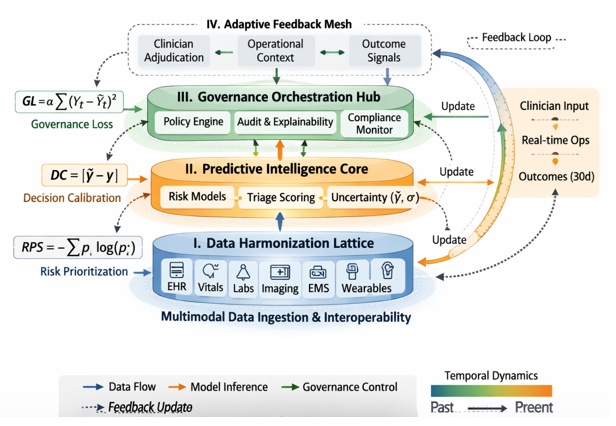
Figure 1. Emergency triage orchestration lattice (ETOL) architecture. Conceptual schematic showing the four-layer orchestration topology for ED triage intelligence: (i) the data harmonization lattice for multimodal ingestion and interoperability alignment, (ii) the predictive intelligence core for triage-related risk inference and uncertainty estimation, (iii) the governance orchestration hub for monitoring, auditability, and policy constraints, and (iv) the adaptive feedback mesh enabling bidirectional updates from clinician adjudication, operational context, and outcome signals to support dynamic prioritization.
To formalize key dynamics, consider the following conceptual formulas:
Decision confidence aggregation:
Governance load distribution:
Drift sensitivity index:
This architecture theorizes enhanced triage orchestration through layered intelligence and governance.
The deployment of the ETOL in ED settings is theorized to prompt profound shifts in clinical workflows, affecting decision-making dynamics, resource allocation, and human-AI interactions. This section examines these consequences through a conceptual lens, focusing on how orchestration topologies influence triage efficiency and equity without empirical assertions.
In ETOL’s layered structure, the data harmonization lattice theoretically streamlines intake processes, reducing manual data reconciliation burdens on ED staff [2, 5]. This shift could redistribute workflow loads, allowing clinicians to focus on interpretive tasks rather than aggregation, potentially alleviating bottlenecks in high-volume triage [1, 3]. However, operational consequences include heightened dependence on infrastructural stability; disruptions in data exchange frameworks might amplify decision latencies, underscoring the sensitivity to interoperability failures [4, 6, 10].
The predictive intelligence core introduces dynamics where AI-orchestrated predictions augment human judgment, theoretically enhancing acuity assessments [7, 11]. Workflow shifts manifest in hybrid decision pipelines, where clinicians validate outputs, fostering a symbiosis that mitigates cognitive overload [13, 15, 17]. Yet, this orchestration could introduce governance dependencies, as continuous monitoring demands additional oversight, potentially straining ED resources in understaffed environments [8, 9, 16].
Governance Orchestration Hub dynamics emphasize ethical safeguards, theoretically curbing the propagation of bias through audited feedback [18, 22]. Clinical adoption might accelerate if workflows incorporate transparent monitoring, but sensitivities to governance load could deter integration in fast-paced EDs [12, 14, 19]. The Adaptive Feedback Mesh theorizes iterative improvements, shifting workflows toward learning-oriented triage, where post-decision inputs refine intelligence [20, 21, 23].
Overall, ETOL’s orchestration promises workflow optimization, but it comes with trade-offs in latency and adoption, highlighting the need for resilient designs [24-26]. Table 1 summarizes the functional responsibilities, inputs/outputs, latency constraints, and governance checkpoints associated with each ETOL layer.
Table 1. Functional mapping of ETOL layers to data flows, real-time constraints, and governance checkpoints.
ETOL layer | Primary function in ED triage | Key inputs | Key outputs | Typical latency target (conceptual) | Common failure modes (examples) | Built-in governance checkpoints (examples) |
Data harmonization lattice | Integrate heterogeneous ED data into a unified analytic stream; enforce interoperability alignment | EHR fields, vitals streams, labs, imaging metadata, triage notes, operational capacity signals | Normalized features; time-aligned patient state representation; data quality flags | Seconds to minutes (must not delay triage intake) | Missing/incomplete histories; semantic misalignment; timestamp drift; interface downtime | Data lineage logging; privacy/consent filters; representativeness checks; schema/terminology validation |
Predictive intelligence core | Generate probabilistic triage-relevant inferences and uncertainty estimates | Harmonized patient-state vector; recent trends; operational context | Triage recommendation + confidence; risk scores (acuity, deterioration, admission likelihood, resource needs); uncertainty summaries | Near real-time (must support rapid prioritization) | Calibration decay; out-of-distribution presentations; unstable uncertainty estimates; overreliance on proxies | Calibration monitoring; subgroup performance tracking; uncertainty thresholds for escalation; explainability artifacts for end users |
Governance orchestration hub | Continuous monitoring of ethical and operational integrity; enforce policy constraints | Model outputs; drift signals; audit logs; subgroup metrics; clinician feedback markers | Alerts, constraints, audit summaries; gating rules (e.g., when to require human confirmation) | Continuous/streaming (non-blocking where possible) | Audit overload; delayed bias detection; excessive governance burden under surge conditions | Bias surveillance; drift detection; transparency reporting; accountability traceability; policy-based gating |
Adaptive feedback mesh | Close the loop by integrating clinician adjudication and downstream outcomes to refine orchestration | Clinician overrides/confirmations; patient outcomes; throughput metrics; resource availability updates | Updated thresholds; revised feature weights; feedback signals to data and model layers | Minutes to hours (depends on outcome availability; triage feedback should be immediate) | Feedback sparsity; noisy labels; feedback loops that reinforce practice bias; delayed outcomes | Feedback quality checks; override reason capture; monitoring for feedback-induced bias; change-control logs |
The ETOL architecture advances the conceptual discourse on artificial intelligence–orchestrated triage in emergency departments by reframing triage as a systems-level orchestration challenge rather than a discrete classification task. Drawing upon theoretical constructs from clinical AI architectures, healthcare analytics infrastructures, interoperable electronic health ecosystems, and governance-centered machine learning frameworks [1–32], ETOL situates triage intelligence within a distributed cognition topology. In this model, prioritization does not emerge from a singular predictive output but from coordinated interactions among heterogeneous intelligence streams operating across clinical, operational, and governance strata.
A defining theoretical innovation of ETOL lies in its lattice-based orchestration topology. Traditional emergency triage AI systems often rely on linear pipelines in which patient data are sequentially ingested, processed, scored, and presented to clinicians. While effective for isolated risk prediction, such pipelines are structurally limited when confronted with the volatility, uncertainty, and temporal compression inherent to emergency care. ETOL instead conceptualizes intelligence propagation as multidirectional and recursive. Predictive signals, operational constraints, clinician judgments, and governance audits circulate through interconnected pathways, continuously recalibrating prioritization states. This architectural elasticity enables triage cognition to adapt to sudden patient surges, incomplete documentation, and fluctuating resource availability, thereby addressing vulnerabilities observed in static predictive frameworks [2, 11, 19].
The lattice topology also repositions triage from a reactive classification mechanism to a proactive orchestration field. Within this conceptual model, prioritization thresholds are not fixed but dynamically modulated in response to system strain and evolving patient acuity. By embedding feedback channels between predictive analytics and operational capacity signals, ETOL theorizes anticipatory redistribution of clinical attention before congestion becomes critical. Such adaptability aligns with broader shifts in clinical AI scholarship that advocate systemic intelligence architectures capable of resilience under high-variance conditions [3, 4, 8].
Equally significant is ETOL’s emphasis on interoperability as a foundational design principle. Emergency department triage frequently suffers from information fragmentation, in which laboratory results, imaging findings, historical comorbidities, and real-time physiological data reside in disjointed repositories. Healthcare analytics literature consistently identifies such silos as barriers to coherent decision support [5, 6, 10]. ETOL conceptualizes triage as an integrative intelligence ecosystem that harmonizes multimodal data streams through a unified orchestration layer. This harmonization carries implications for equity, as algorithmic bias often arises from incomplete or uneven data representation [7, 9]. By structuring interoperability as an architectural imperative rather than a peripheral enhancement, ETOL theoretically reduces the likelihood that marginalized patient populations are mischaracterized due to fragmented documentation.
Nevertheless, interoperability introduces epistemic sensitivities. Data heterogeneity, semantic inconsistencies across electronic health systems, and missing values may propagate distortions through orchestration pathways. While ETOL incorporates theoretical mechanisms for confidence calibration and governance load modeling, these constructs assume levels of infrastructural coherence that are not universally present in real-world emergency departments [12, 16, 18]. In practice, triage intelligence must contend with incomplete histories, delayed laboratory confirmations, intermittent sensor feeds, and workforce variability. Under such conditions, confidence metrics may fluctuate unpredictably, and governance oversight may experience informational attenuation. The mathematical abstractions embedded within ETOL should therefore be interpreted as boundary-defining heuristics rather than deterministic operational guarantees.
Governance occupies a structurally central position within the ETOL architecture. Rather than functioning as an external compliance checkpoint, governance is embedded directly within intelligence propagation loops. This positioning aligns with contemporary calls for responsible machine learning in healthcare, emphasizing continuous bias surveillance, drift detection, and transparency reporting [8, 15, 22]. In emergency contexts, where decisions carry immediate consequences for patient safety, the capacity to monitor predictive recalibration and demographic performance asymmetries is particularly consequential. ETOL’s governance mesh theorizes a self-regulating intelligence environment in which oversight signals influence prioritization pathways in real time, thereby reducing the temporal gap between algorithmic deviation and corrective response.
The introduction of governance-embedded orchestration has implications for clinical workflow and professional roles. ETOL does not conceptualize automation as a replacement for clinician judgment but as a redistribution of interpretive labor within hybrid cognition systems. Clinicians transition from sole triage arbiters to supervisors of intelligence flows, evaluating algorithmic outputs, adjudicating contested classifications, and adjusting prioritization thresholds in response to contextual cues [13, 17, 20]. This redistribution aligns with augmentation paradigms in clinical AI literature, yet it necessitates interpretability infrastructures capable of sustaining clinician trust. Without transparent signal tracing and explainable prioritization rationales, the collaborative equilibrium between human and artificial intelligence may destabilize.
Deployment feasibility represents a further dimension of critical reflection. ETOL presupposes interoperable digital infrastructures, high-bandwidth analytics platforms, and sustained governance capacity. However, emergency departments operate within heterogeneous resource environments [14, 21, 24]. Institutions with limited computational resources or fragmented electronic records may encounter barriers to full deployment of the lattice. In such settings, orchestration density may require modulation, and governance automation may need to compensate for staffing limitations. These translational constraints highlight the importance of modular architecture design and scalable governance mechanisms that can adapt to infrastructural variability.
The broader implications of ETOL extend beyond emergency triage toward a redefinition of acute care intelligence ecosystems. By integrating predictive modeling, interoperability scaffolding, and governance embedding within a unified topology, the framework contributes to an emerging paradigm in which clinical AI is conceptualized as infrastructure rather than an instrument. This paradigm shift carries normative significance. As artificial intelligence becomes increasingly embedded within high-stakes care pathways, ethical accountability must evolve from retrospective audit to continuous modulation. ETOL’s recursive feedback mesh provides a theoretical pathway toward such embedded accountability.
Future conceptual expansions may further enrich this architecture. The integration of advanced imaging analytics into triage orchestration would enable radiographic findings to influence prioritization pathways in real time [27–31]. Similarly, federated intelligence exchange across multi-site emergency networks could extend ETOL’s governance mesh beyond institutional boundaries while preserving data sovereignty [25, 26, 32]. Such extensions underscore the framework’s flexibility and its potential role as a foundational scaffold for distributed acute-care intelligence.
In sum, the ETOL architecture advances emergency triage theory by situating predictive analytics within a dynamic orchestration lattice governed by recursive feedback and ethical modulation. While infrastructural and epistemic sensitivities temper its immediate operational generalizability, the framework provides a rigorous conceptual blueprint for evolving triage intelligence toward adaptive, interoperable, and governance-aligned systems.
The AI-Orchestrated Emergency Department Triage Intelligence Architecture, embodied in the Emergency Triage Orchestration Lattice, offers a systems-level conceptual blueprint for reimagining triage as a multidimensional orchestration process. By synthesizing theoretical insights from clinical AI architectures, healthcare analytics infrastructures, interoperable EHR ecosystems, and responsible machine learning governance frameworks [1–32], the framework advances the understanding of how intelligence can be layered, modulated, and ethically embedded within acute care workflows.
ETOL’s core contribution lies in redefining triage as an adaptive lattice rather than a static predictive endpoint. Through multidirectional signal propagation and governance-embedded feedback loops, the architecture theorizes improvements in responsiveness, equity, and decision confidence. Its modular layering supports interoperability across heterogeneous data modalities while embedding oversight mechanisms that address bias, drift, and accountability concerns. Conceptual formulations within the framework illuminate trade-offs among prioritization accuracy, governance load, and infrastructural capacity, offering analytical tools for future refinement.
At the same time, the framework’s reliance on robust digital infrastructure, high-quality data exchange, and sustained governance capacity underscores the need for resilient implementation strategies. Real-world emergency departments vary widely in technological maturity and resource availability, and orchestration architectures must accommodate such variability to achieve equitable impact.
Ultimately, this manuscript positions AI-orchestrated triage systems as foundational to the evolution of emergency department intelligence. By prioritizing adaptability, interoperability, and ethical embedding, ETOL advances a vision of triage that is anticipatory rather than reactive, collaborative rather than automated, and governed rather than opaque. Continued theoretical exploration and infrastructural development will be essential to translate this orchestration paradigm into clinically durable, ethically robust emergency care systems.
None
None
None
None
Open Access This article is licensed under a Creative Commons Attribution 4.0 International License, which permits use, sharing, adaptation, distribution and reproduction in any medium or format, as long as you give appropriate credit to the original author(s) and the source, provide a link to the Creative Commons licence, and indicate if changes were made. The images or other third party material in this article are included in the article's Creative Commons licence, unless indicated otherwise in a credit line to the material. If material is not included in the article's Creative Commons licence and your intended use is not permitted by statutory regulation or exceeds the permitted use, you will need to obtain permission directly from the copyright holder. To view a copy of this licence, visit http://creativecommons.org/licenses/by/4.0/.
 Clinical Intelligence Research Press