Inpatient flow management represents a critical operational challenge in modern healthcare systems, where inefficiencies in bed allocation, patient throughput, and resource orchestration can lead to overcrowded wards, delayed discharges, and suboptimal care delivery. This conceptual manuscript proposes an original operational analytics scaffold to seamlessly integrate artificial intelligence (AI) into inpatient flow processes, enabling enhanced decision-making without relying on empirical data or performance evaluations. Drawing from theoretical architectures in clinical AI systems, healthcare analytics infrastructures, and decision support pipelines, the scaffold emphasizes modular interoperability, governance mechanisms, and workflow orchestration to address systemic bottlenecks. The framework, termed the Inpatient Flow Orchestration Scaffold (IFOS), comprises layered components for data harmonization, predictive analytics embedding, and adaptive feedback topologies, ensuring alignment with electronic health record (EHR) ecosystems and regulatory frameworks. Conceptual formulas interpret risk propagation through integration layers and governance loads on monitoring systems, highlighting theoretical trade-offs in latency and resource allocation. By synthesizing peer-reviewed literature from 2017 to 2025, this work elucidates the infrastructural prerequisites for AI-driven flow management, including interoperability standards and human-AI interaction dynamics. Ultimately, the scaffold offers a theoretical blueprint for hospitals to conceptualize AI integration, promoting operational resilience and clinical efficiency in inpatient settings without prescriptive implementations. This contribution advances conceptual discourse in AI-integrated healthcare systems, underscoring the need for scaffolded analytics to navigate complex inpatient environments.
Hospital systems worldwide grapple with the intricate dynamics of managing inpatient populations, where the seamless coordination of admissions, intra-hospital transfers, and discharges directly influences clinical quality, patient safety, and institutional sustainability. Inpatient flow is not merely a logistical concern; it represents a systems-level equilibrium problem in which patient acuity, bed availability, staffing elasticity, diagnostic turnaround times, and discharge readiness continuously interact. Even minor perturbations in one domain—such as imaging delays or staffing shortages—can cascade across the institutional ecosystem, generating boarding backlogs, emergency department congestion, and care fragmentation.
The integration of artificial intelligence (AI) into these processes promises theoretical enhancements in predictive capabilities, anticipatory resource allocation, and operational foresight. Predictive occupancy modeling, discharge risk forecasting, and acuity-based triage optimization represent emerging analytical capacities within digitally mature hospitals. Yet the introduction of AI into inpatient ecosystems does not automatically yield systemic coherence. Without structured orchestration, predictive outputs may exist in isolation from workflow realities, exacerbating fragmentation rather than resolving it. Thus, robust scaffolds are required to align algorithmic analytics with entrenched clinical infrastructures, governance architectures, and human decision hierarchies.
This manuscript conceptualizes an analytics-driven scaffold tailored for AI-integrated inpatient flow management. Rather than offering empirical deployment findings, it advances a theoretical architecture designed to orchestrate inpatient systems through layered analytics, interoperability logics, and governance instrumentation. The scaffold is positioned not as a prescriptive implementation protocol but as an interpretive systems model capable of structuring future AI-enabled inpatient environments.
Traditional inpatient flow management frequently encounters bottlenecks due to variable patient acuity, staffing fluctuations, interdepartmental coordination lags, and post-acute placement constraints. Hospitals operate under conditions of bounded elasticity: bed capacity is finite, specialist availability fluctuates, and discharge readiness often depends on external care networks. In such settings, flow inefficiencies accumulate through nonlinear interactions rather than isolated failures.
In AI-integrated environments, these issues are amplified by the necessity for real-time data processing, continuous model inference, and algorithmically mediated decision support. Misaligned analytics—such as predictive tools that fail to incorporate operational constraints—can, in theory, intensify delays rather than alleviate them [1, 2]. For example, theoretical models highlight how poorly integrated AI tools may introduce decision latency by requiring additional verification steps or by generating alerts that are not synchronized with workflow, disrupting the fluid movement of patients from emergency departments to wards [3].
Moreover, predictive systems that optimize for narrow metrics—such as length-of-stay reduction—may inadvertently generate cross-unit strain if not embedded within holistic flow architectures. The scaffold proposed herein conceptualizes a structured mitigation strategy for such bottlenecks. It emphasizes operational analytics not as isolated predictors but as orchestrated components within a feedback-regulated inpatient topology. Through layered coordination, the scaffold aims to convert predictive insight into systemic flow stabilization.
Central to AI-integrated inpatient flow management is the heterogeneity of healthcare data modalities. Structured EHR entries capture laboratory results, vital signs, orders, and timestamps; unstructured clinical notes encode contextual nuance and discharge readiness cues; sensor feeds from monitoring systems provide real-time physiological telemetry; and administrative platforms track bed assignments and occupancy states. Each modality reflects a partial perspective on the patient’s and the system’s status.
The literature underscores the need for analytics scaffolds that harmonize these modalities to support predictive flow modeling [4–6]. Without harmonization, operational analytics risk fragmentation—where predictive discharge models operate independently from bed management dashboards or where acuity scoring tools fail to incorporate narrative context. Such fragmentation undermines the systemic coherence required for effective inpatient orchestration.
The scaffold introduced in this manuscript theorizes a harmonization layer capable of aligning structured and unstructured modalities temporally and semantically. Through integrated data synthesis, AI systems can generate composite representations of inpatient states, enabling more reliable bed-allocation forecasting and discharge-planning support [7]. In this sense, data harmonization becomes not merely a technical prerequisite but a foundational architectural principle for operational analytics in hospital ecosystems.
Deploying AI for inpatient flow management requires navigating institution-specific infrastructural constraints. Hospitals vary widely in their digital maturity, adoption of interoperability standards, legacy system entrenchment, and workforce digital literacy. These heterogeneities create structural friction when introducing analytics layers that depend on seamless data exchange.
Conceptual frameworks emphasize interoperability standards—such as Fast Healthcare Interoperability Resources (FHIR)—as essential enablers of cross-departmental data fluidity [8, 9]. However, interoperability compliance alone does not guarantee orchestration. Integration must extend beyond data transfer to workflow embedding, governance oversight, and iterative recalibration.
Governance considerations further complicate deployment. Dynamic inpatient environments are characterized by fluctuating census loads, policy shifts, and evolving clinical guidelines. Without embedded monitoring protocols, algorithmic drift may emerge, leading to a degradation in predictive performance as institutional conditions evolve [10]. The scaffold proposed here addresses these constraints through infrastructural design principles that prioritize adaptability, modular deployment, and governance-instrumented recalibration loops. Rather than assuming uniform digital capacity, it conceptualizes tiered integration pathways suited to diverse hospital ecosystems.
Effective governance is paramount in AI-integrated inpatient systems. Predictive orchestration influences bed prioritization, discharge sequencing, and inter-unit transfers—decisions with ethical, equity, and regulatory implications. Theoretical discussions reveal that unchecked AI integration can propagate systemic risks, including inequitable resource distribution or biased prioritization of patient subgroups [11, 12].
To preserve the manuscript’s non-empirical orientation while enabling structured reasoning, Table 1 summarizes the interpretive formulas used in IFOS and clarifies how each metric functions as a conceptual lens for trade-offs in risk, confidence/latency, and monitoring burden.
Table 1. Conceptual metrics in IFOS and their theoretical interpretations for governance and operations
IFOS conceptual metric | Expression (as defined) | What it represents (theoretical) | Increases when… | Design implication for the scaffold |
Risk propagation index (RPI) | RPI = Σ(Dᵢ·Aᵢ) / G | How integration complexity can amplify operational risk across layers when governance is weak | Data modality diversity grows (Dᵢ↑); analytic acuity/complexity rises (Aᵢ↑); governance strength falls (G↓) | Strengthen governance layer and harmonization constraints as modalities and model complexity scale |
Decision confidence metric (DCM) | DCM = α·P + β·Q − γ·L | Conceptual balance between predictive fidelity, query resolution, and latency costs | Predictive fidelity rises (P↑); query resolution improves (Q↑); latency increases (L↑ reduces DCM) | Optimize orchestration for actionable timeliness; avoid “high-accuracy/too-late” decisions |
Monitoring burden estimate (MBE) | MBE = k·(V + C) / R | Oversight and monitoring of the load imposed by governance instrumentation | Variables monitored increase (V↑); computational complexity rises (C↑); resource redundancy drops (R↓) | Calibrate monitoring scope; introduce redundancy or automation to prevent governance overload |
Governance must therefore be endogenous to the analytic architecture rather than appended post hoc. Scaffolds require embedded mechanisms to interpret model confidence, audit decision pathways, and surface fairness deviations. Transparency frameworks in clinical workflows emphasize explainability as central to sustaining clinician trust and regulatory legitimacy [13]. The conceptual scaffold developed in this manuscript integrates governance layers directly into its operational core, linking predictive inference to auditability and escalation protocols. Through this design, ethical instrumentation becomes inseparable from throughput optimization.
Inpatient flow exists within a broader socio-technical ecosystem comprising AI analytics, human clinicians, nursing staff, administrative coordinators, and external care networks. Conceptual literature highlights the necessity of scaffolded architectures that foster symbiotic human-AI dynamics—reducing cognitive overload while enhancing operational foresight [14–16].
AI systems that overwhelm clinicians with alerts may degrade rather than enhance efficiency. Conversely, analytics that provide interpretable confidence gradations and actionable coordination cues can augment situational awareness. The proposed scaffold theorizes feedback topologies that integrate clinician adjudication into analytic recalibration cycles. Surge events, staffing shortages, or policy modifications become system inputs rather than destabilizing shocks. Through recursive feedback structures, the inpatient ecosystem is conceptualized as adaptive rather than reactive.
This manuscript advances theoretical discourse by proposing a novel scaffold for AI-integrated inpatient flow management. It synthesizes multidisciplinary literature into an architectural blueprint comprising harmonized data layers, predictive orchestration engines, governance instrumentation, and interoperability channels. Rather than presenting empirical validation, it introduces interpretive formulas and systemic abstractions for analyzing inpatient dynamics.
The objectives are threefold:
To conceptualize inpatient flow as an orchestrated analytic ecosystem rather than a fragmented logistical chain.
To embed governance and interoperability within predictive architectures.
To provide a scaffolded model that guides future theoretical refinement and empirical exploration.
Through this layered, feedback-oriented design, the scaffold contributes to the emerging discourse on operational analytics in hospital systems. It positions AI not as an isolated tool but as an infrastructural intelligence layer capable of reshaping inpatient management paradigms—while remaining theoretically bounded and governance-aware.
The theoretical foundations of AI-integrated inpatient flow management draw on advancements in clinical AI architectures, healthcare analytics infrastructure, and decision-support pipelines. This synthesis integrates peer-reviewed insights from 2017 to 2025, focusing on conceptual models that inform scaffold design but lack empirical evaluation.
Clinical AI system architectures provide the bedrock for integrating intelligence into hospital operations. Architectures emphasizing modular designs enable theoretical scalability in inpatient settings, where AI can augment flow predictions through layered processing [17, 18]. For example, frameworks for AI in chronic disease management illustrate how architectural topologies can orchestrate data flows to support decision-making, paralleling inpatient scenarios where patient trajectories require real-time analytics [5]. Similarly, system designs for infectious disease prediction highlight the role of AI in resource allocation, offering theoretical parallels to hospital bed management [13, 14]. These architectures underscore the need for scaffolds that embed AI without disrupting existing workflows, ensuring theoretical harmony between computational intelligence and clinical imperatives [19, 20].
Healthcare analytics infrastructures extend this foundation by addressing data handling in complex environments. Infrastructures focused on EHR intelligence ecosystems emphasize data federation and analytics pipelines, which are crucial for inpatient flow, where disparate sources must converge [21-25]. Conceptual models for metadata harmonization, such as crosswalks between standards like FHIR and OMOP, theoretically enable seamless interoperability, reducing fragmentation in flow management systems [25]. Analytics infrastructure also includes monitoring mechanisms to detect conceptual drift, such as shifts in data quality that could impact AI-driven predictions [26-28]. In inpatient contexts, these infrastructures support theoretical resource optimization, where analytics scaffolds can interpret allocation dynamics without quantitative benchmarks [23].
EHR intelligence ecosystems further refine the theoretical landscape by integrating patient data into AI frameworks. Ecosystems that leverage multimodal data—combining imaging, vitals, and administrative records—offer conceptual blueprints for inpatient flow, where AI can theoretically enhance throughput by synthesizing diverse inputs [26]. Governance within these ecosystems is critical, with models advocating for ethical oversight to manage biases in AI outputs [11, 22]. For instance, frameworks addressing fairness in medical AI highlight theoretical risks in inpatient allocation, such as disproportionate impacts on vulnerable populations [11]. Interoperability frameworks, including data exchange protocols, ensure that EHR ecosystems align with operational analytics, facilitating the flow of theoretical data across hospital silos [9, 18].
Decision support pipelines represent another pillar, conceptualizing how AI augments clinical judgments in flow management. Pipelines that integrate predictive analytics into workflows theoretically reduce decision latency, enabling proactive inpatient management [24, 29]. Conceptual discussions on AI for sepsis prediction, for example, illustrate pipeline designs that could extend to flow orchestration, where early alerts inform bed assignments. These pipelines often include feedback loops to refine decisions, aligning with scaffold topologies that emphasize iterative adaptation [30, 31]. However, theoretical challenges in pipeline governance, such as regulatory compliance, necessitate scaffolds with built-in monitoring layers [10, 22].
AI governance, monitoring, and deployment systems are essential for sustainable integration. Governance models address ethical challenges in AI-driven healthcare by developing accountability frameworks for inpatient settings [20, 22]. Monitoring systems conceptualize drift detection and performance oversight, crucial for maintaining reliability in dynamic flow environments [27, 28]. Deployment systems focus on practical integration, with conceptual barriers including provider adoption and system disruptions [19]. These elements inform scaffold designs that prioritize governance to mitigate theoretical risks, such as error propagation in flow decisions [15].
Interoperability and data exchange frameworks enable the scaffold’s theoretical functionality. Frameworks that promote standardized exchanges, such as those for multimodal biomedical AI, theoretically bridge gaps within inpatient data silos [26]. Conceptual crosswalks for metadata ensure compatibility across systems, supporting analytics scaffolds in heterogeneous hospital IT landscapes [25]. These frameworks mitigate theoretical interoperability hurdles, enhancing AI's role in flow management [8, 9].
Clinical workflow integration models round out the synthesis, theorizing how AI embeds into daily operations. Models for AI in hospital management highlight workflow shifts, where analytics scaffolds can conceptually redistribute cognitive loads [7, 8]. Integration in plastic surgery billing or breast cancer imaging offers analogous insights into workflow orchestration, emphasizing modular designs for inpatient flow [4, 7]. Theoretical dynamics of human-AI collaboration stress the need for scaffolds that facilitate seamless integration, reducing disruptions while amplifying operational efficiency [16, 30].
Collectively, this literature synthesis reveals gaps in scaffolded approaches for AI-integrated inpatient flow, where existing models often overlook comprehensive orchestration. The proposed scaffold builds on these foundations, introducing unique layers and topologies to advance conceptual systems research.
This section delineates the conceptual architecture of the inpatient flow orchestration scaffold (IFOS), a novel framework engineered to embed AI analytics into hospital inpatient management systems. IFOS conceptualizes a multi-tiered infrastructure that harmonizes data inputs, analytics processing, decision orchestration, and governance feedback, fostering theoretical resilience in flow dynamics.
The IFOS architecture comprises four distinct layers: (1) Data harmonization layer, which theoretically aggregates and standardizes inpatient data from EHRs, sensors, and administrative sources; (2) Analytics embedding layer, where AI algorithms conceptually process flows for predictive insights; (3) Orchestration integration layer, facilitating decision support in bed allocation and discharge planning; and (4) Adaptive governance layer, incorporating monitoring topologies for risk interpretation.
A unique feedback topology in IFOS employs cyclical loops, in which outputs from the orchestration layer inform refinements to data harmonization, enabling theoretical adaptation to inpatient variability. This topology mitigates conceptual propagation of uncertainties through iterative governance checks.
To interpret system dynamics, consider the following conceptual formulas:
Risk Propagation Index
Decision Confidence Metric
Monitoring Burden Estimate
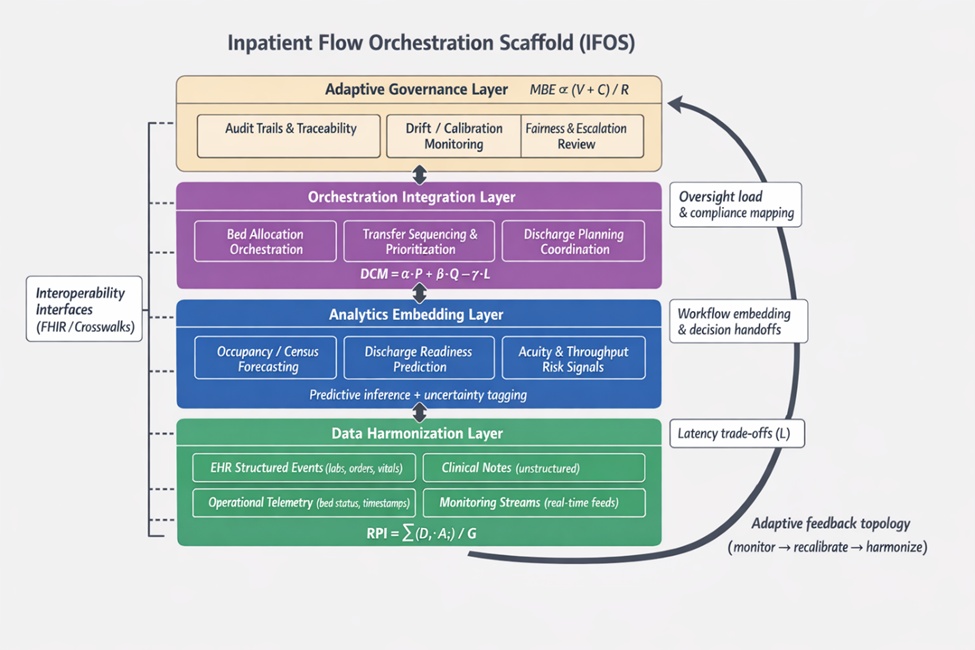
Figure 1. Inpatient flow orchestration scaffold (IFOS) for AI-integrated inpatient management. The conceptual architecture is represented as a four-layer scaffold progressing from (Layer 1) Data Harmonization across heterogeneous inpatient modalities to (Layer 2) Analytics Embedding for predictive flow signals, (Layer 3) Orchestration Integration for bed allocation, transfer sequencing, and discharge coordination, and (Layer 4) an Adaptive Governance layer for auditability, drift/calibration monitoring, fairness oversight, and escalation review. Bidirectional coupling depicts operational interdependence between adjacent layers, while the overarching feedback arc represents an adaptive topology in which governance observations trigger upstream recalibration and re-harmonization. Conceptual interpretive formulas (RPI, DCM, MBE) are positioned at layer interfaces to emphasize theoretical trade-offs among risk propagation, confidence/latency dynamics, and monitoring burden. Table 2 operationalizes the scaffold by mapping each IFOS layer to its primary functions, dominant data inputs/outputs, and the decision surfaces through which inpatient flow actions are theoretically coordinated.
Table 2. IFOS layer functions, inputs/outputs, and operational decision surfaces
IFOS layer | Primary function (conceptual) | Key inputs | Key outputs | Primary decision surface |
Layer 1: Data harmonization | Aggregate, standardize, and align multimodal inpatient data across time and semantics | EHR structured events; clinical notes; operational telemetry (bed status, timestamps); monitoring streams | Harmonized patient + unit state representation; interoperable data objects | “What is the current state of patients/units, and what data are reliable enough for inference?” |
Layer 2: Analytics embedding | Generate predictive flow signals and risk strata for throughput management | Harmonized multimodal states; historical flow patterns; contextual signals | Occupancy forecasts; discharge readiness predictions; acuity/throughput risk signals; uncertainty tags | “What will happen next if current constraints persist?” |
Layer 3: Orchestration integration | Translate predictive signals into coordinated inpatient actions and sequencing logic | Forecasts + risk signals; capacity constraints; workflow rules; clinician overrides | Bed allocation recommendations; transfer prioritization; discharge coordination cues | “Which action sequence optimizes flow while preserving clinical priorities?” |
Layer 4: Adaptive governance | Monitor drift, bias, accountability, and oversight load; trigger recalibration pathways | Model outputs; monitoring metrics; audit logs; fairness indicators; escalation triggers | Audit trails; drift/calibration alerts; fairness deviations; escalation recommendations; recalibration prompts | “Should the system be trusted, constrained, updated, or escalated?” |
The IFOS framework introduces theoretical dependencies that influence governance and workflow paradigms in AI-integrated inpatient flow management. These dependencies manifest as interconnected sensitivities, where infrastructural choices propagate through clinical operations, potentially reshaping human-AI interactions and resource equilibria.
Governance dependencies arise from the scaffold’s reliance on adaptive monitoring layers, which, in theory, impose additional burdens on hospital oversight mechanisms. For instance, the need for continuous drift interpretation in analytics embedding could amplify governance burdens, as conceptualized in models for calibration in prediction systems [27]. In inpatient contexts, this dependency might shift priorities toward regulatory compliance, where AI governance frameworks demand layered accountability to avert theoretical biases in flow decisions [11, 22]. Workflow shifts, conversely, stem from the orchestration layer's integration, theoretically redistributing decision-making from clinicians to hybrid human-AI processes. The literature on AI in clinical practice suggests that such shifts could reduce latency in bed management but introduce dependencies on AI’s confidence, altering traditional hierarchies [1, 24]. For example, in high-acuity wards, scaffolded analytics might conceptually offload routine flow assessments, freeing clinicians for complex cases while necessitating new training protocols [16, 30].
Infrastructure sensitivities further compound these dynamics, with interoperability frameworks highlighting vulnerabilities in data exchange [9, 25]. Theoretical disruptions in EHR ecosystems could cascade into flow inefficiencies, underscoring the scaffold's role in mitigating such risks through harmonization layers [26]. Human-AI workflow shifts also entail cognitive redistribution, where decision support pipelines theoretically enhance throughput but require governance to manage over-reliance [19, 29]. In surge scenarios, these shifts might optimize resource allocation, yet dependencies on governance strength could expose gaps in ethical oversight [10, 20].
Overall, these dependencies and shifts illustrate the scaffold’s theoretical impact on inpatient resilience, balancing operational gains against infrastructural demands. By interpreting these dynamics, IFOS provides a lens for anticipating systemic evolutions in AI-augmented hospitals.
Integrating the inpatient flow orchestration scaffold (IFOS) into conceptual discourse on AI-integrated healthcare systems reveals synergies and tensions with existing theoretical models. The scaffold’s emphasis on operational analytics aligns with architectures for clinical decision support, extending them to inpatient-specific orchestration [3, 17]. Within this alignment, IFOS advances beyond conventional alert-centric CDSS environments by embedding predictive intelligence directly into logistical substrates such as bed allocation, transfer sequencing, and discharge throughput modulation. This repositioning transforms AI from an advisory instrument into an infrastructural coordination layer, theoretically capable of synchronizing clinical acuity with institutional capacity.
However, IFOS diverges from prior system architectures by prioritizing feedback topologies over static pipelines, addressing gaps in adaptive governance noted in deployment challenges [19, 28]. Traditional clinical AI pipelines frequently assume linear progression from data ingestion to inference to clinician action. IFOS instead conceptualizes inpatient management as a recursive systems ecology, where model outputs continuously re-enter operational states. Discharge acceleration, ward redistribution, or escalation prioritization thereby become new analytic inputs, enabling dynamic recalibration. This recursive design responds to long-standing critiques that hospital AI deployments lack adaptive elasticity under census surges, staffing volatility, or seasonal acuity oscillations.
Theoretical implications extend to interoperability, where IFOS’s data harmonization layer complements crosswalk frameworks, potentially enhancing EHR ecosystems in fragmented hospital settings [25]. By aligning multimodal data streams—including admission logs, diagnostic intervals, care team annotations, and bed management telemetry—the scaffold simultaneously supports semantic and temporal interoperability. Such harmonization is particularly relevant in institutions where departmental data silos impede coordinated throughput optimization.
Yet, this integration raises questions about scalability in diverse clinical environments, echoing concerns in multimodal AI applications [26]. Hospitals vary widely in their maturity of digitization, liquidity of infrastructure, and data governance capacity. Consequently, IFOS invites theoretical exploration of modular deployment logics, in which orchestration depth and analytic resolution scale with institutional readiness. This tension between conceptual completeness and infrastructural feasibility remains a defining research frontier.
Governance mechanisms within IFOS mitigate ethical challenges, building on fairness models to theoretically prevent risk propagation in flow management [11, 22]. Predictive discharge prioritization, if ungoverned, could inadvertently amplify disparities linked to insurance status, social support infrastructure, or demographic variables. By embedding audit trails, bias observatories, and escalation review channels within orchestration loops, IFOS reframes inpatient analytics as an ethically instrumented system rather than a purely operational optimizer.
Discussions on AI in infectious disease contexts offer analogous insights, suggesting IFOS could adapt to variable inpatient demands [13–15]. Pandemic surge environments illustrate how inpatient flow becomes epidemiologically entangled—requiring cohort zoning, isolation logistics, and ventilator triage coordination. Interpreted through this lens, IFOS demonstrates theoretical elasticity, capable of integrating contagion modeling variables into bed-allocation and transfer-orchestration schemas.
Workflow integration models further inform the discussion, where IFOS’s orchestration theoretically streamlines processes like discharge planning, akin to AI in hospital management [7, 8]. Rather than treating discharge as a terminal administrative milestone, the scaffold reframes it as a probabilistic coordination vector. Social work readiness, pharmacy clearance, rehabilitation placement, and transportation logistics are synchronized within predictive discharge confidence intervals, enhancing fluidity of throughput.
Human-AI dynamics, as synthesized from literature, highlight potential shifts in cognitive load, necessitating scaffold designs that foster collaboration rather than substitution [16, 30]. Predictive dashboards and orchestration alerts may compress administrative workload while simultaneously introducing interpretive verification demands. IFOS addresses this tension through interpretability overlays—confidence gradients, escalation triggers, and governance annotations—supporting augmented clinical agency rather than algorithmic displacement.
Limitations in current frameworks, such as oversight of monitoring burdens, are addressed through IFOS’s interpretive formulas, which provide tools for conceptual analysis without empirical claims [27]. Continuous inpatient analytics generate surveillance overhead—alert fatigue, dashboard proliferation, and recalibration governance demands. The scaffold’s formulaic instruments theoretically quantify orchestration strain, enabling institutions to evaluate when monitoring intensity itself becomes operationally counterproductive.
Broader discourse on AI governance underscores IFOS’s contribution to regulatory frameworks, promoting transparency in clinical analytics [10, 18]. Traceability layers embedded within the scaffold align with emerging mandates for explainable AI, auditability, and accountability in the deployment of healthcare algorithms. Rather than retrofitting compliance post-implementation, IFOS integrates governance into analytic lifecycles from inception.
By synthesizing these elements, the scaffold advances theoretical understanding and offers a blueprint for future conceptual refinements in inpatient flow systems. It positions operational analytics, interoperability, governance, and human collaboration not as discrete domains but as interdependent strata within a unified orchestration topology.
This conceptual manuscript outlines the inpatient flow orchestration scaffold (IFOS) as a theoretical construct for embedding AI analytics into inpatient management, drawing on a synthesis of the literature on clinical architectures and governance systems. Through its layered design—spanning data harmonization, predictive intelligence, workflow synchronization, and audit governance—the scaffold reconceptualizes inpatient throughput as an analytically orchestrated ecosystem rather than a fragmented logistical process.
Through adaptive feedback topologies, IFOS addresses operational bottlenecks, interoperability needs, and workflow dynamics, interpreted via formulas for risk and confidence. Recursive recalibration loops enable theoretical responsiveness to census volatility, discharge delays, and transfer congestion, situating inpatient flow within a cybernetic systems paradigm.
The scaffold’s governance dependencies and workflow shifts highlight theoretical pathways for enhancing hospital resilience, without prescriptive implementations. Embedded fairness observatories, interpretability channels, and escalation oversight layers ensure that throughput optimization remains ethically bounded and regulatorily aligned.
Human-AI collaboration remains central to this orchestration vision. IFOS anticipates cognitive redistribution across clinical teams, where predictive analytics augment situational awareness while preserving clinician adjudication authority. Such collaboration models reinforce trust, interpretability, and operational legitimacy within AI-mediated hospital environments.
Future conceptual explorations could extend IFOS into specialized inpatient domains, refining its infrastructure to adapt to evolving AI landscapes. Critical care surge systems, infectious disease containment wards, oncology treatment flows, and rehabilitation networks each introduce distinct orchestration variables that may further elaborate scaffold modularity.
Ultimately, IFOS contributes to the discourse on scaffolded analytics, fostering theoretical advancements in AI-integrated healthcare. By synthesizing operational intelligence, interoperability architectures, governance instrumentation, and collaborative workflow design, the scaffold provides a conceptual blueprint for theorizing, evaluating, and progressively refining next-generation inpatient AI ecosystems.
None
None
None
None
Open Access The author(s) retain copyright. This article is licensed under the Creative Commons Attribution-NonCommercial-ShareAlike 4.0 International License. It may be shared and adapted for non-commercial purposes with appropriate attribution, an indication of changes, and distribution of adaptations under the same license. Third-party material may be subject to separate terms identified in its credit line. View the license at https://creativecommons.org/licenses/by-nc-sa/4.0/.
 Clinical Intelligence Research Press