The integration of artificial intelligence (AI) into healthcare systems has transformed population health analytics, enabling scalable infrastructures that process vast datasets to inform clinical decisions, resource allocation, and policy-making. This narrative review synthesizes recent literature on AI system architectures and governance models, focusing on how these elements underpin analytics-driven healthcare ecosystems. We examine the evolution of AI-enabled infrastructures, emphasizing federated learning, explainable models, and ethical frameworks to address data privacy, interoperability, and equity in population-level analytics. Key architectures include vertically integrated systems that streamline data ingestion, model deployment, and real-time inference, as seen in federated approaches that mitigate data silos while preserving patient confidentiality. Governance models are critical for ensuring trustworthy AI deployment, incorporating regulatory oversight, ethical principles adapted from military contexts to healthcare, and consensus-based guidelines for prediction models. We highlight the role of blockchain and data trusts in enhancing transparency and consent mechanisms, particularly in global health responses to pandemics and chronic disease management. The review structures the discourse around systems-level framing, integrating data flows, algorithmic decision support, and closed-loop feedback mechanisms that adapt to clinical outcomes. For instance, electronic health record (EHR)-based prediction models facilitate acute illness forecasting and outcome prediction in conditions like rheumatoid arthritis and oncology. We propose an original synthesis logic that conceptualizes AI infrastructures as adaptive networks, where governance acts as a regulatory layer overlaying architectural components to balance innovation with risk mitigation. Challenges such as bias in commercial datasets and the need for international cooperation are noted, but the emphasis remains on infrastructural resilience. Ultimately, this synthesis underscores the imperative for hybrid human-AI systems that prioritize population health equity, with governance models evolving to support sustainable analytics infrastructures. By positioning AI as a foundational tool for healthcare transformation, the review advocates for interdisciplinary collaboration to refine these systems, ensuring they deliver actionable insights while upholding ethical standards in diverse healthcare settings.
The advent of artificial intelligence (AI) has profoundly reshaped healthcare delivery, shifting from siloed clinical practices to interconnected systems capable of processing population-level data for predictive and prescriptive analytics. At its core, AI in healthcare leverages machine learning algorithms to analyze electronic health records (EHRs), imaging data, and wearable sensor inputs, generating insights that inform public health strategies and individual patient care. This integration is particularly evident in population health analytics, where AI infrastructures aggregate heterogeneous data sources to identify trends, forecast disease outbreaks, and optimize resource distribution. For example, during the COVID-19 pandemic, AI cooperation frameworks enabled global data sharing for rapid response analytics, highlighting the need for robust architectures that handle real-time, multi-modal data [1-7].
Historically, healthcare systems have relied on rule-based decision support, but AI introduces dynamic models that learn from data patterns, enabling proactive interventions. The transition to AI-driven analytics infrastructures addresses longstanding challenges like data fragmentation and limited scalability in traditional health information technology [8-13]. Governance emerges as a pivotal component, ensuring that AI deployments align with ethical norms, regulatory requirements, and equity principles, especially in low- and middle-income countries where digital divides exacerbate disparities [14-19].
Population health analytics has evolved from descriptive statistics to advanced AI paradigms that incorporate predictive modeling and causal inference. Early applications focused on epidemiological surveillance, but contemporary infrastructures employ deep learning for outcome forecasting, such as in rheumatoid arthritis management or oncology decision support. This evolution is driven by the proliferation of big data in healthcare, including structured EHRs and unstructured clinical notes, necessitating architectures that support federated learning to train models across institutions without centralizing sensitive data [2, 7, 11].
Governance models have co-evolved, with frameworks like the CODE-EHR emphasizing best practices for using structured EHRs in research, including transparency in data handling and model validation [12]. Ethical considerations, such as those adapted from military AI principles, stress accountability in generative AI applications for healthcare, ensuring that analytics outputs are interpretable and bias-mitigated [4, 6, 20-22]. The Lancet Commission on governing health futures underscores the importance of digital innovation in fostering learning health systems, where analytics infrastructures continuously improve through feedback loops [9].
AI system architectures in healthcare typically encompass data ingestion layers, computational cores for model training, and deployment interfaces for clinical integration. Vertically integrated designs facilitate end-to-end workflows, from data preprocessing to inference, as explored in developments toward scalable AI platforms [3]. Federated learning stands out as a key architecture, allowing collaborative model building while addressing privacy concerns under regulations like GDPR and HIPAA [2, 7, 11].
Governance models provide the oversight layer, incorporating guidelines for AI-based prediction models that emphasize quality criteria such as calibration and discrimination [1]. In global contexts, initiatives for secondary data use in digital health advocate for standardized governance to enable cross-border analytics, particularly in pandemic preparedness [10, 16]. Blockchain technologies enhance governance by securing data exchanges and enabling traceable consent in health data ecosystems [15, 20, 23-29].
Table 1 summarizes the modular architectural layers underpinning AI-enabled population health analytics infrastructures.
Table 1. Core architectural layers in population health AI infrastructures
Layer | Functional role | Key technologies | Governance interaction | Representative citations |
Data ecosystem | Aggregation of multimodal health data | EHR integration, interoperability APIs, and federated nodes | Data standards and consent management | |
Intelligence core | Predictive and causal modeling | Federated learning, deep neural networks | Model validation and fairness constraints | |
Decision support | Translation of analytics into actionable insights | Explainable A and human-AI interfaces | Transparency and accountability | |
Intervention deployment | Operationalization of insights | Clinical workflows and policy triggers | Ethical oversight and compliance | |
Feedback and learning | Continuous system recalibration | Drift detection and performance monitoring | Lifecycle governance | |
Governance overlay | System-wide oversight | Data trusts, regulatory frameworks, and blockchain | Privacy, equity, traceability |
The interplay between architecture and governance is crucial for population health, where analytics must scale to diverse populations. For instance, explainable AI models predict acute critical illness from EHRs, offering transparency that supports clinical trust [8]. Data trusts and participatory governance models draw lessons from biobanks, promoting stakeholder involvement in health data stewardship [23, 25].
Despite advancements, AI infrastructures face hurdles in interoperability and ethical deployment. Commercial health datasets often introduce biases, impacting algorithm fairness in population analytics [14]. Regulatory oversight for large language models in healthcare is imperative to prevent misuse in analytics pipelines [4]. International cooperation, as seen in COVID-19 responses, reveals gaps in global health security frameworks that AI can help bridge through integrated analytics [5, 16].
This review adopts an original synthesis logic that frames AI infrastructures as modular, adaptive networks comprising data, intelligence, decision, intervention, feedback, and governance layers. Unlike prior taxonomies that classify AI by application domains, our interpretive structuring emphasizes systems-level dynamics, integrating cross-study insights to highlight how architectures and governance interlock to enable closed-loop analytics. The scope focuses on literature, synthesizing architectures for population health analytics and governance models that ensure ethical, scalable deployment, without delving into empirical benchmarks or novel experiments. This positioning allows for a comprehensive narrative that bridges technical designs with policy implications, guiding future infrastructural developments in AI-driven healthcare.
The foundation of AI-enabled healthcare analytics lies in robust data ecosystems that facilitate seamless interoperability across disparate sources. Electronic health records serve as primary repositories, but their structured formats often require augmentation with unstructured data from wearables, genomics, and social determinants [12, 13]. Federated learning architectures address interoperability by enabling model training on decentralized datasets, preserving privacy while aggregating insights for population health [2, 7, 11]. For instance, large-scale federated initiatives during COVID-19 demonstrated how such systems can predict clinical outcomes across global cohorts, integrating data from multiple modalities without centralized storage [7].
Governance in data ecosystems emphasizes secondary use frameworks, where policies for global health digitalization ensure equitable access and minimize risks [10]. Commercial datasets, while valuable, pose challenges due to embedded biases that can skew analytics outputs [14]. Blockchain applications extend interoperability by providing secure, tamper-proof ledgers for data sharing, particularly in pandemic analytics where traceability is paramount [15].
AI analytics in healthcare systems increasingly rely on predictive models that forecast population-level risks and individual outcomes. Guidelines for AI-based prediction models outline quality criteria, including scoping reviews that synthesize best practices for development and validation [1]. Explainable models, such as those predicting acute critical illness from EHRs, incorporate transparency mechanisms to build clinician trust [8]. In oncology and chronic disease contexts, deep learning architectures leverage EHR data to forecast outcomes, adapting to heterogeneous patient populations [28, 29].
System architectures evolve toward vertical integration, where AI development spans from data curation to deployment, ensuring analytics pipelines are resilient and scalable [3]. Federated electronic health records within the European Health Data Space exemplify how architectures can support cross-institutional analytics, governed by standards that prioritize data sovereignty [11].
Governance models are integral to the landscape, providing ethical guardrails for AI analytics. Ethical principles for generative AI, adapted from the military to healthcare, focus on accountability, fairness, and human oversight [6]. Primers on AI ethics in clinical decision support highlight the need for value-aligned systems that mitigate harms in population analytics [21, 22]. Regulatory oversight for large language models addresses risks in healthcare analytics, advocating for transparency in model behaviors [4].
Data trusts offer governance innovations, learning from biobanks to enable participatory models where stakeholders co-design analytics infrastructures [23]. Ethics in digital disease surveillance underscore surveillance governance, balancing public health benefits with privacy [25]. In low- and middle-income settings, governance frameworks drive digital transformation of primary health services, ensuring analytics support equitable care [18, 19].
The global dimension of AI landscapes involves cooperative frameworks that enhance population health analytics. AI cooperation during COVID-19 illustrated how international partnerships can leverage analytics for response coordination [5]. The Lancet Commission on health futures advocates for governance in digital worlds, integrating AI to foster learning health systems [9]. One Health approaches identify weaknesses in global security frameworks, where AI analytics integrate human, animal, and environmental data [16].
Best practices in real-world data life cycles guide collaborative analytics, from acquisition to utilization in population studies [27]. Evaluation frameworks for AI implementation ensure that analytics infrastructures are adaptable to diverse healthcare settings [17].
Synthesizing these elements, the landscape reveals AI infrastructures as interconnected webs where data flows inform analytics, moderated by governance to ensure sustainability. Original cross-study analysis positions federated architectures as bridges between local and global analytics, with governance models acting as adaptive regulators [2, 7, 10-12]. This framing highlights how analytics evolve from static predictions to dynamic systems, incorporating feedback for continuous refinement [8, 13, 26]. Population health benefits from this integration, enabling proactive interventions while addressing ethical imperatives in diverse contexts [4, 6, 9, 14, 16, 18].
Intelligent clinical decision systems leverage AI architectures to translate analytics into actionable insights, forming the core of closed-loop healthcare. These systems integrate predictive models with decision interfaces, enabling real-time support for clinicians in population health management. Vertically integrated architectures facilitate this by aligning data processing with inference layers, ensuring seamless transitions from analytics to decisions [3]. Federated learning enhances decision support by allowing models to learn from distributed data, supporting decisions in decentralized healthcare networks [2, 7, 11].
Explainable AI architectures are pivotal, providing interpretable outputs that inform clinical judgments, such as in acute illness prediction, where model rationales align with clinical reasoning [8]. In oncology, large language models personalize decision support, synthesizing patient data into tailored recommendations [29]. Governance overlays these architectures, with ethical frameworks ensuring decisions respect autonomy and equity [21, 22].
Closed-loop systems extend decision support by incorporating feedback loops that refine analytics based on outcomes. These architectures create iterative cycles: data ingestion leads to intelligence generation, informing decisions that trigger interventions, with outcomes feeding back to recalibrate models [13, 17]. For example, EHR-based forecasting in chronic conditions like rheumatoid arthritis forms loops where predictions guide treatments, and real-world outcomes update models [28]. Global health initiatives during pandemics demonstrate closed-loop analytics, where surveillance data informs decisions, and intervention results enhance predictive accuracy [5, 25].
Governance in closed loops emphasizes continuous monitoring, with guidelines for AI protocols ensuring feedback mechanisms are transparent and auditable [1, 24]. Data trusts facilitate participatory feedback, allowing stakeholders to influence loop refinements [23]. In primary care transformations, closed-loops support population-level decisions, integrating analytics with governance for sustainable health systems [18, 19].
A key feature of intelligent systems is human-AI fusion, where architectures blend algorithmic outputs with clinician expertise. This dynamics is formalized in evaluation frameworks that guide implementation, ensuring fusion enhances rather than supplants human decisions [17]. Ethical primers advocate for designs that prioritize human oversight, mitigating risks in decision support [21, 22]. In population analytics, fusion enables scaled decisions, such as resource allocation informed by AI predictions tempered by governance [9, 12].
To synthesize these architectures, consider a conceptual formula for the closed-loop healthcare cycle:
where H(t) represents the health system state at time t, D(t) is the decision-intervention vector informed by current intelligence I(t−1) from prior analytics, and G denotes the governance constraints ensuring ethical closure. This interpretive model frames loops as recursive, with feedback updating I via outcome data.
Another formula captures human-AI fusion:
Where O is the fused output, A is the AI recommendation, C is the clinician input, and α is a tunable governance parameter balancing automation with oversight. These formulas provide infrastructural abstractions, highlighting cyclical dependencies without empirical metrics. Figure 1 illustrates the adaptive closed-loop population health analytics infrastructure integrating data ecosystems, federated intelligence, human–AI decision fusion, intervention deployment, recursive feedback, and an overarching governance layer.
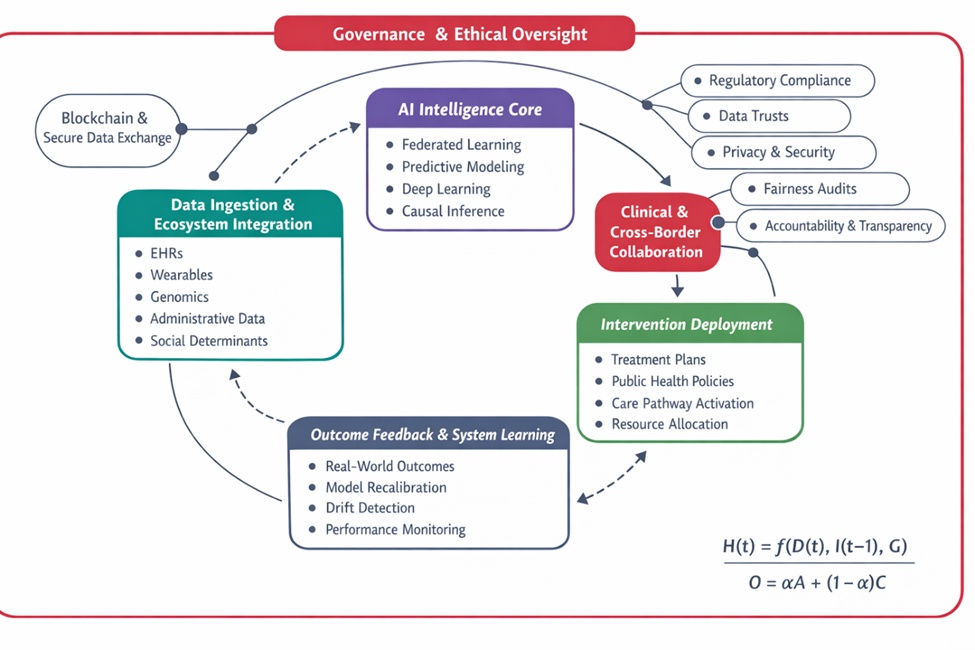
Figure 1. Adaptive closed-loop population health analytics infrastructure with governance overlay. The schematic depicts a modular AI-enabled ecosystem in which heterogeneous healthcare data sources flow into a federated intelligence core that generates predictive insights for clinical and population-level decision support. Decisions trigger interventions whose outcomes feed back into model recalibration, forming a recursive learning loop. Surrounding the architecture is a governance envelope encompassing regulatory compliance, data trusts, privacy safeguards, fairness auditing, and accountability mechanisms. Side nodes represent blockchain-secured data exchange and global cooperation infrastructures, highlighting interoperability and cross-border analytics. The conceptual formulas abstract the recursive system dynamics and human–AI fusion parameters governing decision balance.
Despite the promising architectures and closed-loop intelligence mechanisms outlined, AI-enabled population health analytics infrastructures encounter deeply rooted, multi-layered constraints that complicate real-world operationalization. These limitations are not isolated technical deficiencies but systemic frictions emerging at the intersection of data ecosystems, institutional governance, sociotechnical trust, and global health equity. Their entanglement produces compound risks, particularly when analytics outputs inform policy, funding allocation, or population-scale interventions.
A foundational impediment remains the fragmentation, heterogeneity, and uneven fidelity of health data environments. Population health analytics depends on aggregating signals from electronic health records, wearable biosensors, pharmacy systems, imaging repositories, genomic databases, and administrative claims infrastructures. However, these sources differ substantially in ontological schemas, temporal granularity, coding taxonomies, and completeness, generating interoperability bottlenecks even within single health systems [2, 11, 12]. Semantic misalignment across coding frameworks—such as ICD, SNOMED, and local terminologies—introduces translation loss that degrades downstream model performance.
Federated learning infrastructures, while designed to mitigate centralization risks, inherit statistical heterogeneity from local data silos. Non-IID distributions manifest through demographic skew, disease prevalence variability, and institutional practice differences, complicating gradient aggregation and reducing generalizability [7]. Models trained in high-resource urban hospitals may underperform in rural or underfunded settings, reinforcing predictive inequities.
Data quality deficits further compound this challenge. Missingness, delayed entry, and documentation bias—where severe cases are overrepresented—distort epidemiological signals. Commercially sourced datasets often lack representation from marginalized populations, perpetuating structural blind spots in predictive analytics for chronic diseases, autoimmune disorders, and oncology trajectories [14, 28, 29].
Infrastructure asymmetries add another layer of constraint. Training large multimodal models demands high-performance computing clusters, secure data pipelines, and low-latency networking. Resource-constrained environments face unreliable connectivity, limited storage redundancy, and insufficient cybersecurity safeguards, restricting participation in federated ecosystems and reinforcing global analytic inequities [10, 16, 18].
Trust remains a decisive determinant of adoption. Deep neural architectures, particularly transformer-based multimodal systems, often operate as epistemically opaque engines, producing probabilistic forecasts without clinically interpretable reasoning pathways. Clinicians, public health officials, and policymakers require transparent justificatory scaffolds to contextualize risk predictions before integrating them into decision processes [8, 21, 22].
Although explainable AI (XAI) techniques—such as saliency mapping, SHAP values, and counterfactual modeling—have matured in domains like imaging diagnostics and acute deterioration forecasting, their translation to population health surveillance remains limited [4, 17]. Population analytics involves longitudinal, multivariate, and socioenvironmental data layers, complicating attribution modeling.
Opacity risks two divergent but equally problematic outcomes: algorithm aversion, where users distrust outputs, or automation complacency, where opaque systems are over-trusted. Both scenarios undermine safe closed-loop governance. Generative AI integration into decision dashboards further intensifies transparency concerns, as narrative outputs may mask uncertainty gradients or training data limitations [4, 6].
Ethical vulnerabilities scale with analytic reach. Algorithmic bias does not merely affect individual diagnoses but can distort resource allocation, vaccination prioritization, and screening policies. Feedback loops within closed-loop systems risk reinforcing inequities if biased outputs inform subsequent training cycles [6, 21, 22, 25].
Privacy erosion remains a persistent concern despite federated safeguards. Membership inference, gradient leakage, and model inversion attacks expose sensitive population attributes even when raw data remain localized. As population health analytics increasingly integrates social determinants, geospatial mobility, and behavioral data, re-identification risks intensify.
Globally, digital inequity introduces structural exclusion. Low- and middle-income regions often lack digitized records, interoperable infrastructure, and trained AI personnel, limiting their representation in global models [16, 18, 19]. Consequently, predictive systems optimized on high-income populations may misestimate disease burdens elsewhere. Commercial investment patterns may further skew innovation toward profitable markets, widening analytic and therapeutic disparities [14].
Regulatory pluralism presents operational friction for transnational analytics. Divergent interpretations of data sovereignty, consent, and secondary use complicate federated collaborations [9-12]. Compliance frameworks such as GDPR, HIPAA, and emerging AI Acts impose overlapping yet inconsistent requirements, increasing administrative burden without guaranteeing harmonized safeguards.
Standards initiatives, including CODE-EHR, offer methodological guidance for real-world data use, yet enforcement remains uneven. Governance maturity varies widely across institutions; many operate pilot AI deployments without enterprise-level oversight bodies, audit pipelines, or lifecycle monitoring infrastructures [17]. As large language models and generative analytics enter clinical ecosystems, regulators face additional challenges in validating adaptive systems whose outputs evolve [1, 4].
Operational integration represents a final translational barrier. Embedding AI analytics into public health workflows requires redesigning surveillance pipelines, reporting hierarchies, and intervention triggers. Misalignment between analytic outputs and existing decision cadences can produce alert fatigue or underutilization [13, 17].
Workforce readiness remains uneven. Public health agencies face shortages of data scientists, clinical informaticians, and AI governance specialists. Training clinicians to interpret probabilistic population forecasts demands new educational paradigms. Resistance may also stem from liability ambiguity, professional identity concerns, or fear of workforce displacement [19].
Scaling beyond pilot deployments introduces sustainability pressures. Continuous monitoring, recalibration, cybersecurity auditing, and fairness surveillance require persistent funding and institutional commitment [3, 27]. Without lifecycle governance, analytic infrastructures risk performance drift and ethical degradation.
Collectively, these challenges illustrate that population health AI cannot be operationalized through technical optimization alone. Sustainable deployment requires synchronized evolution across infrastructure, governance, workforce capacity, and global equity frameworks.
Table 2 outlines governance mechanisms aligned with technical, ethical, regulatory, and implementation risks in AI-enabled population health infrastructures.
Table 2. Governance mechanisms and risk mitigation strategies in population health analytics
Risk domain | Systemic challenge | Governance response | Research direction |
Data fragmentation | Interoperability gaps, non-IID data | Federated standards, data harmonization | Heterogeneity-aware aggregation [2, 7, 11] |
Algorithmic bias | Demographic performance disparities | Fairness audits, participatory data trusts | Intersectional bias monitoring [14, 23] |
Privacy and security | Gradient leakage, re-identification | Differential privacy, blockchain audit trails | Quantum-resistant cryptography [15, 20] |
Regulatory fragmentation | Cross-border compliance gaps | Harmonized AI frameworks, CODE-EHR standards | International governance alignment [4, 12] |
Explainability deficits | Opaque deep models | Hybrid XAI systems, transparency dashboards | Clinically embedded interpretability [8, 21, 22] |
Workforce and adoption | Skill gaps, workflow disruption | Training programs, evaluation science | Human-AI fusion validation [17, 19] |
Sustainability | High computational & financial costs | Green AI, lifecycle monitoring | Lightweight architectures [16, 18] |
Addressing these systemic constraints necessitates forward-looking, interdisciplinary research agendas that transcend algorithmic innovation and engage governance science, human factors engineering, and global health systems design.
Future federated ecosystems must evolve beyond basic parameter aggregation toward heterogeneity-aware intelligence fabrics. Research into adaptive weighting, cluster-based federation, and meta-learning aggregation strategies can mitigate non-IID distortions and enhance cross-population generalizability [2, 7, 11]. Fairness-aware optimization—embedding equity constraints directly into aggregation functions—offers a pathway to reduce demographic performance disparities.
Privacy preservation must similarly advance. Homomorphic encryption, secure multi-party computation, and differential privacy require scalability improvements to support real-time analytics. Exploration of quantum-resistant cryptographic protocols is increasingly relevant as health data infrastructures plan for long-term security resilience [15, 20].
Blockchain-anchored audit trails present another frontier, enabling verifiable provenance, consent tracking, and model update accountability across transnational collaborations. Such infrastructures may prove critical for pandemic surveillance and global outbreak modeling, where trust deficits impede data sharing.
Next-generation explainability research must pivot from post-hoc visualization toward clinically embedded interpretability. Hybrid XAI architectures—combining intrinsic transparency layers with model-agnostic interpretation overlays—can generate context-aware rationales aligned with epidemiological reasoning [8, 21, 22].
Human-AI collaboration research should examine interface ergonomics, cognitive load balancing, and trust calibration. Tunable governance dashboards—where policymakers adjust sensitivity thresholds, fairness weights, or uncertainty tolerances—could enable adaptive decision co-creation. Empirical validation of such systems in real public health operations remains a critical research gap.
Longitudinal studies are also needed to assess how explainability affects workforce skill retention, decision latency, and intervention accuracy within closed-loop ecosystems.
Developing adaptive governance frameworks, such as maturity models for resource-constrained settings, is essential to ensure equitable deployment [1, 12, 18]. Longitudinal studies on bias mitigation in real-world analytics, including intersectional equity assessments, should inform standardized protocols. Participatory models drawing from data trusts can empower stakeholders in governance design [23].
International collaboration to harmonize standards for AI in healthcare, building on frameworks like FUTURE-AI, should address high-risk applications in population analytics [4, 6]. Advancing evaluation methodologies for closed-loop performance, including post-deployment monitoring and outcome traceability, will support evidence-based scaling [1, 17, 24].
Research on lightweight models for low-resource environments and green AI to reduce computational footprints aligns with global sustainability goals [16, 18]. Capacity-building initiatives, including workforce training and interdisciplinary partnerships, are critical to bridge implementation gaps [13, 19].
These directions emphasize proactive, equity-centered innovation to evolve AI infrastructures into resilient, trustworthy systems for population health.
This narrative review synthesizes AI system architectures and governance models as foundational to advancing population health analytics. Vertically integrated designs, federated learning, and closed-loop mechanisms enable scalable intelligence from data to intervention, moderated by ethical governance to ensure accountability and equity.
The landscape reveals interconnected data ecosystems, predictive capabilities, and collaborative frameworks that transform healthcare from reactive to proactive paradigms. Yet persistent challenges—data fragmentation, bias risks, regulatory fragmentation, and trust deficits—highlight the need for integrated mitigation.
Looking forward, prioritizing explainability, fairness-aware architectures, adaptive governance, and inclusive research will realize the full potential of AI-driven analytics. By framing infrastructures as adaptive networks with governance as an overarching regulator, healthcare systems can foster sustainable, equitable transformation. Ultimately, interdisciplinary collaboration remains essential to translate these advancements into resilient population health ecosystems that uphold ethical imperatives while delivering measurable benefits across diverse settings.
None
None
None
None
Open Access The author(s) retain copyright. This article is licensed under the Creative Commons Attribution-NonCommercial-ShareAlike 4.0 International License. It may be shared and adapted for non-commercial purposes with appropriate attribution, an indication of changes, and distribution of adaptations under the same license. Third-party material may be subject to separate terms identified in its credit line. View the license at https://creativecommons.org/licenses/by-nc-sa/4.0/.
 Clinical Intelligence Research Press