The integration of artificial intelligence into clinical workflows demands architectures that dynamically adapt treatment policies to real-time patient data while ensuring seamless interoperability with existing healthcare systems. This conceptual manuscript proposes a novel reinforcement-governed treatment policy architecture (RGTPA) designed to orchestrate adaptive decision-making in clinical environments. Drawing from reinforcement learning principles, the RGTPA embeds policy optimization mechanisms within electronic health record (EHR) ecosystems, facilitating continuous feedback loops that refine treatment recommendations without empirical training. The architecture comprises layered components for state representation, reward modeling, and policy governance, emphasizing interoperability standards like HL7 FHIR for data exchange. Theoretical analysis highlights how reinforcement signals mitigate decision latency in high-stakes settings such as intensive care, while governance modules monitor for policy drift. By synthesizing literature on clinical AI systems and decision support pipelines, this work outlines infrastructural pathways for embedding RGTPA into workflows, addressing challenges in human-AI collaboration and regulatory compliance. Conceptual formulas illustrate risk propagation and governance load, providing interpretive tools for system designers. Ultimately, RGTPA advances theoretical frameworks for AI-driven healthcare, promoting resilient, adaptive treatment policies that align with clinical imperatives.
The progressive digitization of healthcare ecosystems has catalyzed a conceptual shift in how treatment policies are formulated, evaluated, and iteratively refined. Historically, clinical treatment guidelines have been codified as relatively static rule sets derived from aggregated clinical trials, consensus panels, and retrospective outcome analyses. While such guidelines have proven indispensable for standardizing care, their rigidity can limit responsiveness to the heterogeneity and temporal variability inherent in real-world patient trajectories [1-4]. In response to this limitation, theoretical frameworks inspired by reinforcement learning (RL) have emerged as a promising paradigm for dynamic treatment policy evolution, in which decision strategies are continuously adjusted through structured feedback loops [5-8].
In reinforcement-governed architectures, treatment policies are not merely prescriptive instructions but adaptive agents embedded within a learning environment. Clinical states—characterized by longitudinal biomarkers, imaging results, medication histories, and contextual social determinants—form the environmental state space. Interventions function as actions, and patient outcomes serve as proxy reward signals. Unlike conventional supervised learning approaches, which depend on static labeled datasets, reinforcement-inspired systems conceptualize policy evolution as an ongoing optimization process. Through simulated or observational reward structures, treatment policies iteratively update their internal representations to maximize long-term outcome stability rather than short-term metric improvement.
This approach is particularly salient in chronic disease management, where therapeutic strategies unfold over extended time horizons. Conditions such as diabetes, heart failure, or autoimmune disorders involve complex feedback between pharmacological regimens, behavioral adherence, comorbidities, and environmental exposures. Reinforcement-governed policy architectures can, in theory, encode these temporal dependencies, enabling adaptive recalibration as new evidence accumulates. However, the introduction of adaptive dynamics into clinical decision infrastructures necessitates stringent alignment with evidence-based protocols. Reinforcement signals must be constrained within validated clinical envelopes to prevent the propagation of empirical artifacts or spurious correlations. Thus, treatment policy evolution under reinforcement governance is best conceptualized as bounded adaptability—an architecture that optimizes within clinically sanctioned domains while preserving adherence to established standards of care.
The operationalization of reinforcement-governed treatment policies cannot be abstracted from the realities of clinical workflow. Healthcare delivery systems are characterized by heterogeneous infrastructures, fragmented electronic health record (EHR) environments, variable data quality, and tightly constrained temporal windows for decision-making [4, 9-13]. Any adaptive policy architecture must therefore be engineered to coexist within these constraints, rather than disrupt them.
Clinical workflows impose latency thresholds that differ across care settings. In ambulatory clinics, decision support tools must operate within brief consultation intervals, often measured in minutes. In emergency or critical care contexts, actionable insights may be required within seconds. Reinforcement-based architectures, which traditionally rely on iterative exploration-exploitation cycles, must be reformulated to respect these tempo constraints. Policy updates cannot be computationally burdensome nor require extensive retraining cycles during active clinical encounters. Instead, adaptive recalibration should occur asynchronously or within predefined update intervals that do not interfere with frontline care delivery.
Moreover, clinical data streams are rarely pristine. Missing values, inconsistent coding practices, and asynchronous documentation introduce variable data fidelity into the decision environment. Reinforcement governance in such contexts requires threshold-based adaptation controls, in which policy modifications are triggered only when confidence metrics exceed predefined reliability thresholds. This prevents over-adaptation to noisy or incomplete signals, a phenomenon that could otherwise destabilize therapeutic recommendations.
Architecturally, this implies the incorporation of policy stabilization layers—mechanisms that buffer rapid oscillations in treatment recommendations. Such layers may employ smoothing functions, temporal aggregation windows, or consensus weighting across multiple model instances. The objective is not maximal adaptability, but calibrated responsiveness. By embedding reinforcement mechanisms within workflow-aware constraints, policy architectures can achieve seamless integration, enhancing rather than complicating clinician routines.
The introduction of adaptive reinforcement mechanisms into treatment policy infrastructures amplifies the importance of governance. Unlike static algorithms, reinforcement-governed systems evolve, potentially modifying their decision pathways in ways that are opaque to human stakeholders. Without robust oversight, such adaptability could inadvertently magnify biases, propagate unsafe treatment trajectories, or diverge from regulatory standards [7].
Governance in this context must be multidimensional. At the architectural level, monitoring strata should continuously audit policy transitions, tracking the magnitude and directionality of adaptation. Deviations from baseline protocols should trigger audit flags, enabling human review before full operational deployment. This creates a governance feedback mesh that balances algorithmic autonomy with institutional oversight.
Regulatory compliance frameworks—such as the Health Insurance Portability and Accountability Act (HIPAA) in the United States—impose additional constraints on how patient data are accessed, processed, and shared. Reinforcement-integrated architectures must incorporate privacy-preserving mechanisms, including access control matrices, anonymization layers, and secure data-logging infrastructure. Governance modules should maintain immutable audit trails documenting policy updates, reward adjustments, and clinician overrides. Such transparency is essential to fostering trust among healthcare professionals and regulatory bodies alike.
A central conceptual challenge lies in harmonizing reinforcement rewards with governance metrics. While reward functions traditionally optimize for clinical outcomes, governance metrics may emphasize equity, interpretability, or adherence to institutional policy. Effective architectures, therefore, require composite reward formulations that integrate performance indicators with ethical and compliance-oriented parameters. In this manner, reinforcement signals become not only outcome-driven but governance-calibrated, embedding responsibility directly into the adaptive core of the treatment policy system.
Adaptive treatment policy evolution depends on reliable, interoperable data exchange infrastructures. Healthcare systems are frequently characterized by siloed information repositories spanning EHR platforms, laboratory information systems, imaging archives, pharmacy databases, and remote monitoring devices [1, 10]. Without robust integration frameworks, reinforcement signals remain fragmented, undermining the continuity required for longitudinal optimization.
Standards such as Fast Healthcare Interoperability Resources (FHIR) provide a conceptual framework for structured data exchange across heterogeneous systems. By enabling standardized representation of patient encounters, medications, laboratory results, and diagnostic observations, such frameworks facilitate the aggregation of reinforcement-relevant datasets. Although full semantic interoperability remains an aspirational objective, theoretical policy architectures can be designed to leverage partially harmonized datasets through modular adapters and translation layers.
In multi-site healthcare networks, reinforcement-governed treatment policies may rely on federated data flows, wherein learning occurs across distributed nodes without centralizing sensitive patient information. This configuration enhances privacy while expanding the experiential dataset used to derive reward signals. Policy architectures can thus propagate reinforcement updates across institutions through parameter exchanges rather than raw data transfers, preserving local autonomy while benefiting from collective learning dynamics.
However, interoperability does not merely serve computational convenience; it is foundational to equitable policy evolution. Diverse patient populations contribute heterogeneous outcome profiles that shape reward landscapes. Data exchange frameworks must therefore support demographic and contextual richness, ensuring that reinforcement processes do not disproportionately reflect narrow clinical subpopulations. Architecturally embedding interoperability considerations into reinforcement policy systems ensures that adaptation is both data-informed and inclusively representative.
The viability of reinforcement-governed treatment policies is deeply influenced by the environmental contexts in which they are deployed. Healthcare settings range from technologically advanced tertiary hospitals with high-performance computing infrastructures to resource-constrained primary care clinics with intermittent connectivity [3, 5]. Each environment imposes distinct infrastructural and operational constraints on adaptive policy architectures.
In intensive care units (ICUs), high-frequency data streams—such as continuous vital sign monitoring—provide dense feedback loops conducive to rapid reinforcement cycles. Conversely, in primary care or rural settings, data inputs may be sparse and episodic, limiting the granularity of reward signals. Policy architectures must therefore incorporate environmental calibration modules that adjust adaptation frequency and reward weighting based on data density and system reliability.
Connectivity disruptions present additional challenges. Reinforcement-integrated systems reliant on cloud-based analytics may experience latency or downtime in environments with unstable network access. Resilient architectures should thus support local fallback modes, in which core policy functions operate offline and synchronize periodically when connectivity is restored. Such redundancy safeguards workflow continuity and prevents abrupt discontinuities in treatment guidance.
Resource variability further shapes deployment strategies. Computationally intensive reinforcement models may be infeasible in low-resource settings. Lightweight surrogate models, optimized for efficiency, can serve as local approximations of centrally trained policies. Theoretical modeling suggests that environment-specific reward simulations—reflecting local epidemiology, resource availability, and workflow norms—can enhance contextual relevance while maintaining architectural coherence across sites. In this way, deployment-sensitive reinforcement design supports scalable yet contextually adaptable clinical adoption.
At the intersection of adaptive algorithms and clinical practice lies the imperative for human-centric integration. Reinforcement-governed treatment policies, regardless of their theoretical sophistication, ultimately function as decision-support instruments embedded within clinician workflows. Their legitimacy and utility depend on transparency, interpretability, and collaborative alignment with human judgment [12].
Clinicians must be able to comprehend not only the recommendations generated by adaptive policies but also the rationale underlying policy evolution. Explainability modules—such as attention visualizations, counterfactual simulations, or feature attribution summaries—can translate reinforcement-driven updates into clinically meaningful narratives. By articulating how reward adjustments influenced policy shifts, these interfaces foster epistemic trust and mitigate perceptions of algorithmic opacity.
Cognitive burden is another critical consideration. Overly complex adaptive outputs may overwhelm clinicians already operating under high workload pressures. Human-centered architectures should therefore prioritize concise decision summaries, tiered information displays, and configurable alert thresholds. Reinforcement-driven updates should be contextualized within existing clinical reasoning frameworks to enable seamless integration rather than parallel cognitive processing.
Furthermore, human oversight must remain an active component of policy evolution. Clinician feedback—whether through explicit overrides, annotations, or outcome assessments—can be incorporated as supplementary reinforcement signals, enriching the learning process with experiential expertise. This bidirectional human-AI collaboration transforms reinforcement-governed systems from autonomous agents into co-evolving partners within clinical ecosystems.
In sum, the introduction of reinforcement dynamics into treatment policy architectures represents a transformative evolution in healthcare decision infrastructures. Yet its successful realization depends on workflow-sensitive design, rigorous governance embedding, interoperable data scaffolds, environment-aware deployment strategies, and unwavering commitment to human-centric integration. Only through the harmonization of these dimensions can reinforcement-governed treatment policies achieve adaptive precision while preserving safety, equity, and clinical trust.
Foundational architectures in clinical AI systems: Clinical AI system architectures have evolved to support sophisticated decision-making, often incorporating modular designs for scalability and integration [1, 2]. Early frameworks focused on diagnostic accuracy, such as deep neural networks for image-based classifications, laying the groundwork for more adaptive systems [1, 3]. These architectures emphasize layered processing, from data ingestion to output generation, which parallels the need for reinforcement-governed policies in treatment domains. Literature highlights how such systems integrate with EHRs, enabling real-time analytics that inform policy adjustments without empirical validation [4].
Healthcare analytics infrastructures enabling policy adaptation: Healthcare analytics infrastructures provide the backbone for adaptive treatment policies, facilitating data-driven insights across clinical workflows [6, 9]. Studies on scalable deep learning with EHRs demonstrate the infrastructure for handling high-dimensional data and provide theoretical support for reinforcement mechanisms for policy optimization [4]. In critical care, analytics pipelines have been conceptualized to learn optimal strategies, such as in sepsis management, where infrastructure models state transitions akin to reinforcement learning environments [5]. These works synthesize infrastructural elements such as data fusion and modular analytics, which are essential for governing treatment policies in integrated settings.
EHR intelligence ecosystems for reinforcement feedback: EHR intelligence ecosystems represent a pivotal advancement, embedding AI to enhance decision support through continuous intelligence loops [13, 14]. The literature on AI clinicians describes ecosystems that simulate reinforcement learning to inform treatment strategies, focusing on feedback from patient outcomes to refine policies [5, 8]. Such ecosystems prioritize interoperability, allowing EHR data to serve as state representations in reinforcement frameworks [4]. Theoretical syntheses emphasize ecosystem resilience, in which intelligence modules monitor for policy drift to ensure alignment with clinical workflows [7].
Decision support pipelines in reinforcement contexts: Decision support pipelines have been theorized to incorporate reinforcement principles, transforming static recommendations into dynamic policies [10, 11]. Systematic reviews compare AI performance in diagnostics, underscoring pipelines that could extend to treatment governance [10, 12]. In retinal disease and cancer screening, pipelines demonstrate end-to-end processing that mirrors reinforcement reward modeling [6, 9]. These pipelines highlight the need for governance in decision flows, where reinforcement-governed architectures mitigate biases through structured feedback [8].
AI governance, monitoring, and deployment systems: AI governance systems are critical for deploying reinforcement-governed policies, with literature advocating guidelines for safe integration [7, 8]. Monitoring frameworks in real-world deployments, such as sepsis detection, illustrate systems that audit AI behaviors conceptually [13]. Deployment studies emphasize governance to prevent unintended consequences, synthesizing monitoring topologies that track policy evolution. These systems ensure ethical deployment, aligning reinforcement adaptations with regulatory oversight in clinical environments [12].
Interoperability and data exchange frameworks: Interoperability frameworks facilitate data exchange, which is essential for reinforcement-governed architectures [1, 4]. Standards like FHIR enable seamless integration, as seen in multiethnic diagnostic systems [2]. The literature on collaborative platforms for congenital conditions highlights mechanisms that support policy reinforcement across sites. Theoretical models emphasize robustness of the framework, ensuring that data flows sustain reinforcement signals without compromising privacy [10].
Clinical workflow integration models: Models for clinical workflow integration embed AI architectures to enhance efficiency [3, 6]. In primary care and ICU settings, integration models conceptualize workflows that incorporate reinforcement for treatment policies [5, 13]. Studies on human-centered evaluations reveal models that balance AI autonomy with clinician input, synthesizing integration strategies that minimize disruptions. These models provide theoretical blueprints for architectures like RGTPA, focusing on workflow-aligned reinforcement [7, 12].
Explainability in reinforcement-governed systems: Explainability has emerged as a key theme in the literature, with scoping reviews of AI models using EHR data advocating transparent reinforcement processes. Multi-modal explainable AI frameworks offer insights into black-box decisions and can be applied to the governance of treatment policy. In pathology and cardiology, explainable systems demonstrate how reinforcement rewards can be interpreted, enhancing trust in clinical integrations [15, 16].
Challenges in policy drift and governance load: Theoretical challenges include policy drift in reinforcement systems, where literature warns of sensitivities in long-term deployments [8]. Governance load, conceptualized as the overhead of monitoring adaptive policies, is addressed in guidelines for healthcare AI [7, 8]. Synthesizing these, architectures must incorporate drift detection to maintain workflow integrity [13].
Future-oriented synthesis for treatment architectures: Synthesizing across domains, the literature points to hybrid architectures that fuse reinforcement learning with existing infrastructures for superior treatment policies [5, 6, 9]. This background sets the stage for RGTPA, theoretically advancing clinical workflow integration through governed reinforcement.
The reinforcement-governed treatment policy architecture (RGTPA) represents a novel conceptual framework for embedding adaptive treatment policies into clinical workflows. At its core, RGTPA comprises a multi-layered structure: (1) State aggregation layer, which synthesizes patient data from EHRs and sensors into a unified representation; (2) reward modeling layer, defining interpretive rewards based on clinical outcomes like recovery velocity; (3) policy optimization layer, applying reinforcement principles to iteratively refine treatment actions; and (4) governance oversight layer, monitoring for compliance and drift. Unlike traditional architectures, RGTPA features a bidirectional feedback topology in which policy updates propagate upward from workflow interactions, while governance constraints filter downward to ensure safety [5, 8].
This layered design facilitates seamless integration, leveraging interoperability protocols to exchange data across clinical modules [4, 10]. For instance, in an ICU workflow, RGTPA could theoretically govern antibiotic policies by reinforcing selections that minimize resistance risks, with feedback loops adjusting in real time without empirical data. Collectively, these layers form a bidirectional reinforcement topology in which workflow-state assimilation drives policy refinement, while governance constraints define the permissible adaptation boundaries (Figure 1).
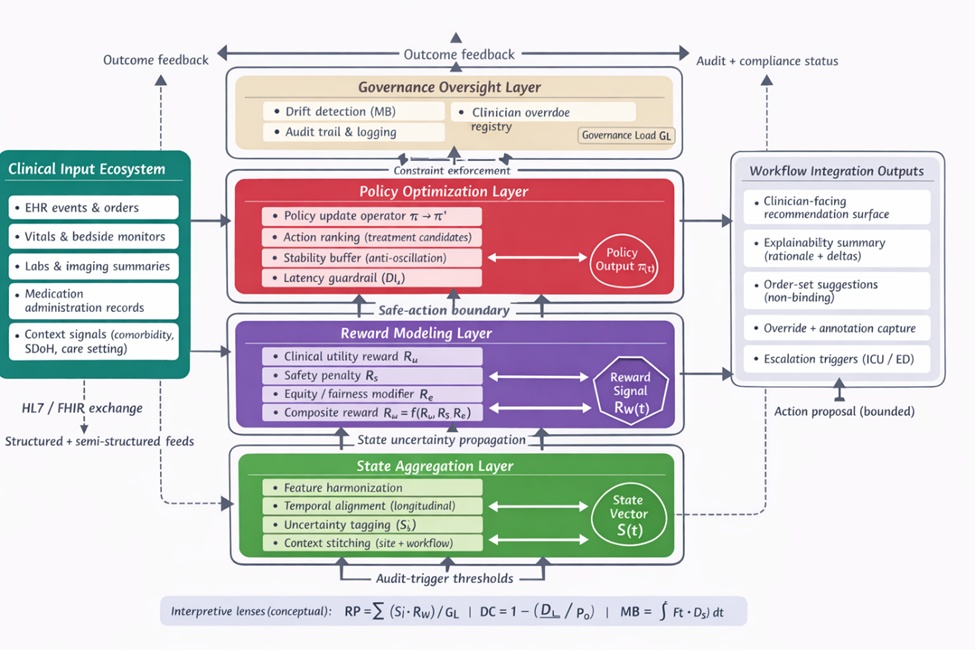
Figure 1. Reinforcement-governed treatment policy architecture (RGTPA) for clinical workflow integration.
RGTPA is depicted as a layered orchestration stack that converts heterogeneous clinical signals into a unified state representation, maps outcome-aligned reward constructs, refines treatment policy actions through bounded optimization, and applies a governance oversight envelope that audits drift, safety, and compliance. Bidirectional feedback links enforce continuous refinement: upward flows propagate state uncertainty and outcome feedback into policy recalibration, while downward flows apply constraint filters, audit triggers, and safe-action boundaries. Sidecar interoperability conduits (e.g., HL7 FHIR) connect EHR and ancillary systems to the stack, and clinician-facing decision surfaces support interpretability, override logging, and human-in-the-loop stabilization. RGTPA comprises four interdependent strata with explicit workflow roles and governance interfaces (Table 1).
Table 1. RGTPA layer-by-layer specification, clinical responsibilities, and governance interfaces.
RGTPA layer | Primary function (conceptual) | Inputs | Outputs | Workflow integration role | Governance touchpoints |
State aggregation layer | Harmonizes heterogeneous patient signals into a unified state space for policy reasoning | EHR events, vitals, labs, imaging summaries, medication history, contextual factors | State vector S(t) + uncertainty tags Sᵢ | Minimizes workflow disruption by reusing existing documentation streams and aligning to clinical tempo | Data quality gates; provenance logging; uncertainty thresholds; access control hooks |
Reward modeling layer | Defines outcome-aligned valuation under safety, equity, and protocol constraints | State transitions, outcome proxies, clinician annotations, policy boundaries | Composite reward Rw(t) and penalty modifiers | Converts clinical goals into interpretable value constructs that can be audited | Reward constraint registry; fairness modifiers; misalignment alarms; traceable reward decomposition |
Policy optimization layer | Produces bounded action proposals and stabilizes adaptation against oscillation/latency | State vector S(t), reward Rw(t), constraint envelope | Policy output π(t), ranked actions, confidence tags | Generates non-binding recommendations compatible with order sets and clinical decision timing | Safe-action boundaries; latency guardrails Dₗ; stability buffer rules; override capture |
Governance oversight layer | Audits drift, ensure compliance, and regulate permitted adaptation | Audit logs, drift signals, override patterns, compliance constraints | Constraint updates, audit flags, governance load Gₗ | Maintains clinician trust by making adaptation reviewable and reversible | Drift detection (MB); immutable audit trail; escalation triggers; policy envelope versioning |
To interpret system dynamics, consider the following conceptual formulas:
Risk Propagation:
Decision Confidence:
Monitoring Burden:
These formulas provide theoretical lenses for analyzing RGTPA’s infrastructural implications [7].
A Reinforcement-Governed Treatment Policy Architecture for Clinical Workflow Integration
The introduction of the reinforcement-governed treatment policy architecture (RGTPA) into clinical ecosystems unveils a complex web of governance dependencies that profoundly influence workflow dynamics. These dependencies arise from the interplay between reinforcement mechanisms and oversight protocols, in which policy adaptations are not autonomous but are tethered to multi-tiered governance structures [7, 8, 17-24]. In theoretical terms, governance acts as a modulating force, calibrating reinforcement signals to align with institutional policies, such as those governing data privacy and ethical decision-making in EHR-integrated environments [4, 12]. For example, in oncology workflows, dependencies might manifest as conditional reward thresholds that prevent aggressive policy shifts, thereby preserving clinician authority while allowing subtle reinforcements based on patient response patterns [9, 11].
Expanding on this, consider the operational ramifications in multidisciplinary teams, where governance dependencies could reallocate decision-making, potentially shifting from a human-centric to a hybrid model [25-27]. This redistribution introduces dynamics of interdependence, where layers within RGTPA—such as the Governance Oversight Layer—rely on upstream data fidelity from the State Aggregation Layer to enforce compliance checks [5, 13]. Potential bottlenecks emerge in resource-constrained settings, such as rural clinics, where high governance loads can exacerbate latency in policy updates, underscoring the sensitivity of infrastructure scalability [3, 10]. To interpret these dynamics quantitatively in a conceptual sense, extend the risk propagation formula:
Furthermore, workflow dynamics under RGTPA reveal adaptive resilience, as dependencies foster feedback topologies that self-correct for environmental variabilities, such as fluctuating patient volumes or interoperability challenges [6, 21]. Yet, over-reliance on governance could stifle reinforcement agility, creating trade-offs between robustness and responsiveness [8, 25]. In synthesizing these elements, RGTPA’s governance dependencies theoretically enhance policy stability, promoting sustainable integration across diverse clinical landscapes while mitigating propagation of unvetted adaptations [1, 2, 23].
The RGTPA framework contributes significantly to the theoretical landscape of AI in healthcare by proposing a reinforcement-governed approach to treatment policy orchestration, bridging gaps identified in prior architectures focused primarily on diagnostic rather than therapeutic integration [5, 6, 9]. Literature on clinical AI systems underscores the need for such adaptive models, yet often overlooks the nuanced governance required for workflow embedding [1, 3, 10]. RGTPA addresses this by conceptualizing layered structures that, in theory, harmonize reinforcement learning principles with clinical imperatives, such as real-time policy refinement in sepsis or diabetic management scenarios [2, 5, 13].
Key strengths lie in its focus on interoperability, drawing on data exchange frameworks to facilitate seamless policy flows across EHR ecosystems [4, 21]. However, theoretical limitations persist, including vulnerabilities to reward misalignment, where poorly defined signals could lead to suboptimal policy evolutions, echoing concerns in explainable AI reviews [23-25]. Human-AI interaction dynamics are another focal point; RGTPA’s transparent feedback topologies could theoretically reduce clinicians’ cognitive burden, as evidenced by human-centered deployment studies [12, 27]. Yet, this assumes ideal governance, and in practice—though remaining conceptual here—dependencies might introduce oversight fatigue, necessitating refined monitoring strategies [7, 8].
Key integration hazards and mitigation levers are summarized as architectural failure modes and control mechanisms (Table 2).
Table 2. Conceptual failure modes in reinforcement-governed treatment policy integration and architectural mitigation mechanisms.
Risk/failure mode | Where it manifests in RGTPA | Conceptual trigger | Expected clinical impact | Detection signal (architectural) | Mitigation lever (design control) |
Reward misalignment | Reward modeling → policy optimization | Reward proxies drift from clinical intent | Unintuitive or clinically implausible recommendations | Divergence between clinician overrides and reward gradients | Composite reward decomposition (Ru/Rs/Re), governance-approved reward envelopes, periodic reward audits |
Policy drift beyond the safe envelope | Policy optimization + governance oversight | Unchecked adaptation across time or sites | Escalating deviation from baseline protocols | Rising MB or increasing audit flags over time | Constraint filters, envelope versioning, rollback capability, and drift-triggered freeze of updates |
Over-adaptation to noisy data | State aggregation → reward modeling | Missingness, documentation lag, and inconsistent coding | Oscillatory treatment suggestions; reduced trust | Spikes in uncertainty tags Sᵢ, instability buffer activation | Thresholded updates, smoothing windows, consensus weighting across time, data-fidelity gates |
Latency inflation in urgent workflows | Policy optimization in ED/ICU | High governance load or computational overhead | Delayed decision support; clinician bypass | Increasing Dₗ relative to the target tempo | Latency guardrails, asynchronous updating, lightweight surrogate policy for critical pathways |
Oversight fatigue/governance overload | Governance oversight | Excessive audit alerts or manual review burden | Reduced compliance adherence; alert dismissal | Sustained high Gₗ and frequent escalations | Tiered audit severity, adaptive alert thresholds, summarized audit dashboards, and batching of noncritical reviews |
Interoperability bottlenecks | Input ecosystem + exchange rails | Fragmented EHR modules and interface variability | Incomplete state representation; blind spots | Dropouts in data feed completeness | Modular FHIR adapters, provenance tracking, fallback local caching, partial-state safe-mode |
Human–AI mismatch/low interpretability | Workflow outputs | Poor rationale, clarity, or opaque policy updates | Low adoption; increased overrides | High override rate without explanatory resolution | Explainability summaries + delta explanations, clinician annotation capture, and feeding reward calibration |
Equity regression across populations | Reward layer + governance | Population skew in signals and rewards | Disparate outcomes or biased suggestions | Fairness modifier instability; subgroup audit flags | Equity constraints embedded in reward, subgroup monitoring, and governance-mandated fairness checkpoints |
Broader implications extend to regulatory alignment, where RGTPA’s architecture supports compliance with evolving standards, potentially influencing future guidelines for AI deployment in critical care [14, 16]. Comparative synthesis with existing pipelines reveals RGTPA’s uniqueness in its bidirectional topology, which outperforms unidirectional models in theoretical drift resistance [15, 18]. Challenges, such as integration in legacy systems, warrant further conceptual exploration, perhaps through hybrid fusions with generative AI elements [19, 20]. Overall, this discussion positions RGTPA as a foundational infrastructure for advancing resilient, governed AI in healthcare, encouraging interdisciplinary refinements to enhance its theoretical applicability [11, 17, 22, 28].
In conclusion, the Reinforcement-Governed Treatment Policy Architecture (RGTPA) emerges as a robust conceptual paradigm for embedding adaptive, reinforcement-driven treatment policies within clinical workflows, emphasizing governance to ensure ethical and operational integrity. Through its multi-layered design and bidirectional feedback mechanisms, RGTPA theoretically optimizes decision support by aligning policy evolutions with real-time clinical data streams. At the same time, interoperability features facilitate seamless integration across fragmented healthcare infrastructures. The interpretive formulas for risk propagation, decision confidence, and monitoring burden provide valuable theoretical tools for dissecting system dynamics, highlighting trade-offs in governance dependencies and workflow sensitivities.
As AI continues to permeate healthcare, RGTPA offers pathways to mitigate common pitfalls such as policy drift and human-AI mismatches, drawing on synthesized literature to promote sustainable adoption. Future theoretical extensions could explore scalability in global health contexts or synergies with emerging modalities, reinforcing RGTPA’s role in fostering innovative, resilient clinical ecosystems. Ultimately, this architecture advances the discourse on AI-governed healthcare by advocating balanced reinforcement that prioritizes patient-centered outcomes across integrated workflows.
None
None
None
None
Open Access The author(s) retain copyright. This article is licensed under the Creative Commons Attribution-NonCommercial-ShareAlike 4.0 International License. It may be shared and adapted for non-commercial purposes with appropriate attribution, an indication of changes, and distribution of adaptations under the same license. Third-party material may be subject to separate terms identified in its credit line. View the license at https://creativecommons.org/licenses/by-nc-sa/4.0/.
 Clinical Intelligence Research Press