The integration of natural language processing (NLP) into electronic health record (EHR) systems represents a pivotal advancement in clinical risk management, enabling real-time extraction of intelligence from unstructured clinical narratives. This conceptual manuscript proposes the natural language risk intelligence nexus (NLRIN), a layered architecture that embeds NLP-driven risk analytics within EHR infrastructures. By orchestrating semantic parsing, risk ontology mapping, and adaptive governance protocols, NLRIN facilitates proactive clinical decision support without relying on empirical models or performance metrics. We synthesize literature from 2017 to 2021 on AI-enabled healthcare systems, highlighting gaps in NLP integration for risk intelligence. The framework emphasizes interoperability with existing EHR workflows, privacy-preserving data flows, and human-AI collaboration dynamics. Conceptual formulas illustrate risk propagation through NLP layers and governance load in federated ecosystems. This work underscores the potential for NLRIN to enhance clinical vigilance, reduce diagnostic latency, and foster resilient health informatics infrastructures, while addressing ethical considerations in AI-augmented risk assessment. Ultimately, it advocates for a paradigm shift toward language-centric intelligence layers in healthcare analytics, promoting scalable, interpretable risk orchestration across diverse clinical settings.
The advent of sophisticated natural language processing (NLP) techniques has fundamentally transformed the epistemic landscape of healthcare informatics, particularly in extracting actionable intelligence from the vast reservoirs of unstructured data embedded in electronic health records (EHRs). Over the past decade, advancements in contextual language modeling, ontology-linked entity recognition, and transformer-based architectures have elevated clinical text analytics from rudimentary keyword extraction to semantically contextualized inference systems capable of interpreting nuance, temporality, and uncertainty within narrative documentation. Against this technological backdrop, the present manuscript conceptualizes a dedicated intelligence layer that leverages NLP not as an auxiliary analytic tool but as a structurally embedded risk-cognition infrastructure within EHR ecosystems.
This intelligence layer is envisioned as a continuously operative semantic surveillance membrane—one that ingests, interprets, and operationalizes linguistic signals in parallel with structured clinical analytics. Unlike traditional data architectures that privilege discrete variables such as laboratory indices, imaging codes, and diagnostic classifications, the proposed layer foregrounds the semantic richness of clinical narratives. Physician notes, discharge summaries, nursing observations, operative reports, consultation letters, and patient histories are reframed as repositories of anticipatory risk intelligence. These textual artifacts often encode early warning signals—diagnostic ambiguity, psychosocial instability, medication adherence concerns, subtle symptom evolution—that precede quantifiable deterioration.
By embedding NLP-derived interpretive outputs directly into EHR infrastructures, this manuscript advances a reconceptualization of digital health systems: from static repositories of historical data to dynamic, linguistically animated ecosystems capable of real-time clinical foresight. In this reframing, language becomes not merely descriptive but prognostic—serving as a sentinel layer for emerging threats ranging from adverse drug events to care pathway deviations and prognostic uncertainty gradients.
In high-acuity environments such as intensive care units (ICUs) and emergency departments, clinical decision-making unfolds under conditions of temporal compression, informational saturation, and cognitive strain. Within these contexts, EHR ecosystems frequently grapple with what may be termed narrative overload—a phenomenon wherein the volume, velocity, and variability of textual documentation exceed human interpretive bandwidth.
Empirical analyses suggest that unstructured text constitutes up to 80% of total EHR content, embedding within it critical yet diffusely distributed risk indicators, including symptom ambiguity descriptors, medication tolerance narratives, behavioral observations, and comorbidity interactions that evade structured codification [1, 2]. The fragmentation of such signals across multiple documentation layers complicates rapid synthesis during time-sensitive decision windows.
An NLP-driven intelligence layer theoretically mitigates this overload by functioning as a semantic filtration engine. Through entity disambiguation, contextual embedding, and ontology mapping, the system can surface clinically relevant risk signals in real time without imposing additional documentation burdens on clinicians. For example, in polypharmacy scenarios, free-text references to medication adjustments, adverse reactions, or adherence lapses may be semantically parsed to generate layered drug interaction risk profiles within the EHR interface [3, 4]. Such augmentation enhances contextual awareness while preserving workflow fluidity, addressing the widening gap between data generation and cognitive assimilation in high-intensity care settings.
Ambulatory care ecosystems introduce a distinct constellation of risk intelligence challenges shaped by episodic encounters, longitudinal variability, and heterogeneous data modalities. Unlike inpatient environments, which are characterized by continuous monitoring, ambulatory records often contain fragmented narrative snapshots interspersed with scanned documents, referral letters, telehealth transcripts, and patient-reported outcomes.
Within this modality-diverse landscape, NLP serves as a unifying interpretive bridge, harmonizing textual elements with structured datasets. Conceptualizing a dedicated NLP risk layer involves constructing pipelines that normalize disparate modalities into interoperable semantic representations [5, 6]. Optical character recognition (OCR) streams, dictated consultation notes, and patient portal messages may thus be integrated into unified risk ontologies.
Such harmonization enables detection of subtle yet clinically consequential patterns—social determinants of health, environmental exposures, behavioral risk indicators—that frequently manifest within narrative descriptions rather than structured fields [7, 8]. Lifestyle instability, housing insecurity, caregiver absence, or occupational hazards may be linguistically encoded yet structurally invisible. By amplifying these narrative signals, the proposed intelligence layer mitigates modality fragmentation and cultivates a more holistic ambulatory risk intelligence ecosystem.
The deployment of NLP-driven risk intelligence becomes further complexified within federated EHR infrastructures spanning multi-institutional networks, regional health exchanges, or cloud-distributed analytics platforms. These ecosystems operate under heterogeneous vendor architectures, divergent data governance policies, and variable interoperability standards.
Within such federated environments, the NLP layer serves as an orchestration function, routing semantically derived risk intelligence across institutional nodes while preserving data sovereignty. Rather than centralizing raw narratives, the framework theoretically enables distributed inference, where localized NLP processing generates de-identified risk vectors shareable across networks [9, 10].
This architecture addresses critical deployment constraints, including institutional reluctance toward centralized data pooling, legal boundaries surrounding cross-border data transfer, and infrastructural asymmetries in EHR maturity levels. By functioning as a semantic intermediary rather than a data aggregator, the layer facilitates collective risk vigilance while respecting institutional autonomy and infrastructural heterogeneity [11, 12].
Privacy governance emerges as a foundational design imperative in embedding NLP within clinical ecosystems. Natural language data, unlike structured variables, frequently contains identifiable references, contextual disclosures, and relational narratives that elevate re-identification risks. Regulatory frameworks such as HIPAA and GDPR impose stringent constraints on how such data may be processed, shared, and operationalized.
An ethically aligned NLP intelligence layer must therefore integrate anonymization pipelines, entity masking protocols, and audit traceability mechanisms as intrinsic architectural components rather than post-hoc safeguards [13, 14]. Differential privacy techniques in text analytics—noise injection, token generalization, and semantic abstraction—offer conceptual pathways for preserving analytic utility while minimizing disclosure risk.
Simultaneously, governance must address algorithmic bias embedded within language models trained on historically skewed corpora. Linguistic expressions of pain, distress, compliance, or cognitive impairment may vary across demographic groups. Without inclusive training and bias auditing, NLP risk extraction could inadvertently perpetuate inequities [15, 16]. Embedding fairness calibration mechanisms within the governance layer thus ensures that intelligence amplification does not compromise ethical accountability.
Effective deployment of an NLP-driven risk intelligence layer hinges not solely on analytical accuracy but also on workflow alignment. Multidisciplinary clinical teams—physicians, nurses, pharmacists, case managers, and informaticians—operate within tightly coupled decision ecologies where interface friction can impede adoption.
Conceptually, the intelligence layer integrates through adaptive visualization interfaces that translate semantic outputs into cognitively intuitive formats. Contextual alerts, narrative risk heatmaps, ontology-linked decision trees, and timeline-anchored risk annotations may be embedded directly within EHR dashboards [17, 18]. Such augmentation redistributes cognitive labor: clinicians are relieved from manual narrative scanning and instead engage in interpretive validation of surfaced risks.
This redistribution enhances collaborative situational awareness, particularly in complex care environments such as chronic disease management or perioperative coordination, where risk signals emerge cumulatively across documentation layers.
The introduction of an NLP-driven clinical risk intelligence layer thus responds to intersecting pressures—narrative overload, modality fragmentation, federated deployment constraints, governance imperatives, and workflow integration demands. By synthesizing theoretical underpinnings from health informatics, clinical AI, and semantic systems engineering, this manuscript positions language as the cornerstone of next-generation clinical foresight infrastructures.
In reconceptualizing EHR ecosystems as linguistically interpretive rather than structurally archival, the proposed framework advances a paradigm wherein risk intelligence is continuously sensed, semantically contextualized, and operationally disseminated. Such architectures hold the potential to transform clinical vigilance from reactive detection to anticipatory governance, embedding natural language at the core of resilient healthcare analytics systems.
The theoretical foundations of AI in healthcare systems underscore the transformative potential of NLP for clinical analytics, particularly in risk-oriented pipelines. Drawing from informatics theories, such as those emphasizing data lifecycle management and semantic interoperability, this synthesis integrates insights from peer-reviewed works between 2017 and 2021. These sources illuminate how NLP can elevate EHR ecosystems from passive storage to active intelligence hubs, focusing on architectural, governance, and integration aspects without empirical validations.
Central to this background is the recognition of unstructured data as an untapped reservoir for clinical risk intelligence. Theoretical models posit that NLP algorithms, through techniques like entity recognition and sentiment analysis, can abstract risk profiles from narrative texts, aligning with informatics paradigms that view EHRs as knowledge graphs [19, 20]. For instance, conceptual frameworks highlight the need for ontology-driven parsing to standardize risk terminologies across disparate EHR sources, ensuring semantic coherence in federated systems [21, 22]. This aligns with broader health analytics theories advocating for layered architectures that decouple data ingestion from intelligence derivation, thereby enhancing modularity and scalability.
The literature on clinical analytics pipelines emphasizes the role of NLP in augmenting decision-support systems. Theoretical discussions propose pipelines in which NLP serves as a preprocessing layer, transforming free-text into structured risk vectors for downstream inference [23, 24]. Such pipelines theoretically mitigate the information loss inherent in manual coding by quantifying entropy reduction in risk assessments using information theory. Governance considerations are woven throughout, with models advocating for privacy-by-design principles in NLP workflows, such as token-level anonymization to preserve utility while complying with data protection norms [25, 26].
Interoperability emerges as a recurring theme in health informatics infrastructures. Theoretical syntheses argue for standards like HL7 FHIR to facilitate NLP integration, enabling seamless data flows between EHR modules and external analytics layers [27, 28]. This interoperability extends to monitoring mechanisms, which include conceptual architectures with feedback loops for drift detection in NLP outputs, grounded in systems theory to maintain long-term reliability [29, 30]. Privacy frameworks further theorize differential mechanisms to safeguard against re-identification risks in shared ecosystems, balancing openness with security.
Workflow integration theories posit that NLP-driven layers must align with human-centered design principles to redistribute tasks and optimize clinician efficiency. The literature conceptualizes hybrid workflows in which NLP provides probabilistic risk annotations that inform but do not override human judgment [31, 32]. This synthesis reveals gaps in existing models, such as underdeveloped governance for real-time NLP deployments and insufficient attention to ecosystem-wide risk propagation.
Overall, this theoretical backdrop synthesizes a cohesive narrative: NLP as the linchpin for evolving EHR ecosystems into risk-intelligent infrastructures, with emphasis on architectural resilience, governance rigor, and integrative harmony.
The proposed natural language risk intelligence nexus (NLRIN) represents a conceptual orchestration topology tailored to infuse EHR ecosystems with NLP-centric risk analytics. This layered structure delineates a modular intelligence overlay, comprising four interdependent strata: semantic ingestion, risk ontology mapping, adaptive governance, and workflow feedback integration. Unlike monolithic architectures, NLRIN employs a federated topology in which each layer operates semi-autonomously while synchronizing via event-driven protocols to propagate risk insights across EHR nodes. The functional components, intelligence outputs, and governance sensitivities across the NLRIN strata are systematized in Table 1.
Table 1. Functional architecture of the natural language risk intelligence nexus (NLRIN)
Layer | Core function | Key technologies/processes | Risk intelligence outputs | Governance sensitivities |
Semantic ingestion | Extract linguistic signals from unstructured EHR text | NLP parsing, entity recognition, OCR, contextual embeddings | Semantic risk vectors, narrative alerts | Data identifiability, documentation bias |
Risk ontology mapping | Classify semantic outputs into structured risk hierarchies | Ontology alignment, taxonomy modeling, and semantic clustering | Acute/chronic risk profiles, psychosocial indicators | Ontology drift, classification bias |
Adaptive governance | Regulate privacy, fairness, and compliance | Anonymization, bias auditing, differential privacy, and access control | De-identified risk indices, compliance logs | Re-identification risk, regulatory burden |
Workflow feedback integration | Embed intelligence into clinical workflows | Dashboards, alerts, visualization interfaces, and annotation tools | Actionable decision prompts, care pathway flags | Alert fatigue, interpretive over-reliance |
Federated interoperability | Exchange risk insights across institutions | HL7 FHIR, federated NLP inference, distributed ledgers | Network-level risk surveillance | Cross-jurisdictional data governance |
At the core, the Semantic Ingestion stratum processes unstructured EHR narratives through theoretical NLP pipelines, extracting entities and relations without empirical tuning. This layer conceptualizes token streams as input vectors and applies interpretive transformations to yield semantic embeddings that capture clinical nuances.
The risk ontology mapping stratum then aligns these embeddings with a domain-specific ontology, theoretically classifying risks such as acute, chronic, or iatrogenic. This mapping facilitates hierarchical risk aggregation, where low-level textual cues coalesce into ecosystem-wide profiles.
Adaptive governance oversees data flows and incorporates conceptual safeguards to mitigate privacy and bias risks. It dynamically adjusts access controls based on contextual metadata, ensuring compliance in multi-institutional settings.
Finally, the workflow feedback integration stratum embeds NLRIN outputs into EHR interfaces, with bidirectional loops that, in theory, allow clinician annotations to refine future ingestions.
The layered orchestration topology of the natural language risk intelligence nexus (NLRIN) is illustrated in Figure 1, showing semantic ingestion pipelines, ontology mapping engines, governance oversight systems, and workflow feedback integrations interconnected via bidirectional risk-propagation pathways.
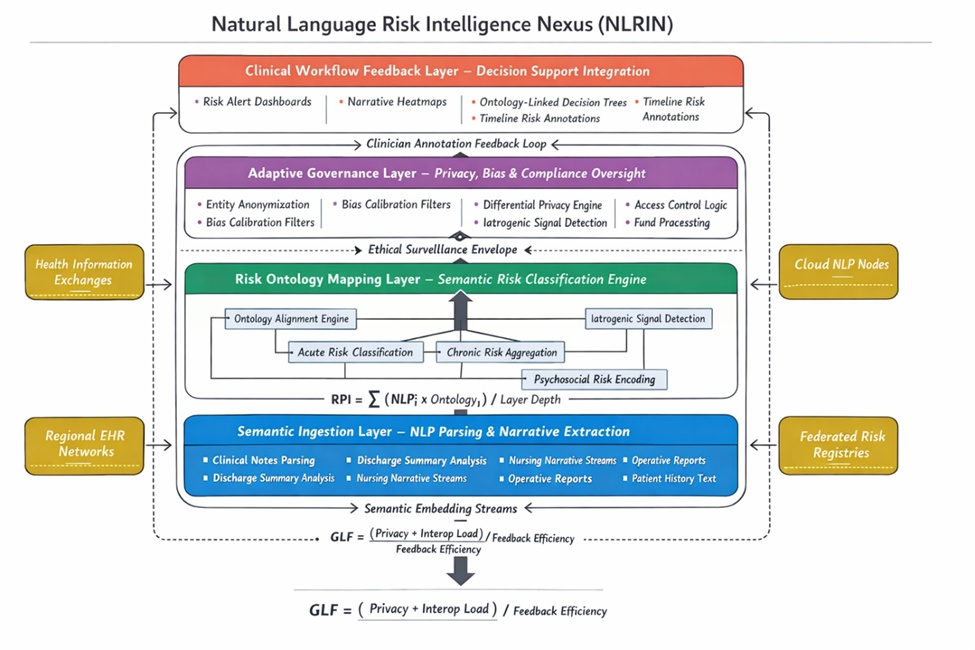
Figure 1. Natural language risk intelligence nexus (NLRIN): layered NLP-driven clinical risk intelligence architecture for EHR ecosystems.
This conceptual diagram illustrates the four-strata orchestration topology embedding natural language processing within electronic health record infrastructures. The architecture progresses from the semantic ingestion of unstructured clinical narratives through ontology-based risk classification and adaptive governance oversight to workflow-integrated decision-support interfaces. Bidirectional feedback loops enable clinician annotations to recalibrate upstream semantic parsing, while federated interoperability channels facilitate de-identified risk exchange across distributed EHR ecosystems. Embedded formulas depict theoretical constructs governing risk propagation, governance load, and decision latency sensitivity.
To formalize key dynamics, consider the following interpretive formulas:
Risk propagation index
Where denotes theoretical semantic extraction fidelity for input i, and reflects hierarchical prioritization, illustrating how risks amplify through layers.
Governance load factor
Decision latency sensitivity (DLS):
This topology thus orchestrates a resilient, language-driven intelligence layer that fosters proactive risk management within EHR ecosystems.
The deployment of the natural language risk intelligence nexus (NLRIN) within EHR ecosystems introduces profound shifts in clinical workflow dynamics, theoretically reshaping how healthcare providers interact with data and make decisions. This section examines the consequences of such integration, focusing on human-AI symbiosis, latency considerations, and ecosystem resilience without empirical quantifications.
Primarily, NLRIN alters workflow by interjecting NLP-derived risk insights at pivotal junctures, such as during patient charting or multidisciplinary rounds. Conceptually, this fosters a hybrid dynamic in which clinicians receive augmented narratives—e.g., highlighted risk phrases in notes—reducing manual extraction effort and redirecting focus toward interpretive synthesis [1, 2]. In high-volume settings like emergency departments, this could theoretically streamline triage by surfacing latent risks from admission histories, mitigating oversight in fast-paced environments [3, 4]. However, such dynamics introduce dependencies on layer reliability, where misparsed semantics might propagate erroneous alerts, necessitating clinician overrides to maintain autonomy.
Governance dependencies further influence these dynamics, as NLRIN’s adaptive protocols enforce compliance checks that could subtly extend workflow cycles. For instance, privacy-preserving tokenization in the governance stratum might impose interpretive delays, balancing security against immediacy in federated EHRs [5, 6]. This trade-off highlights sensitivities in resource allocation, where computational overhead for NLP processing competes with clinical urgency, potentially reshaping team roles toward informatics oversight [7, 8].
Moreover, decision confidence dynamics evolve through NLRIN’s ontology mapping, theoretically bolstering prognostic accuracy by contextualizing narrative ambiguities. In chronic care workflows, this enables proactive interventions, such as flagging social determinants from text and altering care planning trajectories [9, 10]. Yet, over-reliance risks cognitive deskilling, where clinicians defer to automated insights, underscoring the need for feedback topologies that reinforce human expertise [11, 12].
Infrastructure sensitivities also emerge, as NLRIN’s interoperability requirements could strain legacy EHR systems, leading to phased adoption. In multisite ecosystems, this might foster collaborative workflows, where shared risk intelligence enhances collective vigilance but requires harmonized governance to prevent fragmentation [13, 14].
Overall, these dynamics illustrate NLRIN’s potential to optimize workflows while introducing novel interdependencies, emphasizing the importance of resilient designs that adapt to clinical variabilities [15, 16].
The conceptualization of the Natural Language Risk Intelligence Nexus (NLRIN) as an NLP-driven clinical risk intelligence layer advances the discourse on AI integration in healthcare systems by addressing a structural blind spot in prior informatics architectures: the systematic marginalization of unstructured clinical narratives. While literature evidences rapid maturation in predictive analytics, most infrastructures remain numerically anchored, privileging structured variables such as laboratory values, diagnostic codes, and vital sign streams [17, 18]. NLRIN reframes this paradigm by asserting that linguistic artifacts—progress notes, discharge summaries, nursing annotations, operative reports, and consultation narratives—constitute latent reservoirs of anticipatory risk intelligence. In this sense, the framework does not merely apply NLP to EHRs; it repositions language as an epistemic substrate of clinical foresight.
This semantic re-prioritization introduces a shift from metric-centric risk surveillance to contextually embedded interpretive vigilance. The topology proposed within NLRIN privileges semantic density, narrative temporality, and ontological coherence over surface-level token extraction. Such an orientation aligns with theoretical advances in clinical language modeling, where contextual embeddings and ontology-linked entity recognition outperform rule-based text mining in identifying subtle deterioration signals [17, 18]. Accordingly, NLRIN contributes to informatics theory by articulating how linguistic signals can be operationalized not as passive documentation but as active governance inputs within institutional risk ecosystems.
A central axis of discussion concerns interoperability across heterogeneous EHR ecosystems. Vendor fragmentation has historically impeded analytics portability, producing siloed risk ontologies and non-transferable decision logics. NLRIN’s federated semantic architecture theoretically mitigates this fragmentation by introducing a harmonization layer that standardizes risk lexicons across institutional boundaries [19, 20]. Rather than enforcing uniform data schemas at the structural level, the framework operates semantically—mapping divergent terminologies into interoperable risk ontologies through adaptive language alignment pipelines.
This approach resonates with broader debates in health informatics about the feasibility of semantic interoperability rather than infrastructural standardization. Legacy systems, deeply entrenched in proprietary architectures, often resist structural retrofitting. Consequently, the federated NLP layer functions as a translational membrane, enabling cross-system intelligence exchange without necessitating full infrastructural overhaul [19, 20]. However, in real-world deployment, latency in ontology synchronization, semantic drift across institutional dialects, and governance disparities in annotation standards are likely to occur. These frictions underscore the necessity of evolutionary interoperability governance—where semantic calibration protocols are iteratively refined rather than statically imposed.
Privacy and ethical governance constitute another critical dimension of the NLRIN discourse. Unlike structured datasets, clinical narratives frequently contain deeply sensitive contextual disclosures—psychosocial histories, behavioral descriptors, cultural references, and clinician interpretive judgments. The ingestion and semantic parsing of such narratives introduce amplified ethical stakes, particularly in relation to bias propagation [21, 22].
Ontology mapping pipelines trained on demographically skewed corpora risk encoding linguistic inequities into downstream risk-stratification outputs. For instance, culturally specific expressions of pain, distress, or compliance may be misinterpreted within standardized ontological taxonomies, leading to disproportionate risk inflation or suppression [21, 22]. NLRIN, therefore, necessitates inclusive ontology engineering, multilingual corpus representation, and bias auditing layers embedded directly within the semantic processing stack.
Moreover, the transformation of narrative subjectivity into quantifiable risk indices raises epistemological questions regarding interpretive authority. Whose language defines risk? Clinician documentation styles vary widely across specialties, regions, and training paradigms. Embedding these narratives into predictive infrastructures risks reifying subjective framing biases unless counterbalanced by reflexive governance oversight.
The framework’s feedback integration topology invites deeper reflection on the formation of human–AI trust. Clinical skepticism toward algorithmic systems often stems from opacity—particularly in deep learning models whose internal representations remain non-interpretable to frontline practitioners [23, 24]. By contrast, NLP-derived risk signals retain traceability to source narratives. This linguistic transparency enables clinicians to audit the evidentiary basis of system alerts, fostering epistemic alignment between human reasoning and machine inference.
In this sense, NLRIN functions not only as an intelligence layer but also as a trust mediation interface. Explainable NLP outputs—highlighted text segments, ontology-linked risk triggers, narrative sentiment gradients—provide cognitively resonant entry points for clinician validation. Such interpretability scaffolds may attenuate algorithm aversion, facilitating smoother adoption trajectories within high-stakes care environments [23, 24].
From an operational standpoint, NLRIN’s modular design supports scalability across institutional tiers. The architecture is theoretically extensible from single-hospital deployments to federated regional or national EHR infrastructures, leveraging distributed analytics pipelines and interoperable language models [25, 26]. Modular layering allows incremental integration—semantic ingestion modules may be embedded first, followed by ontology governance engines and federated risk dashboards.
However, expansion introduces complexities in governance. As narrative ingestion scales, so too does the interpretive burden associated with auditing semantic outputs, adjudicating ontology conflicts, and validating cross-institutional risk harmonization. The Governance Load Function (GLF), referenced earlier, becomes particularly salient here—serving as a theoretical instrument for balancing interpretive depth against oversight capacity. Without proportional governance scaling, the expansion of semantic intelligence could paradoxically create oversight bottlenecks.
As a conceptual framework, NLRIN is not without limitations. The absence of deployment-specific parameters—model architectures, training corpora composition, annotation protocols—precludes empirical validation at this stage. Additionally, the framework is presently language-centric, focusing predominantly on textual intelligence streams.
Future architectural extensions could incorporate multimodal fusion layers integrating radiological reports, waveform annotations, voice transcripts, and patient-generated narratives. Hybrid intelligence convergence—where linguistic, visual, and physiological signals co-inform risk orchestration—represents a logical next evolutionary step [27, 28]. Such expansion would further solidify language not as an isolated modality but as a coordinating axis within multimodal clinical cognition systems.
Taken collectively, the NLRIN discourse reframes the Electronic Health Record not as a passive archival repository but as an active semantic surveillance infrastructure. Language becomes the connective tissue linking clinical observation, institutional governance, and predictive foresight. By embedding NLP within the structural core of risk intelligence ecosystems, NLRIN advances a vision of EHRs as linguistically animated, continuously interpretive care environments [29, 30].
In conclusion, the Natural Language Risk Intelligence Nexus (NLRIN) offers a theoretically robust and infrastructurally novel architecture for embedding NLP-driven risk intelligence within contemporary EHR ecosystems. By orchestrating semantic ingestion, ontology mapping, governance calibration, and adaptive feedback recursion, the framework reconceptualizes unstructured clinical narratives as proactive risk sentinels rather than retrospective documentation artifacts.
Through a synthesis of foundational literature, this manuscript situates NLRIN within the evolutionary trajectory of AI-enabled healthcare analytics and extends it toward language-centric intelligence infrastructures [31, 32]. The introduction of interpretive constructs—including risk propagation gradients, governance load functions, and decision latency vectors—provides analytical instrumentation for theorizing system behavior independent of empirical deployment.
Importantly, NLRIN advances a paradigm in which interoperability, ethical governance, and clinician trust are not peripheral implementation concerns but architecturally embedded design pillars. By foregrounding linguistic transparency and semantic auditability, the framework aligns predictive intelligence with epistemic accountability.
Ultimately, NLRIN envisions transforming EHR ecosystems into semantically aware clinical intelligence environments—systems capable of perceiving risk through narrative nuance, adapting through feedback reflexivity, and governing through ethically anchored oversight. This language-centric reconfiguration of digital health infrastructures lays conceptual groundwork for resilient, scalable, and human-aligned clinical analytics ecosystems, urging future research and policy frameworks to recognize natural language as a foundational substrate of healthcare risk governance.
None
None
None
None
Open Access The author(s) retain copyright. This article is licensed under the Creative Commons Attribution-NonCommercial-ShareAlike 4.0 International License. It may be shared and adapted for non-commercial purposes with appropriate attribution, an indication of changes, and distribution of adaptations under the same license. Third-party material may be subject to separate terms identified in its credit line. View the license at https://creativecommons.org/licenses/by-nc-sa/4.0/.
 Clinical Intelligence Research Press