Ovarian cancer, particularly high-grade serous carcinoma, is highly lethal, and accurate survival prediction is essential for treatment planning. However, traditional prognostic models rely on limited clinical and histologic features, while deep learning approaches require expensive pixel-level annotations of whole-slide histopathology images, limiting scalability. We propose a weakly supervised attention-based multiple instance learning (MIL) framework that predicts ovarian cancer survival using only slide-level survival labels. Each whole-slide image is treated as a bag of patches, where a patch encoder extracts features using a pre-trained CNN or vision transformer. An attention-based MIL aggregator assigns importance weights to patches, and a survival head outputs a risk score via a deep Cox model. The attention mechanism enhances interpretability by identifying prognostically relevant regions such as aggressive tumor morphology, stromal patterns, and immune infiltration. This reduces the need for manual annotation while preserving clinical relevance. The framework provides a scalable and interpretable approach for survival prediction and can be evaluated on datasets such as TCGA-OV and CPTAC for clinical translation.
Ovarian cancer accounts for approximately 300,000 new cases and 200,000 deaths annually worldwide, with high-grade serous carcinoma representing the most common and aggressive subtype. Despite advances in debulking surgery and platinum-based chemotherapy, five-year survival rates remain below 45% due to late-stage diagnosis and intrinsic or acquired chemoresistance [1, 2]. Histopathological assessment of tumor architecture, nuclear grade, mitotic count, and stromal response provides prognostic information that complements clinical staging, but manual evaluation is subjective and semiquantitative [3, 4].
Deep learning has emerged as a powerful tool for extracting prognostic signatures from whole-slide images (WSIs), but most supervised approaches require pixel-level annotations of tumor regions, stroma, and necrosis. Generating such annotations at the gigapixel scale is prohibitively expensive, requiring hundreds of hours of pathologist time per dataset, and introduces inter-observer variability that degrades model generalizability [5, 6]. The requirement for fine-grained labels fundamentally limits the scalability of supervised methods to large multicenter cohorts where only slide-level diagnoses and outcomes are routinely available [7, 8].
Multiple instance learning (MIL) offers a compelling alternative by treating each WSI as a bag of patches (instances) with a single slide-level label, thereby eliminating the need for patch-level annotations. In the MIL paradigm, a WSI is positive for a given label if at least one patch contains the relevant feature, and negative otherwise, enabling weakly supervised classification without pixel-wise supervision [9, 10]. For survival prediction, each slide is associated with a censored survival time, and the MIL aggregator learns to identify patches whose features correlate with patient outcomes [7, 11].
This article presents a conceptual framework for attention-based MIL specifically designed for ovarian cancer survival prediction from WSIs without pixel-level annotations. The framework integrates three key innovations: a patch encoder that converts histopathology patches into compact feature vectors using pre-trained convolutional or transformer architectures; a gated attention mechanism that learns to weight patches by prognostic relevance; and a deep Cox survival head that outputs risk scores from aggregated bag embeddings [2, 12]. The following sections detail the background, architecture, training considerations, and evaluation strategies for this framework.
Ovarian cancer encompasses multiple histological subtypes with distinct molecular profiles, clinical behaviors, and prognostic implications. High-grade serous carcinoma (HGSC) accounts for approximately 70% of cases and is characterized by marked nuclear atypia, high mitotic index, and characteristic slit-like spaces, with most patients presenting at advanced stage (III/IV) [1, 2]. Clear cell carcinoma (10%) exhibits hobnail cells and hyaline globules, often associated with endometriosis and paradoxically poor prognosis in early-stage disease, while endometrioid (10%) and mucinous (3%) subtypes have more favorable outcomes when diagnosed early [3, 4].
Prognostic histologic features in ovarian cancer include tumor budding, desmoplastic stromal reaction, tumor-infiltrating lymphocytes (TILs), and necrosis, all of which vary substantially across regions within a single WSI. Manual assessment of these features requires exhaustive slide review and suffers from moderate inter-rater agreement, motivating automated approaches that can systematically quantify morphological heterogeneity [1, 7]. The spatial distribution of prognostic features—for example, TILs at the invasive front versus tumor core—further complicates manual assessment but can be captured by patch-based MIL models.
Survival prediction in oncology typically employs the Cox proportional hazards model, which assumes that covariates multiplicatively shift the baseline hazard function without requiring specification of its shape. The model estimates hazard ratios for clinical variables such as age, stage, and residual disease status, with the concordance index (C-index) measuring the probability that a model correctly ranks the survival times of two randomly selected patients [2, 8]. However, clinical variables alone explain only a fraction of survival variance, motivating the integration of high-dimensional histopathology data.
Deep survival models extend the Cox framework by replacing the linear risk score with a neural network that learns nonlinear transformations of input features. For WSI-based prediction, the challenge lies in aggregating millions of patch-level features into a slide-level representation that preserves prognostic information while handling censored observations [7, 11]. MIL formulations naturally accommodate this structure by treating each WSI as a bag from which a risk score is derived, with the partial likelihood loss providing unbiased gradient estimates for censored data [9, 12].
MIL operates under the assumption that labels are available for bags of instances rather than for individual instances, with the bag label determined by the presence of at least one positive instance in binary classification (standard MIL) or by aggregation of instance-level signals in more general settings. For survival prediction, the bag label is not binary but rather a censored continuous outcome, requiring the MIL aggregator to produce a bag-level risk score that reflects the maximum or weighted average of instance-level prognostic signals [9, 11]. Traditional MIL aggregators include max pooling (selecting the instance with highest risk score), mean pooling (averaging all instances), and noisy-or pooling, each with distinct bias-variance tradeoffs [10].
Attention-based MIL replaces fixed pooling operations with a learnable weighted average where attention scores are computed via a small neural network applied to each instance feature vector [9]. The attention mechanism allows the model to focus on prognostically informative patches while downweighting irrelevant regions such as background, necrosis, or normal tissue. Unlike max pooling, which discards all but one instance, attention-based aggregation preserves information from multiple relevant patches, which is critical for survival prediction where the outcome reflects cumulative tumor burden rather than a single extreme region [1, 7].
The proposed framework processes a whole-slide image through four sequential stages: patch extraction, patch encoding, attention-based MIL aggregation, and survival prediction. First, the WSI is tiled into non-overlapping or overlapping patches at a fixed magnification (typically 20× or 40×), with tissue detection removing background areas containing no cellular material [8, 12]. Second, each patch is passed through a pre-trained feature extractor (e.g., ResNet50, EfficientNet-B4, or a vision transformer) that outputs a low-dimensional feature vector, typically 256 to 512 dimensions, capturing morphological characteristics such as nuclear shape, chromatin texture, and glandular architecture [13, 14].
Third, the set of patch feature vectors is input to an attention-based MIL module that computes a single bag embedding as the attention-weighted sum of patch features. The attention weights are learned via a gated attention mechanism that can capture complex, nonlinear relationships between patch features and survival outcomes [1, 9]. Fourth, the bag embedding is passed through a survival prediction head—typically a multilayer perceptron with one or two hidden layers—that outputs a risk score, which is optimized using the Cox partial likelihood loss function that accounts for right-censored survival data [7, 12].
Figure 1 shows the proposed framework organizing weakly supervised ovarian cancer survival prediction as a strictly sequential pipeline that links whole-slide patch extraction, feature encoding, attention-based multiple instance aggregation, survival risk modeling, and clinically interpretable validation outputs.
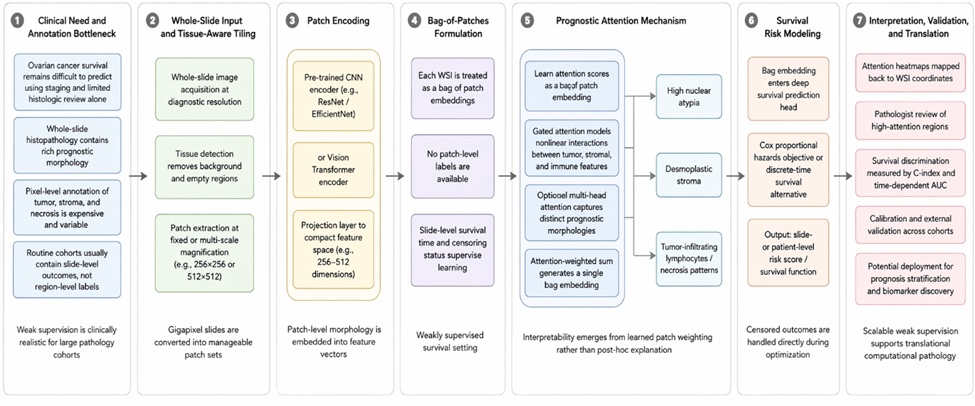
Figure 1. Conceptual Architecture of Attention-Based Multiple Instance Learning for Weakly Supervised Ovarian Cancer Survival Prediction from Whole-Slide Histopathology
The framework assumes that slide-level survival labels (time-to-event and censoring status) are available for all training WSIs, but no pixel-level annotations of tumor regions, stroma, or other histological structures are required. This weakly supervised setting is clinically realistic because cancer registries and biobanks routinely collect survival follow-up data alongside diagnostic slides, whereas pixel-level annotations are rarely available except in small research cohorts [2, 8]. The framework further assumes that WSIs are digitized at sufficient resolution (minimum 20× magnification) to resolve cellular and nuclear details relevant to prognosis, as lower magnification loses discriminative information about nuclear atypia and mitotic figures [5, 6].
A sufficient number of WSIs (typically >200) is necessary to train attention-based MIL models without overfitting, given that each WSI contributes only one survival label despite containing thousands of patches. The framework assumes that survival times are right-censored (e.g., patients alive at last follow-up) and that censoring is non-informative—that is, the censoring mechanism does not depend on unobserved prognostic factors that also affect survival [7, 11]. For multicenter applications, the framework assumes that slide preparation (fixation, sectioning, staining) and digitization protocols are sufficiently standardized or that domain adaptation techniques can mitigate batch effects [8, 12].
The framework is designed around three core principles: weak supervision, interpretability, and scalability. Weak supervision eliminates the requirement for pixel-level annotations by learning directly from slide-level survival labels, dramatically reducing the cost and expertise required for dataset curation. This principle enables rapid deployment on large archival cohorts where only diagnostic slides and follow-up data exist, making the framework suitable for real-world clinical settings where pathologist time is a scarce resource [1, 7].
Interpretability is achieved through the attention mechanism itself, which assigns weights to individual patches that can be visualized as heatmaps over the original WSI. High-attention patches reveal which morphological features the model considers prognostic, enabling pathologist validation and hypothesis generation about novel histological correlates of survival [2, 9]. Scalability to gigapixel images (typically 100,000×100,000 pixels) is achieved by processing patches independently and aggregating via attention, which has linear complexity in the number of patches and can be parallelized across GPU memory using techniques such as gradient checkpointing and mixed-precision training [8, 12].
The first processing step extracts a set of patches from each WSI, typically at a size of 256×256 or 512×512 pixels at 20× magnification, corresponding to approximately 130×130 µm or 260×260 µm of tissue area. Non-overlapping tiling is computationally efficient and avoids redundant processing, but overlapping sampling (e.g., 50% overlap) can improve spatial coverage and reduce boundary artifacts at the cost of increased patch count [5, 6, 8]. Tissue detection algorithms based on Otsu thresholding or pretrained segmentation networks remove background patches containing no cellular material, reducing the number of patches per WSI from hundreds of thousands to tens of thousands and focusing computational resources on informative regions [13, 14].
Patch size and magnification must balance resolution of cellular details against contextual information. Smaller patches (256×256) at higher magnification (40×) better resolve nuclear atypia and mitotic figures but lose glandular architecture, whereas larger patches (512×512) at lower magnification (10×) preserve tissue topology but may average over heterogeneous regions [1, 7]. For ovarian cancer, a multi-scale approach using two patch sizes (e.g., 256×256 at 20× for cellular features and 512×512 at 5× for architectural features) can capture complementary prognostic signals, though this increases computational requirements [2, 12].
Each extracted patch is transformed into a low-dimensional feature vector using a pre-trained convolutional neural network (CNN) or vision transformer (ViT) that has been trained on histopathology or natural images. Standard choices include ResNet50, ResNet101, EfficientNet-B4, or ImageNet-pretrained ViT-small, with the final classification layer removed to output a feature vector of typically 1024 or 2048 dimensions [13, 14]. A projection layer (linear or with one hidden layer) then reduces dimensionality to 256–512 dimensions, which improves computational efficiency of the attention MIL module and reduces overfitting [9, 11].
Self-supervised learning on histopathology datasets (e.g., using SimCLR, MoCo, or DINO) produces patch encoders that outperform ImageNet-pretrained models for downstream pathology tasks, including survival prediction [8, 15, 16]. For ovarian cancer specifically, encoders pre-trained on TCGA histopathology images across multiple cancer types capture domain-specific features such as nuclear chromatin patterns and stromal morphology that are not present in natural images. The patch encoder can be frozen during MIL training to reduce memory requirements and prevent overfitting, or fine-tuned end-to-end if computational resources permit, though fine-tuning risks catastrophic forgetting when training data are limited [7, 12].
Given a bag of N patch feature vectors {h₁, h₂, …, } with
This additive attention mechanism learns which patch features are discriminative for survival prediction without requiring explicit instance-level labels. Unlike max pooling, which selects a single patch, attention aggregation preserves information from multiple informative patches, which is essential for ovarian cancer where survival outcomes depend on aggregate tumor characteristics such as overall TIL density and extent of necrosis rather than a single extreme region [7, 9]. The attention weights can be interpreted as the model’s assessment of each patch’s prognostic relevance, providing a natural basis for heatmap visualization and pathologist validation [2, 11].
The standard tanh-based attention mechanism suffers from limited expressivity because the tanh nonlinearity saturates for large inputs and cannot model complex interactions between features. Gated attention addresses this limitation by incorporating an additional sigmoid-gated branch: = where
For ovarian cancer histopathology, gated attention is particularly advantageous because prognostic features are often defined by combinations of nuclear, stromal, and inflammatory patterns that are not linearly separable in patch feature space. For example, the prognostic significance of TILs depends on both lymphocyte density and the presence of adjacent tumor cells, a conjunction that gated attention can represent more effectively than standard tanh attention [2, 8]. Empirical studies on TCGA data have shown that gated attention consistently outperforms standard attention for survival prediction across multiple cancer types, including ovarian, lung, and renal cell carcinoma [7, 12].
Multi-head attention extends the gated attention mechanism by computing multiple independent sets of attention weights (heads), each with its own learnable parameters for m = 1 to M, where M is typically 4 to 8. Each head produces a separate bag embedding
The multiple attention heads produce distinct heatmaps that can be visualized separately, revealing the morphological features each head has learned to prioritize. In ovarian cancer, one head might consistently attend to regions of solid tumor growth, while another attends to tumor-stroma interfaces where invasion occurs, and a third attends to necrotic debris associated with poor prognosis [2, 8]. This multi-perspective interpretability is a key advantage over single-head attention and standard MIL aggregators, which provide only a monolithic importance score per patch. The computational overhead of multi-head attention is modest, increasing parameters by a factor of M but leaving the forward pass complexity linear in M [1, 9].
Table 1 clarifies why attention-based and especially gated multi-head aggregation is theoretically better suited than fixed pooling strategies for ovarian cancer survival modeling from heterogeneous whole-slide histopathology.
Table 1. Analytical Comparison of Aggregation Strategies for Whole-Slide Survival Modeling in Ovarian Cancer
Aggregation strategy | Core aggregation logic | What prognostic information it preserves | Main limitation for ovarian cancer survival prediction | Interpretability profile | Expected effect on robustness and generalization | Conceptual role in the proposed framework |
Max pooling MIL | Selects the single highest-scoring patch or instance as the slide representation | Captures extreme focal morphology that may indicate highly aggressive regions | Discards distributed prognostic information across tumor, stroma, immune infiltrates, and necrosis; overly sensitive to outlier patches and artifacts | Narrow and unstable; importance collapses onto one patch | Lower robustness when prognostic signal is spatially heterogeneous | Useful baseline but theoretically mismatched to cumulative and heterogeneous survival signals |
Mean pooling MIL | Averages all patch embeddings uniformly | Retains global tissue context and broad morphological burden | Treats informative and uninformative patches equally; dilutes rare but prognostically important regions | Weakly interpretable because all regions contribute similarly | Can appear stable but may underfit clinically meaningful heterogeneity | Baseline representing fully nonselective weak supervision |
Noisy-or / probabilistic pooling | Combines instance signals under a probabilistic assumption that multiple instances jointly determine bag outcome | Better than max when several patches contribute to risk | Still imposes a fixed aggregation rule and may be difficult to align with censored continuous survival outcomes | Moderate but indirect interpretability | Intermediate robustness; depends strongly on formulation assumptions | Transitional strategy between rigid MIL and learned attention |
Single-head attention MIL | Learns one attention distribution over all patch embeddings | Preserves multiple informative regions while suppressing background | May force biologically distinct prognostic patterns into one attention map | Stronger interpretability than fixed pooling; attention heatmap directly viewable | Better generalization than rigid pooling when signal is distributed | Minimal viable attention formulation for weakly supervised survival analysis |
Gated attention MIL | Applies learnable gating to modulate feature interactions before attention normalization | Better captures nonlinear combinations of nuclear, stromal, and inflammatory morphology | More parameters increase overfitting risk in small cohorts | High interpretability with richer feature selectivity | Improved robustness when prognosis depends on feature conjunctions rather than isolated cues | Central mechanism proposed in the manuscript because ovarian prognostic morphology is combinatorial |
Multi-head attention MIL | Learns several parallel attention distributions and combines their bag embeddings | Preserves multiple distinct prognostic subpatterns simultaneously | Requires careful regularization and head interpretation to avoid redundancy | Very strong; each head can be mapped to a distinct morphological emphasis | Strong potential for cross-cohort robustness if heads capture complementary structure | Best aligns with the manuscript’s argument that ovarian survival depends on several coexisting histologic programs |
Hierarchical slide-to-patient attention | Aggregates first within slides and then across multiple slides per patient | Preserves both intratumoral and inter-slide heterogeneity | More complex training and metadata handling | High interpretability at both patch and slide levels | Likely superior for multi-slide cases if patient-wise validation is enforced | Important extension for clinical translation when multiple tumor blocks exist |
The bag embedding
The model is optimized by minimizing the negative Cox partial likelihood loss:
An alternative to the continuous-time Cox model is the discrete-time survival formulation, in which follow-up time is divided into K intervals (e.g., monthly or quarterly) and the model outputs the probability of event occurrence in each interval conditional on survival up to that interval. The bag embedding z is passed through an MLP with K output nodes followed by a sigmoid activation to produce hazard probabilities = P(event in interval k | survival to start of interval k) . The overall survival probability to time t (within interval k) is computed as the product of
Discrete-time survival offers several advantages for attention-based MIL with histopathology images. First, it naturally accommodates time-varying effects, allowing the importance of different histological features to change across the disease course—for example, features predicting early recurrence may differ from those predicting late mortality [7, 8]. Second, discrete-time models produce interpretable survival curves rather than a single risk score, which is clinically actionable for treatment planning. Third, the discrete formulation simplifies handling of tied event times and can be more stable than Cox when the proportional hazards assumption is violated [12]. However, discrete-time models require selecting the number and boundaries of time intervals, which may introduce hyperparameter sensitivity.
The attention weights computed by the MIL aggregator provide a direct mechanism for visualizing which regions of the WSI the model considers most prognostic. For each patch at spatial coordinates ( ), the corresponding attention weight is mapped back to the original WSI coordinate system and rendered as a color overlay, typically with a blue (low attention) to red (high attention) colormap [1, 9]. These heatmaps can be generated at multiple scales by aggregating patch-level attention to superpixel regions or by using overlapping patches with bilinear interpolation to produce smooth spatial maps. Multi-head attention yields multiple heatmaps, each highlighting different histological patterns that the respective head has learned to prioritize [2, 8].
The attention heatmaps enable pathologists to visually assess whether the model has learned biologically plausible prognostic features. In ovarian cancer, high-attention regions typically correspond to areas of high-grade nuclear atypia, solid tumor growth, desmoplastic stroma, or dense TIL aggregates—all established prognostic factors [1, 7]. Conversely, low-attention regions include background, necrosis, normal fallopian tube epithelium, or benign ovarian tissue. When attention maps localize to known prognostic regions, this increases clinician trust and facilitates model acceptance; when attention highlights previously unrecognized regions, this can generate hypotheses for prospective validation [11, 12].
Interpretability alone is insufficient without rigorous clinical validation of the attention patterns. The framework recommends a two-stage validation protocol: first, a pathologist blinded to model outputs reviews high-attention patches from a held-out test set and classifies them into predefined morphological categories (e.g., tumor epithelium, stroma, TILs, necrosis, normal tissue). Second, the distribution of attention weights across these categories is quantified, and statistical tests assess whether attention is disproportionately concentrated on prognostically relevant categories relative to a null distribution [2, 8]. For example, the mean attention weight assigned to tumor patches should significantly exceed the proportion of tumor area in the WSI.
Beyond categorical validation, attention heatmaps can be compared to pathologist-drawn regions of interest (ROIs) from prior studies. The Dice similarity coefficient between high-attention regions (e.g., top 10% of patches by weight) and pathologist-annotated tumor regions provides a quantitative measure of alignment [1, 7]. Disagreements—where the model attends to regions the pathologist did not annotate—may reveal novel morphological correlates of survival, such as specific stromal patterns or peritumoral lymphocyte aggregates not routinely scored in clinical practice. These discoveries can be tested in independent cohorts, potentially identifying new prognostic biomarkers for ovarian cancer [8, 12].
The primary loss function is the negative Cox partial likelihood (for continuous-time survival) or the negative discrete-time log-likelihood(for interval-based survival). However, the attention mechanism introduces additional degrees of freedom that can lead to degenerate solutions, such as uniformly distributed attention weights that approximate mean pooling or a single patch receiving nearly all attention (collapsing to max pooling). To regularize the attention distribution, an entropy regularization term
Additional regularization strategies include weight decay on all network parameters, dropout in the attention MLP and survival MLP, and early stopping based on validation C-index. For the patch encoder, freezing pretrained weights during initial MIL training prevents overfitting, with optional fine-tuning of the final few layers after the MIL aggregator has converged [8, 12]. When multiple slides per patient are available (e.g., multiple tumor blocks), a patient-level loss that aggregates slide-level risk scores (e.g., taking the maximum or mean) can improve stability and account for intratumoral heterogeneity [2, 7].
Ovarian cancer patients often have multiple WSIs per case (e.g., primary tumor, omental metastasis, lymph node involvement), and these slides may contain different prognostic information. The framework must specify how to combine predictions from multiple slides belonging to the same patient. Three strategies are common: (1) treat each slide as an independent bag and average the resulting risk scores; (2) concatenate patch features from all slides into a single bag and process jointly; or (3) use a patient-level MIL with slide-level attention before survival prediction [1, 8]. The first approach is simplest but ignores between-slide relationships; the second is computationally intensive; the third offers a hierarchical attention structure where slide-level attention weights indicate which tumor block is most prognostic.
Cross-validation must respect patient-level separation to avoid data leakage, as slides from the same patient are not independent. The framework mandates patient-wise cross-validation, where all slides from a given patient are assigned exclusively to training, validation, or test splits [7, 12]. Stratified splitting by event status and clinical stage ensures balanced representation across folds. For multicenter data, batch effects (differences in slide preparation, staining protocols, digitization equipment) can confound survival prediction; the framework recommends including site identifiers as covariates in the survival model or using domain-adversarial training to learn site-invariant features [2, 8].
Performance is evaluated using the C-index, measuring correct ranking of survival times (0.5=random, 1.0=perfect; >0.7 clinically useful) [7, 12]. Time-dependent AUC (tAUC) assesses discrimination at specific time points (e.g., 1-, 3-, 5-year) [1, 2]. Calibration is evaluated by comparing predicted vs. observed survival (Kaplan–Meier), and overall performance is summarized using the Integrated Brier Score (IBS) [8, 12]. All metrics are reported with 95% confidence intervals via bootstrap (1,000 iterations).
A three-level validation ensures generalizability: (1) internal k-fold cross-validation (k=5 or 10), (2) temporal validation on a separate time-based test set, and (3) external validation on independent cohorts from different institutions (e.g., CPTAC, TCGA-OV) [1, 7, 12].
Table 2 consolidates the translational logic of the framework by linking each major design choice to its methodological tradeoff, expected failure risk, and required validation pathway before clinical use.
Table 2. Translational Design Matrix for Attention-Based MIL Survival Prediction: Links Between Methodological Choices, Failure Risks, and Clinical Validation Requirements
Design dimension | Strategic options discussed in the manuscript | Principal methodological tradeoff | Failure mode if poorly specified | Clinical or biological consequence | Recommended validation or safeguard | Theoretical implication for the framework |
Patch scale and magnification | Small high-magnification patches; larger low-magnification patches; multi-scale sampling | Cellular detail versus tissue architecture | Missing either nuclear atypia or broader stromal/topologic context | Risk model may overweight one morphological scale and miss another prognostic process | Compare single-scale and multi-scale ablations; inspect attention localization across scales | Prognosis is multi-resolution, so representation design shapes what “survival signal” can be learned |
Tissue filtering and patch selection | Threshold-based tissue detection; learned tissue filtering; overlapping versus non-overlapping tiling | Computational efficiency versus spatial completeness | Background contamination, boundary artifacts, or exclusion of rare informative regions | Heatmaps may highlight artifacts rather than pathology | Audit retained patch distributions and visually review high-attention border regions | Weak supervision depends heavily on the fidelity of the bag before learning begins |
Encoder initialization | ImageNet pretraining; histopathology self-supervision; frozen versus fine-tuned encoder | Domain transferability versus overfitting risk | Features may be semantically weak for pathology or catastrophically drift during fine-tuning | Prognostic morphology may be encoded poorly, reducing biological plausibility | Compare frozen and fine-tuned models; benchmark domain-specific pretraining | Representation quality is not neutral; it determines which tissue patterns attention can exploit |
Attention mechanism choice | Standard attention; gated attention; multi-head attention | Simplicity versus expressive capacity | Uniform attention, single-patch collapse, or redundant heads | Low clinician trust and unstable explanations | Monitor entropy/sparsity of attention; compare head diversity and reproducibility | Interpretability is architecture-dependent rather than automatically guaranteed |
Survival objective | Deep Cox loss; discrete-time survival loss | Ranking efficiency versus time-specific survival estimation | Misfit under non-proportional hazards or unstable interval definitions | Poor calibration or clinically unhelpful outputs | Evaluate C-index, tAUC, IBS, and calibration jointly | Survival formulation changes the meaning of the model output from generic risk to time-sensitive prognosis |
Multi-slide patient handling | Independent slide averaging; concatenated slide bag; hierarchical patient-level attention | Simplicity versus faithful modeling of inter-slide heterogeneity | Slide leakage or underuse of complementary tumor blocks | Patient prognosis may reflect specimen selection bias rather than disease biology | Enforce patient-wise splitting and compare slide-aggregation strategies | The clinically relevant prediction target is the patient, not the isolated slide |
Cross-validation strategy | Internal k-fold; temporal split; external institutional validation | Convenience versus genuine transportability | Optimistic performance due to leakage or cohort homogeneity | Overstated readiness for clinical deployment | Use patient-wise splits, temporal holdout, and external cohorts | Generalization must be demonstrated across time and site, not inferred from internal accuracy alone |
Batch effects and site variation | Standardization, site covariates, or domain adaptation | Model purity versus operational realism | Model learns stain/scanner/site signatures instead of prognosis | False confidence and poor external reproducibility | Perform site-stratified analyses and domain shift testing | Clinical translation requires separating biological signal from acquisition bias |
Attention heatmap validation | Visual inspection only; category-based pathology review; overlap with ROI annotations | Convenience versus evidentiary rigor | Plausible-looking but biologically unverified explanations | Interpretability claims remain weak and non-actionable | Conduct blinded pathologist review and quantify alignment statistically | Explanation must be clinically adjudicated to become meaningful evidence |
Benchmarking endpoint | Internal discrimination only versus discrimination plus calibration and external reproducibility | Easier reporting versus translational credibility | High C-index with poor calibration or unstable transportability | Limited value for treatment planning and risk communication | Report bootstrap confidence intervals, calibration, IBS, and external performance | A translational survival framework must be judged as a clinical decision model, not merely a pattern recognizer |
Ablation studies compare the attention-based model with baselines (mean, max, noisy-or pooling, random attention) [8, 9, 11]. Statistical tests (bootstrap or DeLong) assess significance. Additional analyses evaluate attention type (multi-head vs single-head, gated vs standard) and encoder initialization [2, 12].
We propose an attention-based MIL framework for ovarian cancer survival prediction from whole-slide images without pixel-level annotations. It integrates a patch encoder, gated multi-head attention, and a survival prediction head optimized via Cox loss, enabling scalable weakly supervised learning.
Key advantages include reduced annotation cost, interpretability via attention heatmaps, and computational scalability for large datasets.
Limitations include reliance on high-quality survival data, sensitivity to patch sampling and encoder design, and limited modeling of spatial relationships. Extensive external validation is required before clinical use.
None
None
None
None
Open Access The author(s) retain copyright. This article is licensed under the Creative Commons Attribution-NonCommercial-ShareAlike 4.0 International License. It may be shared and adapted for non-commercial purposes with appropriate attribution, an indication of changes, and distribution of adaptations under the same license. Third-party material may be subject to separate terms identified in its credit line. View the license at https://creativecommons.org/licenses/by-nc-sa/4.0/.
 Clinical Intelligence Research Press