Clinicians often need rapid, evidence-based answers that integrate patient-specific electronic health records (EHRs) with clinical guidelines, but existing decision support tools are limited in real-time personalization. While large language models (LLMs) offer strong medical reasoning, they are prone to hallucinations and lack direct access to local EHR data, making them unsafe for standalone clinical use; meanwhile, traditional retrieval systems cannot synthesize coherent, context-aware responses. This paper proposes a retrieval-augmented generation (RAG) framework that combines dual-source retrieval from both institutional EHRs and clinical guideline databases. The system includes an EHR indexer, a guideline repository, a semantic retriever, an LLM-based generator, and a safety filter for hallucination mitigation. By grounding outputs in retrieved patient data and evidence-based recommendations, the model improves factual reliability, explainability, and clinical trustworthiness. Overall, the framework enables safe, real-time clinical question answering by integrating LLM reasoning with verified medical sources, with future validation planned on public EHR and guideline datasets.
Clinicians face substantial information needs during patient care, ranging from diagnostic questions about symptom complexes to therapeutic decisions about medication selection and prognostic inquiries about expected disease trajectories. Current solutions such as UpToDate, PubMed, and specialty society guidelines provide authoritative but non-personalized information, requiring clinicians to mentally integrate generic recommendations with specific patient characteristics from EHRs [1, 2]. This manual integration process is time-consuming and error-prone, particularly in high-acuity settings where rapid decision-making is essential.
Large language models have demonstrated remarkable performance on medical question answering benchmarks such as MedQA and PubMedQA, sometimes exceeding human expert accuracy on standardized examinations [3, 4]. However, standalone LLMs exhibit critical limitations for clinical deployment: they hallucinate factual content, possess outdated knowledge due to training data cutoffs, and cannot access institutional EHR data containing patient-specific laboratory values, medications, and clinical history [5, 6]. These limitations render ungrounded LLMs unsuitable for real-time clinical decision support where patient safety depends on accurate, current, personalized information.
Retrieval-augmented generation addresses both limitations by retrieving relevant contextual information from external knowledge sources before generating an answer [7, 8]. In the clinical domain, RAG can retrieve from two complementary sources: the patient's own EHR data providing personalized context, and clinical guidelines providing authoritative evidence-based recommendations [9, 10]. This dual retrieval approach grounds LLM generation in both patient-specific and population-level evidence, substantially reducing hallucination risk while maintaining the generative flexibility of LLMs.
This paper presents a conceptual framework for real-time clinical question answering that integrates EHR retrieval, clinical guideline retrieval, and LLM generation into a unified RAG architecture. The framework is designed for emerging AI applications without experimental implementation, focusing instead on architectural principles, component specifications, and evaluation strategies.
Clinicians generate numerous questions during patient care, including diagnostic inquiries (e.g., "What is the differential diagnosis for this presentation?"), therapeutic questions (e.g., "What is the first-line antibiotic for community-acquired pneumonia in this patient with penicillin allergy?"), and prognostic queries (e.g., "What is the expected recovery time following this surgical procedure given the patient's comorbidities?") [11]. Studies of clinical workflow demonstrate that unanswered questions are common, with clinicians often unable to find answers during patient encounters due to time constraints and inefficient search processes [1]. Current workflows typically require manual searching of multiple systems—EHR for patient data, UpToDate for guidelines, and PubMed for primary literature—creating cognitive burden and delaying decision-making.
LLMs have shown impressive capabilities on medical question answering benchmarks, with models such as GPT-4 achieving passing scores on the United States Medical Licensing Examination and demonstrating proficiency on biomedical research questions [3, 4, 12]. These models can explain medical concepts, generate differential diagnoses, and summarize clinical information with fluency that mimics human expert reasoning [13, 14]. However, critical limitations persist: LLMs hallucinate plausible but incorrect information, their knowledge is frozen at training time and becomes outdated, and they have no inherent access to local EHR data containing the specific patient context necessary for personalized medicine [5, 6]. These limitations are not merely technical nuisances but fundamental safety hazards for clinical deployment [15, 16].
RAG addresses the grounding problem by retrieving relevant documents from an external knowledge corpus before generating an answer, then conditioning the LLM on both the retrieved context and the user's question [7, 8]. The retrieval component typically uses dense passage retrieval, where a bi-encoder model maps queries and documents into a shared embedding space, enabling efficient approximate nearest neighbor search over millions of documents [17]. Unlike standalone LLMs that rely solely on parametric knowledge, RAG systems can access up-to-date information from external sources and provide citations traceable to retrieved documents, substantially reducing hallucination rates in conversational and structured output tasks [18, 19].
Clinical practice guidelines represent authoritative, evidence-based recommendations for patient care, developed by specialty societies such as the American College of Cardiology, American Society of Clinical Oncology, and Infectious Diseases Society of America [20]. These guidelines are available in both structured formats (e.g., decision trees, algorithmic pathways) and unstructured formats (e.g., narrative text, PDF documents) [21, 22]. Commercial products such as UpToDate and DynaMed provide curated, updated guideline summaries, while primary guidelines are published in medical journals and society websites [23]. For RAG systems, guidelines offer an ideal knowledge source because they are authoritative, regularly updated, and explicitly designed to answer clinical questions with graded levels of evidence and recommendation strength.
The proposed framework processes a clinician's natural language question through a five-stage pipeline: first, the question is encoded for retrieval; second, the EHR retriever fetches relevant patient data from structured and unstructured records; third, the guideline retriever fetches relevant evidence-based recommendations; fourth, the LLM generator produces an answer conditioned on both retrieved contexts; and fifth, a safety filter verifies grounding and filters harmful content before presenting the answer to the clinician [7, 8, 24]. This architecture ensures that every generated statement can be traced to either the patient's EHR or an authoritative guideline, enabling transparency and clinical verification.
Figure 1 illustrates the full dual-source RAG architecture through which clinician questions are transformed into traceable answers by sequential query interpretation, parallel EHR and guideline retrieval, grounded generation, and mandatory safety verification.
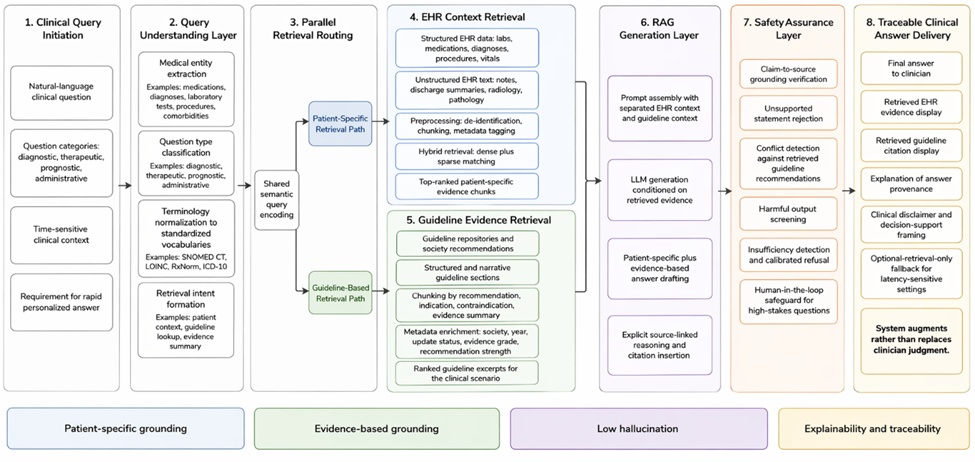
Figure 1. Conceptual Architecture of Dual-Source Retrieval-Augmented Generation for Real-Time Clinical Question Answering
The framework assumes that healthcare institutions have access to digitized EHR data in structured formats (medications, laboratory results, diagnoses, procedures, vital signs) and unstructured formats (clinical notes, discharge summaries, radiology reports) that can be indexed for retrieval [25]. It further assumes that clinical guidelines are available in machine-readable formats or can be converted from PDFs through optical character recognition and structuring pipelines. Real-time processing assumes acceptable latency thresholds of less than five seconds for non-urgent questions, recognizing that some complex retrievals may require additional time without compromising clinical utility.
Four design principles guide the framework: patient-specific grounding ensuring that answers incorporate individual patient data; evidence-based grounding ensuring that recommendations align with authoritative guidelines; low hallucination achieved through retrieval verification and citation requirements; and explainability enabling clinicians to inspect retrieved sources that support each answer component [8]. These principles prioritize safety and transparency over maximal generative flexibility, recognizing that clinical applications demand verifiable outputs rather than creative or novel responses [15, 16].
Table 1 clarifies the distinct functional roles, safety contributions, and failure consequences of each architectural component in the proposed dual-source RAG framework.
Table 1. Functional Differentiation of Core Components in Dual-Source RAG for Clinical Question Answering
Component | Primary Function | Principal Input | Principal Output | Safety-Relevant Contribution | Main Failure Mode if Weakly Implemented | Design Implication |
Query understanding layer | Interprets clinician intent and extracts medically relevant entities | Natural-language clinical question | Structured retrieval query with normalized concepts and question type | Reduces retrieval mismatch by aligning question semantics with clinical terminology | Misclassification of question type or missed entities leads to retrieval of irrelevant evidence | Clinical vocabulary normalization and question-type detection should precede retrieval |
EHR retrieval module | Identifies patient-specific structured and unstructured evidence | Current patient record, historical EHR documents, normalized query | Ranked patient-specific evidence chunks | Grounds answers in actual laboratory values, medications, diagnoses, procedures, and note content | Omission of key patient facts results in incomplete or unsafe personalization | Hybrid retrieval should capture both semantic similarity and exact clinical detail |
Guideline retrieval module | Identifies authoritative recommendations relevant to the case | Guideline corpus, metadata, normalized query | Ranked guideline excerpts with provenance and evidence grade | Aligns responses with current evidence-based recommendations | Retrieval of outdated, weak, or irrelevant guidelines distorts recommendation quality | Metadata-aware retrieval should prioritize recency, update status, and recommendation strength |
Prompt construction layer | Separates and organizes retrieved evidence for generation | EHR evidence plus guideline evidence plus clinician question | Structured prompt with source delineation | Prevents the model from conflating patient facts with general recommendations | Poor prompt structure encourages source blending or unsupported synthesis | Prompt templates should preserve explicit source boundaries |
LLM generation module | Synthesizes a fluent answer using retrieved context | Structured grounded prompt | Draft clinical answer with citations and reasoning trace | Produces readable, patient-specific, evidence-based synthesis | Hallucinated bridging statements or overconfident recommendations may emerge despite retrieval | Generation must be constrained to retrieved context and refusal behavior |
Grounding verification layer | Tests whether answer claims are supported by retrieved sources | Draft answer plus retrieved evidence | Verified or rejected answer segments | Directly limits hallucinations and unsupported assertions | Unsupported claims pass through into clinician-facing output | Sentence-level verification should be treated as a mandatory gate |
Safety filter layer | Screens for harmful or contradictory outputs | Verified answer plus clinical risk signals | Safe answer, warning, or refusal | Protects against dangerous recommendations and unsafe ambiguity | High-risk recommendations may be displayed without adequate safeguards | Safety rules should be stricter for high-acuity questions |
Clinician-facing interface | Presents answer and supporting evidence transparently | Safe verified answer plus citations | Traceable decision-support output | Enables clinician inspection, trust, and final judgment | Opaque display reduces usability and weakens explainability | Output should expose both answer content and provenance, not answer alone |
Unstructured clinical text represents a rich source of patient information, including history of present illness, review of systems, physical examination findings, assessment and plan from progress notes, as well as radiology and pathology reports [25]. For retrieval, these documents require preprocessing including de-identification to remove protected health information, sentence or paragraph chunking for granular retrieval, and metadata tagging with document type, date, and author role. The dense retriever encodes these chunks into embedding vectors that capture semantic meaning, enabling retrieval of clinically relevant passages even when exact keyword matches are absent [17].
Structured EHR data—medications with dosages and administration routes, laboratory results with reference ranges and flags for abnormal values, diagnoses with standardized codes, procedures with dates, and vital signs with trends—provides quantifiable patient information essential for clinical reasoning [25]. For retrieval, structured data can be linearized into natural language templates (e.g., "Patient's most recent hemoglobin A1c was 7.2% on 2024-01-15") and indexed alongside unstructured text, or encoded separately using specialized retrievers designed for tabular data. Laboratory trends over time, medication changes, and diagnostic trajectories are particularly valuable for answering questions about disease progression and treatment response.
Medical text presents unique retrieval challenges because clinical concepts may be expressed using different terminology (e.g., "myocardial infarction" versus "heart attack") while keyword matching remains important for specific terms such as medication names or laboratory codes [17]. Hybrid retrieval combining dense semantic retrieval (capturing conceptual similarity) with sparse keyword retrieval (BM25 capturing exact term matches) typically outperforms either approach alone in biomedical domains [7]. A reranking stage using a cross-encoder model can further improve relevance by directly computing query-document relevance scores for top candidates, albeit at higher computational cost suitable for re-ranking rather than initial retrieval [17].
Clinical guidelines vary substantially in length from brief recommendations to comprehensive documents exceeding 100 pages, requiring thoughtful chunking strategies that preserve semantic coherence while enabling granular retrieval [22, 23]. Sentence-level chunks provide maximum granularity but may lose surrounding context, while section-level chunks preserve the logical structure of recommendations, including indications, contraindications, evidence summaries, and strength of recommendations. Metadata enrichment is essential, tagging each chunk with source guideline title, issuing society, publication date, update status, evidence grade (e.g., Level A, Class I), and recommendation strength to enable filtering and prioritization during retrieval [21, 22].
Given a clinician's question about a specific patient, the guideline retriever identifies the most relevant recommendation excerpts by encoding the question and guideline chunks into a shared embedding space [17]. Retrieved excerpts can be prioritized by recency (favoring updated guidelines over older versions) and evidence grade (favoring high-quality evidence such as randomized controlled trials over expert opinion) [21, 22]. When multiple guidelines address the same clinical scenario—for example, conflicting recommendations from different specialty societies—the framework can retrieve and present all relevant excerpts, enabling clinicians to adjudicate discrepancies rather than forcing a single recommendation [23].
The dense retriever employs a bi-encoder architecture that independently encodes queries and documents into fixed-dimensional embedding vectors, enabling efficient approximate nearest neighbor search over pre-computed document embeddings [7, 17]. For medical domain adaptation, the retriever can be fine-tuned on clinical question-answer pairs or medical information retrieval datasets such as emrQA or PubMedQA to improve semantic matching of medical terminology [2, 3]. An embedding dimension of 768 to 1024 balances retrieval quality with storage efficiency, supporting indexing of millions of EHR chunks and guideline excerpts while maintaining sub-second retrieval latency [17].
The LLM generator conditions on a prompt that concatenates retrieved EHR data, retrieved guideline excerpts, and the clinician's original question, producing a fluent answer that synthesizes patient-specific and evidence-based information [7, 8]. Model sizes between 7 billion and 70 billion parameters offer a practical trade-off between reasoning capability and inference latency, with smaller models suitable for local deployment behind institutional firewalls and larger models potentially requiring cloud infrastructure [9, 10]. Instruction tuning on medical question answering datasets teaches the model to follow clinical prompt formats, cite retrieved sources, and appropriately refuse to answer when retrieved context is insufficient.
The prompt structure explicitly separates system instructions, retrieved context, and user question, with the system instruction defining the model's role as a clinical decision support tool that must ground all answers in provided sources [8]. Retrieved EHR data appears first, formatted with clear section headers and date stamps, followed by retrieved guideline excerpts with source citations including society name, publication year, and evidence grade [22, 23]. The user question then appears, and the model is instructed to generate an answer that explicitly references specific retrieved passages, cites sources using numeric references, and states when retrieved information is insufficient to answer confidently [18, 19].
Before retrieval, the system analyzes the clinician's natural language question to extract medical entities (medications, diagnoses, laboratory tests, procedures) and classify question type into diagnostic, therapeutic, prognostic, or administrative categories [2]. Entity extraction identifies patient-specific references such as "this patient's creatinine" that require EHR retrieval focused on the current encounter, while question type classification determines which guideline sections are most relevant—therapeutic questions prioritize treatment recommendation sections whereas diagnostic questions prioritize differential diagnosis algorithms [11]. This preprocessing step also normalizes medical terminology to standardized vocabularies (RxNorm for medications, LOINC for laboratory tests, SNOMED CT for diagnoses) to improve retrieval matching.
Real-time clinical use requires end-to-end latency under five seconds for non-urgent questions, achieved through a combination of pre-computation and inference optimization [7, 17]. EHR and guideline embeddings are pre-computed offline and stored in vector indexes, reducing retrieval to a fast nearest neighbor search rather than expensive on-the-fly encoding. LLM inference benefits from quantization (reducing model weights from 16-bit to 8-bit or 4-bit precision) and speculative decoding (using a smaller draft model to generate candidate tokens that the larger model verifies in parallel) [9, 10]. For latency-sensitive settings such as emergency departments or operating rooms, the framework can optionally return retrieval results alone without generation, providing clinicians with relevant source excerpts within one second.
After generation, the framework verifies that each factual claim in the answer can be traced to at least one retrieved source, rejecting answers that contain unsupported statements [18, 19, 24]. This verification can be implemented as a second LLM call that checks answer-sentence against retrieved passages, or as a rule-based system requiring explicit citation markers in the generated output. When retrieved context is insufficient to answer a question completely, the model is instructed to state its limitations explicitly (e.g., "The retrieved EHR does not contain recent laboratory values for this patient") rather than hallucinating missing information [18, 24]. Questions that fall entirely outside the scope of retrieved guidelines or EHR data trigger a refusal response directing clinicians to alternative resources such as specialist consultation or primary literature.
Post-generation guardrails apply content safety filters to detect and block harmful outputs including treatment recommendations that contradict retrieved guidelines, dangerous medication combinations, or inappropriate diagnostic assertions [15, 16]. Medical disclaimers are appended automatically to all answers, stating that the system provides decision support rather than autonomous recommendations and that final clinical decisions rest with the treating physician [13, 14]. For high-stakes questions identified by question type classification (e.g., "Should I administer thrombolytics?" in suspected stroke), the framework requires explicit clinician approval before displaying the generated answer, creating a human-in-the-loop safeguard that preserves clinical accountability [11].
Retrieval performance is evaluated using held-out clinical questions drawn from real clinician queries, with metrics including recall@k (proportion of questions for which at least one relevant source appears in the top-k retrieved results), mean reciprocal rank (inverse rank of the first relevant result), and normalized discounted cumulative gain (accounting for graded relevance of multiple retrieved sources) [3, 17]. For EHR retrieval, relevance is defined by whether retrieved patient data actually answers the clinical question (e.g., retrieving the most recent creatinine value for a question about kidney function), while guideline retrieval relevance requires that excerpts contain the correct recommendation for the clinical scenario [22, 23]. Target thresholds include recall@5 above 0.90 for both retrieval sources, ensuring that generation has access to necessary context.
Answer quality requires evaluation along multiple dimensions: factual accuracy assessed by clinician review comparing generated answers against gold-standard responses derived from EHR data and guidelines, hallucination rate measured as the proportion of answer statements unsupported by retrieved sources, answer completeness measured as the proportion of gold-standard information present in the generated answer, and citation correctness measured as whether cited sources actually support the claims they accompany [5, 6, 8]. Clinician evaluation panels comprising attending physicians from relevant specialties rate answers on Likert scales for clinical appropriateness, safety, and actionability [13, 14]. A hallucination rate below 5% and factual accuracy above 95% represent minimum acceptable thresholds for clinical deployment.
Real-world pilot studies with practicing clinicians assess the framework's practical utility using time-motion analysis (time saved per question compared to manual EHR and guideline searching), answer correctness verified against a reference standard created by expert panels, clinician trust measured through validated questionnaires, and usability assessed using system usability scale instruments [1, 11]. Pilot deployment on public EHR datasets such as MIMIC-III or MIMIC-IV and public guideline repositories would enable rigorous evaluation without institutional review board constraints during development [9, 10, 25]. Successful pilots would demonstrate statistically significant reductions in answer time, non-inferiority or superiority in answer correctness compared to current workflows, and clinician trust scores exceeding predefined thresholds.
Table 2 translates the proposed architecture into an evaluation logic by linking retrieval performance, generation quality, safety enforcement, and real-world clinical usefulness.
Table 2. Evaluation Matrix Linking Retrieval Quality, Generation Reliability, Safety Performance, and Clinical Utility in Real-Time Clinical RAG
Evaluation Domain | What Should Be Measured | Representative Metric or Assessment Logic | Why It Matters in This Framework | Minimum Interpretive Expectation for a Viable System |
EHR retrieval performance | Ability to recover patient-specific evidence needed to answer the question | Recall@k, mean reciprocal rank, relevance of retrieved laboratory values, medications, diagnoses, notes | The framework fails to personalize safely if patient evidence is not retrieved | Relevant patient evidence should appear consistently within the top retrieved set |
Guideline retrieval performance | Ability to recover authoritative recommendations aligned with the scenario | Recall@k, nDCG, recency-weighted relevance, evidence-grade-aware ranking quality | Evidence-based grounding depends on retrieving the correct recommendation context | Updated and clinically appropriate guideline excerpts should be prioritized reliably |
Cross-source complementarity | Degree to which retrieved EHR evidence and guideline evidence jointly support answer construction | Proportion of questions for which both patient-specific and recommendation-specific evidence are retrieved | The framework’s novelty lies in dual grounding rather than single-corpus retrieval | Most answerable questions should be supported by both retrieval pathways when clinically appropriate |
Generative factual accuracy | Accuracy of synthesized answer relative to retrieved evidence and expert reference standard | Expert review, claim matching, correctness scoring | A fluent answer is clinically useless if it misstates patient facts or guidance | High factual consistency with retrieved evidence is essential before deployment |
Hallucination control | Frequency of unsupported claims in model output | Unsupported statement rate, claim-to-source verification failure rate | The manuscript positions hallucination mitigation as a central safety objective | Unsupported claims should be rare and explicitly detectable |
Citation fidelity | Whether cited sources actually support the adjacent answer claims | Source-claim concordance review | Traceability is meaningful only if citations are accurate rather than cosmetic | Citations should map directly to the claims they support |
Answer completeness | Degree to which clinically necessary information is included without critical omissions | Comparison with expert-generated reference answers | Partial answers may still be unsafe if essential contraindications or patient factors are omitted | Clinically material elements should be present, especially for therapeutic questions |
Latency and workflow fit | Time required for end-to-end retrieval, generation, verification, and display | Total response time, module-specific latency, fallback performance | The system is intended for real-time use at the point of care | Response time should remain compatible with actual clinical decision windows |
Safety adjudication performance | Ability to detect harmful, contradictory, or insufficiently grounded responses | Safety filter precision and recall, rate of appropriate refusals, escalation frequency for high-stakes questions | Safety gates distinguish clinically responsible assistance from generic QA | High-risk outputs should be blocked or escalated rather than displayed uncritically |
Human factors and clinical utility | Practical effect on clinician trust, usability, and time burden | Time-motion analysis, usability scales, trust questionnaires, clinician preference comparison | Clinical adoption depends on usefulness, not just technical performance | The system should reduce search burden while preserving clinician confidence and oversight |
This paper has presented a conceptual framework for retrieval-augmented generation that integrates dual-source retrieval from electronic health records and clinical guidelines to enable real-time, patient-specific clinical question answering. The architecture addresses the fundamental limitations of standalone large language models—hallucination, lack of patient-specific grounding, and inability to access local EHR data—by conditioning generation on retrieved context from both the individual patient's medical record and authoritative evidence-based guidelines.
The framework's key advantages include patient-specific grounding that ensures answers reflect the individual's actual laboratory values, medications, and clinical history; evidence-based grounding that aligns recommendations with current guidelines from specialty societies; low hallucination achieved through retrieval verification and citation requirements; and explainability enabled by traceable source citations. By retrieving rather than memorizing clinical knowledge, the system maintains up-to-date information without retraining and provides transparency that is essential for clinician trust and patient safety.
Several limitations require acknowledgment. The framework's performance depends critically on retrieval quality—if the retriever fails to fetch relevant EHR data or guideline excerpts, generation quality degrades regardless of LLM capability. LLM inference latency, even with optimization, may exceed acceptable thresholds for some high-acuity settings, though retrieval-only fallback modes can mitigate this concern. Most importantly, the framework requires rigorous clinical validation before deployment, including prospective studies measuring impact on clinician workflow, decision quality, and patient outcomes.
We call for implementation of this framework on public EHR datasets such as MIMIC-IV and public clinical guideline repositories, enabling the research community to evaluate retrieval and generation performance without institutional barriers. Subsequent validation in real-world clinical pilots with attending physicians would assess practical utility and safety. If successful, this RAG-based approach could transform clinical decision support from generic information retrieval to personalized, real-time, evidence-based reasoning that augments rather than replaces clinician judgment.
None
None
None
None
Open Access The author(s) retain copyright. This article is licensed under the Creative Commons Attribution-NonCommercial-ShareAlike 4.0 International License. It may be shared and adapted for non-commercial purposes with appropriate attribution, an indication of changes, and distribution of adaptations under the same license. Third-party material may be subject to separate terms identified in its credit line. View the license at https://creativecommons.org/licenses/by-nc-sa/4.0/.
 Clinical Intelligence Research Press