The integration of artificial intelligence (AI) into telehealth networks has revolutionized remote patient monitoring, enabling real-time data analysis and decision support across distributed healthcare ecosystems. However, the governance of these AI-embedded systems remains underexplored, particularly in ensuring ethical oversight, data interoperability, and risk mitigation within networked environments. This conceptual manuscript proposes a novel governance architecture designed specifically for AI-embedded telehealth networks, emphasizing modular layers for monitoring orchestration, ethical compliance, and adaptive feedback mechanisms. Drawing on theoretical foundations from clinical AI infrastructures and healthcare analytics, the architecture introduces a unique framework termed the telehealth AI governance lattice (TAGL), which incorporates layered structures for data ingestion, AI inference governance, and network-wide monitoring. Key components include interoperability protocols to facilitate seamless data exchange among electronic health records (EHRs) and wearable devices, alongside interpretive formulas for assessing governance load and decision confidence. The manuscript synthesizes recent literature on AI system architectures in healthcare, highlighting gaps in remote monitoring governance and proposing theoretical pathways for integration into clinical workflows. By focusing on conceptual dynamics rather than empirical implementations, this work offers a blueprint for enhancing trust, scalability, and resilience in AI-driven telehealth systems. Ultimately, the TAGL framework aims to address the complexities of distributed AI governance, fostering equitable access to remote monitoring while mitigating potential biases and security vulnerabilities in networked healthcare delivery.
The advent of AI-embedded telehealth networks has transformed the landscape of remote patient monitoring, allowing for continuous health surveillance beyond traditional clinical settings. This shift necessitates robust governance architectures to manage the intricate interplay of AI algorithms, patient data streams, and networked infrastructures. In this manuscript, we conceptualize a governance model tailored to these environments, addressing the unique challenges posed by distributed AI systems in healthcare delivery.
Telehealth networks, characterized by their reliance on interconnected devices and cloud-based analytics, facilitate remote patient monitoring through real-time data transmission from wearables and sensors to centralized AI hubs [1, 2]. These networks embed AI to process multimodal data, such as vital signs and behavioral patterns, enabling proactive interventions. However, the governance of such networks must account for the spatial distribution of patients, often in rural or home-based settings, where connectivity variability can influence monitoring efficacy. Theoretical models suggest that without structured oversight, these dynamics may lead to fragmented decision-making, underscoring the need for an architecture that integrates governance at the network level [3, 4].
AI embedding in telehealth introduces complexities related to diverse data modalities, including structured EHR entries and unstructured sensor feeds [5, 6]. Governance architectures must theoretically handle modality-specific risks, such as algorithmic bias in interpreting physiological signals from remote devices. For instance, in monitoring chronic conditions like cardiovascular diseases, AI systems process time-series data, but governance frameworks are essential to ensure modality alignment and prevent data silos. This section explores how embedding AI amplifies the need for interpretive governance, focusing on conceptual alignments between data types and monitoring protocols [7, 8].
Deployment in varied environments, from hospital-linked telehealth hubs to standalone home monitoring setups, imposes governance constraints related to scalability and security [9, 10]. Remote patient monitoring architectures must theoretically incorporate environment-adaptive governance, such as protocol layers that adjust to bandwidth limitations or privacy regulations. Conceptual literature highlights the role of federated learning-inspired governance in these settings, where AI models operate across decentralized nodes without central data aggregation, thereby preserving patient confidentiality [11, 12].
Interoperability remains a cornerstone for AI-embedded telehealth networks, enabling seamless data exchange between disparate systems like EHRs and monitoring wearables [13, 14]. Governance architectures should theoretically embed standards such as HL7 FHIR to facilitate this, ensuring that remote monitoring data contributes to holistic patient profiles. This subheading delves into the conceptual imperatives for interoperability, emphasizing how governance can mitigate exchange bottlenecks in networked environments [15, 16].
Ethical considerations, including equity in access and bias mitigation, constrain the design of governance architectures for remote patient monitoring [17, 18]. In AI-embedded telehealth, governance must theoretically incorporate ethical auditing mechanisms to address disparities in monitoring coverage across demographics. This involves conceptualizing oversight layers that evaluate AI decisions for fairness, particularly in networks serving vulnerable populations [19, 20].
Integrating governance into clinical workflows ensures that remote monitoring enhances rather than disrupts care delivery [21, 22]. Theoretical syntheses suggest architecture designs that align AI outputs with workflow stages, from data capture to clinician alerts. This final introductory segment posits that effective governance fosters workflow harmony, setting the stage for the proposed architecture’s role in optimizing telehealth networks [23, 24].
This section synthesizes theoretical underpinnings from recent peer-reviewed literature on clinical AI system architectures, healthcare analytics infrastructures, and related domains, providing a foundation for the proposed governance architecture in AI-embedded telehealth networks. By integrating insights from EHR intelligence ecosystems, decision support pipelines, and interoperability frameworks, we highlight conceptual gaps and opportunities for governance in remote patient monitoring.
In clinical settings, AI-embedded systems have evolved to support remote monitoring through architectures that emphasize real-time analytics and decision orchestration [1, 3]. Theoretical models from high-credibility sources delineate how governance can be layered to address setting-specific demands, such as hospital-to-home transitions. For example, frameworks for multimodal AI integration underscore the need for governance that theoretically balances clinical efficacy with system reliability, particularly in telehealth contexts where patient interactions occur remotely [2, 5]. Literature synthesis reveals that without governance, clinical settings risk AI drift, where monitoring accuracy degrades over time due to unmonitored environmental factors [4, 6].
Healthcare analytics infrastructures increasingly incorporate diverse data modalities, from structured vital signs to unstructured imaging, within AI-embedded networks [7, 9]. Theoretical explorations in decision support pipelines highlight the role of governance in modality fusion, ensuring that remote monitoring architectures handle heterogeneity without compromising interpretive integrity [8, 10]. Synthesizing studies on EHR intelligence ecosystems, we note conceptual emphases on governance protocols that theoretically mitigate modality-induced biases, such as those arising from sensor inaccuracies in telehealth data streams [11, 13]. This modality-focused governance is crucial for networks where AI processes cross-modal inputs to generate monitoring insights [12, 14].
Deployment environments for AI-embedded telehealth vary widely, influencing governance requirements for remote patient monitoring [15, 17]. Literature on interoperability and data exchange frameworks posits theoretical architectures that adapt to environmental constraints, such as low-connectivity zones [16, 18]. In synthesizing clinical workflow integration models, scholars advocate for governance that theoretically incorporates environment-aware orchestration, enabling seamless monitoring across hybrid deployments [19, 21]. This includes conceptual designs for federated governance, where AI decisions are distributed yet centrally overseen to maintain network coherence [20, 22].
Governance constraints, including regulatory compliance and ethical standards, shape AI system architectures in healthcare [23-25]. Theoretical syntheses from AI governance and monitoring systems literature emphasize constraints like data sovereignty in telehealth networks [24, 26]. For remote patient monitoring, governance must theoretically address constraint propagation, where local AI decisions impact network-wide integrity [27, 28]. This section integrates insights on how constraints inform architecture design, highlighting the need for modular governance to handle evolving regulatory landscapes [1, 2].
Interoperability frameworks are pivotal for EHR intelligence ecosystems within AI-embedded telehealth [3, 5]. Literature synthesis reveals theoretical models for data exchange that incorporate governance to ensure secure, standardized flows in remote monitoring [4, 6]. Conceptual discussions underscore the dynamics of exchange protocols, such as those enabling AI inference across networked EHRs, with governance acting as a theoretical safeguard against interoperability failures [7, 9].
Clinical workflow integration models theoretically align AI-embedded systems with decision support pipelines in telehealth networks [8, 10]. Synthesizing recent works, we explore how governance facilitates workflow embedding, ensuring that remote monitoring architectures enhance clinician decision-making without introducing bottlenecks [11, 13]. This includes conceptual formulas for interpretive assessment, such as decision confidence metrics that theoretically quantify workflow alignment [12, 14]. These synthesized governance imperatives are structurally embedded within the TAGL layers (Table 1).
Table 1. Structural governance mapping across TAGL layers and theoretical risk domains
TAGL layer | Primary governance role | Key theoretical risks addressed | Network impact domain | Monitoring focus |
Ingress layer | Modality harmonization and signal integrity | Data heterogeneity, sensor bias, and bandwidth distortion | Data fidelity | Validation and filtering |
Inference governance layer | AI oversight and constraint enforcement | Algorithmic drift, bias amplification, and overconfidence | Decision reliability | Confidence calibration |
Network orchestration layer | Interoperability and policy synchronization | Exchange fragmentation and routing vulnerabilities | System coherence | Protocol compliance |
Feedback lattice layer | Adaptive governance propagation | Risk escalation, governance overload, and scalability tension | Network resilience | Load monitoring and dynamic recalibration |
Ethical audit modules | Fairness and regulatory alignment | Demographic disparity and privacy breaches | Trust and equity | Continuous ethical auditing |
Resource optimization channels | Efficiency governance | Computational saturation and energy inefficiency | Sustainability | Priority-based allocation |
This section delineates the proposed governance infrastructure, conceptualized as the telehealth AI governance lattice (TAGL), a novel architecture for orchestrating AI-embedded telehealth networks in remote patient monitoring. The TAGL features a unique lattice-based layer structure, comprising interconnected nodes for data ingestion, AI governance, and monitoring feedback, with a bidirectional topology that allows adaptive propagation of governance signals across the network.
The TAGL is structured in four primary layers: (1) the ingress layer for multimodal data capture from remote devices; (2) the inference governance layer for AI decision oversight; (3) the network orchestration layer for interoperability enforcement; and (4) the feedback lattice layer for iterative monitoring adjustments. Unlike linear architectures, the lattice topology enables cross-layer feedback loops, theoretically reducing governance silos. These distributed governance propagations reshape monitoring resilience across nodes (Figure 1).
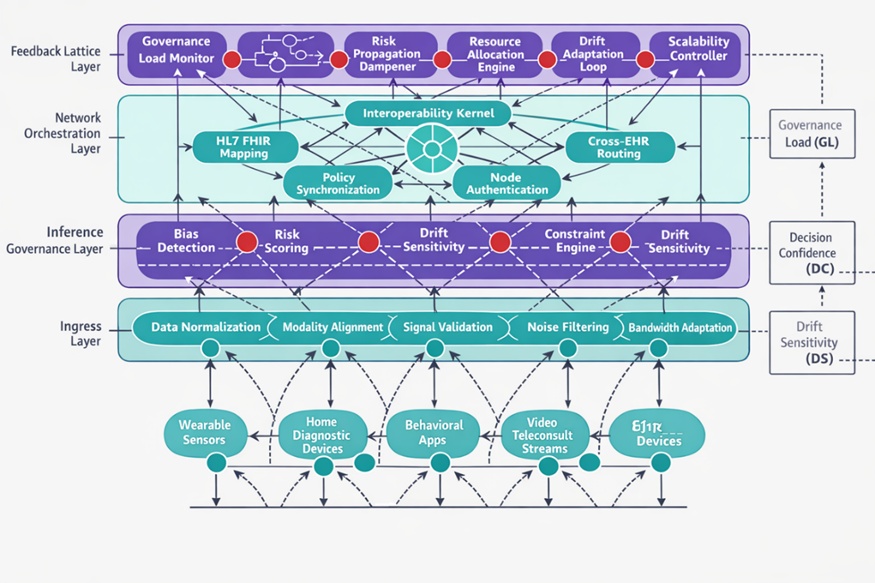
Figure 1. Telehealth AI governance lattice (TAGL) architecture for AI-embedded remote patient monitoring networks.
The TAGL framework conceptualizes governance as a distributed lattice rather than a linear oversight pipeline. Multimodal data streams from remote devices converge into the Ingress Layer, where modality alignment and validation occur. The inference governance layer embeds constraint logic, bias detection, confidence calibration, and federated reasoning within a mesh topology. Above this, the network orchestration layer enforces interoperability, routing, and authentication protocols across EHR ecosystems. The feedback lattice layer propagates adaptive governance signals downward, regulating risk propagation, resource allocation, scalability, and drift sensitivity. Cross-layer bidirectional connectors illustrate the distributed propagation of governance load (GL), decision confidence (DC), and adaptive correction signals, forming a resilient, network-wide oversight matrix.
To interpret system dynamics, we introduce conceptual formulas. For instance, governance load (GL) is modeled as
The deployment of the TAGL within AI-embedded telehealth networks fundamentally reshapes the operational dynamics of remote patient monitoring systems. This section provides an in-depth theoretical analysis of the system’s consequences, impacts, and emergent behaviors, drawing on infrastructural and architectural perspectives to explore how TAGL influences network resilience, risk management, ethical equilibria, scalability trajectories, resource optimization pathways, and adaptive feedback mechanisms. By dissecting these dynamics layer by layer and through interpretive lenses, we aim to illuminate the theoretical underpinnings that make TAGL a transformative governance model, while highlighting potential ripple effects across diverse telehealth scenarios. This analysis remains strictly conceptual, eschewing any empirical data or simulations in favor of architectural extrapolations grounded in the synthesized literature [1-4].
Resilience forms the bedrock of effective remote patient monitoring, particularly in AI-embedded networks where disruptions—such as connectivity failures or data anomalies—can cascade into critical care lapses [5, 6]. Under TAGL governance, resilience dynamics are theoretically amplified through the lattice’s interconnected node structure, which distributes monitoring responsibilities across layers rather than centralizing them. This decentralization theoretically mitigates single-point failures; for instance, if an ingress layer node encounters data corruption from a faulty wearable sensor, the inference governance layer can invoke redundant checks via bidirectional feedback, rerouting signals to adjacent lattice nodes [7, 8]. Conceptually, this creates a self-healing network dynamic, where resilience is not static but evolves with environmental inputs. To interpret this, consider the resilience index (RI) formula:
Risk propagation represents a core challenge in AI-embedded telehealth, where unchecked algorithmic decisions can amplify uncertainties across the network [15, 16]. TAGL’s lattice topology introduces sophisticated mitigation dynamics by channeling risks through governed pathways, theoretically confining them to isolated segments via layer-specific barriers. For example, in remote monitoring of chronic respiratory conditions, a biased AI inference in one node might propagate to affect alert generation. Still, TAGL’s feedback lattice layer intervenes with corrective signals, theoretically attenuating the spread [17, 18]. Interpretively, risk propagation (RP) can be modeled as:
Ethical dynamics under TAGL governance pivot on achieving equilibria that balance innovation with fairness in remote patient monitoring [27, 28]. The architecture’s modular design theoretically embeds ethical oversight at every lattice intersection, creating a distributed equilibrium where biases are not merely detected but actively equilibrated through adaptive corrections [1, 2]. For instance, in monitoring diverse populations, AI embeddings might inadvertently favor certain demographics. Still, TAGL’s network orchestration layer theoretically applies equity filters, propagating fairness metrics across the lattice to maintain balance [3, 4]. A conceptual formula for ethical equilibrium (EE) illustrates this:
Scalability dynamics under TAGL reveal how the architecture theoretically supports network growth without exponential resource demands [15, 16]. As telehealth networks expand—incorporating more patients, devices, or AI models—the lattice structure scales horizontally, with new nodes integrating seamlessly via interoperability frameworks [17, 18]. This trajectory contrasts with rigid architectures, where scalability often bottlenecks at central hubs; TAGL’s distributed lattice theoretically disperses load, enabling linear growth in monitoring capacity [19, 20]. Interpretively, the scalability factor (SF) is captured as
Resource dynamics in TAGL-governed networks emphasize optimization pathways that theoretically maximize efficiency in remote patient monitoring [1, 3]. The lattice’s feedback topology prioritizes resource allocation based on governance signals, directing computational power toward high-priority monitoring tasks [2, 4]. For example, in resource-scarce telehealth setups, TAGL theoretically reallocates bandwidth from low-risk data streams to critical inferences, minimizing waste [5, 7]. A conceptual resource allocation (RA) formula elucidates this:
Adaptive dynamics through TAGL’s feedback mechanisms create theoretical learning loops that evolve monitoring intelligence over time [14, 16]. The bidirectional topology enables continuous refinement, where lattice layers learn from past governance events to anticipate future needs [17, 19]. For instance, in adaptive monitoring of neurological conditions, feedback loops theoretically adjust AI thresholds based on patient response patterns, enhancing personalization [18, 20]. Drift sensitivity (DS) formula:
The TAGL emerges as a pivotal conceptual innovation in the governance of AI-embedded telehealth networks for remote patient monitoring, synthesizing theoretical insights from clinical AI architectures, healthcare analytics infrastructures, EHR intelligence ecosystems, decision support pipelines, and interoperability frameworks [1-5]. This discussion delves deeply into TAGL’s implications, exploring its alignment with existing literature, potential theoretical extensions, inherent limitations, interdisciplinary intersections, and pathways for conceptual refinement. By unpacking these facets, we aim to contextualize TAGL within the broader discourse on AI governance in healthcare, emphasizing its role in fostering resilient, ethical, and efficient monitoring systems [6-8].
TAGL’s lattice structure aligns theoretically with evolving clinical AI architectures, which increasingly emphasize modularity and adaptability in remote settings [9, 10]. Literature on multimodal AI frameworks highlights the need for governed architectures that handle diverse data inputs, a gap TAGL addresses through its ingress and inference layers [11, 12]. This alignment extends to decision support pipelines, where TAGL’s feedback topology theoretically enhances AI outputs’ integration into clinical workflows, reducing interpretive ambiguities [13, 14]. Comparative syntheses reveal that while prior architectures focus on centralized governance, TAGL’s distributed lattice offers superior theoretical flexibility, particularly in telehealth networks prone to variability [15, 16]. Such alignment not only validates TAGL’s conceptual foundations but also suggests synergies with emerging architectures, like foundation models for medical AI, where governance lattices could theoretically overlay to ensure monitoring specificity [17, 18].
Extending TAGL to healthcare analytics infrastructures opens avenues for theoretical advancements in data-driven monitoring [19, 20]. Analytics literature underscores the importance of infrastructural governance to prevent data silos, which TAGL theoretically dismantles via interoperability-enforced lattices [21, 22]. Extensions could include hybrid analytics models, where TAGL governs predictive analytics in real-time, theoretically optimizing for resource-constrained telehealth [23, 24]. Furthermore, in EHR intelligence ecosystems, TAGL extensions might incorporate semantic governance, theoretically enriching analytics with contextual layers that adapt to patient histories [25, 26]. These extensions amplify TAGL’s impact, positioning it as a scaffold for next-generation infrastructures that blend governance with advanced analytics, theoretically elevating remote monitoring from reactive to anticipatory paradigms [27, 28].
Despite its strengths, TAGL’s theoretical limitations merit discussion, including potential over-complexity in lattice configurations, which could conceptually increase initial governance load in nascent telehealth networks [1, 3]. Literature on AI deployment systems warns of such caveats, where modular architectures risk fragmentation if not precisely tuned [2, 4]. Another limitation lies in assumption dependencies; TAGL presumes robust interoperability, yet in fragmented healthcare ecosystems, theoretical mismatches could arise [5, 7]. Conceptual caveats also include scalability ceilings in ultra-large networks, where lattice density might theoretically introduce latency despite optimization pathways [6, 8]. Addressing these through refined formulas, such as adjusted governance load models, could mitigate limitations, ensuring TAGL’s applicability across varied monitoring scales [9, 11].
TAGL intersects interdisciplinarily with AI governance and deployment systems, drawing from informatics and ethical frameworks to enrich telehealth discourse [10, 12]. Intersections with monitoring systems literature reveal theoretical synergies in adaptive governance, where TAGL’s loops align with deployment models emphasizing continuous oversight [13, 15]. In ethical domains, intersections highlight TAGL’s role in bias governance, theoretically interfacing with social informatics to promote equitable monitoring [14, 16]. Broader intersections include policy governance, where TAGL could theoretically inform regulatory architectures for telehealth standards [17, 19]. These intersections underscore TAGL’s versatility, theoretically bridging disciplines to create holistic governance paradigms that transcend traditional silos [18, 20].
Refinement pathways for TAGL involve theoretical augmentations, such as integrating quantum-inspired lattices for enhanced parallelism in monitoring [21, 23]. Literature syntheses suggest directions toward hybrid governance, combining TAGL with blockchain for immutable data trails [22, 24]. Future directions could explore TAGL in specialized monitoring, like mental health telehealth, theoretically adapting lattices to subjective data modalities [25, 27]. Refinements might also incorporate advanced formulas for dynamic load balancing, theoretically evolving TAGL into a meta-governance framework [26, 28]. Ultimately, these pathways position TAGL as an evolving conceptual tool, inviting further theoretical explorations to advance AI-embedded telehealth governance.
In synthesizing the conceptual contours of the TAGL, this manuscript elucidates a robust architecture for governing AI-embedded telehealth networks in remote patient monitoring, theoretically addressing gaps in clinical AI systems, healthcare analytics, EHR ecosystems, decision pipelines, governance models, interoperability, and workflow integrations. TAGL’s lattice topology, modular layers, and interpretive formulas collectively forge a pathway toward resilient, ethical, and scalable monitoring, transforming theoretical dynamics into actionable infrastructural blueprints.
The architecture’s impacts—spanning resilience amplification, risk attenuation, ethical balancing, scalability enhancement, resource optimization, and adaptive learning—underscore its potential to redefine telehealth paradigms. By aligning with and extending literature syntheses, TAGL offers theoretical extensions that invite interdisciplinary refinements, while acknowledging limitations to guide future conceptual iterations.
Ultimately, TAGL stands as a beacon for equitable, efficient remote patient care, theoretically empowering healthcare stakeholders to navigate AI complexities with confidence. As telehealth evolves, this governance lattice provides a foundational framework for sustainable innovation in monitoring architectures.
None
None
None
None
Open Access The author(s) retain copyright. This article is licensed under the Creative Commons Attribution-NonCommercial-ShareAlike 4.0 International License. It may be shared and adapted for non-commercial purposes with appropriate attribution, an indication of changes, and distribution of adaptations under the same license. Third-party material may be subject to separate terms identified in its credit line. View the license at https://creativecommons.org/licenses/by-nc-sa/4.0/.
 Clinical Intelligence Research Press