The integration of large language models (LLMs) into clinical decision infrastructures represents a transformative shift in healthcare delivery, enabling enhanced reasoning, data synthesis, and adaptive support for clinicians. This conceptual manuscript proposes a novel architecture, termed the adaptive LLM-orchestrated clinical ecosystem (ALOCE), designed to seamlessly embed LLMs within existing electronic health record (EHR) systems, interoperability frameworks, and governance protocols. By delineating a multi-layered structure encompassing data ingestion, semantic processing, decision augmentation, and continuous monitoring, ALOCE addresses key challenges such as data silos, ethical AI deployment, and real-time adaptability in clinical environments. Drawing on theoretical foundations from AI governance and healthcare informatics, the architecture incorporates feedback topologies for drift detection and ethical alignment, ensuring robustness in diverse clinical workflows. Conceptual formulas are introduced to model risk propagation across layers, decision confidence thresholds, and governance load balancing, providing interpretive tools for system designers. The manuscript synthesizes recent literature on clinical AI architectures, highlighting interoperability standards like FHIR and the role of LLMs in augmenting human decision-making without empirical validation. Ultimately, this work outlines a blueprint for scalable, ethical LLM integration, fostering improved patient outcomes through intelligent infrastructure orchestration. While theoretical, the implications extend to policy, deployment strategies, and future research in AI-driven healthcare systems.
The advent of large language models (LLMs) has catalyzed a paradigmatic shift in the computational interpretation of clinical information, introducing unprecedented capabilities for processing vast volumes of heterogeneous, unstructured healthcare data. Unlike earlier rule-based or narrowly supervised machine learning systems, LLMs operate through deep contextual embeddings that enable semantic inference across longitudinal patient records, narrative clinician documentation, diagnostic reports, and multimodal textual artifacts. These capabilities position LLMs as transformative intelligence substrates within digital health ecosystems. However, despite their theoretical promise, their integration into clinical decision infrastructures remains fragmented, operationally inconsistent, and governance-constrained, thereby introducing latent risks to patient safety, interpretive reliability, and system-level efficiency [1, 2].
Clinical decision environments are intrinsically complex, requiring the synthesis of multidimensional data streams spanning electronic health records (EHRs), radiological imaging narratives, laboratory interpretations, pharmacological histories, and patient-generated documentation. Decision fidelity often depends not only on data availability but on the interpretive coherence through which such data are operationalized. Traditional decision infrastructures—frequently built upon deterministic logic engines or siloed analytics modules—struggle to accommodate the semantic density and contextual variability embedded within modern clinical documentation [3, 4]. These infrastructures are further strained by real-time demands in acute care environments, where diagnostic latency or informational fragmentation can materially influence patient outcomes.
Within this evolving landscape, LLMs introduce the capacity to function as semantic orchestration engines—systems capable of harmonizing disparate informational modalities into unified interpretive representations. Yet, without architectural frameworks explicitly designed to embed LLM cognition into clinical decision pipelines, their deployment risks becoming peripheral, redundant, or operationally disruptive. This manuscript therefore conceptualizes an integrated architectural paradigm that bridges LLM intelligence with clinical decision infrastructures through layered orchestration, governance embedding, and interoperability alignment. Importantly, this work advances a theoretical systems design perspective, deliberately avoiding empirical performance benchmarking in favor of architectural logic, infrastructure harmonization, and governance modeling.
Clinical ecosystems generate information across a spectrum of structured and unstructured modalities, each characterized by distinct syntactic, semantic, and temporal properties. Structured EHR fields—such as laboratory values, medication codes, and vital sign logs—offer high standardization but limited contextual richness. Conversely, unstructured clinical notes, discharge summaries, operative reports, and patient narratives encode nuanced interpretive signals that often escape structured representation. LLMs demonstrate unique aptitude in traversing this divide, enabling cross-modal synthesis through natural language understanding and contextual embedding [5, 6].
Through transformer-based attention mechanisms, LLMs can theoretically align symptom narratives with diagnostic coding patterns, correlate longitudinal documentation with risk trajectories, and extract latent semantic markers embedded in free-text clinical discourse. Such capabilities hold potential to reduce clinician cognitive load by transforming fragmented documentation into consolidated intelligence views. However, this augmentation is contingent upon architectural infrastructures capable of ingesting, normalizing, and routing diverse data formats into LLM interpretive layers without distorting clinical provenance or contextual integrity [7, 8].
Absent such infrastructure, LLM outputs risk semantic misalignment—where interpretive inferences are generated without full visibility into structured correlates or temporal dependencies. Therefore, modality-aware ingestion pipelines, semantic harmonization layers, and contextual anchoring mechanisms become foundational prerequisites for safe LLM deployment in clinical intelligence ecosystems.
Real-world clinical deployment environments introduce infrastructural, computational, and regulatory complexities that extend far beyond model performance considerations. Hospitals and ambulatory care networks operate across heterogeneous hardware landscapes, legacy information systems, fragmented data repositories, and institution-specific workflow protocols. Integrating LLM-driven analytics into such environments requires infrastructural elasticity capable of interfacing with both modern cloud-native systems and entrenched on-premise architectures [9, 10].
Moreover, clinical decision infrastructures must operate within stringent regulatory envelopes governing data privacy, cybersecurity, and auditability. Interoperability standards—most notably fast healthcare interoperability resources (FHIR)—provide structured exchange protocols that enable cross-system communication while preserving compliance [11, 12]. However, LLM architectures must be explicitly engineered to operate within these standards, ensuring that semantic processing layers neither bypass nor compromise regulated data exchange pathways.
The architecture proposed in this manuscript addresses deployment heterogeneity through modular infrastructural design. By decomposing LLM integration into interoperable components—data ingestion nodes, semantic processing cores, governance filters, and decision routing interfaces—the system maintains adaptability across institutional environments. Such modularity enhances infrastructural resilience, allowing decision pipelines to sustain operational continuity even amid hardware constraints, system outages, or interoperability disruptions.
Governance constitutes one of the most consequential determinants of LLM viability in clinical decision infrastructures. Unlike traditional analytics systems, LLMs generate probabilistic semantic outputs that may include hallucinations, contextual distortions, or bias amplification. In high-stakes healthcare environments, such interpretive deviations carry ethical, legal, and clinical ramifications [13, 14].
Consequently, LLM integration necessitates governance-embedded architectures rather than post-hoc oversight. This includes audit logging frameworks, explainability layers, bias surveillance modules, and validation checkpoints that monitor semantic fidelity across decision cycles. Governance must also address accountability diffusion—clarifying responsibility boundaries between human clinicians, AI systems, and institutional oversight bodies [15, 16].
This manuscript advances the concept of governance load modeling, a theoretical construct describing the oversight intensity required to operationalize LLM intelligence safely. As model autonomy increases, governance load correspondingly expands, necessitating infrastructural mechanisms capable of sustaining audit density without impeding clinical workflow velocity. Embedding governance directly into architectural layers ensures that safety, compliance, and accountability function as operational substrates rather than external constraints.
Clinical decision-making is inherently collaborative, spanning multidisciplinary teams that include physicians, nurses, pharmacists, radiologists, and administrative coordinators. Effective intelligence infrastructures must therefore transcend system interoperability to achieve workflow interoperability—ensuring that insights generated within one domain propagate meaningfully across the care continuum [17, 18].
LLM integration amplifies this requirement. Semantic outputs must be translatable into structured alerts, decision support prompts, documentation enhancements, and care pathway recommendations that align with existing clinical interfaces. Without interoperability harmonization, LLM intelligence risks remaining informationally rich yet operationally inert.
Architectural interoperability frameworks enable fluid data exchange between LLM cognition layers and downstream clinical systems, including computerized physician order entry (CPOE), clinical decision support systems (CDSS), and population health dashboards. Such harmonization fosters unified intelligence ecosystems in which semantic reasoning augments, rather than fragments, multidisciplinary collaboration [19, 20].
Synthesizing these infrastructural, governance, and interoperability considerations reveals a critical architectural imperative: LLMs cannot be safely or effectively deployed as isolated analytical tools. Instead, they must be embedded within orchestrated decision infrastructures that regulate data ingestion, contextual interpretation, oversight enforcement, and workflow dissemination.
This manuscript positions its contribution within this architectural gap, proposing a theoretically grounded framework that integrates LLM semantic intelligence with clinical decision pipelines through layered orchestration, governance embedding, and interoperability alignment. By conceptualizing LLMs not merely as models but as infrastructural cognition engines, the architecture redefines their role from passive text processors to active participants in clinical intelligence ecosystems.
In doing so, the work advances a systems-level perspective on clinical AI integration—one that foregrounds safety, accountability, and infrastructural harmony as co-equal design priorities alongside analytical capability.
Ethical dimensions constitute a foundational design axis in AI-augmented clinical infrastructures, shaping not only deployment feasibility but also long-term institutional legitimacy. As LLMs assume interpretive and reasoning roles within clinical decision ecosystems, ethical considerations extend beyond traditional biomedical principles to encompass algorithmic justice, epistemic transparency, and infrastructural accountability. Issues such as equity in access, representational inclusivity in training corpora, and transparency in algorithmic reasoning directly influence how decision infrastructures are conceptualized, governed, and operationalized [21, 22].
Equity in access remains a central ethical imperative. Clinical AI systems, including LLM-augmented infrastructures, risk reinforcing systemic disparities if deployed unevenly across resource-variable healthcare environments. Institutions with advanced digital infrastructures may benefit disproportionately from AI-enhanced decision support, while under-resourced settings face infrastructural exclusion. Conceptual architectures must therefore incorporate distributive design logic—ensuring that LLM orchestration layers can operate across scalable computational environments, from high-throughput academic medical centers to bandwidth-constrained regional clinics.
Transparency in algorithmic reasoning represents a parallel ethical axis. LLMs generate probabilistic semantic outputs through deep representational embeddings that are often opaque to end users. In clinical contexts, opacity undermines trust calibration, medico-legal defensibility, and clinician adoption. Decision infrastructures must therefore embed interpretability scaffolds capable of rendering LLM reasoning pathways auditable, traceable, and clinically contextualized. Such scaffolds may include semantic attribution layers, evidence-linkage mapping, and uncertainty annotation channels that situate generated insights within verifiable informational substrates.
Bias surveillance further amplifies ethical design complexity. LLMs trained on historically skewed clinical documentation may propagate representational inequities across diagnostic or treatment recommendations. Architectural countermeasures require feedback-embedded bias monitoring loops capable of detecting demographic skew, linguistic misclassification, or contextually distorted inference patterns. These loops function not as reactive governance overlays but as continuously adaptive ethical regulators integrated within inference pipelines.
Importantly, ethical governance must operate longitudinally rather than episodically. As clinical language evolves, care protocols shift, and population health dynamics transform, ethical adherence cannot remain static. Decision infrastructures must incorporate recursive ethical recalibration mechanisms that reassess fairness, inclusivity, and interpretive fidelity over time. Such feedback architectures ensure that ethical safeguards scale proportionally with infrastructural learning capacity.
Collectively, these ethical dimensions establish boundary conditions within which LLM-enabled decision infrastructures must operate. Rather than constraining innovation, ethical embedding functions as an infrastructural stabilizer—ensuring that semantic intelligence augmentation does not outpace accountability safeguards.
This introduction, therefore, establishes the conceptual substrate for a deeper theoretical exploration of LLM orchestration within clinical decision ecosystems. By foregrounding infrastructural synergies—spanning semantic processing, governance embedding, interoperability harmonization, and ethical surveillance—the manuscript positions its architectural proposal as a systems-level reimagination of clinical AI integration. Importantly, the work avoids empirical performance claims, instead offering a theoretically grounded blueprint intended to guide future infrastructural design, institutional policy development, and translational research trajectories.
The theoretical landscape of artificial intelligence in healthcare has undergone rapid structural evolution, with large language models emerging as pivotal interpretive engines capable of transforming clinical decision infrastructures. While earlier AI paradigms emphasized structured data analytics, predictive modeling, and image-centric deep learning, LLMs introduce semantic generalization capacities that extend across documentation, communication, and reasoning layers of healthcare delivery [1, 2].
This section synthesizes peer-reviewed scholarship published between 2017 and 2024, focusing on conceptual architectures, governance frameworks, and interoperability infrastructures relevant to LLM integration. Rather than cataloging empirical performance outcomes, the synthesis distills structural design logics, infrastructural abstractions, and theoretical orchestration paradigms that inform next-generation clinical intelligence systems.
Electronic health records function as the informational nucleus of contemporary healthcare delivery, aggregating structured and unstructured patient data across longitudinal care journeys. Consequently, clinical AI architectures have historically evolved in close alignment with EHR ecosystems, embedding machine learning modules within documentation, diagnostic, and administrative workflows [3, 4].
Conceptual literature emphasizes modular architectural decomposition as a prerequisite for scalable AI integration. Modular frameworks enable discrete functional segmentation across ingestion, preprocessing, feature extraction, inference, and dissemination layers. Such stratification enhances maintainability, interpretability, and infrastructural adaptability in heterogeneous clinical environments [5, 6].
Layered architectures also preserve data fidelity by ensuring that transformation processes remain traceable across processing stages. Feature extraction modules operate independently from inference engines, allowing semantic enrichment without corrupting original clinical documentation. This separation becomes especially critical when integrating LLM cognition layers, as semantic reinterpretation must remain anchored to source provenance to preserve medico-legal traceability.
Deep learning integrations within diagnostic pipelines further reinforce the necessity of architecture-aware design. Conceptual models illustrate how imaging analytics, laboratory interpretation engines, and clinical documentation processors can coexist within unified decision infrastructures while maintaining modality-specific processing pathways [7]. These frameworks, though often discussed without empirical benchmarking, provide foundational scaffolds upon which LLM-driven semantic orchestration layers can be superimposed.
Healthcare analytics infrastructures constitute the operational backbone of clinical decision support, transforming raw clinical data into actionable intelligence. Contemporary theoretical models conceptualize these infrastructures as multimodal fusion pipelines, integrating physiological monitoring streams, documentation corpora, imaging outputs, and population health registries into unified analytic environments [8, 9].
Within these environments, AI functions as an interpretive amplification layer rather than a replacement for clinical reasoning. Conceptual syntheses propose analytics pipelines that embed predictive reasoning engines alongside descriptive and prescriptive modules, enabling longitudinal risk modeling, intervention forecasting, and care pathway optimization [10, 11].
For LLM integration, analytics infrastructures must evolve beyond numeric and imaging analytics to incorporate semantic cognition layers. These layers process narrative documentation, extract contextual dependencies, and generate interpretive summaries that augment structured analytics outputs. The fusion of quantitative and qualitative intelligence streams produces multidimensional decision substrates capable of supporting complex clinical deliberations.
Governance considerations intersect deeply with analytics design. Theoretical frameworks emphasize ethical data stewardship, privacy preservation, and algorithmic accountability as infrastructural imperatives rather than regulatory afterthoughts [12]. Embedding governance within analytics pipelines ensures that semantic processing adheres to consent boundaries, jurisdictional data regulations, and institutional oversight protocols.
A recurring theme across the literature is the necessity of interoperability as a structural enabler of AI scalability. Clinical intelligence systems rarely operate within isolated institutional silos; instead, they must exchange data across laboratories, imaging centers, outpatient networks, and public health registries.
Conceptual interoperability frameworks extend beyond syntactic data exchange toward semantic continuity—the preservation of contextual meaning across system boundaries. For LLM-enabled infrastructures, this becomes particularly salient. Semantic outputs generated within one institutional node must remain interpretable, verifiable, and clinically actionable when transmitted to downstream systems.
Standards-aligned exchange frameworks, federated data harmonization models, and ontology-anchored documentation protocols collectively support this continuity. By embedding interoperability within architectural substrates, clinical decision infrastructures can sustain cohesive intelligence propagation even across geographically distributed care ecosystems.
Governance scholarship within clinical AI literature increasingly converges on embedded oversight paradigms. Rather than positioning governance as an external auditing function, contemporary conceptual models advocate infrastructural governance layering—where oversight mechanisms are integrated directly within system architectures.
Such models include validation gateways, audit logging engines, compliance surveillance modules, and escalation routing protocols that activate when interpretive anomalies emerge. For LLM-driven infrastructures, governance assumes heightened importance due to the probabilistic and generative nature of semantic inference.
The literature further introduces the notion of dynamic governance elasticity—oversight intensity scaling in proportion to system autonomy, decision criticality, and contextual uncertainty. Embedding such elasticity ensures that governance does not impede operational efficiency while still preserving patient safety and institutional accountability.
Synthesizing these theoretical streams reveals a convergence toward architecture-centric AI integration. Clinical intelligence systems are no longer conceptualized merely as analytical tools but as infrastructural ecosystems requiring harmonized orchestration across ingestion, cognition, governance, and dissemination layers.
LLMs enter this landscape not as isolated natural language processors but as semantic reasoning substrates embedded within broader decision infrastructures. Their safe and effective deployment depends on architectural alignment with EHR ecosystems, analytics pipelines, interoperability frameworks, and governance oversight models.
This theoretical synthesis, therefore, establishes the intellectual scaffolding for the architectural framework proposed in the subsequent sections—positioning LLM integration as an infrastructural design challenge rather than a model optimization problem.
Interoperability frameworks, such as those aligned with FHIR standards, are central to AI governance in healthcare, facilitating seamless data exchange across ecosystems [13, 14]. Literature synthesizes models that embed governance into deployment systems, theorizing monitoring mechanisms to detect biases and ensure compliance [15, 16]. These frameworks highlight the necessity of standardized protocols for LLM incorporation, preventing fragmentation in clinical workflows [17].
Monitoring paradigms in AI systems focus on continuous oversight, with conceptual literature advocating for adaptive deployment models that integrate feedback for system refinement [18, 19]. In clinical workflow integration, these paradigms theorize orchestration layers that align AI outputs with human oversight, enhancing decision reliability [20, 21]. Governance extends to deployment, where theoretical constructs model resource allocation to balance computational demands with clinical efficacy [22].
Evolutionary perspectives trace the progression from basic EHR systems to intelligent ecosystems augmented by AI [23, 24]. Synthesis reveals a shift toward orchestration models that leverage LLMs for semantic enrichment, conceptualizing topologies that incorporate iterative learning without empirical data [25, 26]. This evolution underscores the need for architectures resilient to drift, with governance ensuring sustained alignment in dynamic clinical environments [27, 28].
To interpret key dynamics in LLM-integrated infrastructures, several formulas are proposed. First, risk propagation (RP) across architectural layers can be modeled as
This synthesis coalesces theoretical insights, revealing gaps in current literature that the proposed architecture addresses through innovative integration strategies.
This section delineates the adaptive LLM-orchestrated clinical ecosystem (ALOCE), a novel architecture for integrating large language models into clinical decision infrastructure. ALOCE features a unique five-layer structure: (1) Data harmonization layer, ingesting and normalizing multimodal inputs from EHRs and external sources; (2) Semantic enrichment layer, where LLMs process and contextualize data; (3) Decision augmentation layer, fusing LLM insights with rule-based protocols; (4) Governance and monitoring layer, enforcing ethical checks and drift detection; and (5) Adaptive feedback layer, enabling iterative refinements via closed-loop topologies.
The feedback topology employs a bidirectional graph-based structure, with nodes representing layers and edges denoting dynamic adjustments, ensuring real-time alignment. For instance, anomalies detected in the Monitoring Layer trigger recalibrations in upstream layers, modeled conceptually as a resilience function. Anomalies detected in monitoring trigger upstream recalibrations across ingestion, enrichment, and augmentation pathways (Figure 1).
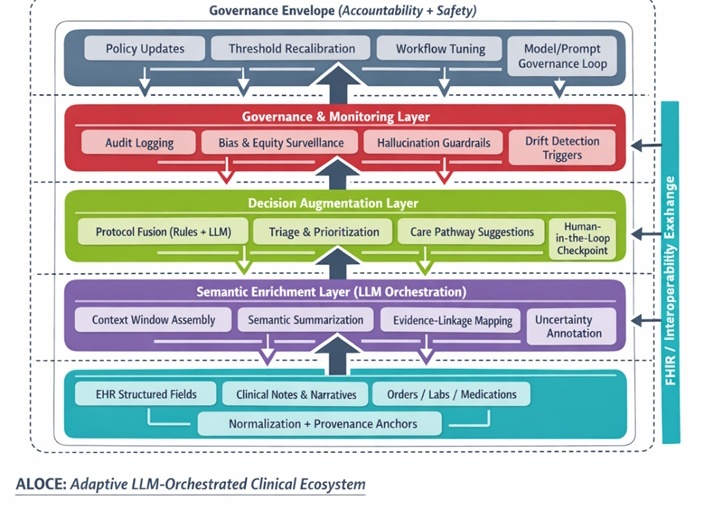
Figure 1. Adaptive LLM-orchestrated clinical ecosystem (ALOCE) architecture for integrating large language models into clinical decision infrastructure.
The schematic depicts a five-layer stack that operationalizes LLM-based semantic enrichment within standards-aligned clinical data flows. Multimodal inputs are normalized in the data harmonization layer, then routed into the semantic enrichment layer for contextual assembly, evidence-linkage, and uncertainty annotation. Outputs are fused with protocol constraints in the decision augmentation layer. At the same time, the governance and monitoring layer embeds audit logging, bias surveillance, hallucination guardrails, and drift triggers as continuous oversight controls. The adaptive feedback layer closes the loop through policy updates and threshold recalibration, enabling longitudinal alignment of decision behavior with governance constraints. A side interoperability rail indicates standards-based exchange pathways (e.g., FHIR-aligned interfaces) that reduce workflow fragmentation while preserving provenance and accountability.
ALOCE’s design prioritizes scalability, with theoretical provisions for resource allocation to mitigate governance loads in high-volume clinical settings. The functional responsibilities, interfaces, and safety containment roles of each layer are summarized (Table 1).
Table 1. Functional specification of the ALOCE architecture.
ALOCE layer | Primary inputs | Primary outputs | Core processing responsibilities | Embedded governance hooks | Failure containment intent |
1) Data harmonization layer | Structured EHR fields; orders/labs/meds; clinician notes; external clinical documents; institutional metadata | Normalized, provenance-anchored patient context packets; standardized data objects | Data normalization; de-identification boundary enforcement (as applicable); provenance anchoring; context packaging; temporal ordering of events | Data access policy gates; consent/jurisdiction checks; provenance logging; interface validation rules | Prevents upstream data leakage and downstream misattribution by preserving traceable source context and standardized formats |
2) Semantic enrichment layer (LLM orchestration) | Context packets from harmonization; narrative text blocks; standardized objects; clinician query prompts | Structured semantic summaries; evidence-linked rationales; uncertainty-annotated interpretations | Context window assembly; semantic summarization; cross-document reconciliation; evidence-linkage mapping; uncertainty annotation; query-to-context alignment | Hallucination guardrails (evidence-link requirement); uncertainty thresholding; prompt governance constraints; trace logging for interpretive steps | Limits ungrounded generation by forcing outputs to remain bounded by verifiable inputs and explicit uncertainty signaling |
3) Decision augmentation layer | Semantic outputs; existing rules/protocol pathways; clinical workflow triggers; care setting constraints | Actionable decision support artifacts (alerts, suggestions, documentation assists); protocol-aligned recommendations | Protocol fusion (rules + semantic insight); prioritization/triage routing; human-in-the-loop checkpoints; decision formatting into CDS-compatible structures | Decision gating (high-risk actions require human confirmation); escalation routing; contradiction detection against protocol constraints | Prevents unsafe automation by ensuring LLM insight is advisory, protocol-aligned, and routed through human oversight at defined thresholds |
4) Governance and monitoring layer | System logs; decision artifacts; feedback signals; drift indicators; equity/bias indicators | Audit trails; bias/drift alerts; compliance flags; governance load signals | Continuous auditing; bias/equity surveillance; drift detection; anomaly detection; accountability boundary enforcement; monitoring burden estimation | Audit logging; bias monitors; drift triggers; access controls; explainability capture; governance load balancing signals | Detects and contains emergent risk (drift, bias, unsafe patterns) before propagation across workflows; enables accountable rollback pathways |
5) Adaptive feedback layer | Governance outputs; clinician feedback; policy updates; workflow metrics (non-empirical, operational) | Updated thresholds; revised policies; workflow tuning directives; model/prompt governance updates | Policy-to-system translation; threshold recalibration; workflow tuning; controlled updates to prompts/routing logic; governance loop stabilization | Change control; versioning; approval checkpoints; rollback controls; escalation protocols | Prevents uncontrolled evolution by ensuring adaptation is policy-governed, traceable, and reversible under oversight |
Each layer is characterized by its primary inputs and outputs, semantic/operational responsibilities, embedded governance controls, and failure containment intent to support safe clinical decision augmentation without relying on empirical performance claims.
The deployment of the ALOCE within clinical decision infrastructures engenders profound systemic ramifications, spanning operational efficiencies, ethical equilibria, and adaptive capacities in healthcare delivery [1, 2]. This section elucidates the theoretical consequences of such integration, modeling the interplay between architectural components and broader ecosystem dynamics without recourse to empirical data. By conceptualizing impacts through layered analyses, we explore how ALOCE’s multi-tiered structure influences decision fidelity, resource orchestration, and resilience against perturbations in clinical environments.
At the core of these ramifications lies the augmentation of decision pipelines, where the Semantic Enrichment Layer interfaces with LLMs to distill unstructured data into actionable insights [3, 4]. Theoretically, this fosters a ripple effect on clinical workflows, enhancing the granularity of diagnostic reasoning while mitigating information overload for practitioners [5, 6]. For instance, in high-acuity settings like intensive care units, the Decision Augmentation Layer could theoretically amplify human-AI symbiosis, leading to streamlined triage processes and reduced latency in care delivery [7, 8]. However, this augmentation introduces dynamics of dependency, where over-reliance on LLM outputs might erode clinician autonomy, necessitating balanced integration models that preserve human oversight [9, 10].
Ethical and governance impacts emerge prominently, as the Governance and Monitoring Layer embeds continuous ethical checks, theoretically curbing biases propagated through data silos [11, 12]. The ramifications extend to equity in healthcare access, where ALOCE’s interoperability focus could democratize advanced decision support in underserved regions, provided governance constraints are uniformly applied [13, 14]. Yet, theoretical models warn of amplified risks in diverse populations, such as cultural misalignments in LLM interpretations of patient narratives, potentially exacerbating disparities if not mitigated through adaptive feedback [15, 16].
Resource allocation dynamics represent another critical ramification, with ALOCE’s layered topology demanding computational and human resources that scale with clinical volume [17, 18]. Conceptually, this can be modeled via a resource allocation formula:
Furthermore, the adaptive feedback topology in ALOCE engenders long-term ecosystem evolution, theoretically enabling infrastructures to self-optimize against concept drift in clinical data [22, 23]. This dynamic could transform static decision systems into learning ecosystems, fostering resilience in pandemics or policy shifts. Still, it also amplifies monitoring burdens, as continuous oversight becomes integral to system integrity [24, 25]. The ramifications include enhanced predictive foresight, where LLMs anticipate workflow disruptions, yet this requires theoretical safeguards against cascading failures in interconnected healthcare networks [26, 27].
In synthesizing these ramifications, ALOCE’s architecture not only redefines clinical decision infrastructures but also prompts a reevaluation of systemic interdependencies, urging designers to prioritize holistic impacts over isolated efficiencies [28]. This theoretical lens underscores the transformative potential while cautioning against unmitigated adoption, paving the way for nuanced discussions on implementation pathways.
The conceptual architecture of ALOCE illuminates pivotal intersections between large language models and clinical decision infrastructures, extending theoretical discourse on AI’s role in healthcare beyond mere technological integration [1, 2]. Central to this discussion is the harmonization of LLM capabilities with clinical exigencies, where the multi-layered design mitigates traditional pitfalls like data fragmentation and ethical lapses [3, 4]. By embedding semantic processing within EHR ecosystems, ALOCE theoretically empowers clinicians with contextualized intelligence, fostering a paradigm shift from reactive to proactive decision-making [5, 6]. This resonates with literature on AI governance, emphasizing that robust monitoring layers are indispensable for sustaining trust in automated systems [7, 8].
Yet, the discussion must grapple with inherent tensions, such as the balance between LLM autonomy and human-centric control [9, 10]. Theoretical explorations reveal that while decision augmentation enhances efficiency, it risks diluting clinical judgment if feedback topologies fail to incorporate diverse stakeholder inputs [11, 12]. In interoperability contexts, ALOCE’s alignment with standards like FHIR could theoretically streamline multi-institutional collaborations, but this assumes uniform adoption, which literature suggests is challenged by regulatory variances [13, 14]. Expanding on governance constraints, the architecture’s ethical scaffolding addresses hallucination risks, yet theoretical models indicate that bias propagation remains a latent threat in multicultural clinical settings [15, 16].
Resource and scalability considerations further enrich the discourse, as ALOCE’s adaptive mechanisms demand sophisticated orchestration to avoid overburdening infrastructures [17, 18]. The introduced formulas for risk propagation, decision confidence, and governance load provide interpretive frameworks that can guide theoretical optimizations, such as adjusting adaptability exponents to suit varying clinical volumes [19]. This aligns with syntheses on deployment paradigms, where continuous monitoring not only detects drift but also cultivates ecosystem maturity over time [20, 21].
Broader implications for healthcare policy emerge, as ALOCE-type architectures could inform standards for AI deployment, advocating for theoretical benchmarks in interoperability and ethics [22, 23]. However, the discussion acknowledges limitations: without empirical grounding, these conceptualizations remain speculative, urging future research to validate through simulated scenarios or policy analyses [24, 25]. Comparative theoretical lenses from related literatures suggest that while ALOCE advances LLM integration, it must evolve alongside emerging threats like data privacy breaches in interconnected systems [26, 27].
Ultimately, this discussion posits ALOCE as a catalyst for reimagining clinical infrastructures, blending innovation with caution to ensure AI serves as an enabler rather than a disruptor in healthcare [28]. By expanding on these facets, the architecture invites interdisciplinary dialogue, bridging informatics, ethics, and clinical practice for a more resilient future.
In conclusion, the ALOCE offers a comprehensive conceptual blueprint for integrating large language models into clinical decision infrastructures, addressing core challenges in data synthesis, governance, and workflow adaptability. Through its unique five-layer structure and bidirectional feedback topology, ALOCE theoretically transforms fragmented systems into cohesive, intelligent ecosystems, enhancing decision support while upholding ethical standards. The systemic ramifications explored underscore potential for improved patient outcomes and operational resilience, tempered by considerations of resource demands and bias mitigation.
This manuscript synthesizes theoretical insights from recent literature, highlighting interoperability’s role in fostering scalable AI deployments. Conceptual formulas provide tools for interpreting dynamics like risk and confidence, aiding designers in navigating complexities. While ALOCE advances the field, its theoretical nature invites extensions through policy frameworks and interdisciplinary collaborations.
Future directions include exploring hybrid architectures that incorporate emerging AI modalities, ensuring sustained relevance in evolving healthcare landscapes. By prioritizing ethical orchestration, ALOCE paves the way for AI-driven infrastructures that prioritize human well-being, marking a pivotal step toward intelligent, equitable clinical decision-making.
None
None
None
None
Open Access The author(s) retain copyright. This article is licensed under the Creative Commons Attribution-NonCommercial-ShareAlike 4.0 International License. It may be shared and adapted for non-commercial purposes with appropriate attribution, an indication of changes, and distribution of adaptations under the same license. Third-party material may be subject to separate terms identified in its credit line. View the license at https://creativecommons.org/licenses/by-nc-sa/4.0/.
 Clinical Intelligence Research Press